• Following Us

  • Categories

  • Check out the Archives


  • Awards & Nominations

Star Trek – Shadows on the Sun by Michael Jan Friedman (Review)

This August, to celebrate the upcoming release of Star Trek: Into Darkness on DVD and blu ray, we’re taking a look at the Star Trek movies featuring the original cast. Movie reviews are every Tuesday and Thursday.

We’ll be supplementing our coverage of the movies with tie-ins around (and related to) the films. We’ll be doing one of these every week day. This is one such article.

It almost feels like sacrilege to fill in the gap left at the end of Star Trek VI: The Undiscovered Country. The film was such a perfect send-off that picking up a novel directly after the end credits role feels like it might undermine the perfect farewell story for the veteran crew. After all, director Nicholas Meyer suggested that the film was an attempt to capture the spirit of Fukuyama’s “end of history”, representing the “end of history” for the original crew.

Except, of course, it wasn’t the end. In terms of internal Star Trek chronology, episodes of Star Trek: The Next Generation had picked up on the later adventures of Scotty and Spock. Star Trek: Voyager would flashback to a Sulu story unfolding concurrently with The Undiscovered Country. Scotty and Chekov would appear in Star Trek: Generations, which would also serve as a disappointing farewell to one James Tiberius Kirk. It seems bitterly appropriate (if far from fair) that Uhura should remain the only major player whose story actually ends with The
Undiscovered Country
.

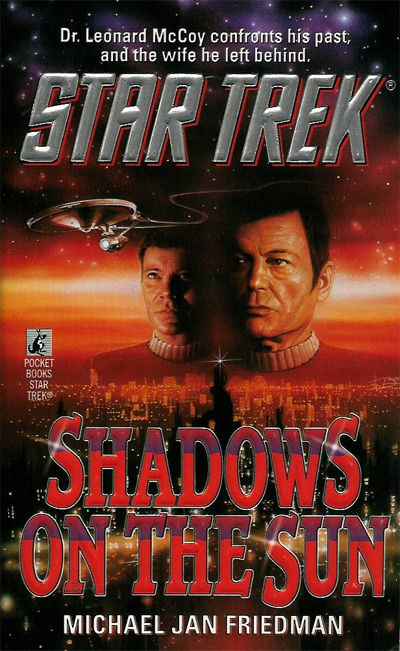
Still, despite his passing of the torch appearance in Encounter at Farpoint, you could make an argument that The Undiscovered Country was the end of the line for Leonard McCoy more than Kirk or Spock. And, as such, Michael Jan Friedman’s Shadows on the Sun serves as an effective (if flawed) reflection on the way that McCoy’s presence sort of faded from the 24th century spin-offs. startrek-shadowsonthesun
Continue reading

Star Trek Special #2 (DC Comics, 1994) – A Question of Loyalty (Review)

This August, to celebrate the upcoming release of Star Trek: Into Darkness on DVD and blu ray, we’re taking a look at the Star Trek movies featuring the original cast. Movie reviews are every Tuesday and Thursday.

We’ll be supplementing our coverage of the movies with tie-ins around (and related to) the films. We’ll be doing one of these every week day. This is one such article.

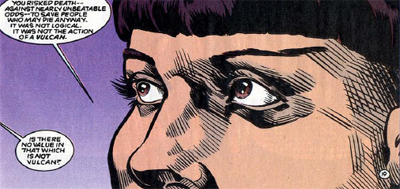
A Question of Loyalty is essentially a Star Trek character study, comparing and contrasting the two young Vulcan female characters to appear in the film franchise, providing a meeting between Valeris and Saavik, Spock’s two young protegés. The production history of Star Trek VI: The Undiscovered Country is interesting, as there were early plans to include Saavik. For a variety of reasons, this didn’t work out and director Nicholas Meyer and his writers decided to cast a new role, Valeris. A Question of Loyalty allows the two characters to come face-to-face, and offers both some character motivation for the under-developed Valeris and a fond farewell for Saavik.

Her ears are tingling...

Her ears are tingling…

Continue reading

Star Trek – In the Name of Honour by Dayton Ward (Review)

This August, to celebrate the upcoming release of Star Trek: Into Darkness on DVD and blu ray, we’re taking a look at the Star Trek movies featuring the original cast. Movie reviews are every Tuesday and Thursday.

We’ll be supplementing our coverage of the movies with tie-ins around (and related to) the films. We’ll be doing one of these every week day. This is one such article.

The Klingons changed rather dramatically, between the classic Star Trek and Star Trek: The Next Generation. Part of the changes were physical – most obviously, advances in make-up allowed Klingon characters to be shown with their now-iconic forehead ridges. However, there was another interesting change. Somewhere between The Turnabout Intruder and Encounter at Farpoint, the Klingons went from generic communist stand-ins to a fully-formed alien culture with a wealth of ritual and tradition.

To a large extent, this shift took place during the movie era. Klingons wound up being the focus of Star Trek III: The Search for Spock, and were a significant presence in each of the films that followed. Star Trek V: The Final Frontier, produced at the same time as the first season of Star Trek: The Next Generation, suggested that it wasn’t necessary for the Federation and the Klingon Empires to be mortal enemies. The final movie featuring the original cast, Star Trek VI: The Undiscovered Country, tied up Kirk’s adventures with the promise of galactic peace.

Still, it’s hard to reconcile the differences in characterisation between the Klingons seen in the classic Star Trek television show and those from the later spin-offs. With In the Name of Honour, Dayton Ward tries to explore this radical shift and also to bridge The Final Frontier and The Undiscovered Country. He does the former much better than the latter.

startrek-inthenameofhonour

Continue reading

Star Trek – Dwellers in the Crucible by Margaret Wander Bonanno (Review)

This August, to celebrate the upcoming release of Star Trek: Into Darkness on DVD and blu ray, we’re taking a look at the Star Trek movies featuring the original cast. Movie reviews are every Tuesday and Thursday.

We’ll be supplementing our coverage of the movies with tie-ins around (and related to) the films. We’ll be doing one of these every week day. This is one such article.

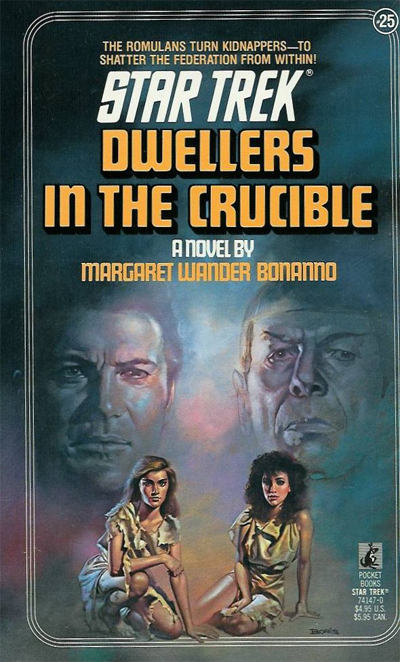
The state of Star Trek tie-ins in 1985 was radically different than it is today. While the film series was at height of its popularity, generating a great deal of attention for the franchise, authors working on the associated tie-in novels were granted a great deal of freedom. Books from this era tend to be a great deal looser, adapting a sort of “devil may care” attitude towards the type of restrictions one might impose on a Star Trek story. Novels could be dedicated to new characters or to existing aliens, or offer radical twists on the show’s rich mythology. It was almost free-style Star Trek, with authors afforded the freedom to tell the stories that they wanted to tell, no matter how difficult it might be to fit that within the confines of “Star Trek.”

Dwellers in the Crucible captures a lot of the spirit of this era quite well. It’s Margaret Wander Bonanno’s first Star Trek tie-in book, but it’s also her strangest. It’s a rather high-concept piece of trashy “women in prison” fiction that dares to ask a question that nobody in their right mind had ever broached before: what if Kirk and Spock were lesbians?

st-dwellersinthecrucible

Continue reading

Non-Review Review: Star Trek V – The Final Frontier

This August, to celebrate the upcoming release of Star Trek: Into Darkness on DVD and blu ray, we’re taking a look at the Star Trek movies featuring the original cast. Movie reviews are every Tuesday and Thursday.

Star Trek V: The Final Frontier is not a good movie. There’s really nothing that can be excavated from the film that might redeem it. It isn’t a misunderstood masterpiece. It isn’t an insightful diamond in the rough. It’s just a bad film, the one which forms the cornerstone of the “odd-numbered Star Trek films” curse. It’s indulgent, pretentious and narrow-minded. It tries to blend a world-weary cynicism with an ill-judged and mean-spirited sense of humour.

Despite being shorter than Star Trek IV: The Voyage Home, it feels remarkably longer. It feels like a rather halfhearted attempt to recapture the spirit of the television show – oblivious to the fact that the franchise has spent the past decade moving onwards. It confuses ponderous pretension for intelligent insight.

Feeling blue...

Feeling blue…

Continue reading

Star Trek – Unspoken Truth by Margaret Wander Bonanno (Review)

This August, to celebrate the upcoming release of Star Trek: Into Darkness on DVD and blu ray, we’re taking a look at the Star Trek movies featuring the original cast. Movie reviews are every Tuesday and Thursday.

We’ll be supplementing our coverage of the movies with tie-ins around (and related to) the films. We’ll be doing one of these every week day. This is one such article.

Saavik is an interesting character, for several reasons. Most obviously, there’s the behind the scenes manoeuvrings involving the new character. Everything from her origin to the recasting of the role between Star Trek II: The Wrath of Khan and Star Trek III: The Search for Spock. There’s the inclusion of a short scene in Star Trek IV: The Voyage Home, and the fact that the last time we see Saavik, she’s watching the reunited cast of the original Star Trek continue their galactic adventures.

There’s her complete absence from Star Trek V: The Final Frontier and then the weird pseudo-return of the character in Star Trek VI: The Undiscovered Country, where the role that would become Valeris was originally considered for Saavik, before being cast with Kim Cattrall, an actress who had originally been considered to play Saavik. It’s interesting to consider the conceptual history of the character, given what she was supposed to represent upon her introduction in The Wrath of Khan.

Margaret Wander Bonanno does an excellent job exploring Saavik’s life in the wake of her decision to remain on Vulcan in The Voyage Home, with Unspoken Truth doing an excellent job playing with the character in the grand scheme of the shared Star Trek universe.

startrek-unspokentruth

Continue reading

Star Trek Special #1 (1994) – The Needs of the One (Review)

This August, to celebrate the upcoming release of Star Trek: Into Darkness on DVD and blu ray, we’re taking a look at the Star Trek movies featuring the original cast. Movie reviews are every Tuesday and Thursday.

We’ll be supplementing our coverage of the movies with tie-ins around (and related to) the films. We’ll be doing one of these every week day. This is one such article.

In many ways, the Star Trek movies feature more character development and exploration for the cast than the entire three seasons of the television show. Star Trek III: The Search for Spock and Star Trek IV: The Voyage Home are true ensemble pieces, but there’s also more of a sense that this is a family rather than a bunch of people who just hang out together. I’d argue that the cast of Star Trek: The Next Generation remain the tightest ensemble that the franchise has ever produced, but the first six movies portray the crew of the original Enterprise as a bunch of people who have been to hell and back together.

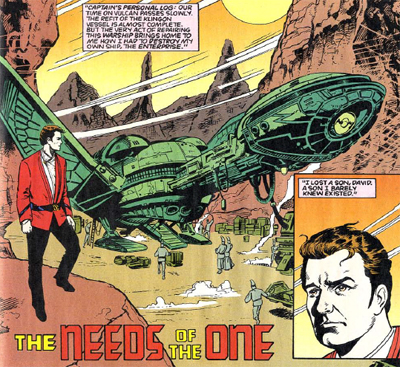
Michael Collins’ The Needs of the One represents a bit of an interlude between The Search for Spock and The Voyage Home, taking place during the crew’s three month “Vulcan exile.” While Collins’ script suffers from its inability to decide whether it’s a Spock-centric character drama or a day-in-the-life of the renegade crew, it’s a fascinating story situated in a lacuna of the movies’ chronology. It cements the idea that Spock has been radically altered over the course of the film series, and that his character arc spans the first four films.

Indeed, Collins’ opening sequence tying together his failure to achieve Kolinahr in Star Trek: The Motion Picture with his decision to once again rejoin the crew in The Voyage Home.

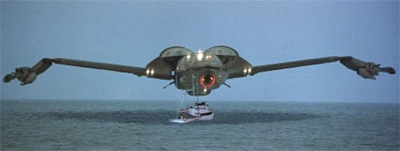
When all Kirk asked for was a tall ship, he probably should have been more specific...

When all Kirk asked for was a tall ship, he probably should have been more specific…

Continue reading

Non-Review Review: Star Trek IV – The Voyage Home

This August, to celebrate the upcoming release of Star Trek: Into Darkness on DVD and blu ray, we’re taking a look at the Star Trek movies featuring the original cast. Movie reviews are every Tuesday and Thursday.

Up until the release of JJ Abrams’ Star Trek in 2009, Star Trek IV: The Voyage Home was the most successful of the Star Trek films. Indeed, it ranks alongside Star Trek II: The Wrath of Khan as the film which has most deeply dug itself into the popular consciousness. “I’m from Iowa; I only work in outer space” might not be as iconic a quote as “KHAAAAAAN!!!”, but a lot of people casually remember “the one with the whales.”

The fourth film in the series closes off an inter-connected trilogy of Star Trek films, wrapping up character development for the leads and tying up loose ends, but it’s also – somewhat paradoxically – the most accessible of the movies. If you’re looking for an introduction to Star Trek, it’s hard to think of a more welcoming entry than The Voyage Home. However, what’s really strangely charming about The Voyage Home is that it’s also probably the film truest to the franchise’s humanist values.

Ship off the starboard bow!

Ship off the starboard bow!

Continue reading

Star Trek (DC Comics, 1984) #28 – The Last Word (Review)

This August, to celebrate the upcoming release of Star Trek: Into Darkness on DVD and blu ray, we’re taking a look at the Star Trek movies featuring the original cast. Movie reviews are every Tuesday and Thursday.

We’ll be supplementing our coverage of the movies with tie-ins around (and related to) the films. We’ll be doing one of these every week day. This is one such article.

Star Trek II: The Wrath of Khan, Star Trek III: The Search for Spock and Star Trek IV: The Voyage Home form a trilogy that tells a single story, covering Spock’s death and resurrection, the loss of the Enterprise and the construction of its replacement and Kirk’s journey from washed-up old commander to saviour of the planet Earth. Although the three films weren’t planned as a single story, they worked out surprisingly well as a Star Trek epic told across three films and four years.

Four years is a remarkable turn-around for three franchise films, let alone three well-received franchise films. However, it’s worth conceding that the storyline had a fairly significant impact on the tie-in media. Books could be published set in the existing gaps in chronology, but DC’s plan for their first volume of Star Trek comics was to feature stories set in the contemporary film universe. Since that universe was in the middle of its own story, and the comic publishers had no idea how it would play out, the results are interesting.

Lighten up...

Lighten up…

Continue reading

Star Trek: Myriad Universes – Echoes and Refractions: The Chimes at Midnight by Geoff Trowbridge (Review)

This August, to celebrate the upcoming release of Star Trek: Into Darkness on DVD and blu ray, we’re taking a look at the Star Trek movies featuring the original cast. Movie reviews are every Tuesday and Thursday.

We’ll be supplementing our coverage of the movies with tie-ins around (and related to) the films. We’ll be doing one of these every week day. This is one such article.

The death of Spock at the climax of Star Trek II: The Wrath of Khan is one of the definitive Star Trek moments. Pop culture has assimilated the moment, to the point where any half-decent nerd will identify “the needs of the many…” or “I have been and always shall be…” or maybe even “of all the souls I encountered…” It’s an absolutely massive moment for the franchise, where the film series dared to kill off the show’s most iconic and best-loved character.

It’s no wonder that the moment is such a strong focal point for those seeking to explore Star Trek. Star Trek: Into Darkness riffs mercilessly on that iconic scene, inverting it and counting on the iconography to generate enough emotional resonance for the film to get away with a fairly half-hearted homage. (The effects of The Wrath of Khan last until Star Trek III: The Search for Spock, while the consequences of the climax of Into Darkness don’t even last until the closing credits.)

So that famous sequence serves as an effective focal point of Geoff Trowbridge’s The Chimes at Midnight, which offers a parallel continuity of the Star Trek films in a universe where Spock died after the events of Yesteryear.

st-myriaduniverses

Continue reading