• Following Us

  • Categories

  • Check out the Archives


  • Awards & Nominations

Star Trek: Deep Space Nine – The Maquis, Part II (Review)

Star Trek: Deep Space Nine is twenty years old this year. To celebrate, I’m taking a look at the first and second seasons. Check back daily for the latest review or retrospective.

Oddly enough, for an episode designed to serve as a launching pad for Star Trek: Voyager, The Maquis, Part II really feels like the point where Star Trek: Deep Space Nine becomes Ira Steven Behr’s show. Deep Space Nine had been created by Michael Piller and Rick Berman. While Berman oversaw the franchise as a whole, Piller had been a guiding influence during the first two seasons of Deep Space Nine. However, his attention would wander to both Voyager and the pending films based on the Star Trek: The Next Generation film franchise.

As a result, producer Ira Steven Behr would be left in the driving seat of Deep Space Nine. Behr had some experience with the franchise. he was part of the wonderful writers’ room responsible for the massive upswing in the quality of The Next Generation, but left after a year on that show – describing it as “the Connecticut of Star Trek.” Years later, he was aggressively pursued by Piller to work on Deep Space Nine, where Piller felt his philosophy might be more at home.

The Maquis, Part II is far from Behr’s first writing credit on the show, and it’s certainly not the first time his influence has been felt. It is, however, the point at which it feels like Behr’s creative vision is firmly cemented the show’s outlook. Piller would move further away over the course of the next year, and Behr’s influence would grow even stronger, but this is the point where Behr’s vision of Deep Space Nine really takes hold.

Burning bridges...

Burning bridges…

Continue reading

Star Trek: Deep Space Nine – Playing God (Review)

Star Trek: Deep Space Nine is twenty years old this year. To celebrate, I’m taking a look at the first and second seasons. Check back daily for the latest review or retrospective.

Playing God is – structurally – quite similar to Shadowplay. The episode follows the same basic format. We have three plots running concurrently. One of these plots is a science-fiction plot while the other two are centred around character development. What’s interesting about Playing God is that the script essentially changes the priority of these plot threads. In Shadowplay, the central plot concerned the science-fiction mystery in the Gamma Quadrant, while here the ethical quandary is pushed firmly to the background. (Much to the chagrin of writer Jim Trombetta.)

Instead, Playing God brings the character plotline to the front, giving us the first Dax-centric episode firmly based around Jadzia rather than the symbiote inside of her.

Quark smells a rat... er... I mean vole...

Quark smells a rat… er… I mean vole…

Continue reading

Star Trek: Deep Space Nine – Paradise (Review)

Star Trek: Deep Space Nine is twenty years old this year. To celebrate, I’m taking a look at the first and second seasons. Check back daily for the latest review or retrospective.

In a really weird way, this second half of the second season of Star Trek: Deep Space Nine really has its finger on the pulse of the nineties. Whispers tapped into pre-millennial anxiety, the sort of paranoia that fed into shows like The X-Files and would play itself out through the show’s admittedly underdeveloped “Changeling” arc. In a few episodes, The Maquis will play with the old “freedom fighter/terrorist” debate in a way that was only really possible in an America completely at peace, post-Cold War but pre-9/11.

Paradise taps into some other anxieties. According to The Star Trek: Deep Space Nine Companion, writer Jim Trombetta was heavily influenced by the anti-technology philosophy of the Khmer Rouge, the infamous regime where even the stereotypical signs of learning and education (for example, wearing glasses) were justification for execution. However, whatever the inspiration, Paradise seems to tap into something decidedly more contemporary.

"This is my boom stick!"

“This is my boom stick!”

Continue reading

Star Trek: Deep Space Nine – The Alternate (Review)

Star Trek: Deep Space Nine is twenty years old this year. To celebrate, I’m taking a look at the first and second seasons. Check back daily for the latest review or retrospective.

Well, at least the second season of Star Trek: Deep Space Nine is experimental. It might not always pay-off, but there’s a clear sense that the show is trying new things, bending various genres to make them fit within the broad outline of a Star Trek show. Necessary Evil was a fascinating attempt to construct a noir episode, while Rivals was a less-than-successful sit-com in space. The Alternate is very much doing “Star Trek as monster movie”, which is surprisingly fun.

To be fair, it’s not a subgenre new to the franchise. Indeed, the first episode of the original show to air, The Man Trap, was essentially a monster horror in space. Still, The Alternate feels a bit more sinister and dark than  anything that Star Trek: The Next Generation might attempt. (Schisms probably comes closest, but – even then – there’s no sense that the monsters are stalking the starship. They have to abduct their victims to experiment on them.)

More than that, though, The Alternate is also a fascinating exploration of Odo as a character, looking at the relationship that Odo has with his co-workers and how that is rooted in his relationship with the man who claims to be his “father.”

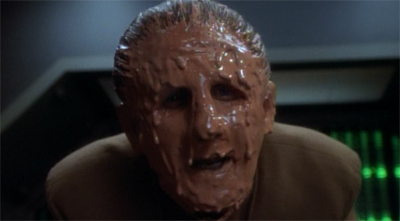
Melting! Melting! Oh what a world!

Melting! Melting! Oh what a world!

Continue reading

Star Trek: Deep Space Nine – Second Sight (Review)

Star Trek: Deep Space Nine is twenty years old this year. To celebrate, I’m taking a look at the first and second seasons. Check back daily for the latest review or retrospective.

You know, this the first real Sisko-heavy episode we’ve had since Emissary. He’s the lead, so he’s never too far from the heart of the story, and episodes like Dramatis Personae and Invasive Procedures gave Avery Brooks an opportunity to demonstrate his acting chops (and ability to be just as bad-ass, albeit in a different way, as Kirk and Picard). However, Sisko never really dominates or towers over Star Trek: Deep Space Nine in the same way that Kirk and Picard seemed to anchor their shows. Deep Space Nine is closer to an ensemble show than any other Star Trek series, and characters like Odo and Kira (and even Quark) have received as much (if not more) definition than Sisko, despite the fact he is the lead.

That’s not a bad thing. Over the run of the series, Deep Space Nine would produce a number of classic hours of television centred around Sisko as a character. The Visitor, Far Beyond the Stars, and In the Pale Moonlight are all hours that lean heavily on Brooks and can all be counted among the very best episodes of Star Trek ever produced.

Second Sight, on the other hand, is not.

Burning passion...

Burning passion…

Continue reading

Star Trek: Deep Space Nine – In the Hands of the Prophets (Review)

Star Trek: Deep Space Nine is twenty years old this year. To celebrate, I’m taking a look at the first season. Check back daily for the latest review or retrospective.

Both Star Trek and Star Trek: The Next Generation allowed their first seasons to run an episode too long. The City on the Edge of Forever, the penultimate episode of the first ever season of Star Trek, is a genuine classic. I don’t envy any story that has to follow it, especially not something as mediocre as Operation — Annihilate! While Conspiracy, the second-to-last episode of the first season of The Next Generation, is hardly a classic in the same league, it does up the stakes on the show’s first year, and tie up a dangling plot thread. The Neutral Zone, on the other hand, is a bland return to form, with a particularly insufferable b-plot.

So the excellence of Duet might offer the viewer cause to worry. A penultimate first-season episode which is significantly above average? One would be forgiven for wondering if the first season might have been best served to wrap itself up at that point, going out in a high, safe in the knowledge that it had contributed one classic episode to the Star Trek mythos and with the potential to offer quite a few more. Quit while you’re winning, and don’t tempt fate with another superfluous episode.

In the Hands of the Prophets, however, puts those fears to rest. Serving as a companion piece to Duet, it’s another one of those “only on Deep Space Nine stories, closing out the first season with a reminder of what makes the show unique. In the Hands of the Prophets is another classic piece of Deep Space Nine. It might not pack quite the punch that Duet did, but it’s a compelling piece of drama which demonstrates just how much Deep Space Nine has to offer the Star Trek mythos.

Beyond belief...

Beyond belief…

Continue reading

Star Trek: Deep Space Nine – Dramatis Personae (Review)

Star Trek: Deep Space Nine is twenty years old this year. To celebrate, I’m taking a look at the first season. Check back daily for the latest review or retrospective.

Dramatis Personae tends to get lost in the shuffle at the end of Star Trek: Deep Space Nine‘s first season. Sitting between two of the season’s most generic Star Trek stories (If Wishes Were Horses… and The Forsaken) and two distinctly Deep Space Nine classics (Duet and In the Hands of the Prophets), it’s easy to see why Joe Menosky’s tale of repeated history tends to get overlooked. It manages to sit quite neatly in both camps, as a generic Star Trek tale and as something more specific to Deep Space Nine.

After all, possession stories are scattered throughout the Star Trek mythos. Star Trek: The Next Generation was quite fond of have various members of the crew impersonated or doubled or controlled by a variety of alien influences. Dramatis Personae also feels like a very Joe Menosky script, linked by various thematic connections to the writer’s work on both The Next Generation and later on Star Trek: Voyager.

And yet, despite all those links, Dramatis Personae feels quite anchored to Deep Space Nine. It’s hard to imagine the dynamic working with any other Star Trek cast, even Voyager‘s Maquis and Starfleet ensemble. There’s also the sense that the episode’s pattern of repeated history feels more in keeping with Deep Space Nine‘s perception of history than any other Star Trek show’s.

The man with the plan...

The man with the plan…

Continue reading

Star Trek: Deep Space Nine – Battle Lines (Review)

Star Trek: Deep Space Nine is twenty years old this year. To celebrate, I’m taking a look at the first season. Check back daily for the latest review or retrospective.

Battle Lines is, quite frankly, not a very good piece of television. Like a few of the episodes scattered throughout the first season of Star Trek: Deep Space Nine, it feels like it was pulled from a list of rejected scripts for Star Trek: The Next Generation. Ironically, it feels more like a reheated left-over than the next episode, The Storyteller, which was actually a recycled script from the first season of The Next Generation. Were it not for the involvement of Kai Opaka and a few hints about Bajoran spirituality, Battle Lines would feel almost as generic as The Passenger.

The concept is fascinating, and it represents another long-term shift in Deep Space Nine, but the script from Hilary J. Bader feels too functional and broad to do the episode justice. Instead, it feels fairly bland, which is a bit disappointing for an episode where Sisko accidentally gets the pope caught up in the universe’s most deadly game of laser tag.

Taking a stab at bringing peace...

Taking a stab at bringing peace…

Continue reading

Star Trek: Deep Space Nine – Vortex (Review)

Star Trek: Deep Space Nine is twenty years old this year. To celebrate, I’m taking a look at the first season. Check back daily for the latest review or retrospective.

Something very interesting happens in the second half of Star Trek: Deep Space Nine‘s first season. It seems like the writers and producers are making a conscious effort to develop the show’s characters, themes and the world that these inhabit. Plot threads are hinted at, only to be left dangling. Ideas are broached, and tucked away for another day. Given that Star Trek: The Next Generation waited until the third season to broach serialisation in Sins of the Father, the approach taken here is quite striking.

These three episodes are more notable for what they set up rather than what they actually accomplish on their own terms. These adventures lay groundwork, or at least hint at laying groundwork, that will pay off throughout the show’s extended seven-year run. Okay, not exactly. There are some redundant elements here that never actually pay off, but Vortex, Battle Lines and The Storyteller all play into the show’s bigger story arc, even if it seems the writers aren’t entirely sure what those story arcs are.

It's murky out there...

It’s murky out there…

Continue reading

Star Trek: Deep Space Nine – Move Along Home (Review)

Star Trek: Deep Space Nine is twenty years old this year. To celebrate, I’m taking a look at the first season. Check back daily for the latest review or retrospective.

And here we hit what is commonly agreed to be the nadir of Star Trek: Deep Space Nine‘s rocky first season. Even the production staff seemed to acknowledge the problems with Move Along Home. Director David Carson conceded that it was “disappointing”, while future writer Ronald D. Moore could help  “wondering if everyone had lost their minds.” And there’s no way of getting around it. Move Along Home is a stinker in virtually every way that counts. It’s messy, contrived, confused, but without the wit to pull off the surreality of the set-up. There are no stakes, and the only way the episode can generate suspense is by lying to the audience.

And yet, despite that, I am actually much fonder of Move Along Home than I am of The Passenger. Don’t get me wrong, I don’t like either very much, but I’m more forgiving of the problems with Move Along Home, which stem from the episode’s ambition. There’s a sense that at least the episode was trying to do something a bit novel, even it backfired spectacularly. If I have to choose between flawed ambition and bland mediocrity, I’ll choose flawed ambition every time. Move Along Home might be a pretty dodgy episode, but at least its less generic than The Passenger.

A piece of the action...

A piece of the action…

Continue reading