• Following Us

  • Categories

  • Check out the Archives


  • Awards & Nominations

Star Trek: The Next Generation – The Measure of a Man: Extended Cut (Review)

This January and February, we’ll be finishing up our look at the second season of Star Trek: The Next Generation and moving on to the third year of the show, both recently and lovingly remastered for high definition. Check back daily for the latest review.

We’ll be supplementing our coverage of the episodes with some additional materials – mainly novels and comics and films. This is one such entry.

This is a rare treat.

The Measure of a Man is generally regarded as one of the best episodes that Star Trek: The Next Generation ever produced, and a crown jewel in the entire Star Trek franchise. As such, it’s a prime candidate for this sort of lavish restoration treatment, with the blu ray collection featuring not only the televised version of the episode, but a special extended edition.

This extended edition was the version originally filmed and edited together, until the production team realised that it ran almost a quarter-of-an-hour over the slot allocated to the show on syndicated airing.
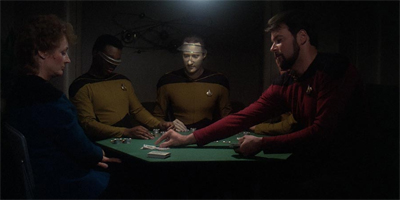
tng-themeasureofaman23

Continue reading

Star Trek: The Next Generation – The Measure of a Man (Review)

This January and February, we’ll be finishing up our look at the second season of Star Trek: The Next Generation and moving on to the third year of the show, both recently and lovingly remastered for high definition. Check back daily for the latest review.

Ah, The Measure of a Man.

It’s the first point in the run of Star Trek: The Next Generation where we’ve reached an episode that could legitimately be ranked as one of the best that the show would ever produce. Even today, the episode remains a favourite of Star Trek fans around the world, and a superb demonstration of what the series is capable of. Almost half-way into the second season, we get a glimpse of what The Next Generation could be, and how it balance its own identity against the proud philosophical traditions of its parent series.

It’s also quite brilliant.

A Data with destiny...

A Data with destiny…

Continue reading

Star Trek: The Next Generation – Unnatural Selection (Review)

This January and February, we’ll be finishing up our look at the second season of Star Trek: The Next Generation and moving on to the third year of the show, both recently and lovingly remastered for high definition. Check back daily for the latest review.

It’s really strange that this is our first Pulaski-centred episode. It’s even stranger that it’s the shows only Pulaski-centred episode, given she’s a new character being inserted into an established ensemble. It’s even stranger-er that the episode doesn’t really seem to have much to say about Pulaski apart from the fact that she is the show’s new doctor – and she’s a bit of an idiot. Which is not necessarily what you want when you’re trying to endear a new character to the audience.

Then again, Unnatural Selection is a pretty good indicator of where Star Trek: The Next Generation is right now. The show hasn’t quite figured out that it’s a good idea to anchor character-centric stories in the character upon which that intended to centre. It’s one of the most successful aspects of Michael Piller’s approach, and part of what really revitalised the writing in the show’s third season. As it stands, Unnatural Selection seems to be a story about medical stuff, so it gets to focus on Pulaski. Who is really just sort of there.

I can see this getting old fast...

I can see this getting old fast…

Continue reading

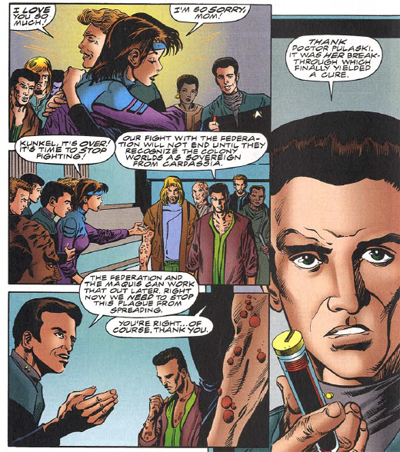
Star Trek: Deep Space Nine (Marvel Comics) #3-4 – The Cancer Within (Review)

This January and February, we’ll be finishing up our look at the second season of Star Trek: The Next Generation and moving on to the third year of the show, both recently and lovingly remastered for high definition. Check back daily for the latest review.

We’ll be supplementing our coverage of the episodes with some additional materials – mainly novels and comics and films. This is one such entry.

Poor Doctor Pulaski. She seems to have just disappeared from the canon. First season casualty Tasha Yar seemed to haunt to the show, returning for Yesterday’s Enterprise while her daughter become a recurring foe from The Mind’s Eye onwards. Even Wesley popped back every once in a while following his departure from the series. Pulaski, on the other hand, remains something of a phantom.

Barring an audible reference to her made in the background during the Star Trek: Voyager finalé Endgame, she disappears from the franchise without so much as a peep at the end of Shades of Grey.  She isn’t even referenced by name in the first episode of the third season to air (Evolution) or the first produced (The Ensigns of Command). While Beverly Crusher’s return is used as a plot point for Wesley, we only get the most fleeting of references to Pulaski in Who Watches the Watchers?

While this can easily be explained by the complex relationship that Diana Muldaur seems to have with Star Trek: The Next Generation. She has suggested the atmosphere on set was decidedly unfriendly, so the fact that Pulaski doesn’t return should not be that much of a surprise. What is interesting is the general apathy that the expanded universe seems to have for Pulaski. While even guest characters seem to get their own back stories and development in novels and comics, Pulaski is treated as a decidedly minor character in the Star Trek canon, reduced to guest spots and small appearances.

I like my family reunions generic and bland...

I like my family reunions generic and bland…

Continue reading

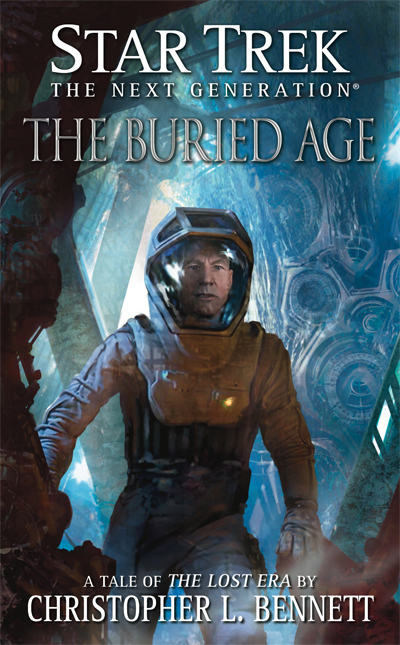
Star Trek: The Lost Era – The Buried Age by Christopher L. Bennett (Review)

This January and February, we’ll be finishing up our look at the second season of Star Trek: The Next Generation and moving on to the third year of the show, both recently and lovingly remastered for high definition. Check back daily for the latest review.

We’ll be supplementing our coverage of the episodes with some additional materials – mainly novels and comics and films. This is one such entry. This is actually supplementary to the first season of the Next Generation, specifically the episode Encounter at Farpoint.

“I’m offering the chance to find something entirely new,” Picard teases at one point in The Buried Age. “To begin filling in a tremendous gap in our understanding of galactic history.” In a way, Picard might as well be addressing the reader, explaining one of the many joys of Christopher L. Bennett’s The Buried Age. It is a chance to delve into the world of Star Trek, exploring the lacuna that exists leading directly into Encounter at Farpoint.

tng-theburiedage

Continue reading

My 12 for ’13: Star Trek Into Darkness & Fighting for the Future…

This is my annual countdown of the 12 movies that really stuck with me this year. It only counts the movies released in Ireland in 2013, so quite a few of this year’s Oscar contenders aren’t eligible, though some of last year’s are.

This is number 6…

Star Trek Into Darkness won’t win any awards for scripting or plotting. It’s very hard to succinctly explain the various overlapping evil plans directed by the movie’s two competing villains – who knows what at which point, and how that makes sense in the context of their objectives. Star Trek Into Darkness is a bit of a hot mess when it comes to storytelling – an overly convoluted plot that spends far too much time homaging what come before, when it should be boldly going somewhere new.

And yet, despite that, there is an ambition to Star Trek Into Darkness, a willingness to embrace big ideas and questions about cynicism and optimism, about hope and fear, about the attitude that people adopt towards the future. At the most basic level, that’s what Star Trek is. Into Darkness doesn’t have the same space as a television show to delve into those questions, nor to offer the same degree of nuance.

However, it’s a willingness to ask them that is quite endearing.

startrekintodarkness21

Continue reading

Star Trek: Deep Space Nine – The Jem’Hadar (Review)

Star Trek: Deep Space Nine is twenty years old this year. To celebrate, I’m taking a look at the first and second seasons. Check back daily for the latest review or retrospective.

In terms of sheer quality of execution, The Jem’Hadar is probably the weakest of Star Trek: Deep Space Nine‘s season finalés. It lacks the gut punch of A Call to Arms, the shock twist of Broken Link, the atmosphere of The Adversary or even the timeliness of In the Hands of the Prophets. It is, at its most basic level, a story about a disastrous first contact that occurs during a father-son bonding trip that goes horribly wrong, ending with precious little actually advanced.

However, in terms of conceptual ideas, The Jem’Hadar is a game-changer. It is the cornerstone upon which Deep Space Nine would construct its most iconic narrative arc. It caps off two years of trying to develop the Ferengi as more than one-note jokes. It’s a bold statement about the freedom that Deep Space Nine would enjoy with Star Trek: The Next Generation retiring from the airwaves. It cemented the notion that Deep Space Nine never really dealt in two-part episodes to bridge seasons.

For Deep Space Nine, season finalés did not exist simply as pieces of Lego designed to snugly fit those other pieces at the start of the following season, crafting some illusion of continuity flow between two different seasons of television. Instead, cliffhangers on Deep Space Nine changed the rules, shook up the status quo, and teased the changing face of things to come.

A Jem?

A Jem?

Continue reading

Star Trek: Deep Space Nine – The Maquis, Part I (Review)

Star Trek: Deep Space Nine is twenty years old this year. To celebrate, I’m taking a look at the first season. Check back daily for the latest review or retrospective.

The Maquis is an interesting episode, because it really illustrates the weird place that Star Trek: Deep Space Nine holds in the pantheon. It’s the middle act of an arc designed to play out across the final season of Star Trek: The Next Generation, the second season of Deep Space Nine and into the first year of Star Trek: Voyager. This was all part of gigantic lead-up to Voyager, a way for the producers to generate friction between the regular cast of the show.

However, with The Next Generation ending and Voyager being set on the other side of the galaxy, Deep Space Nine wound up stuck with this plot thread. As Michael Piller concedes in The Deep Space Log Book: A Second Season Companion, “DS9 is the true inheritor of the Maquis since there is no long term benefit to Voyager.” And so – despite the fact the Maquis were never intended for the show – they wind up become a perfect vehicle to explore the show’s world view.

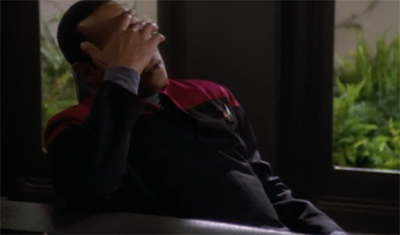
Picard's not the only one who can get a good face palm going on...

Picard’s not the only one who can get a good face palm going on…

Continue reading

Star Trek: Deep Space Nine – Whispers (Review)

Star Trek: Deep Space Nine is twenty years old this year. To celebrate, I’m taking a look at the first and second seasons. Check back daily for the latest review or retrospective.

You could make a credible argument that each of the first three Star Trek shows beautifully encapsulated their time and place. The original show was the very embodiment of the sixties zeitgeist, providing a channel for commentary and insight into counter-culture and the Vietnam War, and an outlet for various fixations and phobias. Star Trek: The Next Generation was a show that spoke to a version of America which was emerging from the Cold War, a clean and sterile morning for a new America.

Star Trek: Deep Space Nine was positioned somewhat strangely, as the idealism and enthusiasm of the early nineties gave way to paranoia and insecurity. If the hyperreal technicolour production values of the original Star Trek spoke to the energy and enthusiasm sixties, then the drab grey Orwellian design of Deep Space Nine was a reflection of the late nineties.

Whispers is really the first time that the show has pushed its sense of paranoia to the fore, and it confirms that Deep Space Nine will be a show of its time, anchored in the nineties.

It's all a bit askew...

It’s all a bit askew…

Continue reading

Star Trek: Deep Space Nine – Melora (Review)

Star Trek: Deep Space Nine is twenty years old this year. To celebrate, I’m taking a look at the first season. Check back daily for the latest review or retrospective.

It’s hard to believe, based on what we’ve witnessed so far, but one day viewers will be able to think “oh, a Bashir episode!” without an involuntary shudder. There will come a time when the writing staff figure out how to write a Bashir-centric episode. In fact, they’ll even revisit this central premise in the show’s final season, in a way that is much less creepy because at least it acknowledges the creepiness. However, we’re a long way from that.

It’s not that Bashir is a bad character. In fact, I’m very fond of him. I think that this version of the character works very well as part of an ensemble, or even teamed up with another major character to carry a story. However, I don’t think that the show has quite figured out how to tell a Bashir-centric story yet. Most notably because – like The Passenger before it – Melora isn’t really about Bashir. At least not in a way that isn’t creepy and disturbing and unnerving.

Instead, Bashir is mostly a vehicle for the guest character of the week, who lends the episode her name and serves as the focal point of some incredibly condescending and patronising writing which doesn’t make the optimistic future of Star Trek look particularly bright.

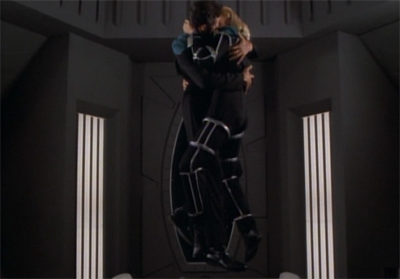
Floating in a most peculiar way...

Floating in a most peculiar way…

Continue reading