• Following Us

  • Categories

  • Check out the Archives


  • Awards & Nominations

Non-Review Review: Demolition

This film was seen as part of the Audi Dublin International Film Festival 2016.

Demolition is saturated by quirk.

Demolition is suffocated by quirk.

Continue reading

Non-Review Review: Anomalisa

This film was (almost) seen as part of the Audi Dublin International Film Festival 2016.

Anomalisa is a heartbreaking tale of isolation and loneliness, an affecting drama about living in a world that feels illusory.

Directed by Duke Johnson and Charlie Kaufman, from Kaufman’s screenplay adapted from his own stageplay, most of the discussion of Anomalisa has focused upon its unconventional production. The movie was essentially crowdsourced, as the space allocated in the closing credits to the project’s kickstarter backers will attest. However, Anomalisa is also a stop motion production, painstakingly and meticulously filmed using life-like dolls to tell a sad story about adultery and anomie.

anomalisa1

In some respects, this fascination with form makes sense. After all, Anomalisa is a very human and grounded story. Even allowing for the difficulty that Kaufman had fundraising for the project, it would likely have been more practical to realise the story with living performers in a more conventional style. However, the distinctive technique provides a powerful emotional weight to Johnson and Kaufman’s story. The relative banality of the illusion is very much the much the point.

Anomalisa is not so much a story about fantasy as it is about a disconcerting sense of unreality.

anomalisa-098_0

Continue reading

Non-Review Review: Sing Street

This film was seen as part of the Audi Dublin International Film Festival 2016.

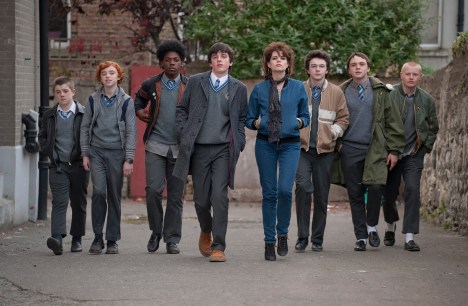
Sing Street is a joyous musical coming of age story.

As with Once and Begin Again, director John Carney demonstrates an innate (and romantic) appreciation for the role of music in interpersonal interactions. As in both Once and Begin Again, Carney employs music as an emotional shorthand; both in how the characters relate to one another and how the audience relates to the film. As with his two prior films, Carney treats music as a language of love and attraction, offering his characters the chance to communicate ideas or feeling that can only be hinted at through conversation, no matter how intimate.

However, Sing Street more firmly ties its musical elements to a sense of memory or nostalgia, with a soundtrack that evokes the film’s secondary school setting as effectively as costumes or set dressings. Sing Street is an ode to the joys and adventures of youth, set to a catchy synthesiser beat.

singstreet1

Continue reading

Non-Review Review: How to be Single

How to be Single is nowhere near as radical as its title would suggest.

As with Deadpool, there is a sense that film is more interested in acknowledging the tropes and conventions of the genre than it is in actively subverting them. How to be Single talks a good game, particularly through its central character. Dakota Johnson is well cast as the movie’s lead, anchoring an impressive ensemble of comedic actors. While How to be Single nods towards and acknowledges the expectations of the romantic comedy genre, it is more interested in gently bending and flexing the rules than actively breaking them.

According to formula...

According to formula…

Not that there is anything wrong with this approach. Indeed, How to be Single is a fairly solid example of the genre, with a witty script and a great cast providing just about everything that the audience could expect from a romantic comedy. How to be Single is perhaps a little too long for its own good, particularly in its final act. There are points at which the film hews a little bit too close to the romantic clichés for its own good, particularly in plot threads focusing on Leslie Mann and Alison Brie. However, the movie is charming enough that these are not fatal flaws.

How to be Single could easily have been a little more transgressive or a little more provocative, but the end result is a well-made and well-acted romantic comedy that has just enough self-awareness to understand the audience’s expectations; just not enough to really surpass them.

By the book...

By the book…

Continue reading

Non-Review Review: Triple 9

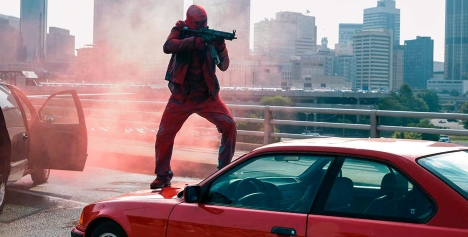
Triple 9 looks great.

Although it set in modern day Atlanta, director John Hillcoat seems to frame Triple 9 as a grim companion piece to The Road. Hillcoat captures the horrors of urban decay, creating a world that seems to teeter on the edge of the abyss. The camera pans through abandoned tenement buildings and lingers on graffiti; bodies are found in shopping trolleys while tinted windows serve to conceal immediate dangers. As filmed by Hillcoat and filtered through the lens of cinematographer Nicolas Karakatsanis, Atlanta seems to be composed of slums and overpasses.

Traffic stop...

Traffic stop…

From the impressive opening heist set piece, Hillcoat saturates the film with red, as if our heroes are only glimpsed through the light of hellfire. That red comes from multiple sources; a red dye pack that explodes at the worst possible moment, the boots worn by one of the characters, the lights from a police car, the fire from a distant (and somewhat anticlimactic) explosion. Triple 9 is oppressive and grim, with Hillcoat threatening to bring the world collapsing down upon his protagonists.

The problem with Triple 9 has nothing to do with Hillcoat’s aesthetic. Instead, the film suffers from a generic and unfocused script populated by characters who lack agency and identity. The main figures in Triple 9 often feel like pieces of paper caught in a breeze, moving in any given direction at the whim of the plot rather than through any essential quality of their own. Things happen not because they are organic (or even inevitable), but because they are convenient. There are points at which it seems like maybe the characters are not in hell; maybe the audience are.

Married to the mob...

Married to the mob…

Continue reading

Non-Review Review: Deadpool

Deadpool is an incredibly juvenile self-aware R-rated superhero action comedy.

And there is nothing wrong with that.

Drawing on the character's rich history...

Drawing on the character’s rich history…

Continue reading

Non-Review Review: The Big Short

The Big Short manages the deft task of being clever while being light, of being thorough without being slow, of being self-aware and ironic while still being earnest.

The Big Short is a very delicate cocktail, a precisely-calibrated high-wire act that threatens to collapse at any moment like the banking system it so scathingly indicts. If the financial markets that spurred the crisis were built upon the illusion of knowledge and projection of confidence, it seems reasonable to wonder the same thing of Adam McKay’s wry dramedy. There are several stretches of the movie that seem too ridiculous to be true, only for characters to break the fourth wall and assure the audience as to the veracity of what is portrayed on-screen.

At the margins...

At the margins…

The Big Short is pulled in multiple directions at the same moment, constantly wary of being pulled too far in one direction or the other. The film balances very carefully, trying to find the middle-ground between “too light” and “too heavy” as it offers an introduction to (and whistle-stop tour of) the financial crisis. There is a sense that The Big Short might go too far in any given moment; that its portrayal of the bubble as farce might shatter the verisimilitude, or that the anger simmering beneath the surface might explode and burn up the screen.

However, the most remarkable thing about The Big Short is not how skilfully it tells its story, but how easy it makes all this look.

Just the Pitts...

Just the Pitts…

Continue reading

Non-Review Review: Creed

Creed feels like something of an unlikely companion piece to Star Wars: The Force Awakens.

Increasingly, it seems that nostalgia is becoming a dominant force in popular culture. There has always been a market for nostalgia, but the past few years have seen an explosion in the management and exploitation of recognisable properties. It seems like almost everything is being fashioned into a franchise. In the seventies or eighties, it would have been unthinkable to imagine a shared universe built around Sylvester Stallone’s Rocky. Now, the surprise is not so much that the shared universe exists, but that it is good. Creed is a great boxing film.

creed3

If nostalgia is to become a governing force going forward, it is worth reflecting on approaches that work and those that do not. For every franchise that works, there is another that flounders. For every Mad Max: Fury Road, there is a Terminator: Genisys waiting in the wings. The key is to understand this pull of the past and to engage with it; to treat nostalgia as more than just a cynical market force, but to weave a story around it. JJ Abrams has proven quite adept with this, given the success of The Force Awakens at understanding the appeal of Star Wars.

Creed is every bit as successful, engaging with its own legacy and the weight of its nostalgia in a manner that suggests that writer and director Ryan Coogler understands not only what makes Rocky work as a piece of film, but also the gravity that exerts.

creed4

Continue reading

Non-Review Review: Joy

Joy is very much a showcase for David O. Russell’s interests, and his excesses.

Russell is a filmmaker with a particular sensibility in style. This is particularly obvious in the way that the director feels continuously drawn to the same performers and themes. As with many of Russell’s films, the cast of Joy is populated by actors who have worked with the director before. This is most apparent in the casting of Russell’s current creative ruse Jennifer Lawrence, who worked with Russell on Silver Linings Playbook and American Hustle. She is joined by Russell veterans like Bradley Cooper and Robert DeNiro.

Could the domestic cleaning industry use a shot in the arm?

Could the domestic cleaning industry use a shot in the arm?

Similarly, the film plays to Russell’s particular fascinations; Joy ties together the director’s engagement with Americana and his exploration of dysfunctional family dynamics. Joy places these two themes front-and-centre, but never quite synthesises them into a convincing whole. All too often, it feels like Joy is far more interested in the discordant home life of its female protagonist than all of the historical details it has to weave into her rags-to-riches tale. This causes problems when her journey takes her away from that home, and the film loses interest.

Joy is somewhat overstuffed, its attention wandering as the run-time goes on. For a story about a self-made millionaire whose rags-to-riches success embodies the ideal of the American Dream, Joy often feels quite rote; luxuriating in its depiction of her family life, the movie’s second half feels over extended as it clocks through all the beat expected in a story like this. Its final third is given over to a crisis that feels as obligatory as its resolution is convenient. For a movie about a woman with an ability to see innovation, Joy is trapped by its conventionality.

Talk about a mop top...

Talk about a mop top…

Continue reading

Non-Review Review: The Revenant

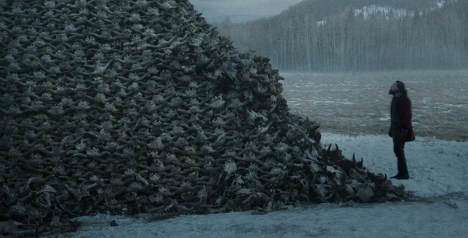
The Revenant is a beautiful and visceral piece of work.

Sporting a troubled production history, The Revenant is surprisingly straightforward film. Based on the tale of famed fur trapper (and tall-tale-teller) Hugh Glass, The Revenant charts one man’s journey from near-death back to civilisation against the harsh and unforgiving American wilderness. The Revenant is essentially a journey in a straight line, as Glass struggles to find a way back to security and revenge himself upon his colleagues who left him for dead. The film’s biggest structural issues lie in a desire to distort or convolute that straight line.

therevenant6

However, the fairly linear and straightforward plot is really just a framework for director Alejandro G. Iñárritu and cinematographer Emmanuel Lubezki to present the audience with striking vistas and symbolism that ranges from blindingly obvious to wilfully obtuse. The film is absolutely stunning, capturing its tone perfectly and presenting any number of memorable images and moments. Even when the visual trips sideways or backwards feel indulgent or unnecessary, they are still beautiful.

The Revenant is perhaps a little too fixated on over-complicating what is a fairly straightforward narrative, with a script that can seem unexpectedly obtuse for what is basically a single long chase movie crossed with a classic “man against nature” survival film. Nevertheless, the result is a striking piece of work that is awe-inspiring in visual (and visceral) terms.

therevenant7 Continue reading