• Following Us

  • Categories

  • Check out the Archives


  • Awards & Nominations

Non-Review Review: X-Men – Apocalypse

X-Men: Apocalypse is a retro superhero blockbuster, and not just because it happens to be set in the eighties.

At this stage, the X-Men franchise is practically a warhorse of superhero cinema. Although Blade tends to get overlooked in discussions of the current superhero boom, it is fair to trace the current deluge of superhero films back to the twin releases of Bryan Singer’s X-Men and Sam Raimi’s Spider-Man. Without those two films, released more than a decade-and-a-half ago, the current blockbuster landscape would look a lot different. Those films changed audience expectations and demonstrated what could be done with the format.
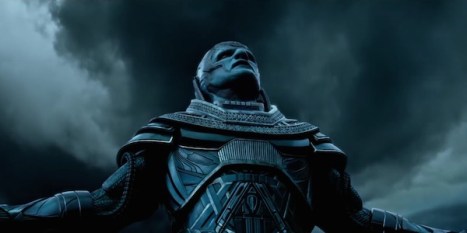
xmenapocalypse1

“Shoot me from a low angle to make me seem huge. I’m talking real ‘Triumph of the Will’, here.” (Special Guest Caption by Ed Azad.)

There have two big screen reboots of Spider-Man in the intervening years, with both Andrew Garfield and Tom Holland stepping into the red booties vacated by Tobey Maguire. In contrast, the Hugh Jackman and Patrick Stewart are still playing the iconic roles they established more than fifteen years ago, with X-Men: Days of Future Past straining to reconcile the original cast with the replacements who appeared in X-Men: First Class. However, in the intervening years, superhero cinema has changed dramatically.

In many respects, Apocalypse feels like the X-Men is playing catch-up with the generation of superhero blockbusters that arrived it its wake, taking the opportunity to do its own big “rock ’em, sock ’em” apocalyptic superhero team-up showdown of the kind that has never really featured in the franchise. Apocalypse finds the X-Men franchise embracing a particular style of superhero brawler typified by The Avengers back in 2012. Ironically, the genre itself has moved on, leaving the entire exercise feeling a little quaint.

xmenapocalypse

“It was acceptable in the eighties.” (Special Guest Caption by Ed Azad.)

Continue reading

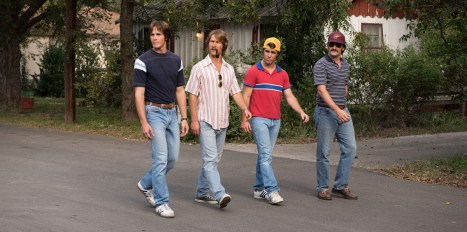
Non-Review Review: Everybody Wants Some!!

Richard Linklater is a director fascinated by the time in between.

This seems like a very obvious statement. After all, Linklater is still (relatively) fresh from a slew of nominations for Boyhood, a film that was famous for being shot with the same cast over the course of years and allowing the audience to literally watch its central character grow and develop. Many critics argued that the film was nothing more than a gimmick, a piece of performance art more than a narrative. Of course, the gimmick was largely the point of the film. Linklater is a director fascinated with the passage of time; Boyhood pushes that to the limit.

everybodywantssome

Of course, it is also interesting what Linklater does with his sense of time. Many of Linklater’s films unfold against the backdrop of a deadline. Before Sunrise, Before Sunset and Before Midnight build their deadlines into the title. Dazed and Confused follows a bunch of students on the last day of school. Everybody Wants Some!! operates with a literal countdown the ticks from the moment that Jake arrives at his college dorm to the start of his college classes. In theory, the film runs up against the clock.

However, Linklater’s deadlines tend to be arbitrary. His films are never race-to-the-finish thrillers as one might expect. Rarely are those precious few hours and minutes filled with important life-changing decisions and profound conversations. Instead, they are filled with a celebratory glimpse of the mundane, more extraordinary for their ordinariness. If anything, they feel like collective pauses; they are a deep breath before jumping back into life, a moment taken out of time, the last few hours before the clock really starts ticking.

everybodywantssome3

Continue reading

Non-Review Review: The Silent Storm

The Silent Storm is an ironic title for this over-produced melodrama.

The Silent Storm is a story about an abusive marriage and an unlikely affair that blossoms on an abandoned Scottish island when a trouble young man is assigned to the care of a fire-and-brimstone minister and the minister’s housekeeper-slash-wife. Inevitably tension mount and passions flair as the three characters dance around each other, with nothing but the craggy cliffs and choral soundtrack to keep them company. For an empty island abandoned to the forces of modernity, there’s a pretty loud choir to keep our three primary characters company.

Let us prey...

Let us prey…

There is an appeal to this sort of dour character study. Writer and director Corinna McFarlane has cast two great actors in the lead roles of her first narrative feature; Damien Lewis and Andrea Riseborough are perfectly suited to this depressive melodrama, as a couple trapped in a repressive and abusive marriage with simmering tensions. The problem is the McFarlane never pitches the film at the right level. For a harrowing story of abuse and violence, the film frequently trips into self-parody.

Part of the fault rests with Lewis and Riseborough, who turn their performances up to eleven to match the production around them. However, a lot of the blame falls to McFarlane, who is utterly unwilling to let any moment stand on its own without pushing the theme or the mood to breaking point. The result is a film that struggles to find the right tone and so occasionally feels like a postmodern ironic deconstruction of the genre into which it is trying to fit.

Passion project...

Passion project…

Continue reading

Non-Review Review: Friend Request

Friend Request does not work.

There is a great horror film to be made about the internet age. After all, the best horror has always reflected the time around it. The witch hunts of the fifties paved the way for The Invasion of the Body Snatchers, while the AIDs panic of the eighties gave way to body horrors like The Fly or The Thing. There is undoubtedly a classic horror waiting to be made about the perils of online life and the strange connections that form through computer monitors. Unfortunately, Friend Request is not it.

"I CAN HAZ FRIEND?"

“I CAN HAZ FRIEND?”

Continue reading

Non-Review Review: The Man Who Knew Infinity

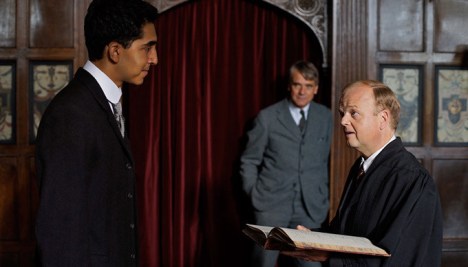
It takes a lot of skill to make mathematics seem beautiful. It is enough work to render those complex equations that mash together numbers and greek letters as something profound and understandable to contemporary audiences. After all, maths is static at best. When it comes to the kind of mathematical genius that inspires these sorts of biographies, the math tends towards the abstract. When The Man Who Knew Infinity works best, it manages to capture just some of the romance trapped between those braces.

Of course, there are points at which The Man Who Knew Infinity threatens to get too romantic. Writer and director Matthew Brown has an obvious (and infectious) enthusiasm for his subject, Indian mathematician Srinivasa Ramanujan. The Man Who Knew Infinity works best when it expresses this affection through its leads. Jeremy Irons makes a surprisingly convincing evangelist for abstract mathematics, and Dev Patel offers utter conviction in the lead role. However, there are points at which Brown seems unwilling or unable to trust his actors or his audience.

What a nice fellow...

What a nice fellow…

Continue reading

Non-Review: Eye in the Sky

Eye in the Sky is a powerful contemporary morality play.

Eye in the Sky feels a lot like an old-style “television play.” It recalls the sorts of stories from the period when television was trying figure out its relationship between film and stage. The action unfolds in a number of relatively confined locations with a relatively modest cast. This cast is then presented with a moral dilemma, which the script spends most of its one-hundred-minute runtime carefully twisting and unpacking. Even today, it is not too difficult to imagine an event “live” broadcast on a smaller broadcaster working from the same premise.

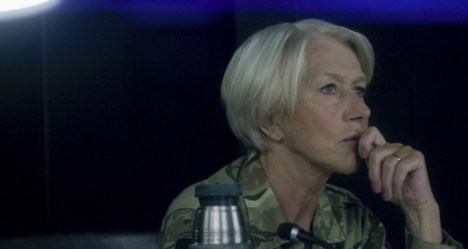
Mirr(en)ed in doubt...

Mirr(en)ed in doubt…

That is not to suggest that Eye in the Sky is cheap or uncinematic. Director Gavin Hood imbues the story with a lush cinematic style that feels a lot bigger than the moral drama playing out between the characters. Hood gives Eye in the Sky a sense of scale and heft that belies any formal similarities of classic television productions. At times, Hood is a little too cinematic, the hand of the director feeling a little too heavy in a morality play that takes great pains to be even-handed and complex.

However, these moments are fleeting; the film’s power lingers longer.

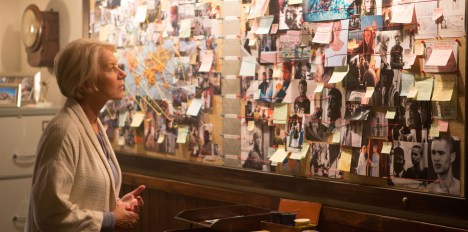
Eye see all...

Eye see all…

Continue reading

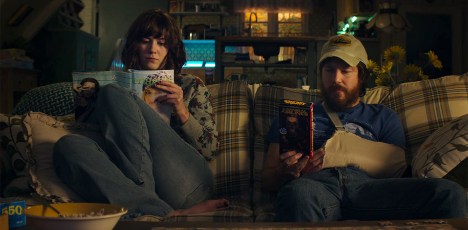
Non-Review Review: 10 Cloverfield Lane

10 Cloverfield Lane is a beautiful piece of speculative paranoid horror.

The plot follows Michelle, a young woman who is involved in a car crash. She wakes up to find herself in a strange concrete bunker, under the care of the mysterious (and more-than-slightly sinister) Howard. As she comes to her senses, Howard advises her that something horrible has happened; the world has ended outside and they are sealed safely inside an air-tight self-sustaining bunker. However, Michelle has a healthy degree of skepticism about Howard’s claims, wondering what exactly is going on and just how trustworthy Howard actually is.

At home at the end of the world. Maybe.

At home at the end of the world.
Maybe.

To reveal any more would be to spoil the film. 10 Cloverfield Lane is very much a “mystery box” production, in keeping with various other JJ Abrams projects from Cloverfield to Super 8 to Star Trek Into Darkness. Although Abrams is not directing, 10 Cloverfield Lane retains a lot of the director’s aesthetic. It is a film that is designed to be seen with the bare minimum of information, to the point where the unveiling of the movie’s title came surprisingly late in the release process.

However, writers Drew Goddard and Daniel Casey (working from a story by Matthew Stuecken and Josh Campbell) and director Dan Trachtenberg use that mystery box structure in a manner distinct from Abrams’ blockbuster sensibilities. 10 Cloverfield Lane plays like a feature-length high-budget episode of The Twilight Zone, a story that looks and sounds great but would (mostly) lend itself to a stage play adaptation. 10 Cloverfield Lane feels very much like a classic high-concept science-fiction horror, in the best possible way.

Music to his ears...

Music to his ears…

Continue reading

Non-Review Review: Divergent – Allegiant

In terms of dystopian young adult science-fiction/fantasy franchises, Divergent is solidly mid-tier. It is in technical and production terms superior to The Maze Runner, but markedly inferior to The Hunger Games. It lacks the sort of spectacular camp that made The Mortal Instruments stand out, for better or worse. It is a reasonable execution of a fairly reliable (although also heavily problematic) central concept, but without anything that really elevates it above its competitors.

Allegiant is the first part of a two-part finalé to the series, as has become the norm for these types of films. However, it all feels rather rote. Allegiant does not feel like the first part of a two-parter, instead feeling like its own story that could support a sequel but alternatively would be a perfectly fine place to wrap up if the studio decide to all it a day. The fact that it is the first of a two-part adaptation of a source material feels like a decision that was made because that is just how you adapt young adult franchises at this point in time.

Hate to burst your bubble...

Hate to burst your bubble…

Continue reading

Non-Review Review: Mammal

This film was seen as part of the Audi Dublin International Film Festival 2016.

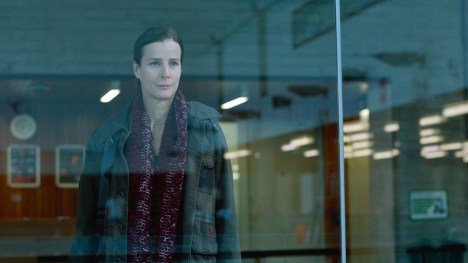
Mammal is a psychosexual exploration of grief with a strong sense of direction and two strong central performances, albeit one that manages the rare feat of feeling both sensationalism and lifeless in the same instant.

Writer and director Rebecca Daly has a strong sense of tone, creating a palpable uncertainty and anxiety that pervades the first half of the film. Daly crafts an engaging sense of ambiguity, allowing tensions and uncertainties to simmer beneath the surface of the relationship between her two central characters. The performances help a great deal, with Rachel Griffiths doing great work as the divorced and isolated Margaret and Barry Keoghan offering strong support as the mysterious Joe. Mammal is filled with awkward silences and tense foreboding.

mammal

Unfortunately, all of those tension and anxiety has to build to something, and Mammal suffers in how it decides to deliver upon and follow through on all that suspense and ambiguity. Mammal really struggles during its second act, offering twists that should be shocking but are ultimately entirely predictable. Mammal seems to try to escalate in its final act, but the film suffers quite a bit from its own efficiency at setting the mood. In its last forty minutes, the film is left nowhere to go but the most expected directions, the blows softened by the fact they’ve been awkwardly signposted.

Mammal works best when it focuses on the interiority of its characters, but struggles when it asks them to act upon one another.

mammal2

Continue reading

Non-Review Review: Green Room

This film was seen as part of the Audi Dublin International Film Festival 2016.

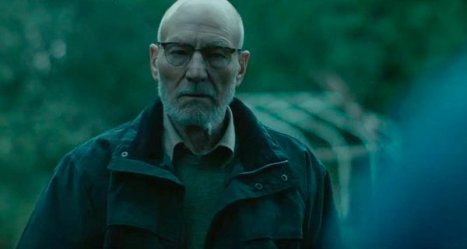
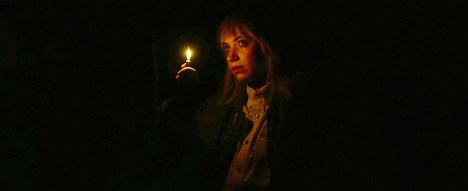
Green Room is a masterful artisanally-crafted suspense thriller.

Writer and director Jeremy Saulnier crafts a loving tribute to seventies horror that feels like a truer successor to the “backwoods horror” genre than many contemporary remakes and reimaginings. Following a punk band named The Ain’t Rights that stumble into a tense stand-off with a bunch of neo-nazis in rural Oregon, Green Room is almost aggressively old-school in its horror sensibilities. It is tense and claustrophobic, paranoid and unsettling. Saulnier has a masterful understanding of the genre and its expectations, crafting a pitch perfect homage.

greenroom

Green Room is a very canny piece of work, but never in a manner that is distracting. The film is wry without being ironic, more arch than subversive. Appropriately enough, given its punk protagonists, the movie’s hints of cynicism about its genre and set-up bely a more earnest appreciation of the form. Green Room is a classic and conventional horror film about a bunch of kids who took a wrong turn, and it is utterly unapologetic about that. Instead, it commits to providing one of the most visceral traditional horror experiences in recent memory.

Green Room is a nasty piece of work. And is all the better for it.

greenroom6

Continue reading