• Following Us

  • Categories

  • Check out the Archives


  • Awards & Nominations

Doctor Who: Forest of the Dead (Review)

To celebrate the fiftieth anniversary of the longest-running science-fiction show in the world, I’ll be taking weekly looks at some of my own personal favourite stories and arcs, from the old and new series, with a view to encapsulating the sublime, the clever and the fiendishly odd of the BBC’s Doctor Who.

Forest of the Dead originally aired in 2008.

Everybody knows that everybody dies. But not every day. Not today. Some days are special. Some days are so, so blessed. Some days, nobody dies at all. Now and then, every once in a very long while, every day in a million days, when the wind stands fair, and the Doctor comes to call, everybody lives.

– River brings Moffat’s contributions to the Davies era a full circle

There’s actually quite a lot to like about Forest of the Dead. Like Silence in the Library, it doesn’t really push Moffat’s work on Doctor Who that much further. A lot of its big ideas can be found in Moffat’s earlier Doctor Who work. Still, it is quite clever and quite well-written, and a pretty well-constructed episode. This is, after all, the last episode of the Davies era that is not credited to Davies himself. Given it’s written by the showrunner elect, that celebratory feel is justified.

At the same time, however, there are some very uncomfortable gender roles at work in Forest of the Dead for female characters like Donna or River. Moffat would come under a lot of fire during his tenure producing Doctor Who for the way that he wrote female characters, but I’d actually argue that the problems with Forest of the Dead are more in keeping with wider Davies-era trends towards the way that female characters are written.
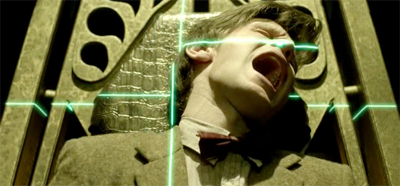
It just clicked...

It just clicked…

Continue reading

Doctor Who: Silence in the Library (Review)

To celebrate the fiftieth anniversary of the longest-running science-fiction show in the world, I’ll be taking weekly looks at some of my own personal favourite stories and arcs, from the old and new series, with a view to encapsulating the sublime, the clever and the fiendishly odd of the BBC’s Doctor Who.

Silence in the Library originally aired in 2008.

There’s the real world, and there’s the world of nightmares. That’s right, isn’t it? You understand that?

Yes, I know, Doctor Moon.

What I want you to remember is this, and I know it’s hard. The real world is a lie, and your nightmares are real.

– Cal and Doctor Moon get to the root of what makes Moffat scripts terrifying

Ah, Silence in the Library. The Steven Moffat story that isn’t, that doesn’t. The first Steven Moffat script that isn’t the strongest story in its season by a clear margin; the first Steven Moffat adventure that didn’t claim the Hugo for Doctor Who. The biggest problem with Silence in the Library and Forest of the Dead is that they can’t quite measure to The Empty Child, The Doctor Dances, The Girl in the Fireplace or Blink. That’s hardly an unforgivable sin, and there’s no shame in not being quite as good an episode of Doctor Who as Midnight was.

I’m quite fond of the two-parter, even though I’ll concede that it has its problems. The most obvious of which is the fact that – four years into the revival – the audience has had a chance to come to appreciate “Moffat-isms”, with many viewers able to recognise the writer’s preferred genre tricks and tropes. Silence in the Library is far from the most original script of the season, but it’s well written and well executed.

It’s just a little too familiar.

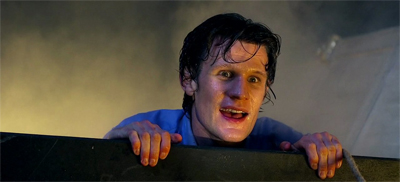
Going by the book on this one...

Going by the book on this one…

Continue reading

Doctor Who: Cold Blood (Review)

To celebrate the fiftieth anniversary of the longest-running science-fiction show in the world, I’ll be taking weekly looks at some of my own personal favourite stories and arcs, from the old and new series, with a view to encapsulating the sublime, the clever and the fiendishly odd of the BBC’s Doctor Who.

Cold Blood originally aired in 2010.

It is the story of our past and must never be forgotten.

– Eldane attempts to justify the “traditional monster” two-parters the revived show is so fond of

The Hungry Earth wasn’t too bad. It wasn’t great. There was nothing too exciting or novel about it, but it wasn’t a complete failure. It was an interesting and affectionate throwback to an older style of Doctor Who. It wasn’t exceptional, but it was -broadly speaking – functional. Chris Chibnell’s script had some rough edges, mostly around characterisation, but there was nothing too unworkable about the premise, which basically consisted of a selection of classic Doctor Who tropes thrown in a blender and served up to the audience.

However, Cold Blood is much less satisfying. Part of that is because it’s part of a story that can’t be sustained by nostalgia or affectionate references to tales long past. There’s also the fact that it hinges on an emotional climax that asks us to invest in an especially two-dimensional supporting cast. And that’s saying nothing about how the last few minutes of the episode aren’t even devoted to tying up its own threads so much as playing into the much more interesting season-long arc.

Cold Blood leaves me… well, cold.

Doesn't scan...

Doesn’t scan…

Continue reading

Doctor Who: The Hungry Earth (Review)

To celebrate the fiftieth anniversary of the longest-running science-fiction show in the world, I’ll be taking weekly looks at some of my own personal favourite stories and arcs, from the old and new series, with a view to encapsulating the sublime, the clever and the fiendishly odd of the BBC’s Doctor Who.

The Hungry Earth originally aired in 2010.

Oh look! Big mining thing! Oh, I love a big mining thing. See, way better than Rio. Rio doesn’t have a big mining thing.

– the Doctor looks on the bright side of arriving in not!Rio

The Hungry Earth represents the biggest structural shift of Steven Moffat’s first season of Doctor Who. The writer would indulge in a number of radical structural changes over his time running the show, but his first season as showrunner conforms to the pattern of Russell T. Davies’ four full seasons. There’s the introductory present/past/future trilogy, the two mid-season two-parters and the gigantic two-part season finalé. The content of Moffat’s season might have been markedly different (actual romantic snog! a season building an arc that isn’t just references and easter eggs!), but the format was carried over faithfully.

Moffat’s following two seasons would get more experimental. For one thing, both seasons would be split in half. This allowed Moffat to offer the first genuine cliffhanger in the revival’s history to last more than a week, with a gap of several months between A Good Man Goes to War and Let’s Kill Hitler. His second season would feature the first two-part season opener (and first one-part season finalé) of the revived television show. His third season would feature no two-part episodes, spread across two calendar years.

However, sitting at the tail end of his first season, The Hungry Earth feels like the strangest structural element of Moffat’s first year in charge of Doctor Who. It’s what would traditionally be the first two-parter of the season, pushed back towards the end of the year.

Balancing the scales...

Balancing the scales…

Continue reading

Doctor Who: The Name of the Doctor (Review)

How do we get down there? Jump?

Don’t be silly. We fall.

– Clara and the Doctor set things straight

Like The Wedding of the River Song, The Name of the Doctor suggests that Moffat might be better served by reverting to the Davies-era model of two-part season finalés. The strongest season ender of the Moffat era (and probably the best season finalé of the revived show) was The Big Bang, because it felt like Moffat had enough space to allow his ideas to breathe. The Name of the Doctor is a lot sharper and a lot more deftly constructed than any of the closing episodes from Russell T. Davies’ seasons, but it feels a little too compact, a little too tight for its own good.

To be fair, Moffat is has very cleverly structured his season. The mystery of Clara was seeded as early as Asylum of the Daleks and hints have been scattered throughout the past year of Doctor Who. Even the build-up to the final line of the episode feels like an idea that Moffat has been toying with since The Beast Below. Despite all this, it still feels like The Name of the Doctor could do with a little more room to elaborate and develop the concepts at the core of the story.

Journey to the centre of the Doctor?

Journey to the centre of the Doctor?

Continue reading

Doctor Who: The Bells of St. John (Review)

There’s something in the wifi.

– the Doctor does his best Jaws impression

The Bells of St. John is an intriguing piece of Doctor Who. This is the first time that the show has had to manage a companion swap in the middle of a season. That said, it doesn’t really work to think of the seventh season as a single cohesive entity.

The first five episodes are something of an abridged season, akin to the 2009 season of specials starring David Tennant. They are dedicated to tidying away lingering plot threads from the last two years of the show, and resolving Moffat’s lingering plot threads. The Power of Three and The Angels Take Manhattan are very much about tidying up the Doctor’s lingering connection to Rory and Amy.

In contrast, the second half of the season has a much more celebratory feeling to it, tied together by the over-arching mystery around Clara. While Clara pops up in Asylum of the Daleks, she’s very much a teaser of a mystery to come rather than a character in her own right. Instead, the themes of the season start in The Snowmen, introducing (or reintroducing) the Great Intelligence and Clara, and outlining the mystery of “the twice-dead girl.”

As a result, The Bells of St. John feels very much like a season opener to an unfortunately brief season of celebration.

Maybe that should be "thrice dead"?

Maybe that should be “thrice dead”?

Continue reading

Doctor Who: The Eleventh Hour (Review)

To celebrate the fiftieth anniversary of the longest-running science-fiction show in the world, I’ll be taking weekly looks at some of my own personal favourite stories and arcs, from the old and new series, with a view to encapsulating the sublime, the clever and the fiendishly odd of the BBC’s Doctor Who.

The Eleventh Hour originally aired in 2010.

So, coming?

No.

You wanted to come fourteen years ago.

I grew up.

Don’t worry. I’ll soon fix that.

– the Doctor and Amy

The arrival of a new producer on Doctor Who always represents a shift in some way shape or form. The change from Barry Letts to Philip Hinchcliffe must have seemed radical, even at the time. Graham Williams following Hinchcliffe represented a similarly strange departure. The departure of Russell T. Davies, the producer who had brought Doctor Who back to television after over a decade, was always going be a pretty significant change for those watching. Steven Moffat’s first episode as producer might not seem like it’s a shocking departure from what came before, but it also quite efficiently and effectively distinguishes Moffat’s tenure from that of his direct predecessor.

While by no means as radical a shift as Spearhead from Space, there is a very clear feeling that The Eleventh Hour brings with it significant tonal and thematic changes to the tale of the Doctor.

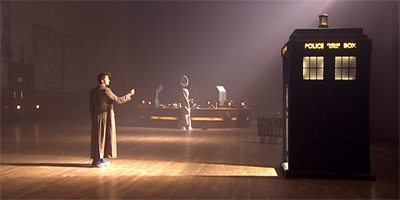
A mad man with a box...

A mad man with a box…

Continue reading

Doctor Who: The Snowmen (Review)

Snowmen are rubbish in July. You’ll have to be better than that.

– the Doctor points out that the Great Intelligent doesn’t seem especially… intelligent

The Snowmen is a return to the sort of plot-driven Christmas Special that we occasionally saw during the Davies era. Much like The Christmas Invasion was concerned with introducing David Tennant and The End of Time, Part I was focused on wrapping up the Davies era, The Snowmen feels like it’s more concerned with setting up the fiftieth anniversary half-season ahead than it is with being a Christmas Special in its own right.

Sure, The Snowmen has all the festive trappings you might expect. There are killer snowmen, as the title implies. There’s a rich lonely old miser, as we’ve come to expect in these sorts of tales. There’s a nice Victorian setting for all the action as well. However, The Snowmen devotes a considerable amount of time to developing the mystery surrounding the Doctor’s new companion, and setting up a recurring foe for this fiftieth anniversary half-season.

The result is somewhat unsatisfying, as if The Snowmen is working harder to check the requisite boxes than it is to provide seasonal Doctor Who viewing.

What white teeth they have...

What white teeth they have…

Continue reading

Doctor Who: The Angels Take Manhattan (Review)

The decision to build Steven Moffat’s third season of Doctor Who around a series of done-in-one stories has been a bit of a mixed blessing. Asylum of the Daleks was suitably madcap Saturday tea-time telly, and A Town Called Mercy was an affectionate homage to Americana, but Dinosaurs on a Spaceship barely had room to breath, overloaded on cool moments with little room left for plotting.

The Angels Take Manhattan suffers the most from this sense that it is being compacted. Watching the episode, it feels like Moffat is trying to cram too much story into a single forty-five minute episode. It makes the viewer long for the days when Russell T. Davies would gleefully run his episodes over the allocated forty-five minute slot. Here, Moffat’s big high-concept “timey wimey” ideas and his farewell to his two companions eating up so much of the run-time that the plot itself still feels like an afterthought, running on contrivance and coincidence rather than anything more substantial.

That doesn’t mean it isn’t an affective farewell to Rory and Amy, or that it doesn’t draw fantastic performances from its central quartet, but it does mean that The Angels Take Manhattan is never quite as sturdy as it should have been.

A walk in the park…

Continue reading

Doctor Who: The Power of Three (Review)

The Power of Three is Chris Chibnell’s best Doctor Who script to date. While a little heavy-handed in the way it deals with the relationship between the Doctor and Amy and Rory, it’s still a nice change of pace. It’s a thoughtful episode exploring the Doctor’s relationship with time. (And that shared by his companions.) While the alien invasion seems a little tacked on, to the point where it only seems to serve the final pun, The Power of Three is still a solid penultimate outing for this trio of adventurers.

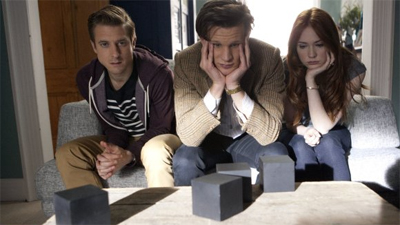
Thinking outside the box…

Continue reading