• Following Us

  • Categories

  • Check out the Archives


  • Awards & Nominations

Star Trek – Leonard McCoy, Frontier Doctor by John Byrne (Review)

The August, to celebrate the upcoming release of Star Trek: Into Darkness on DVD and blu ray, we’re taking a look at the Star Trek movies featuring the original cast. Movie reviews are every Tuesday and Thursday.

We’ll be supplementing our coverage of the movies with tie-ins around (and related to) the films. We’ll be doing one of these every week day. This is one such article.

It’s fascinating how few stories take place around Star Trek: The Motion Picture. There’s a rake of tie-in material that exists to flesh-out the Enterprise’s five-year mission, and a large volume of material set during the period from Star Trek II: The Wrath of Khan straight through to Star Trek VI: The Undiscovered Country. However, the space around The Motion Picture has been somewhat overlooked by writers delving into the expanded world of Star Trek tie-in fiction.

To be fair, there are reasons for this. Although it was a box office success, looked stunning for the time, had a rake of big ideas and welcomed the crew to the screen, The Motion Picture isn’t generally considered to be one of the high points of the franchise. As such, it seems reasonable that it garners less attention, the affection shown by a few writers aside. There’s also the fact that The Motion Picture opens with the crew of the Enterprise broken up, scattered amongst the cosmos.

The Motion Picture sees Kirk putting the band back together after the universe seems to have forgotten about them, pulling them out of mothballs. Any story set in the lead-up to The Motion Picture would have to feature the ensemble all separated and going about their own thing. This limits the kind of stories that can be told in the setting, and makes it less appealing than other settings in Star Trek continuity.

John Byrne’s Leonard McCoy, Frontier Doctor gives us a glimpse of what a project set between the end of the Enterprise’s mission and the start of The Motion Picture might look like. It’s essentially a solo adventure series focusing on one member of the cast, and it’s absolutely fascinating.
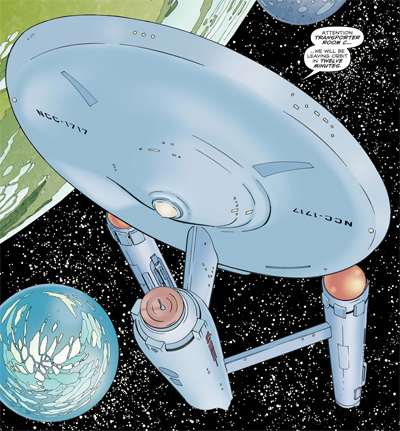
These are the voyages of the Starship... Yorktown...

These are the voyages of the Starship… Yorktown…

Continue reading

Star Trek – The Galileo Seven (Review)

To celebrate the release of Star Trek: Into Darkness this month, we’ll be running through the first season of the classic Star Trek all this month. Check back daily to get ready to boldly go. It’s only logical.

It’s amazing to think that only now, almost half-way through the first year of Star Trek, the show is doing a Spock-centric episode. Spock is an iconic and instantly recognisable part of Star Trek lore, to the point that Leonard Nimoy’s version of the character served as the link between the classic series and JJ Abrams’ 2009 reboot of the franchise. The character appeared in The Cage, the very first episode of Star Trek ever produced. He is perhaps even more iconic than James T. Kirk himself.

So it feels slightly weird, then, that The Galileo Seven should serve as the first episode of the series completely devoted to Spock as a character, pushing Jim firmly to the background as we get a look at Spock’s first command experience.

Talk about carrying dead weight...

Talk about carrying dead weight…

Continue reading

Star Trek – Dagger of the Mind (Review)

To celebrate the release of Star Trek: Into Darkness this month, we’ll be running through the first season of the classic Star Trek all this month. Check back daily to get ready to boldly go. It’s only logical.

I knew we were due a nice Shakespearean title soon. And The Conscience of a King is just around the corner, to boot. Seriously though, I have to admit a massive fondness for these wonderfully lofty and high-minded episode titles. It’s something that links the original Star Trek and Star Trek: Deep Space Nine quite firmly, and was sadly never enthusiastically taken up by any of the other spin-offs. It’s a shame, because – regardless of the quality of the episodes in question – there’s something undeniably endearing about forty-five minutes of television given a pretentious name like For the World is Hollow and I Have Touched the Sky, The City on the Edge of Forever or Wrongs Darker Than Death or Night.

A scream...

A scream…

Continue reading

Non-Review Review: Star Trek – Into Darkness

Note: This is a spoiler-heavy review. If you want a spoiler-lite recommendation, click here. If not, continue at your own risk.

Towards the climax of Star Trek: Into Darkness, Kirk and the Enterprise flee an aggressor by entering warp. At that speed, several factors the speed of light itself, they surmise that they must be safe from their pursuer. Of course, they prove to be wrong – brutally so. Everything in Into Darkness moves fast, so fast that the Enterprise’s top speed seems more like a casual jog than a breakneck acceleration. The plot rockets along with incredible speed, from plot point to plot point, counting on the momentum to sustain the film and carry it across the line.

There is enough material here to produce a trilogy of films. Indeed, cynics might suggest that a lot of the movie’s iconography and plot points are indeed recycled from the central “trilogy” of the original Star Trek films, running from the homages to Star Trek II: The Wrath of Khan right down a climactic visual reference to Star Trek IV: The Voyage Home. Abrams and his team of writer continue their work from 2009’s breakout blockbuster Star Trek by putting the franchise’s most compelling images and cues into a high-speed blender.

Into Darkness just substantially increases the concentration.

Seeing red...

Seeing red…

Continue reading

Star Trek 101: The Best of The Original Series

To celebrate the release of Star Trek: Into Darkness, we’re holding a month full of Star Trek  related fun. We’re reviewing every episode of the show’s first season, from The Cage through to Operation — Annihilate!, one-per-day for all of May. We’re also looking at some of the various spin-offs, tie-ins and pop culture intersections, so there’s always something going on to do with Star Trek. Anyway, with the release of the new film, we thought it might be interesting to make some recommendations for fans of the new films who wanted to “dip their toes in the water” so to speak, offering a quick taste of the best that the classic 1960s original Star Trek has to offer those wanting to boldly go with Kirk, Spock and McCoy.

tos-operationannihilate26

Continue reading

Non-Review Review: Star Trek – Into Darkness

Note: This is a spoiler-lite review. If you want a spoiler-heavy in-depth look at the film, click here.

Towards the climax of Star Trek: Into Darkness, Kirk and the Enterprise flee an aggressor by entering warp. At that speed, several factors the speed of light itself, they surmise that they must be safe from their pursuer. Of course, they prove to be wrong – brutally so. Everything in Into Darkness moves fast, so fast that the Enterprise’s top speed seems more like a casual jog than a breakneck acceleration. The plot rockets along with incredible speed, from plot point to plot point, counting on the momentum to sustain the film and carry it across the line.

There is enough material here to produce a trilogy of films. Indeed, cynics might suggest that a lot of the movie’s iconography and plot points are indeed recycled from the central “trilogy” of the original Star Trek films, running from the homages to Star Trek II: The Wrath of Khan right down a climactic visual reference to Star Trek IV: The Voyage Home. Abrams and his team of writer continue their work from 2009’s breakout blockbuster Star Trek by putting the franchise’s most compelling images and cues into a high-speed blender.

Into Darkness just substantially increases the concentration.

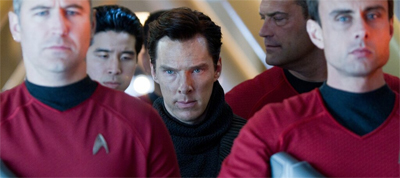
Seeing red...

Seeing red…

Continue reading

Star Trek – The Enemy Within (Review)

To celebrate the release of Star Trek: Into Darkness this month, we’ll be running through the first season of the classic Star Trek all this month. Check back daily to get ready to boldly go. It’s only logical.

One thing that I don’t think the original Star Trek gets nearly enough credit for is the quality of the writers that Gene Roddenberry recruited to contribute scripts. Television obviously operated under a different model at the time, but there’s an impressive selection of science-fiction literary giants who contributed scripts to the show. More than that, it’s impressive how many of those stories became truly iconic Star Trek stories.

The Enemy Within is the work of author Richard Matheson, best known for stories like I Am Legend or What Dreams May Come. It’s very much a high-concept science-fiction story, but it’s also notable because it establishes two of what would become the show’s favourite tropes: transporter accidents and evil duplicates. Indeed, the two devices would be reunited in the following season’s Mirror, Mirror. These narrative elements even featured in the last season of Star Trek: Enterprise to air, in episodes like Daedalus and In a Mirror, Darkly.

Perhaps it’s a demonstration of how important these outside writers were to the development of Star Trek as a franchise that Matheson would effectively codify two stock narrative devices that would still be in use four decades later.

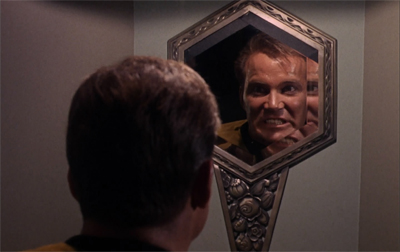
Mirror, mirror...

Mirror, mirror…

Continue reading

Star Trek: The Next Generation – The Child (Review)

To celebrate the twenty-fifth anniversary of Star Trek: The Next Generation, and also next year’s release of Star Trek: Into Darkness, I’m taking a look at the recent blu ray release of the first season (and a tiny bit of the second), episode-by-episode. Check back daily for the latest review.

Let’s play make believe for a second here. Let’s imagine you are producing a television show that had a very rocky first season, but seemed to be making steps in the right direction. This was a show already respected for its depiction of social issues like racism or drug use…

However, despite that, the first year of the show had some major gender issues. Your writers and actors had been pointing out that some of the episodes in that first year could be considered sexist. Of the three actresses in you regular cast, two left. One became the first regular on a Star Trek show to die in the middle of the season, and you had to write the first episode of the second season to write out the other actress who had been having some trouble with a male producer.

Now, keeping all that in mind, let’s carefully consider what to do with the remaining female lead character. If you are producing the second season of Star Trek: The Next Generation, you choose to have an alien impregnate that character without consent, use her body as incubation chamber, exploit her maternal instincts and then make her watch what she believes to be her own child die. More than that, you make sure that the female character is completely superfluous to the script itself, and that nobody seems to care particularly about her.

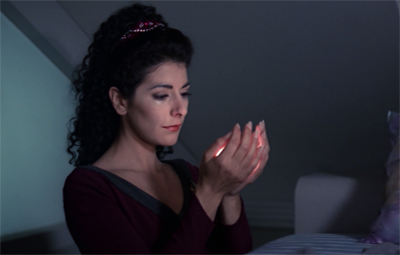
Don't worry, Troi. Face of the Enemy is less than half a decade away...

Don’t worry, Troi. Face of the Enemy is less than half a decade away…

Continue reading

Non-Review Review: Invasion of the Body Snatchers (1978)

The Invasion of the Body Snatchers is a wonderful science-fiction premise, so it’s really no wonder that the story has been taken to the big and small screens so often. It’s a great example of how a story can strike different notes in different eras, and how something can easily be about one thing in one era, and take on an entirely different meaning in a later one. The 1978 adaptation is a wonderful piece of high-concept science-fiction, which skilfully takes the ideas from the original classic film, and shakes them around just a little bit.

It's a scream!

Continue reading