• Following Us

  • Categories

  • Check out the Archives


  • Awards & Nominations

Non-Review Review: Star Trek III – The Search for Spock

This August, to celebrate the upcoming release of Star Trek: Into Darkness on DVD and blu ray, we’re taking a look at the Star Trek movies featuring the original cast. Movie reviews are every Tuesday and Thursday.

I have a soft spot for Star Trek III: The Search for Spock. It’s a weird thing to admit, but it was really my first encounter with the crew of the original Star Trek television show. I was only eight or nine at the time, and I’d grown up watching and loving Star Trek: The Next Generation. Of course, this was in an era before DVD and blu ray made it feasible (and affordable) to collect the whole thing. So I branched out by trying the movies.

Being a young child in the era before the internet, I didn’t know that the second through fourth films formed a loose thematic trilogy. I just picked the film with the title that jumped out at me. Since “Spock” was an iconic part of Star Trek, and I knew him from his guest appearance on The Next Generation, The Search for Spock seemed the logical choice.

And it retains a special place in my heart.
"I have been, and always shall be, your friend..."

“I have been, and always shall be, your friend…”

Continue reading

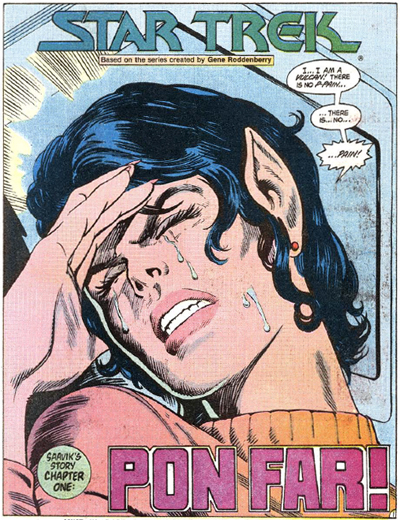
Star Trek (DC Comics, 1984) #7-8 – Saavik’s Story (Review)

This August, to celebrate the upcoming release of Star Trek: Into Darkness on DVD and blu ray, we’re taking a look at the Star Trek movies featuring the original cast. Movie reviews are every Tuesday and Thursday.

We’ll be supplementing our coverage of the movies with tie-ins around (and related to) the films. We’ll be doing one of these every week day. This is one such article.

Star Trek comics are an interesting way of catching a glimpse at the franchise one-step away from the heart of production. While there are other forms of tie-in media, comics are produced on a monthly schedule. While scripts need to be written and art needs to be drawn, there’s less lead-in time required, meaning that contemporary Star Trek comics are often able to react dynamically to on-screen events. While novels might take up to a year from original pitch to the time they hit the stands, there’s something rather more urgent about tie-in comic books.

This is an issue for many tie-ins comics. For example, the syndicated Star Trek newspaper strip launched shortly before the release of Star Trek: The Motion Picture made a point to feature Ilia as a bridge officer on a relaunched USS Enterprise. She rather suddenly disappeared after those involved actually saw the movie and realised that she didn’t quite survive the adventure. Similarly, when it came to detailing the adventures of Kirk and company in the wake of Star Trek III: The Search for Spock, writer Mike W. Barr moved the crew over to the USS Excelsior, in accordance with writer Harve Bennett’s original plan.

That said, Mike W. Barr’s comic book origin story for Lt. Saavik holds up rather well, fitting quite comfortably with Carolyn Clowes’ origin for the character offered in the superb 1990 book The Pandora Principle. Of course, Barr’s origin sketches the broadest of outlines, and is clearly more preoccupied with crafting a pulpy space opera adventure.

Saving Saavik!

Saving Saavik!

Continue reading

Star Trek – Ex Machina by Christopher L. Bennett (Review)

This August, to celebrate the upcoming release of Star Trek: Into Darkness on DVD and blu ray, we’re taking a look at the Star Trek movies featuring the original cast. Movie reviews are every Tuesday and Thursday.

We’ll be supplementing our coverage of the movies with tie-ins around (and related to) the films. We’ll be doing one of these every week day. This is one such article.

Ex Machina is really an astoundingly clever piece of work. On the surface, a lot of reads like a fan’s wishlist, a collection of “snags” made while watching the classic Star Trek films and making a conscious effort to fix them up a bit. There’s a lot of effort into explaining the changes between Star Trek: The Motion Picture and Star Trek II: The Wrath of Khan, with character-centric subplots focusing on Kirk’s ego or Chekov’s growing disenfranchisement.

Indeed, Bennett even provides an entirely unnecessary but quite-enjoyable-nonetheless set of annotations for Ex Machina, explaining where and how he’s tying his story into a rake of continuity. He describes Ex Machina as probing “an unexplored gap” in the franchise’s chronology. Ex Machina exists as both a sequel to a rather bland third-season episode of the show (For the World is Hollow and I Have Touched the Sky) and The Motion Picture. Neither is especially loved among fans.

However, what’s fascinating about Ex Machina is the way that none of this prevents Bennett from crafting a compelling and intriguing narrative. It’s clear that he’s enjoying attempts to fill in various gaps, but Ex Machina works incredibly well as a piece of Star Trek which stands on its own two feet.

st-exmachina

Continue reading

Non-Review Review: Star Trek – The Motion Picture

This August, to celebrate the upcoming release of Star Trek: Into Darkness on DVD and blu ray, we’re taking a look at the Star Trek movies featuring the original cast. Movie reviews are every Tuesday and Thursday.

Star Trek: The Motion Picture has a lot to recommend it. It’s big, thoughtful science-fiction, ripe with ideas and high-concepts tying directly into the root of the franchise. It gives both Kirk and Spock clear character arcs. It looks and sounds amazing, demonstrating just how far special effects had evolved in the decade since the show went off the air. However, it suffers from a pace that might best be described as “glacial”, and a sense that – for all the grand ideas – we aren’t really boldly going anywhere that new. Elements of the film can’t help but recall both the 1968 science-fiction classic 2001: A Space Odyssey and even the show’s own episode The Changeling.

While it’s easy to admire The Motion Picture, it’s a lot harder to enjoy it.

Strange new worlds...

Strange new worlds…

Continue reading

Star Trek – Leonard McCoy, Frontier Doctor by John Byrne (Review)

The August, to celebrate the upcoming release of Star Trek: Into Darkness on DVD and blu ray, we’re taking a look at the Star Trek movies featuring the original cast. Movie reviews are every Tuesday and Thursday.

We’ll be supplementing our coverage of the movies with tie-ins around (and related to) the films. We’ll be doing one of these every week day. This is one such article.

It’s fascinating how few stories take place around Star Trek: The Motion Picture. There’s a rake of tie-in material that exists to flesh-out the Enterprise’s five-year mission, and a large volume of material set during the period from Star Trek II: The Wrath of Khan straight through to Star Trek VI: The Undiscovered Country. However, the space around The Motion Picture has been somewhat overlooked by writers delving into the expanded world of Star Trek tie-in fiction.

To be fair, there are reasons for this. Although it was a box office success, looked stunning for the time, had a rake of big ideas and welcomed the crew to the screen, The Motion Picture isn’t generally considered to be one of the high points of the franchise. As such, it seems reasonable that it garners less attention, the affection shown by a few writers aside. There’s also the fact that The Motion Picture opens with the crew of the Enterprise broken up, scattered amongst the cosmos.

The Motion Picture sees Kirk putting the band back together after the universe seems to have forgotten about them, pulling them out of mothballs. Any story set in the lead-up to The Motion Picture would have to feature the ensemble all separated and going about their own thing. This limits the kind of stories that can be told in the setting, and makes it less appealing than other settings in Star Trek continuity.

John Byrne’s Leonard McCoy, Frontier Doctor gives us a glimpse of what a project set between the end of the Enterprise’s mission and the start of The Motion Picture might look like. It’s essentially a solo adventure series focusing on one member of the cast, and it’s absolutely fascinating.

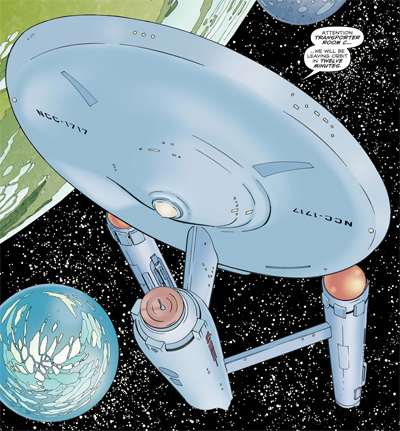
These are the voyages of the Starship... Yorktown...

These are the voyages of the Starship… Yorktown…

Continue reading

Star Trek – Errand of Mercy (Review)

To celebrate the release of Star Trek: Into Darkness this month, we’ll be running through the first season of the classic Star Trek all this month. Check back daily to get ready to boldly go. It’s only logical.

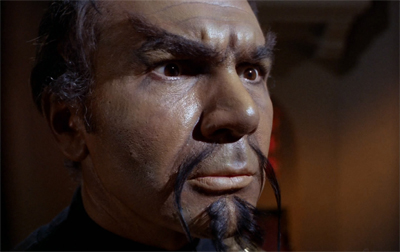
Ah, Klingons. It feels strange to think that we’re almost at the end of the show’s first year and that we’re only meeting the franchise’s most famous aliens now. More than that, in the original version of the show, their distinctive model space ships didn’t appear until the third season, in Elaan of Troyius, the same episode where their iconic imperial crest appeared. They wouldn’t get their bumpy foreheads for over a decade, until Star Trek: The Motion Picture. And a lot of what we’d take for granted about Klingon culture would only be established in the tie-in novel The Final Reflection and later in Star Trek: The Next Generation.

Still, Errand of Mercy welcomes the Klingons to the franchise, and offers a demonstration of why the aliens had such staying power. It’s also a rather wonderful Cold War analogy, feeling like something of a companion piece to Gene L. Coon’s A Taste of Armageddon.

I bet a lot of people were surprised that they could Klingon to their reputation as Star Trek's top alien for so long...

I bet a lot of people were surprised that they could Klingon to their reputation as Star Trek’s top alien for so long…

Continue reading

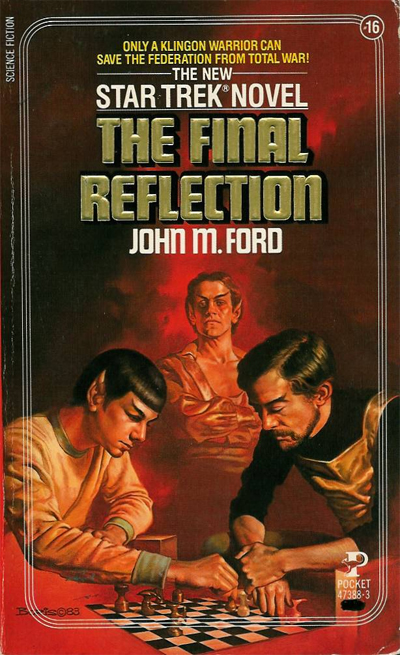
Star Trek – The Final Reflection by John M. Ford (Review)

To celebrate the release of Star Trek: Into Darkness this month, we’ll be running through the first season of the classic Star Trek all this month. Check back daily to get ready to boldly go. It’s only logical.

We’ll be supplementing our coverage of the episodes with some additional materials – mainly novels and comics and films. This is one such entry.

The Final Reflection was written in 1984. Development on Star Trek: The Next Generation would only be announced in 1986. Sure, there were a bunch of successful movies being produced, but these only amounted to a couple of hours of Star Trek once every few years. And, even then, the movies were aimed at a much broader audience, without the same development and continuity that a television show could offer. Not that Star Trek ever really had that tight a sense of continuity, of course, but it must have seemed unlikely that things could ever go back to the way they had been. Certainly, in 1984, nobody could have anticipated the eighteen-straight years of Star Trek running from Encounter at Farpoint to These Are the Voyages.

As a result, fans had to look to other avenues to expand and develop the rich Star Trek universe. The novels were one such avenue, although they developed slowly. Mission to Horatius had been published while the show was on the air, but it was very clearly aimed at a younger audience. Spock Must Die! would be published in 1970. However, the spin-off fiction developed relatively slowly. Star Trek had yet to become a massive franchise with tie-in multimedia commercial opportunities.

Perhaps because the Star Trek novels had not quite turned into a massive franchising opportunity, and they weren’t under the same level of publicity or scrutiny that they would be in the years to come, writer John M. Ford was able to do something quietly revolutionary with his first Star Trek novel, The Final Reflection. He was able to venture away from our core cast of iconic characters and instead develop the Klingon Empire.

More than that, though, he was able to paint the Klingons as the good guys.

tos-thefinalreflection5

Continue reading

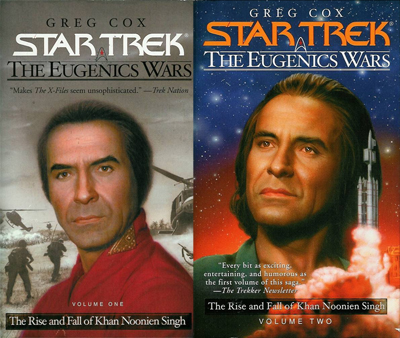
Star Trek: The Eugenics Wars – The Rise & Fall of Khan Noonien Singh, Volumes I & II, by Greg Cox (Review)

To celebrate the release of Star Trek: Into Darkness this month, we’ll be running through the first season of the classic Star Trek all this month. Check back daily to get ready to boldly go. It’s only logical.

We’ll be supplementing our coverage of the episodes with some additional materials – mainly novels and comics and films. This is one such entry.

In 1967, the 1990s must have seemed so very far away. At the height of the Cold War, the prospect that mankind would have made it into twenty-first century without one catastrophic global conflict must have seemed improbable at best. Indeed, the odds that anybody would still be talking about (let alone watching) a kitsch piece of sixties television science-fiction would have appeared remote. So Star Trek seemed perfectly justified sticking a reference to a major war towards the end of the twentieth century into an episode towards the end of the first season.

However, if there’s one thing that Star Trek fans cannot abide, it’s a possible continuity problem. So, when genetically engineered supermen didn’t almost conquer the world during the last decade of the twentieth century, it was only a matter of time before we got a two-volume set dedicated to resolving this particular problem.

tos-theeugenicswars

Continue reading

Star Trek – Burning Dreams by Margaret Wander Bonanno (Review)

To celebrate the release of Star Trek: Into Darkness this month, we’ll be running through the first season of the classic Star Trek all this month. Check back daily to get ready to boldly go. It’s only logical.

We’ll be supplementing our coverage of the episodes with some additional materials – mainly novels and comics and films. This is one such entry.

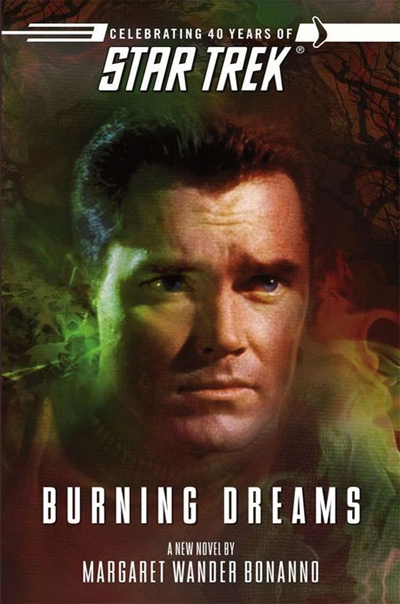
It’s amazing just how iconic and influential the character of Christopher Pike is, despite the fact that he only appeared as a guest character in a two-part episode of the first season of Star Trek. Of course, he was the lead character of a pilot that was filmed in 1964, but not aired until almost a quarter of a century later, but it still seems strange that the character should hold such sway over Star Trek fandom. Perhaps it’s a sign of how preoccupied fans are with trivia and minutiae. Maybe it’s a sign of how skilfully Star Trek cultivates holes in its own mythology (in this case Pike’s time as captain) for the fans to fill. It might even be the lingering sense of tragedy surrounding the “captain who never was”, played by an actor who died at the young age of 42.

Whatever the reason, it feels appropriate that Pike was one of the characters celebrated and included in the franchise’s 40th anniversary celebrations, and the character is well served by the decision to task Margaret Wander Bonanno with writing “the definitive Pike novel.”

tos-burningdreams

Continue reading

Star Trek – Errand of Vengeance: The Edge of the Sword by Kevin Ryan (Review)

To celebrate the release of Star Trek: Into Darkness this month, we’ll be running through the first season of the classic Star Trek all this month. Check back daily to get ready to boldly go. It’s only logical.

We’ll be supplementing our coverage of the episodes with some additional materials – mainly novels and comics and films. This is one such entry.

When you think about it, Star Trek finished its first season with its mythology reasonably well established. There were the Romulans, the Klingons and the Federation. (Oh, my!) We knew that Kirk had a brother on the colonies, who died in the season finalé. Vulcan was a hot desert planet. The Prime Directive existed, and we even got a taste of how Starfleet operated. However, these things all developed gradually over the course of the year, and early episodes couldn’t even seem to agree who exactly Kirk was working for.

The Federation was first mentioned in Arena and only fully named in A Taste of Armageddon. The Klingons were introduced in Errand of Mercy, with a cold war between the two galactic powers finally turning hot. Of course, it’s hard to write “finally” when they had only been introduced in this particular episode. So where were the Klingons during the show’s first year? How come we didn’t pick up any of the tension that must have been simmering?

Kevin Ryan’s Errand of Vengeance trilogy attempts to offer some context, suggesting that the Klingon threat had been brewing during the entire first season. It follows Jon Anderson, a new recruit to the ship’s security department, arriving just before the events of What Are Little Girls Made Of? Oh, and he’s a Klingon infiltrator.

tos-errandofvengeance1

Continue reading