• Following Us

  • Categories

  • Check out the Archives


  • Awards & Nominations

Star Trek: The Next Generation – The Icarus Factor (Review)

This January and February, we’ll be finishing up our look at the second season of Star Trek: The Next Generation and moving on to the third year of the show, both recently and lovingly remastered for high definition. Check back daily for the latest review.

The Icarus Factor is a character-driven story. At least, it wants to be a character-driven story. The problem is that Star Trek: The Next Generation hasn’t reached the point where it can really do character-driven storytelling with a measure of consistence. (The fact that Picard confronting his future failures in Time Squared worked was more down to Patrick Stewart than the episode’s script.)

The Icarus Factor is a story focusing on Riker as a character, and it suffers from the fact that Riker hasn’t really been well-defined to date. We’re repeatedly told that he’s ambitious and career-driven, but most his on-screen characterisation has fluctuated between reckless, jerkish and horny. So The Icarus Factor tries to compensate by giving Riker the most generic back story possible for a lead male character on a television show.

This is the story of Riker’s daddy issues.

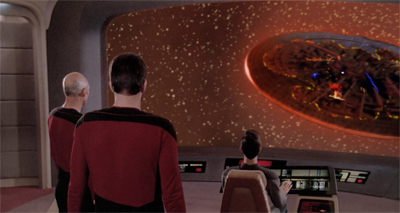
Somehow, this image just sums up Riker as a character...

Somehow, this image just sums up Riker as a character…

Continue reading

Star Trek: The Next Generation – Contagion (Review)

This January and February, we’ll be finishing up our look at the second season of Star Trek: The Next Generation and moving on to the third year of the show, both recently and lovingly remastered for high definition. Check back daily for the latest review.

Contagion is a nice reminder that the average quality of Star Trek: The Next Generation is improving. While the stand-out episodes of the second season of The Next Generation tend to attract a lot of attention, the more solid episodes tend to get a bit lost in the discussion. Contagion doesn’t rank alongside Elementary, Dear Data, A Matter of Honour, The Measure of a Man or Q Who?, but it’s still demonstrating that we’ve reached a point where the show can churn out a pretty good episode without it feeling like a special occasion.

It’s a bit of a shame, then, that Contagion comes from two individuals outside the show’s writers’ room.

The Yamato rests in pieces...

The Yamato rests in pieces…

Continue reading

Star Trek: The Next Generation – Masks by John Vornholt (Review)

This January and February, we’ll be finishing up our look at the second season of Star Trek: The Next Generation and moving on to the third year of the show, both recently and lovingly remastered for high definition. Check back daily for the latest review.

We’ll be supplementing our coverage of the episodes with some additional materials – mainly novels and comics and films. This is one such entry.

Generally, I’ve been looking at novels and tie-ins that are specifically or thematically related to specific episodes of Star Trek: The Next Generation. It’s a valid approach to writing about the show, searching out material that expands or develops themes and concepts and characters lightly touched upon during the episode in question. However, some times it is also worth taking time out to look at what was happening in tie-in fiction at approximately the same time.

Obviously, the scripts written by writers working on the show were the result of a careful creative process drawing input from the writers in general, the producers and the studio. They were crafted with a key eye to shaping the future direction of the show, by the people working on the show. Looking at official tie-in material from the same time allows us to venture a bit outside that circle, and to get a glimpse of what The Next Generation might have looked like to a creator outside the writers’ room as it was going to air.

Masks was published in July 1989, after Shades of Grey had aired and the second season had limped off the screen. While author John Vornholt obviously could not have seen the whole season on submitting his novel, it is interesting to get his view of the sci-fi spin-off in its sophomore season.

tng-masks

Continue reading

Star Trek: Myriad Universes – Echoes and Refractions: Brave New World by Chris Roberson (Review)

This January and February, we’ll be finishing up our look at the second season of Star Trek: The Next Generation and moving on to the third year of the show, both recently and lovingly remastered for high definition. Check back daily for the latest review.

We’ll be supplementing our coverage of the episodes with some additional materials – mainly novels and comics and films. This is one such entry.

Quite a few of the Myriad Universe stories feel like “for want of a nail” stories. Changing one little detail of Star Trek history and the entire universe comes apart at the seams. In the Echoes and Refractions collection alone, The Chimes at Midnight offers a nightmare glimpse of a universe where Spock died in childhood, while A Gutted World explores what might have happened if the Cardassians had never left Bajor. Neither alternate universe represented a sustainable alternative to the Star Trek we know and love. The subtitles might as well have been “… and then things got worse.”

With the final story in the collection, Chris Roberson takes another tack. Brave New World isn’t a story about how removing one vital thread of the Star Trek tapestry causes the whole thing to unravel. Instead, it’s something quite a bit bolder. It’s a genuine alternate universe, one boldly different – not inherently better or worse, but just an example how things might have unfolded if just one little thing had been different.

st-myriaduniverses

Continue reading

Star Trek: The Next Generation – A Matter of Honour (Review)

This January and February, we’ll be finishing up our look at the second season of Star Trek: The Next Generation and moving on to the third year of the show, both recently and lovingly remastered for high definition. Check back daily for the latest review.

The second season of Star Trek: The Next Generation might be a bit rough around the edges (among other places), but there’s still a sense that the show is trying to improve itself, struggling to find its own voice. Most of the first season seemed content to offer a pale imitation of the classic Star Trek show, ignoring the fact that a lot had changed in the two decades since Kirk and Spock took to the air.

A Matter of Honour is an example of The Next Generation engaging the late eighties instead of trying to evoke the lost spirit of the sixties. Taking the “Klingons as Communists” metaphor as far as it could logically go, and serving as a companion piece to Star Trek VI: The Undiscovered Country, A Matter of Honour is a tale of deep space détente.

Guess who's going to dinner where?

Guess who’s going to dinner where?

Continue reading

Star Trek: Deep Space Nine – The Jem’Hadar (Review)

Star Trek: Deep Space Nine is twenty years old this year. To celebrate, I’m taking a look at the first and second seasons. Check back daily for the latest review or retrospective.

In terms of sheer quality of execution, The Jem’Hadar is probably the weakest of Star Trek: Deep Space Nine‘s season finalés. It lacks the gut punch of A Call to Arms, the shock twist of Broken Link, the atmosphere of The Adversary or even the timeliness of In the Hands of the Prophets. It is, at its most basic level, a story about a disastrous first contact that occurs during a father-son bonding trip that goes horribly wrong, ending with precious little actually advanced.

However, in terms of conceptual ideas, The Jem’Hadar is a game-changer. It is the cornerstone upon which Deep Space Nine would construct its most iconic narrative arc. It caps off two years of trying to develop the Ferengi as more than one-note jokes. It’s a bold statement about the freedom that Deep Space Nine would enjoy with Star Trek: The Next Generation retiring from the airwaves. It cemented the notion that Deep Space Nine never really dealt in two-part episodes to bridge seasons.

For Deep Space Nine, season finalés did not exist simply as pieces of Lego designed to snugly fit those other pieces at the start of the following season, crafting some illusion of continuity flow between two different seasons of television. Instead, cliffhangers on Deep Space Nine changed the rules, shook up the status quo, and teased the changing face of things to come.

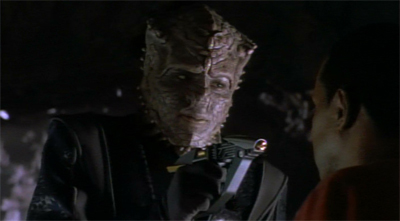
A Jem?

A Jem?

Continue reading

Star Trek: Mirror, Mirror #1 – Fragile Glass (Review)

Star Trek: Deep Space Nine is twenty years old this year. To celebrate, I’m taking a look at the first and second season. Check back daily for the latest review or retrospective.

We’ll be supplementing our coverage of the episodes with some additional materials – mainly novels and comics and films. This is one such entry.

One of the benefits and the curses of tie-in material is the ability to connect the dots – to tie together two parts of continuity separated by time and space, filling in the blanks in some character or plot arc. Often, this feels extraneous at best. In order for the televised stories to work, there must be enough information conveyed effectively to the audience so they can make their own leaps. Trying to plug imaginary and unnecessary holes is seldom satisfying.

On the other hand, there are occasionally gaps that are worth exploring. These are gaps that have been explained on the show, but which are still large enough that creators can fit their own interesting stories between them. The divide between Mirror, Mirror and Crossover is one such gap, as we go from the original Star Trek‘s version of the mirror universe to the very different iteration seen on Star Trek: Deep Space Nine.

Tom DeFalco’s Fragile Glass attempts to sketch in some of the details around this gap. While it’s not entirely satisfying as either a missing link or a story in its own right, it does offer some nice pulpy fun and gets considerable mileage out of the “Spock vs. Kirk” premise.

I am not Spock...

I am not Spock…

Continue reading

Star Trek: Deep Space Nine – Blood Oath (Review)

Star Trek: Deep Space Nine is twenty years old this year. To celebrate, I’m taking a look at the first season. Check back daily for the latest review or retrospective.

Blood Oath is a pretty fantastic piece of Star Trek: Deep Space Nine, and kicks the second season back into gear after a few mediocre (although not embarrassing) episodes. While it’s hardly the best episode of the year, and comes with its share of problems and baggage, it’s a tight and well-constructed piece of space opera. It’s a pulpy Klingon adventure, with the show’s best exploration to date of the existential problems of being Dax and a relatively simple (but potent) moral dilemma. It’s also just great fun.

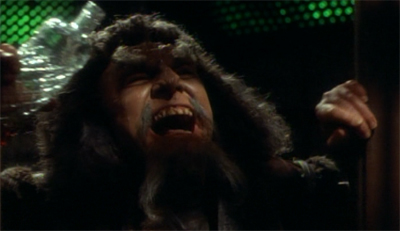
Here's Kor!

Here’s Kor!

Continue reading

Star Trek: Deep Space Nine – Rules of Acquisition (Review)

Star Trek: Deep Space Nine is twenty years old this year. To celebrate, I’m taking a look at the first season. Check back daily for the latest review or retrospective.

The Nagus was a surprising high-point of the first season of Star Trek: Deep Space Nine. It represented a conscious effort to rehabilitate and reappraise the Ferengi, the aliens introduced as potentially major adversaries in the first season of Star Trek: The Next Generation, only to wind up as mostly unfunny comic relief. The Nagus dared to suggest that the Ferengi might not be the monsters the Federation considers them to be, suggesting that their culture – while different – was no less worthy of respect or consideration than that of the Klingons.

Rules of Acquisition is a clear follow-up, right down to the way that it includes Grand Nagus Zek. However, it’s nowhere near as charming and successful as The Nagus, because it feels like it’s just treading water. It teases potential developments down the line, but the story seems locked in a familiar holding pattern – right down to the rather convenient ending that inevitably sees Quark snatching defeat from the jaws of victory.

It’s not quite a bad episode, certainly not on the scale of the colossal misfire that was Melora, but it’s also not a particularly good one.

Nothing to see here...

Nothing to see here…

Continue reading

Star Trek: Deep Space Nine – Invasive Procedures (Review)

Star Trek: Deep Space Nine is twenty years old this year. To celebrate, I’m taking a look at the first and second seasons. Check back daily for the latest review or retrospective.

Invasive Procedures is an interesting episode. It has a great high concept, some nice character beats, and offers an inside glimpse at an astonishingly interesting alien culture. Verad is a compelling guest character and Sisko gets to be pretty badass, continuing the presentation of the character as some weird composite of James T. Kirk and Jean-Luc Picard.

There are however, a number of very sizeable flaws. The most obvious being that – despite this is nominally a “Dax” story – Dax winds up feeling more like a plot point than a character in her own right.

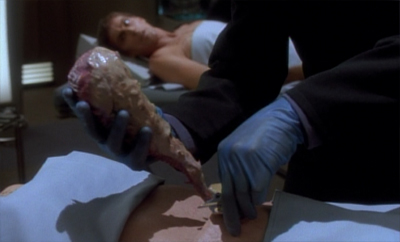
Slugging it out...

Slugging it out…

Continue reading