• Following Us

  • Categories

  • Check out the Archives


  • Awards & Nominations

Star Trek – Crucible: Spock – The Fire and the Rose by David R. George III (Review)

This August, to celebrate the upcoming release of Star Trek: Into Darkness on DVD and blu ray, we’re taking a look at the Star Trek movies featuring the original cast. Movie reviews are every Tuesday and Thursday.

We’ll be supplementing our coverage of the movies with tie-ins around (and related to) the films. We’ll be doing one of these every week day. This is one such article.

The second part of David R. George II’s epic Crucible trilogy, The Fire and the Rose, can’t quite measure up to the charm and warmth of the first instalment in the series, Provenance of Shadows. George’s Crucible trilogy is a breathtakingly ambitious piece of work. Celebrating the fortieth anniversary of Star Trek with a trilogy of novels, each grounded in The City on the Edge of Forever and each based around a different member of the show’s leading trinity. The Fire and the Rose is still a very smart and well-constructed read, but it stands in the shadow of the first of George’s three books.

I suspect that at least part of the reason The Fire and the Rose doesn’t work as well is down to the subject. Leonard McCoy is a vitally important Star Trek character, but he was also a relatively under-developed one. While he was one of the leading trio on the original show, he was never as popular as Kirk and Spock, and never garnered the same amount of attention. (Notwithstanding solid work done by writers like Diane a Duane.) So McCoy was a relatively blank canvas for George to develop.

In contrast, Spock is the face of Star Trek. He was part of the first episode of Star Trek ever produced. He appeared in the most recent film released. Although DeForest Kelley christened Star Trek: The Next Generation with a cameo in Encounter at Farpoint, Leonard Nimoy’s visit to the spin-off earned a full two-parter in Unification. As such, Spock is a character who has been developed and explored and expanded by countless writers over the franchise’s long history.

Quite frankly, it’s hard to imagine there’s too much left to say about him. George tries quite hard, and find a nuance or two, but The Fire and the Rose feels more like an attempt to consolidate what we already know of Spock.
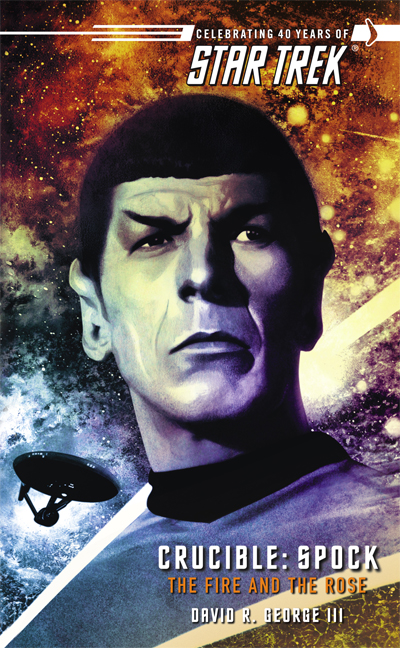
cruciblespock

Continue reading

Star Trek – Ex Machina by Christopher L. Bennett (Review)

This August, to celebrate the upcoming release of Star Trek: Into Darkness on DVD and blu ray, we’re taking a look at the Star Trek movies featuring the original cast. Movie reviews are every Tuesday and Thursday.

We’ll be supplementing our coverage of the movies with tie-ins around (and related to) the films. We’ll be doing one of these every week day. This is one such article.

Ex Machina is really an astoundingly clever piece of work. On the surface, a lot of reads like a fan’s wishlist, a collection of “snags” made while watching the classic Star Trek films and making a conscious effort to fix them up a bit. There’s a lot of effort into explaining the changes between Star Trek: The Motion Picture and Star Trek II: The Wrath of Khan, with character-centric subplots focusing on Kirk’s ego or Chekov’s growing disenfranchisement.

Indeed, Bennett even provides an entirely unnecessary but quite-enjoyable-nonetheless set of annotations for Ex Machina, explaining where and how he’s tying his story into a rake of continuity. He describes Ex Machina as probing “an unexplored gap” in the franchise’s chronology. Ex Machina exists as both a sequel to a rather bland third-season episode of the show (For the World is Hollow and I Have Touched the Sky) and The Motion Picture. Neither is especially loved among fans.

However, what’s fascinating about Ex Machina is the way that none of this prevents Bennett from crafting a compelling and intriguing narrative. It’s clear that he’s enjoying attempts to fill in various gaps, but Ex Machina works incredibly well as a piece of Star Trek which stands on its own two feet.

st-exmachina

Continue reading

Non-Review Review: Star Trek – The Motion Picture

This August, to celebrate the upcoming release of Star Trek: Into Darkness on DVD and blu ray, we’re taking a look at the Star Trek movies featuring the original cast. Movie reviews are every Tuesday and Thursday.

Star Trek: The Motion Picture has a lot to recommend it. It’s big, thoughtful science-fiction, ripe with ideas and high-concepts tying directly into the root of the franchise. It gives both Kirk and Spock clear character arcs. It looks and sounds amazing, demonstrating just how far special effects had evolved in the decade since the show went off the air. However, it suffers from a pace that might best be described as “glacial”, and a sense that – for all the grand ideas – we aren’t really boldly going anywhere that new. Elements of the film can’t help but recall both the 1968 science-fiction classic 2001: A Space Odyssey and even the show’s own episode The Changeling.

While it’s easy to admire The Motion Picture, it’s a lot harder to enjoy it.

Strange new worlds...

Strange new worlds…

Continue reading

Star Trek – Leonard McCoy, Frontier Doctor by John Byrne (Review)

The August, to celebrate the upcoming release of Star Trek: Into Darkness on DVD and blu ray, we’re taking a look at the Star Trek movies featuring the original cast. Movie reviews are every Tuesday and Thursday.

We’ll be supplementing our coverage of the movies with tie-ins around (and related to) the films. We’ll be doing one of these every week day. This is one such article.

It’s fascinating how few stories take place around Star Trek: The Motion Picture. There’s a rake of tie-in material that exists to flesh-out the Enterprise’s five-year mission, and a large volume of material set during the period from Star Trek II: The Wrath of Khan straight through to Star Trek VI: The Undiscovered Country. However, the space around The Motion Picture has been somewhat overlooked by writers delving into the expanded world of Star Trek tie-in fiction.

To be fair, there are reasons for this. Although it was a box office success, looked stunning for the time, had a rake of big ideas and welcomed the crew to the screen, The Motion Picture isn’t generally considered to be one of the high points of the franchise. As such, it seems reasonable that it garners less attention, the affection shown by a few writers aside. There’s also the fact that The Motion Picture opens with the crew of the Enterprise broken up, scattered amongst the cosmos.

The Motion Picture sees Kirk putting the band back together after the universe seems to have forgotten about them, pulling them out of mothballs. Any story set in the lead-up to The Motion Picture would have to feature the ensemble all separated and going about their own thing. This limits the kind of stories that can be told in the setting, and makes it less appealing than other settings in Star Trek continuity.

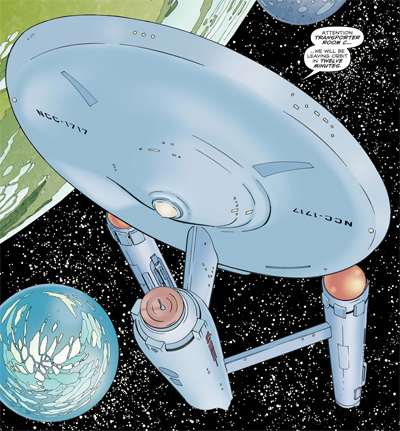
John Byrne’s Leonard McCoy, Frontier Doctor gives us a glimpse of what a project set between the end of the Enterprise’s mission and the start of The Motion Picture might look like. It’s essentially a solo adventure series focusing on one member of the cast, and it’s absolutely fascinating.

These are the voyages of the Starship... Yorktown...

These are the voyages of the Starship… Yorktown…

Continue reading

Star Trek (Gold Key) #56 – No Time Like the Past (Review)

To celebrate the release of Star Trek: Into Darkness this month, we’ll be running through the first season of the classic Star Trek all this month. Check back daily to get ready to boldly go. It’s only logical.

We’ll be supplementing our coverage of the episodes with some additional materials – mainly novels and comics and films. This is one such entry.

It’s remarkable to think that Star Trek was kept alive in the decade between the airing of The Turnabout Intruder and Star Trek: The Motion Picture. The most popular television show to air in the 1968 and 1969 season was Rowan and Martin’s Laugh-In, a show that was apparently lucky to receive two “best of” DVD collections in the early part of the last decade, collecting a grand total of eight of the 140 episodes. Given that Star Trek didn’t even rank among the twenty highest rated shows of that broadcast season, it’s incredible that the show endured for so long.

To be fair, there is a lot of material which fills the gap between the last episode of the live action television show and the first feature film. There was Star Trek: The Animated Series, perhaps the most high-profile release. There were a few novels, even if the tie-in line wouldn’t necessarily take off until the eighties. And there were the comic books, produced by Gold Key, notable as perhaps the largest publisher of non-superhero comics in the seventies.

These comics weren’t classics. It’s hard to argue that they are essential additions to the mythos, or that anybody would miss anything be ignoring them entirely. However, there’s a weird pulpy sci-fi charm to these stories that makes them interesting, even when you would wonder whether the artist or writer had actually watched any episodes of the show they were apparently adapting.

Trippy!

Trippy!

Continue reading

Star Trek – Operation — Annihilate!

To celebrate the release of Star Trek: Into Darkness this month, we’ll be running through the first season of the classic Star Trek all this month. Check back daily to get ready to boldly go. It’s only logical.

How do you follow The City on the Edge of Forever? The previous episode is one of the best-loved episodes of Star Trek ever produced, one of the great science-fiction television episodes of the sixties, and one of the best science-fiction romances ever written. It’s a gigantic and massively influential piece of television, one of the cornerstones of Star Trek and perhaps the best indicator of just how thoughtful and how genuine the franchise can be when it tries. So, what’s next? Where do we go from here? What is the next shot after that last scene of Kirk abandoning the Guardian of Forever on a desolate rock?

It’s always interesting to compare the first season of Star Trek to the first year of Star Trek: The Next Generation. The former can be counted among the very best of the show’s thirty televised seasons, while the latter can be counted among the worst. However, they do have something in common. They both probably should have ended an episode early, with The City on the Edge of Forever and Conspiracy serving as effective caps on each show’s first season, leaving the audience a chance to digest what they had seen.

Unfortunately, neither show ended on anything that could be measured among the strongest show of a given year. The Neutral Zone ended the first season of The Next Generation with a moralising whimper. While Operation — Annihilate! is quite entertaining on its own terms, it doesn’t rank among the best of the season. Still, it’s a solid pulpy science-fiction tale, which might not be the worst thing.

Man of action!

Man of action!

Continue reading

Star Trek – Crucible: McCoy – Provenance of Shadows by David R. George III (Review)

To celebrate the release of Star Trek: Into Darkness this month, we’ll be running through the first season of the classic Star Trek all this month. Check back daily to get ready to boldly go. It’s only logical.

We’ll be supplementing our coverage of the episodes with some additional materials – mainly novels and comics and films. This is one such entry.

The classic Star Trek was not really a character-driven show. Of course, everybody recognises Kirk, Spock and McCoy, but the show seldom took the time to really dig into their history or origins. We’d occasionally find out that Kirk had some overlap with the villain of the week. He had served on a starship that had been the victim of a vampire space cloud, or lived on a colony during a brutal massacre. These details added up to something, along with the occasional reference to (and eventual death of) his brother Sam.

Spock got a bit more development, probably due to the fact that he was an alien. After all, developing Spock meant developing an entire exotic alien species, and offered some insight into how Vulcans must live. We’d also get occasional factoids or tidbits (Vulcans can mind meld, they have inner eyes, they had a schism millennia ago) that help to give a concrete picture of the where the character came from and where he might like to go.

McCoy, on the other hand, was a bit of a blank slate. Everybody knows McCoy. He’s the irritable surgeon on the ship, prone to insulting Spock and complaining about the fact that he’s flying through space in a ship filled with mechanical doo-hickeys. However, we never really get a sense of McCoy’s past. We never learn much about his family on-screen, except when the writers wanted a bit of dramatic fodder in the penultimate movie featuring the original cast, Star Trek V: The Final Frontier. But we don’t talk about that.

So David R. George III’s Crucible: McCoy – Provenance of Shadows is an interesting book. Not only because it is a book completely devoted to the least-developed of the iconic leading trio, but also because this relatively under-developed character also gets one of the longest Star Trek tie-in books ever written. And without too much focus on his past.

tos-cruciblemccoy

Continue reading

Star Trek – The City on the Edge of Forever (Review)

To celebrate the release of Star Trek: Into Darkness this month, we’ll be running through the first season of the classic Star Trek all this month. Check back daily to get ready to boldly go. It’s only logical.

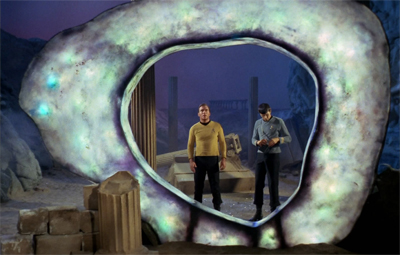
The City on the Edge of Forever stands as both on of the most troubled episodes of Star Trek ever produced, and one of the most brilliant. It’s a powerful science-fiction romance, cleverly constructed and smoothly executed. Everything in the episode seems to working smoothly, which seems all the more improbable given the difficulties occurring behind the scenes. Harlan Ellison’s teleplay differs significantly from the finished product, but it’s very hard to argue that the televised episode isn’t among the finest Star Trek stories ever produced.

The hole in things...

The hole in things…

Continue reading

Star Trek – The City on the Edge of Forever by Harlan Ellison/Cordwainer Bird (Review)

To celebrate the release of Star Trek: Into Darkness this month, we’ll be running through the first season of the classic Star Trek all this month. Check back daily to get ready to boldly go. It’s only logical.

We’ll be supplementing our coverage of the episodes with some additional materials – mainly novels and comics and films. This is one such entry.

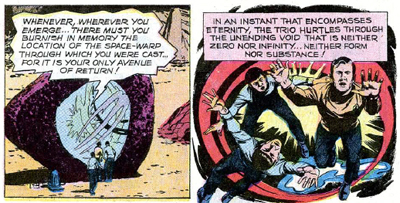
The City on the Edge of Forever had a troubled history, not that you’d know it based on what appeared on screen. Like quite a few classic Star Trek episodes (The Enemy Within, The Doomsday Machine, Amok Time), it was developed from a script written by a giant of science-fiction. Harlan Ellison is a respected author with a considerable reputation. However, the version of The City on the Edge of Forever which eventually made it to screen at the end of the show’s first season is radically different from the version Ellison original wrote. “It’s not the vision I had,” Ellison quotes at the start of the paperback edition of his original screenplay, released in 1996.

The book is a fantastic read, and well worth a look for anybody with any interest in Star Trek or Ellison, or even good science-fiction or the craft of television writing. Reading the various drafts, there’s no denying that it is a phenomenal script, as good as the script that eventually went into production. At the same time, it’s also quite clear that it would not have made for as classic a Star Trek episode.

Into the vortex...

Into the vortex…

Continue reading

Star Trek – Errand of Mercy (Review)

To celebrate the release of Star Trek: Into Darkness this month, we’ll be running through the first season of the classic Star Trek all this month. Check back daily to get ready to boldly go. It’s only logical.

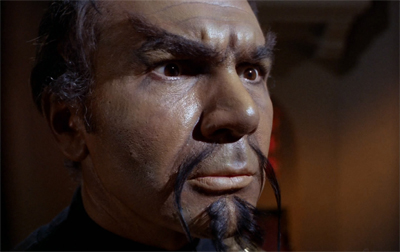
Ah, Klingons. It feels strange to think that we’re almost at the end of the show’s first year and that we’re only meeting the franchise’s most famous aliens now. More than that, in the original version of the show, their distinctive model space ships didn’t appear until the third season, in Elaan of Troyius, the same episode where their iconic imperial crest appeared. They wouldn’t get their bumpy foreheads for over a decade, until Star Trek: The Motion Picture. And a lot of what we’d take for granted about Klingon culture would only be established in the tie-in novel The Final Reflection and later in Star Trek: The Next Generation.

Still, Errand of Mercy welcomes the Klingons to the franchise, and offers a demonstration of why the aliens had such staying power. It’s also a rather wonderful Cold War analogy, feeling like something of a companion piece to Gene L. Coon’s A Taste of Armageddon.

I bet a lot of people were surprised that they could Klingon to their reputation as Star Trek's top alien for so long...

I bet a lot of people were surprised that they could Klingon to their reputation as Star Trek’s top alien for so long…

Continue reading