• Following Us

  • Categories

  • Check out the Archives


  • Awards & Nominations

Star Trek: Deep Space Nine – Necessary Evil (Review)

Star Trek: Deep Space Nine is twenty years old this year. To celebrate, I’m taking a look at the first season. Check back daily for the latest review or retrospective.

Commence Station Security log. Stardate 47282.5. At the request of Commander Sisko, I will hereafter be recording a daily log of law enforcement affairs. The reason for this exercise is beyond my comprehension, except perhaps that humans have a compulsion to keep records and lists and files. So many, in fact, that they have to invent new ways to store them microscopically, otherwise their records would overrun all known civilisation. My own very adequate memory not being good enough for Starfleet, I am pleased to put my voice to this official record of this day. Everything’s under control. End log.

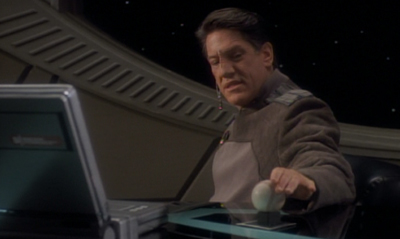
Necessary Evil continues to deliver on the promise of “things you can’t do anywhere but Star Trek: Deep Space Nine that Michael Piller made at the start of the show’s second season. It’s a genuinely ambitious piece of Star Trek, all the stronger for the fact that it’s idea that could go horribly and spectacularly wrong. Movies like Blade Runner demonstrated that it is possible to blend the aesthetics of science-fiction and film noir, but it seems like a mix that would sit rather uncomfortably in the bright utopian future of Star Trek.

However, Deep Space Nine was never afraid to experiment with its format. This wasn’t always successful, but it did give the show a unique flavour. And when it did work, as it does here, it offered something new and exciting to the franchise’s playbook.

Time for a Changeling...

Time for a Changeling…

Continue reading

Star Trek: Deep Space Nine – The Siege (Review)

Star Trek: Deep Space Nine is twenty years old this year. To celebrate, I’m taking a look at the first and second seasons. Check back daily for the latest review or retrospective.

The Siege wraps up the first ever three-part episode of Star Trek in a surprisingly efficient manner. There are a few missteps, a lack of nuance and an over abundance of convenience and simplicity. However, it succeeds in doing what this opening three-parter set out to do. It tells a single story which could only ever have been told on Star Trek: Deep Space Nine. It gives a sense of scale to the show which is unique to the series, and it creates a palpable sense of uncertainty about the Federation’s mission to Bajor.

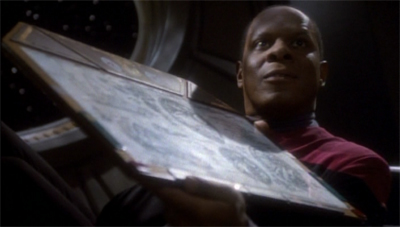
"He's letting me know, he'll be back..."

“He’s letting me know, he’ll be back…”

Continue reading

Star Trek: Deep Space Nine – The Circle (Review)

Star Trek: Deep Space Nine is twenty years old this year. To celebrate, I’m taking a look at the first and second seasons. Check back daily for the latest review or retrospective.

Drama naturally lends itself to a neat three-act structure. At the most basic level, it’s as simple as beginning, middle and end. However, it’s also a format taught in just about every screenwriting course, and it’s even used as the conventional model for those with more innovative approaches. With that in mind, it’s interest that Star Trek has done relatively few three-part stories. The Circle sits in the middle of the first such attempt, in the second season of the second spin-off. The format would not see use again for over a decade, when it would become a feature of the final season of Star Trek to air on television.

Given the franchise is relatively fond of two-parters, it seems strange that there haven’t been more attempts to extend that out an episode. Perhaps the reason is obvious. Of the three acts, the beginning and the end are the most essential. Both come with a certain in-built amount of energy. The first part introduces the problem, while the conclusion deals with it. However, it’s the middle which proves problematic. It’s the point in the story after you’ve set up the conflict, but before you resolve it. Given how much difficulty Star Trek: The Next Generation had with conclusions, imagine how difficult the second part of a three-parter would be.

Even when Star Trek: Enterprise adopted the three-parter format it ran into basic structural difficulties, with a couple feeling like a two-part episode with an additional prologue or epilogue added on. The Circle isn’t a terribly flawed piece of television, but it suffers from the fact that Star Trek has never really tried storytelling in this mode before.

The writing's on the wall...

The writing’s on the wall…

Continue reading

Star Trek: Deep Space Nine – The Homecoming (Review)

Star Trek: Deep Space Nine is twenty years old this year. To celebrate, I’m taking a look at the first and second seasons. Check back daily for the latest review or retrospective.

The Homecoming is notable for a number of reasons. It kicks off the franchise’s first three parter. Sure, Family provided a nice epilogue to The Best of the Both Worlds, but The Homecoming, The Circle and The Siege represents the first explicit three-part story in the history of the franchise. Star Trek: Enterprise would develop a fondness for the format in its final season and one of those three-parters (The Forge, The Awakening and Kir’Shara) would owe a conscious debt to this opening trilogy.

It also pretty much sets the tone of season premieres on Star Trek: Deep Space Nine. Star Trek: The Next Generation and Star Trek: Voyager would both display a fondness for bridging their seasons with two-part adventures. The opening episode would air as a season finalé, with the resolution airing as the opening episode of the following season. Deep Space Nine was not so literal minded. While each season premiere was informed by the themes and events of the last season’s closing episode, Deep Space Nine tended to favour opening with multi-part episodes rather than conclusions to narrative hooks.

Rather than wrapping up the threads hinted at in In the Hands of the Prophets, The Homecoming only builds on them. It suggests that the problems and the difficulties facing Bajor won’t magically disappear because ninety minutes of screen time have elapsed.

Dynamic Kira action pose!

Dynamic Kira action pose!

Continue reading

Star Trek: Deep Space Nine – In the Hands of the Prophets (Review)

Star Trek: Deep Space Nine is twenty years old this year. To celebrate, I’m taking a look at the first season. Check back daily for the latest review or retrospective.

Both Star Trek and Star Trek: The Next Generation allowed their first seasons to run an episode too long. The City on the Edge of Forever, the penultimate episode of the first ever season of Star Trek, is a genuine classic. I don’t envy any story that has to follow it, especially not something as mediocre as Operation — Annihilate! While Conspiracy, the second-to-last episode of the first season of The Next Generation, is hardly a classic in the same league, it does up the stakes on the show’s first year, and tie up a dangling plot thread. The Neutral Zone, on the other hand, is a bland return to form, with a particularly insufferable b-plot.

So the excellence of Duet might offer the viewer cause to worry. A penultimate first-season episode which is significantly above average? One would be forgiven for wondering if the first season might have been best served to wrap itself up at that point, going out in a high, safe in the knowledge that it had contributed one classic episode to the Star Trek mythos and with the potential to offer quite a few more. Quit while you’re winning, and don’t tempt fate with another superfluous episode.

In the Hands of the Prophets, however, puts those fears to rest. Serving as a companion piece to Duet, it’s another one of those “only on Deep Space Nine stories, closing out the first season with a reminder of what makes the show unique. In the Hands of the Prophets is another classic piece of Deep Space Nine. It might not pack quite the punch that Duet did, but it’s a compelling piece of drama which demonstrates just how much Deep Space Nine has to offer the Star Trek mythos.

Beyond belief...

Beyond belief…

Continue reading

Star Trek: Deep Space Nine – Duet (Review)

Star Trek: Deep Space Nine is twenty years old this year. To celebrate, I’m taking a look at the first season. Check back daily for the latest review or retrospective.

And here we hit the first truly classic episode of Star Trek: Deep Space Nine. Positioned almost at the very end of what has been a fairly uneven season of television, Duet firmly demonstrates that this spin-off can hold its head tall among the other franchise installments. Duet isn’t just a quintessential Deep Space Nine episode. It isn’t just a classic Star Trek episode. It is an absolutely beautiful piece of allegory, a stunning character study and a probing exploration of collective guilt and responsibility.

J'accuse...

J’accuse…

Continue reading

Star Trek: Deep Space Nine – Dramatis Personae (Review)

Star Trek: Deep Space Nine is twenty years old this year. To celebrate, I’m taking a look at the first season. Check back daily for the latest review or retrospective.

Dramatis Personae tends to get lost in the shuffle at the end of Star Trek: Deep Space Nine‘s first season. Sitting between two of the season’s most generic Star Trek stories (If Wishes Were Horses… and The Forsaken) and two distinctly Deep Space Nine classics (Duet and In the Hands of the Prophets), it’s easy to see why Joe Menosky’s tale of repeated history tends to get overlooked. It manages to sit quite neatly in both camps, as a generic Star Trek tale and as something more specific to Deep Space Nine.

After all, possession stories are scattered throughout the Star Trek mythos. Star Trek: The Next Generation was quite fond of have various members of the crew impersonated or doubled or controlled by a variety of alien influences. Dramatis Personae also feels like a very Joe Menosky script, linked by various thematic connections to the writer’s work on both The Next Generation and later on Star Trek: Voyager.

And yet, despite all those links, Dramatis Personae feels quite anchored to Deep Space Nine. It’s hard to imagine the dynamic working with any other Star Trek cast, even Voyager‘s Maquis and Starfleet ensemble. There’s also the sense that the episode’s pattern of repeated history feels more in keeping with Deep Space Nine‘s perception of history than any other Star Trek show’s.

The man with the plan...

The man with the plan…

Continue reading

Star Trek: Deep Space Nine – Progress (Review)

Star Trek: Deep Space Nine is twenty years old this year. To celebrate, I’m taking a look at the first season. Check back daily for the latest review or retrospective.

Progress is the best episode of Star Trek: Deep Space Nine‘s first season to date. Of course, there are better episodes ahead – two of them clustered at the end of the show’s truncated first year – but Progress still represents a considerable improvement over anything that has come before. It isn’t quite perfect, but it does have a nice character focus and takes advantage of the show’s unique perspective and position. It’s evidence that the writing staff were at least engaging with the show’s status quo and trying to work with it to tell interesting stories, with Progress offering an early pure example of what Deep Space Nine story should probably look like.

While the first season has been quite bumpy (although notably less bumpy than any of the opening seasons of the other three Star Trek spin-offs), Progress offers a demonstration that we are getting somewhere. The title might apply as much to the status of the show itself as to the themes of the episode.

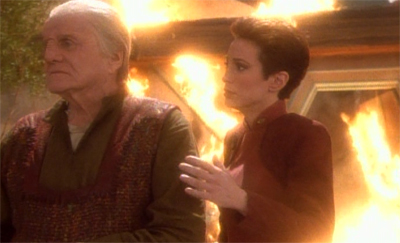
Burning down the house...

Burning down the house…

Continue reading

Star Trek: Terok Nor – Night of the Wolves by S.D. Perry & Britta Dennison (Review)

Star Trek: Deep Space Nine is twenty years old this year. To celebrate, I’m taking a look at the first season. Check back daily for the latest review or retrospective.

We’ll be supplementing our coverage of the episodes with some additional materials – mainly novels and comics and films. This is one such entry.

Prequels are a tricky business. Not just because we already know the ending – after all, we love adapting old familiar stories in new ways, and knowing the outcome can easily lend a project an air of grand tragedy or irony. However, the temptation with prequels is to make it all make sense, to tie absolutely everything up in a neat little bow, resolving all the plot threads and removing any hint of ambiguity or mystery from the original work – less of a story in its own right and more of a “fill in the blanks” approach.

James Swallow’s Day of the Vipers occasionally fell into this trap as it offered an account of the Cardassian plot to take control of Bajor, but it managed to offer its own insights and character development – giving us a suitably complex and self-justifying version of Gul Dukat. Night of the Wolves is somewhat less successful at avoiding the same problems, with a plot that appears to have been fashioned by linking off-hand references and back story from various early episodes together.

We get Odo and Kira meeting for the first time; an account of the liberation of Gallitep; a back story for a young Damar; the roots of Natima Lang’s dissatisfaction with the Central Command. None of these threads seem to build to anything insightful or clever, instead playing out predictably – pretty much exactly as we might have imagined them.

Continue reading

Star Trek: Deep Space Nine – Battle Lines (Review)

Star Trek: Deep Space Nine is twenty years old this year. To celebrate, I’m taking a look at the first season. Check back daily for the latest review or retrospective.

Battle Lines is, quite frankly, not a very good piece of television. Like a few of the episodes scattered throughout the first season of Star Trek: Deep Space Nine, it feels like it was pulled from a list of rejected scripts for Star Trek: The Next Generation. Ironically, it feels more like a reheated left-over than the next episode, The Storyteller, which was actually a recycled script from the first season of The Next Generation. Were it not for the involvement of Kai Opaka and a few hints about Bajoran spirituality, Battle Lines would feel almost as generic as The Passenger.

The concept is fascinating, and it represents another long-term shift in Deep Space Nine, but the script from Hilary J. Bader feels too functional and broad to do the episode justice. Instead, it feels fairly bland, which is a bit disappointing for an episode where Sisko accidentally gets the pope caught up in the universe’s most deadly game of laser tag.

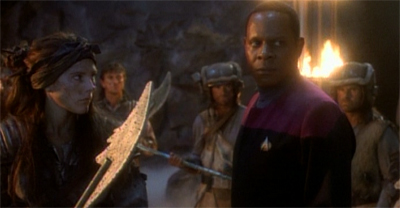
Taking a stab at bringing peace...

Taking a stab at bringing peace…

Continue reading