• Following Us

  • Categories

  • Check out the Archives


  • Awards & Nominations

Star Trek: Deep Space Nine – Terok Nor #0 (Review)

Star Trek: Deep Space Nine is twenty years old this year. To celebrate, I’m taking a look at the first season. Check back daily for the latest review or retrospective.

We’ll be supplementing our coverage of the episodes with some additional materials – mainly novels and comics and films. This is one such entry.

Terok Nor might be the best of Malibu Comics’ Star Trek: Deep Space Nine range, a one-shot written by Mark A. Altman and illustrated by Trevor Goring. It isn’t so much the plot that makes Terok Nor so distinctive – there is a lot of running around, some betrayals, some action sequences – but rather the execution of Altman’s story and the atmosphere provided by Goring’s pencils. The origin story of the space station Terok Nor, Altman very shrewdly frames the story as something of an oral history. It’s almost mythic and grand and epic, drawn in broad strokes rather than finer detail.

It serves quite well as the story of the construction of the central hub of the Star Trek show most concerned with legacy and history.
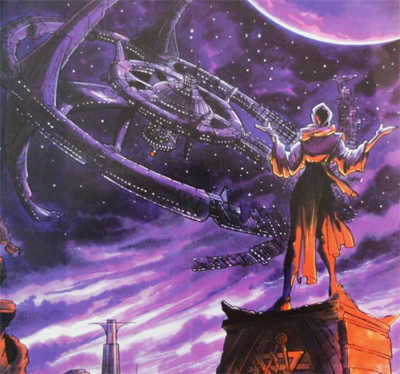
A monument to the Bajoran people...

A monument to the Bajoran people…

Continue reading

Star Trek: Deep Space Nine – Rules of Acquisition (Review)

Star Trek: Deep Space Nine is twenty years old this year. To celebrate, I’m taking a look at the first season. Check back daily for the latest review or retrospective.

The Nagus was a surprising high-point of the first season of Star Trek: Deep Space Nine. It represented a conscious effort to rehabilitate and reappraise the Ferengi, the aliens introduced as potentially major adversaries in the first season of Star Trek: The Next Generation, only to wind up as mostly unfunny comic relief. The Nagus dared to suggest that the Ferengi might not be the monsters the Federation considers them to be, suggesting that their culture – while different – was no less worthy of respect or consideration than that of the Klingons.

Rules of Acquisition is a clear follow-up, right down to the way that it includes Grand Nagus Zek. However, it’s nowhere near as charming and successful as The Nagus, because it feels like it’s just treading water. It teases potential developments down the line, but the story seems locked in a familiar holding pattern – right down to the rather convenient ending that inevitably sees Quark snatching defeat from the jaws of victory.

It’s not quite a bad episode, certainly not on the scale of the colossal misfire that was Melora, but it’s also not a particularly good one.

Nothing to see here...

Nothing to see here…

Continue reading

Star Trek: Deep Space Nine – Melora (Review)

Star Trek: Deep Space Nine is twenty years old this year. To celebrate, I’m taking a look at the first season. Check back daily for the latest review or retrospective.

It’s hard to believe, based on what we’ve witnessed so far, but one day viewers will be able to think “oh, a Bashir episode!” without an involuntary shudder. There will come a time when the writing staff figure out how to write a Bashir-centric episode. In fact, they’ll even revisit this central premise in the show’s final season, in a way that is much less creepy because at least it acknowledges the creepiness. However, we’re a long way from that.

It’s not that Bashir is a bad character. In fact, I’m very fond of him. I think that this version of the character works very well as part of an ensemble, or even teamed up with another major character to carry a story. However, I don’t think that the show has quite figured out how to tell a Bashir-centric story yet. Most notably because – like The Passenger before it – Melora isn’t really about Bashir. At least not in a way that isn’t creepy and disturbing and unnerving.

Instead, Bashir is mostly a vehicle for the guest character of the week, who lends the episode her name and serves as the focal point of some incredibly condescending and patronising writing which doesn’t make the optimistic future of Star Trek look particularly bright.

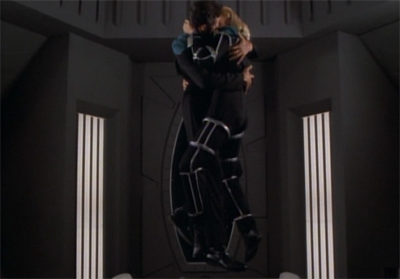
Floating in a most peculiar way...

Floating in a most peculiar way…

Continue reading

Star Trek: Deep Space Nine – Cardassians (Review)

Star Trek: Deep Space Nine is twenty years old this year. To celebrate, I’m taking a look at the first and second seasons. Check back daily for the latest review or retrospective.

Cardassians suffers a bit from the same problems that haunt Invasive Procedures. Here’s another solidly constructed piece of world-building featuring a wonderful guest cast and an intriguing high concept. However, in the midst of all this, it seems like the human (er, Cardassian) element gets a bit lost. It’s great to have Garak and Dukat back on the show, and it’s great to deal with more fallout from the Occupation, but Cardassians never makes the emotional connection that a story about war orphans probably should.

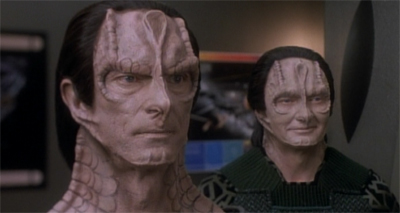
Keeping up with the Cardassians...

Keeping up with the Cardassians…

Continue reading

Star Trek – Worlds of Deep Space Nine: Unjoined (Trill) by Michael A. Martin and Andy Mangels (Review)

Star Trek: Deep Space Nine is twenty years old this year. To celebrate, I’m taking a look at the first and second seasons. Check back daily for the latest review or retrospective.

We’ll be supplementing our coverage of the episodes with some additional materials – mainly novels and comics and films. This is one such entry.

Worlds of Deep Space Nine was an ambitious project, but one that existed as a testament to the world-building that defined Star Trek: Deep Space Nine. A series of six novellas published in three books, each covering one of five planets associated with the television show (plus Andor), the book series was intended to launch the unofficial “ninth season” of the show. Beginning unofficially with The Lives of Dax and A Stitch in Time, the idea was for the spin-off novels to continue to develop and expand the series’ loose threads.

It’s quite something that Deep Space Nine left enough fertile ground to support a relaunch that ran so long, covering story beats that couldn’t necessarily be included in the television show – Bajor’s admittance to the Federation, the rebuilding of Cardassia, the aftermath of the war. Unjoined builds off the Trill storylines running through Deep Space Nine, using the events from the “eighth season” (the books through Unity) as a stepping stone to explore Trill culture.

ds9-unjoined

Continue reading

Star Trek: Deep Space Nine – The Lives of Dax: Reflections (Jadzia) by L.A. Graf

Star Trek: Deep Space Nine is twenty years old this year. To celebrate, I’m taking a look at the first and second seasons. Check back daily for the latest review or retrospective.

We’ll be supplementing our coverage of the episodes with some additional materials – mainly novels and comics and films. This is one such entry.

The Trill are an absolutely fascinating species, arguably much more so on Star Trek: Deep Space Nine than they were on Star Trek: The Next Generation. They were introduced in The Host as a race that was relatively straightforward – a bunch of symbionts living inside humanoid bodies. There was no indication that the host was anything but a blank slate for the organism inside to overwrite and control.

On Deep Space Nine, they became much more complex. The show’s first Trill-centric episode, Dax, pondered if it was possible to divorce the actions of the host from those of the symbiont, or vice versa. Though the episode in question wimped on giving a definitive answer one way or the other, the implication is that each Trill is a fusion of host and symbiont, rather than one dominating the other. Because of that, it seemed like the show always had trouble defining Jadzia (the character on the show) relative to Dax (the sum of lifetimes of experience).

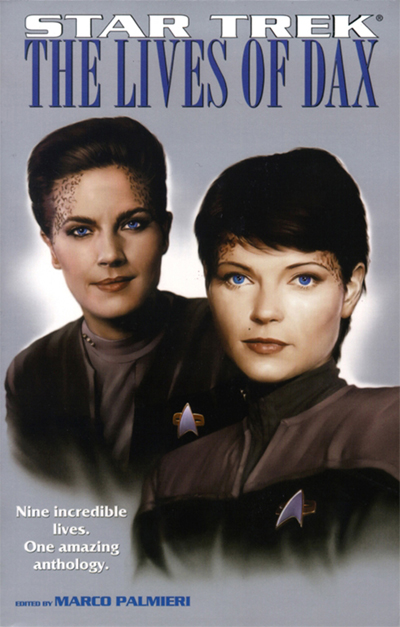
As such, it’s hard not to pity veteran writers Julia Ecklar and Karen Rose Cercone (writing as “L.A. Graf”) for drawing the short straw and winding up writing the story from the anthology The Lives of Dax focusing on Jadzia.

ds9-thelivesofdax1

Continue reading

Star Trek: Deep Space Nine – If Wishes Were Horses… (Review)

Star Trek: Deep Space Nine is twenty years old this year. To celebrate, I’m taking a look at the first season. Check back daily for the latest review or retrospective.

And after Progress gives us the most Deep-Space-Nine-y” episode yet, If Wishes Were Horses… offers the most generic Star Trek episode this side of The Passenger. The plot here should be very familiar. Like in Imaginary Friend or Shore Leave, the characters find their imaginations seem to be bringing things to life. Of course, it turns out to be an advanced alien intelligence that really just wants to study our crew, like in The Observer Effect or Scientific Method or even Schism. What I’m getting at here is that there’s really very little in this premise which hasn’t been done before or since on Star Trek, and nothing which wouldn’t feel more at home on Star Trek: The Next Generation or Star Trek: Voyager.

While it’s not as bad as The Passenger or Move Along Home, it is terribly generic and it feels like a waste of an episode in an already truncated season.

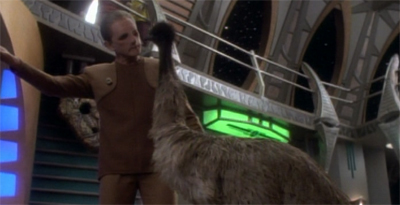
If wishes were emus...

If wishes were emus…

Continue reading

Star Trek: Deep Space Nine – The Storyteller (Review)

Star Trek: Deep Space Nine is twenty years old this year. To celebrate, I’m taking a look at the first season. Check back daily for the latest review or retrospective.

The Storyteller should not work half as well as it does. While some episodes this season (notably The Passenger and Battle Lines) feel like they were simply lifted directly from the “reject” pile within the writers’ room on Star Trek: The Next Generation, The Storyteller is actually a rejected pitch from that show’s first season. Written by Kurt Michael Bensmiller, the writer responsible for Time Squared, one of the stronger installments of the show’s first two years, it was also written late in 1992, about a month before Star Trek: Deep Space Nine would actually air.

And yet, despite that, The Storyteller really feels like a show that wouldn’t work on any of the other Star Trek spin-offs. A lot of that seems to be down to the work by Ira Steven Behr to polish up Bensmillers’ draft and to add a lot of character work and development to what is a decidedly high concept. As producer Michael Piller confessed in Captains’ Logs Supplemental – The Unauthorized Guide to the New Trek Voyages, “Ira did a lot of work on that script.”

O'Brien's mind is a bit clouded right now...

O’Brien’s mind is a bit clouded right now…

Continue reading

Star Trek: Deep Space Nine – The Passenger (Review)

Star Trek: Deep Space Nine is twenty years old this year. To celebrate, I’m taking a look at the first season. Check back daily for the latest review or retrospective.

And here we hit what amounts to the rock bottom of Star Trek: Deep Space Nine‘s first season. The Passenger and Move Along Home exist as the two weakest stories in this first season, and the point from which Deep Space Nine begins to map a path towards recovery, climaxing in the best final two episodes of any first season in the history of Star Trek. We’re a long way from that, and we seem furthest from it here.

While Move Along Home is a legitimately bad episode, one with flaws that probably should have been spotted in any of the episode’s troubled development history, The Passenger suffers because it is the most bland and generic of the first season Deep Space Nine episodes. It accomplishes nothing, but it feels worse because its ambitions were so low. It’s the kind of story that could easily have been told on any Star Trek show, or any science-fiction series, but with no sense of local colour to give it distinctive flavour.

The Passenger is just as bland as the title makes it sound.

The not-so-good Doctor...

The not-so-good Doctor…

Continue reading

Star Trek: Deep Space Nine – Dax (Review)

Star Trek: Deep Space Nine is twenty years old this year. To celebrate, I’m taking a look at the first season. Check back daily for the latest review or retrospective.

Dax is a very weird episode. It is the first episode centred around Jadzia Dax, but it also demonstrates the problems that will affect Dax-centric episodes throughout Terry Farrell’s time on the show. Due to the nature of the character, the stories about Dax tend to treat her as a plot point or a macguffin rather than a character in and of herself. Here, for example, Dax finds herself on trial for the actions of her direct predecessor, Curzon Dax. It’s a fascinating moral and philosophical dilemma (can you hold somebody accountable for their actions in a past life?), but it’s a story about Dax that isn’t about the character as she currently exists. It’s fascinating and frustrating in equal measure, but at least it’s a sign that Star Trek: Deep Space Nine is content to do more than merely imitate Star Trek: The Next Generation.

Touching...

Touching…

Continue reading