• Following Us

  • Categories

  • Check out the Archives


  • Awards & Nominations

October 2011 In Review

I occasionally post a little section at the end of the month reviewing some of the more interesting stuff I’ve written – perhaps it might be helpful to a reader navigating the archives, but it’s really for myself, looking back from time to time. Anyway, I hope you enjoy it.

It was a fun month here at the m0vie blog, and one in which we gleefully got to indulge our nerdy little interests. To celebrate the release of Spielberg’s The Adventures of Tintin: The Secret of the Unicorn, I decided to try to review all 24 of Hergé’s Adventures of Tintin. In case you want to browse the reviews, here they are:

It was also a fun month because I somehow ended up on the front page of IMDb, recommended on their hit-list for an article I wrote about my anticipation around the release of Tintin. It’s always a huge pleasure to be cited by people who you admire and respect, in a field where they are really the very big players, and I’m honestly humbled by the experience.

And then there was this

Paul Cornell, comic book writer at DC and writer for the revived Doctor Who (and the novels that preceded it), linked to my review of his superb run on Action Comics. It’s one of the truly great modern comic book runs, and wholeheartedly recommended, but it’s just really, really cool to have Mr. Cornell acknowledge the review. At the risk of gushing, he’s a writer that I’ve been following ever since I caught a repeat of Father’s Day, which was the episode that convinced me that Doctor Who was well worth my time. So, the idea that the guy somehow innocuously clicked on to this blog made my week.

So, yep, at the risk of geeking, it was an awesome month.

Is Captain Haddock the Ultimate Hero of Hergé’s Tintin?

I think it’s safe to agree that Captain Archibald Haddock was the breakout character of Hergé’s The Adventures of Tintin. Introduced in The Crab With the Golden Claws, one of three adventures to form the basis of Spielberg’s The Adventures of Tintin: The Secret of the Unicorn, Haddock has rarely been absent from the series in the time that followed. Indeed, Hergé even went back and wrote him into the end of a story (The Land of Black Gold) that he began before Haddock was even created. Haddock’s appeal seems to be incredible, with the blue-turtleneck-wearing sea-captain almost as iconic as Tintin and Snowy. Returning to the series for the first time in years, as the release of the new movie approaches, I couldn’t help but wonder if Haddock was the real hero of the series.

He'll never desert Tintin...

Continue reading

Tintin: Tintin and the Alph-Art (Review)

In the lead-up to the release of The Adventures of Tintin: The Secret of the Unicorn, I’m going to be taking a look at Hergé’s celebrated comic book character, from his humble beginnings through to the incomplete post-modern finale. I hope you enjoy the ride.

Tintin and the Alph-Art is a strange little story. It’s the last Tintin adventure that Hergé began before his death, more than fifty years after the intrepid reporter had debuted in Tintin in the Land of the Soviets. I’ve also found something strangely wonderful in the idea that the final Tintin pages that Hergé drew threatened to close the series forever, with the boy reporter trapped in a polyester sculpture, entombed forever as a work of art – it’s not exactly a happy ending, but I’d argue it was a fitting one. There isn’t a definitive finished version of the story available – Hergé died leaving notes and sketches and half-formulated ideas, but there’s little real sense of how he wanted the story to end, or even how he’d get Tintin out of that one final death trap. Of all the “unofficial” Tintin works out there, and there are quite a few, Tintin and Alph-Art is perhaps the one most closely associated with Hergé, drawing from a story he never finished to try to cap off a saga five decades in the making.

And then... nothing...

Note: I am discussing the “unofficial” version of the story completed by Yves Rodier. I will also make reference to the annotated Hergé script released a while back.

Continue reading

Non-Review Review: The Adventures of Tintin – The Secret of the Unicorn

It’s Indiana Jones, but for kids! It’s fascinating that the collaboration of Steven Spielberg and Peter Jackson should produce something that feels much more like the earlier Indiana Jones films than Spielberg’s most recent collaboration with George Lucas. Adapting Hergé’s The Adventures of Tintin was always going to be a challenging proposition, and it’s to the credit of everybody involved that it turned out so well. While it’s not quite perfect, The Adventures of Tintin: The Secret of the Unicorn is undoubtedly Spielberg’s most entertaining family film since Jurassic Park.

Franchise launcher?

Continue reading

Tintin: Tintin and the Picaros (Review)

In the lead-up to the release of The Adventures of Tintin: The Secret of the Unicorn, I’m going to be taking a look at Hergé’s celebrated comic book character, from his humble beginnings through to the incomplete post-modern finale. I hope you enjoy the ride.

So, here we are. Hergé’s last completed Tintin story. The month flew by reading and (in most cases) re-reading the stories that I grew up with. It’s interesting to return to the stories you read as a child, discovering new depth and complexity in what had previously been entertaining little diversions. Since The Red Sea Sharks, Hergé seems to have been toying with the popular franchise he has created, playing with and subverting a formula established over twenty-odd adventures. The Castafiore Emerald reads almost like a deconstruction of a typical Tintin adventure, with the a variety of threads that refuse to add up to a mystery. Flight 714 was almost a parody, relying on contrivance to the point of ridiculousness. And so, with his last complete story, Tintin and the Picaros reads as a criticism of the hero himself, poor and innocent Tintin, who proves to be quite an impotent little character.

Fly-on-the-wall look at San Theodoros?

Continue reading

Tintin: Flight 714 (Review)

In the lead-up to the release of The Adventures of Tintin: The Secret of the Unicorn, I’m going to be taking a look at Hergé’s celebrated comic book character, from his humble beginnings through to the incomplete post-modern finale. I hope you enjoy the ride.

Flight 714 is an interesting Tintin book, if only because it’s the most conventional Tintin story we’ve had in quite some time, while also being one of the oddest books in the franchise. There have been comparisons made between Hergé’s penultimate completed entry in The Adventures of Tintin and the television show Lost, which should give you some inkling of just how strange things get during this particular trip. And, given Tintin’s been to the surface of the moon, things get quite strange.

Don't sweat the landing...

Continue reading

Tintin: The Castafiore Emerald (Review)

In the lead-up to the release of The Adventures of Tintin: The Secret of the Unicorn, I’m going to be taking a look at Hergé’s celebrated comic book character, from his humble beginnings through to the incomplete post-modern finale. I hope you enjoy the ride.

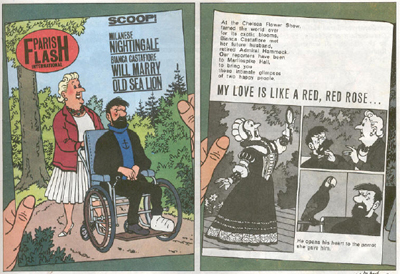
The Castafiore Emerald is famous as an example of Hergé playing with the reader’s expectations of a Tintin book. It’s essentially an exercise in creating suspense out of nothing, with the mystery of the eponymous jewel ultimately turning out to be a rather mundane affair, and instead allowing for all sorts of hilariously mundane hijinks to befall Hergé’s cast with relatively little point to it all. Then, after all, this is fiction, as Tintin seems coyly aware of on the cover, staring our at us with his finger on his lips, smiling like he knows something none of his castmates do. If you can embrace the central pointlessness of it all, and enjoy it as a collection of wryly observed scenes, The Castafiore Emerald is another rewarding addition to a series growing gradually more experimental.

That engagement's news to Haddock!

Continue reading

Tintin in Tibet (Review)

In the lead-up to the release of The Adventures of Tintin: The Secret of the Unicorn, I’m going to be taking a look at Hergé’s celebrated comic book character, from his humble beginnings through to the incomplete post-modern finale. I hope you enjoy the ride.

Tintin in Tibet is a highly regarded book. In fact, it’s arguably the most highly regarded book in the entire Adventures of Tintin collection, and it’s easy to see why. While I could recall the events of some of the stories I’d read as a child almost word-for-word, and while I harbour a deep affection for particular adventures in the series, I don’t think I was looking forward to revisiting any of the classic Tintin stories nearly as much as I was anticipating flicking through Tintin in Tibet. I remember the book filling me with a tremendous sense of optimism and hope as a child, a story of faith and hope against impossible odds, deeply moving because of its relative intimacy.

I was not disappointed.

Whiteout...

Continue reading

Tintin: The Red Sea Sharks (Review)

In the lead-up to the release of The Adventures of Tintin: The Secret of the Unicorn, I’m going to be taking a look at Hergé’s celebrated comic book character, from his humble beginnings through to the incomplete post-modern finale. I hope you enjoy the ride.

The Red Sea Sharks is, I suppose, a fine adventure tale, even if it’s not an entry in Hergé’s canon that I’m particularly fond of. The nineteenth instalment in the series, the author uses the opportunity to tie a whole slew of open story threads together and anchor the long-term continuity of the series, but he also decides to deal with the issue of modern slavery – a controversial and topical issue, to be sure. However, while I have no doubt the author’s intentions were true, the story reads more than a little awkwardly in dealing with the topic.

Calculus gets his skates on...

Continue reading

Tintin: The Calculus Affair (Review)

In the lead-up to the release of The Adventures of Tintin: The Secret of the Unicorn, I’m going to be taking a look at Hergé’s celebrated comic book character, from his humble beginnings through to the incomplete post-modern finale. I hope you enjoy the ride.

The Calculus Affair is an interesting little story that is one part suspense thriller, and another part mystery. In short, it’s almost the perfect cocktail to brew up a Cold War espionage thriller, which was exactly what Hergé was going for. It wouldn’t be too difficult to rework the adventure as a James Bond movie (in fact, it even features a sequence with our lead piloting a tank), but Hergé does a lot of work to ensure that the story never gets too heavily bogged down. Much like King Ottokar’s Sceptre, the story stands quite well as an examination of the time when it was written.

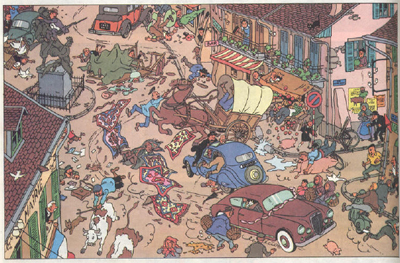
Another fine mess!

Continue reading