• Following Us

  • Categories

  • Check out the Archives


  • Awards & Nominations

Space: Above & Beyond – Pilot (Review)

This November (and a little of December), we’re taking a trip back in time to review the third season of The X-Files and the first (and only) season of Space: Above and Beyond.

Space: Above and Beyond made a great deal of sense in the context of the mid-nineties. Fox had begun its life as a scrappy little network that had trouble producing seven nights of broadcasting, but had rapidly solidified itself into a credible alternative to the big three networks. There were lots of reasons for this. The X-Files was one reason, but the network had also solidified itself with a slate of popular young dramas like Beverly Hills 90210, Melrose Place and Party of Five. Securing the NFL rights in 1993 didn’t hurt.

By late 1995, Fox was largely past the growing pains stage of its evolution. The network had been announced in late 1985, and first hit the airwaves in late 1986. It was approach the end of its first decade by the time Space: Above and Beyond was broadcast. Fox was no longer a small network fighting for scraps, but a viable challenger to the so-called “big three.” This change in outlook would lead to great success in the twenty-first century, but would also lead to change in how Fox did business.

Everything burns...

Everything burns…

The X-Files had been the right show at the right time in a number of ways. It landed at the perfect point to speak to a generation that grew up in the shadow of Watergate, but also to tap into millennial anxieties and insecurities. From a commercial perspective, The X-Files launched towards the end of the period where Fox could take chances on young shows struggling to find an audience. The first season of The X-Files was a cult hit, but not a breakout success story. The network had faith in the show, and that faith paid off.

It is interesting to wonder whether The X-Files would have received a second season if it débuted even two years later. After all, Fox would develop a reputation as a network with a ruthless tendency towards cancellation and plug-pulling. If The X-Files had first appeared in September 1995, would it have enjoyed the same fate as Space: Above and Beyond?
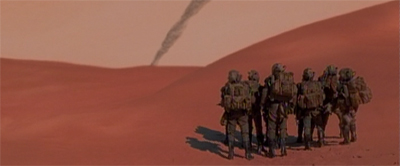
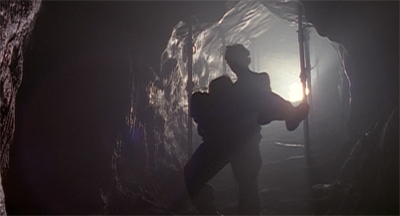
Distant sands...

Distant sands…

Continue reading

The X-Files – Season 2 (Review)

This August (and a little of September), we’re taking a trip back in time to review the second season of The X-Files. In November, we’ll be looking at the third season. And maybe more.

The first few seasons of a television show are very much about defining the show – figuring out what works and what doesn’t, and what form the show will take. After all, a lot of discussion and planning takes place during development, but all of that is on paper. It’s only once you’ve worked with the cast and had a chance to gauge audience response that it is possible to truly understand a television show.

The first two seasons of The X-Files seem like an attempt to map out the show, to mark the boundaries and do some fine calibration. The show had been a sleeper hit in its first season, popular enough to secure a second season on Fox. However, the second season had seen the series become a breakout hit. It climbed rather dramatically in the ratings, and the show would continue that ascent through to the fifth season in the lead-in to the feature film. However, the second season still feels like it’s a learning curve.

xfiles-onebreath6

There are exceptional episodes in the second season. The season provides a wealth of classic stories. Fresh Bones and Our Town stand out as two of the best monster-of-the-week stories that the show had done by this point in its life-cycle. Even outside of that, there are classics like One Breath or Humbug or The Host or F. Emasculata. However, there are also quite a few misfires like Fearful Symmetry or Excelsis Dei or 3.

There are a lot of points in the second season where it feels like The X-Files is experimenting, trying new things that would ultimately become part of the show’s unique identity. Not all of these elements worked, but that is the luxury of a second season. It allows the production team to do that sort of experimentation so they might find their groove.

xfiles-duanebarry16 Continue reading

The X-Files – Die Hand Die Verletzt (Review)

This August (and a little of September), we’re taking a trip back in time to review the second season of The X-Files. In November, we’ll be looking at the third season. And maybe more.

Die Hand Die Verletzt is a fascinating piece of work, for a number of reasons. The most striking reason, however, is that it is essentially a comedy episode. While The X-Files has always had a wry sense of humour – Mulder’s viewing habits are a recurring joke, after all – this is the first time the series has tried to produce a full-length comedy episode. Die Hand Die Verletzt is still a horror story, and the comedy is pretty black, but it does seem to prove that the show can do an entire episode that is funny.

The implications of this are far-reaching. At its height, the beauty of The X-Files was its versatility. The show could tell just about any sort of story imaginable, flitting between prestige drama, out-and-out horror, pastiche, broad comedy, political thriller, satire or even romance. While you could always bet on at least a hint of the supernatural and a dash of horror, The X-Files could really be anything that Chris Carter and his writers wanted it to be. It was even a show that could collide with other shows, as in The Springfield Files or X-Cops.

She's the devil in disguise...

She’s the devil in disguise…

To be fair, the second season is already reaching towards that approach to The X-Files. Although he has yet to produce a script for the series, the show has hired Darin Morgan to work on the writing team; his sensibilities would be proven truly and brilliantly gonzo. Irresistible proved that you could produce an episode of The X-Files without an overt supernatural horror, focusing on a more grounded horror. Red Museum provided an “almost crossover” with another television series.

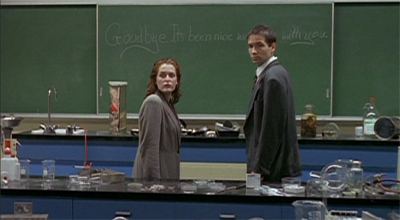
However, Die Hand Die Verletzt is the point at which the show does something that looks truly weird in the context of what has come before, yet feeling strangely comfortable in light of what has followed. The script may mark the departure of Glen Morgan and James Wong from the show – the duo leaving to produce Space: Above & Beyond – but it isn’t the end of an era so much as the start of a new one.

The writing's on the... er... chalkboard...

The writing’s on the… er… chalkboard…

Continue reading

The X-Files – Firewalker (Review)

This August (and a little of September), we’re taking a trip back in time to review the second season of The X-Files. In November, we’ll be looking at the third season. And maybe more.

Firewalker is a perfectly solid episode of The X-Files.

The problem is that Firewalker needs to be so much more than “solid.” It’s the first show of the season that has Mulder and Scully working together on an X-file. Nine episodes into the season, the show has finally put the two characters together and dropped them into a regular episodic adventure plot. Scully is back. There is no Cigarette-Smoking Man, no Skinner, no Krycek. The show had waited more than two months to get back to the familiar formula, so there was a palpable sense of anticipation.

Burn, baby, burn...

Burn, baby, burn…

To be fair to Firewalker, there’s a lot to like here. It’s a nice paranoia thriller, one that could easily serve as a text book example of a stand-alone X-Files episode. As you might expect from a script by Howard Gordon, Firewalker is also a nice character study for Mulder. It has a phenomenal guest cast – featuring actors like Bradley Whitford, Leland Orser and Shawnee Smith. On paper, Firewalker is a great episode of The X-Files. Divorced from context, it holds up rather well.

Unfortunately, Firewalker can’t be divorced from context. The episode has quite a few glaring problems. It seems a little disappointing that the first episode after Gillian Anderson’s return to full-time work on the show is a character study of Mulder. The plot is just a little too archetypal, feeling like a retread of Ice from the first season. The episode tries to get back to business as usual without bother to unpack everything that has happened since The Erlenmeyer Flask.

Into darkness...

Into darkness…

Continue reading

The X-Files – One Breath (Review)

This August (and a little of September), we’re taking a trip back in time to review the second season of The X-Files. In November, we’ll be looking at the third season. And maybe more.

If there were ever any doubt that The X-Files is fundamentally about faith in the nineties, One Breath should put the matter to rest.

An astounding, moving, staggering and thoughtful piece of work, One Breath not only wraps up the arc that opened the second season, it also provides closure to the themes that writers Glen Morgan and James Wong had been seeding throughout this first stretch of the season. One Breath bookends the meditation on faith that began in Little Green Men and serves as a counterpoint to the paranoia of Blood and the nihilism of 3.

One Breath is a tremendous piece of work, the best episode of the season and one that deserves to be mentioned among the very best the show ever produced.

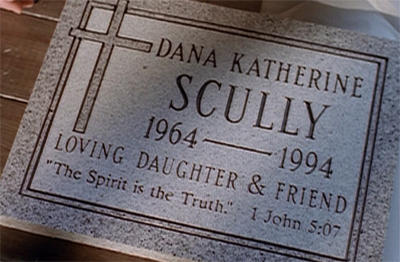
Grave stakes...

Grave stakes…

Continue reading

The X-Files – Blood (Review)

This August (and a little of September), we’re taking a trip back in time to review the second season of The X-Files. In November, we’ll be looking at the third season. And maybe more.

It’s interesting to get The Host and Blood produced back-to-back. Both episodes serve to draw writer Darin Morgan into the world of The X-Files. Brother of staff writer Glen Morgan, Darin Morgan would go on to become one of the most unique and distinctive voices to work on Chris Carter’s television shows – his scripts for The X-Files and Millennium stand out among the very best episodes the shows ever produced, with a very subversive and wry approach to the subject matter.

Morgan enjoyed one of the most surreal paths to the writers’ room imaginable. An actor with a few scattered credits on eighties television, including various shows his brother worked on like 21 Jump Street and The Commish, Morgan was cast as in the thankless role of “Fluke man” in The Host. However, he also found himself drawn into the production of the next episode, Blood. An episode with some production difficulties, Darin Morgan offered some ideas on how to develop the story.

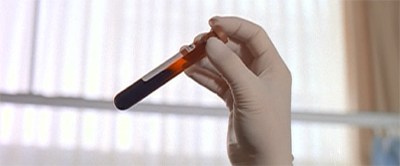
Blood work...

Blood work…

Ultimately, Darin Morgan didn’t write Blood. The script was written by Glen Morgan and James Wong, with Darin receiving a “story” credit on the finished episode. However, his ideas had impressed producer Howard Gordon, who would later propose that Darin Morgan join the writing staff. Morgan would accept the invitation and write Humbug later in the second season, before producing two genuine classics during the show’s phenomenal third year. (And also War of the Coprophages.) Darin Morgan would later write two more scripts for Millennium.

As such, Blood isn’t really a Darin Morgan episode. As it was written by Glen Morgan and James Wong, their own sensibilities shine through on the broadcast episode. However, Blood does contain a few of the wonderful trademarks of Darin Morgan’s approach to the show, not least of which a very post-modern cynicism about cynicism. Blood feels like a rather subtle and incisive critique of the culture of paranoia that The X-Files thrives on, refusing to offer clear-cut answers and suggesting that Mulder might be just a little bit off-balance.

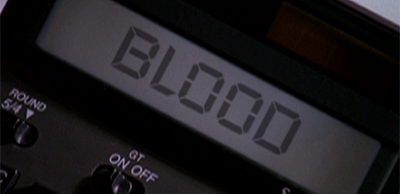
A very calculated title drop!

A very calculated title drop!

Continue reading

The X-Files – Little Green Men (Review)

This August (and a little of September), we’re taking a trip back in time to review the second season of The X-Files. In November, we’ll be looking at the third season. And maybe more.

“We wanted to believe,” Mulder’s opening monologue explains. In a way, The X-Files works best as a profound meditation on faith. Not just Scully’s traditional religious faith, but Mulder’s belief that the world must make sense – even a crazy conspiratorial sort of sense. While Scully is a practising Roman Catholic, Mulder’s officer poster proclaims “I want to believe.” It’s a show about faith in humanity. A show about two people with unshakeable faith in each other.

“Trust no one,” a dying Deep Throat advised Scully in The Erlenmeyer Flask, words impossible to live by. Unsurprisingly, while treated as a mantra and motto for the show, the agents seem to freely ignore that last warning. Mulder and Scully trust each other. Mulder trusts the Lone Gunmen, and Senator Matheson, along with just about everything he reads or is told that reinforces his faith. It’s telling that – despite his cynicism about the government and her religious faith – the show casts Scully (rather than Mulder) in the role of skeptic.

His darkest hour...

His darkest hour…

Little Green Men is effectively a second pilot for the show. While set in the new status quo established during the closing scene of The Erlenmeyer Flask, the episode is very much structured as a “jumping on” point for those who might want to start watching the series. After all, the first season had been a cult hit, but hadn’t quite set the world on fire. Offering an introduction to those attracted by the growing buzz surrounding the show over the summer hiatus makes sense.

And so Little Green Men is built around Mulder’s crisis of faith and his attempts to vindicate that faith, offering a thoughtful examination of a man who wants to believe. While Little Green Men doesn’t offer any large steps forward in the show’s mythology or story arcs, it is a moving and introspective piece.

Samantha gets carried away...

Samantha gets carried away…

Continue reading

The X-Files – Beyond the Sea (Review)

Ah, Beyond the Sea. My favourite episode of the first season. Maybe my favourite episode of the first two seasons, although I’ll confess that my opinion is prone to change. I’m in good company. Darin Morgan points to it as his favourite episode. Chris Carter has (again and again) singled it out as the best episode of the show’s first season – a piece of television that works “on every level.”

It’s easy to point out all the exceptional stuff in Beyond the Sea. Gillian Anderson is phenomenal, as we’ve come to suspect from spending half a season with her. David Duchovny is quite happily relegated to a supporting role, willing to allow his co-star room to breathe. Brad Dourif is sensational. Glenn Morgan and James Wong’s script is phenomenal. David Nutter’s direction is absolutely top-notch.

However, what always struck me about Beyond the Sea was just how incredibly confident and casual it was. It was bold and clever and provocative, but it was also tight and controlled. It’s brilliant, but it never feels like this isn’t a level of craft the show can’t consistently hit.

We are the dead...

We are the dead…

Continue reading

The X-Files – Shadows (Review)

Shadows feels a tad generic, but that’s by design. Written by the duo of Glenn Morgan and James Wong, Shadows was apparently intended to appease the network by offering something in the mold of a traditional ghost story – indeed, The Entity is often cited as an influence on the episode. Shadows runs off a rather conventional premise – a woman is haunted by a strange force capable of manipulating and moving objects, out to avenge some grave wrong.

In many respects, following The Jersey Devil, it almost seems like the first season of The X-Files is trying to knock off various items on a paranormal checklist. UFOs? Got ’em. A popular cryptozoology monster? Yep. Ghosts or poltergeists? We got a story here. The result is hardly inspiring. The X-Files tends to work a bit better when it’s venturing off the beaten track, taking something that isn’t mainstream and running with it.

Author John Kenneth Muir argued that watching The X-Files was like “watching a movie every week.” If that’s the case, Shadows feels more like a movie of the week.

The pen is mightier than the sword!

The pen is mightier than the sword!

Continue reading

The X-Files – Squeeze (Review)

Squeeze is the first “monster of the week” episode of The X-Files, and also the first episode that wasn’t written by creator Chris Carter. Instead, Squeeze came from the word processors of James Wong and Glen Morgan. Wong and Morgan would become a hugely influential (if not always successful) writing duo during the nineties. They’d write some of the best scripts for The X-Files, but they’d also leave (briefly) to run their own short-lived science-fiction drama in Space: Above & Beyond.

After Fox cancelled that show, the pair would briefly return to The X-Files before taking over Chris Carter’s other Fox drama Millennium, for that show’s second season. I’d argue that Wong and Morgan’s Millennium was one of the most inventive and insane seasons of television produced by any network in the nineties, and it’s a shame that Carter would have to re-assume the reins for the show’s third and final season. After that, the pair found considerable success creating the Final Destination film series.

However, all of that was in the future, but you can clearly see their creative talent at work here. Squeeze isn’t just the first episode of The X-Files unrelated to the show’s alien mythology, it is also one of the most memorable episodes ever written, creating a monster so iconic that he would wind up bookending the first season when he returned in Tooms.

Eye see you...

Eye see you…

Continue reading