












This January and February, we’ll be finishing up our look at the second season of Star Trek: The Next Generation and moving on to the third year of the show, both recently and lovingly remastered for high definition. Check back daily for the latest review.
We’ll be supplementing our coverage of the episodes with some additional materials – mainly novels and comics and films. This is one such entry. This is actually supplementary to the first season of the Next Generation, specifically the episode Encounter at Farpoint.
When Malibu comics launched their Star Trek: Deep Space Nine comic in 1993, the first season of the show had concluded. Due to licensing issues, Marvel Comics published the first Star Trek: Voyager tie-in comic in late 1996, after the show’s second season had concluded. The notoriously dodgy Gold Key Star Trek comics did run alongside the classic television show, but at least waited until 1967 to begin getting the details horribly wrong.
So publishing a tie-in to Star Trek: The Next Generation in early 1988 was an ambitious move by DC comics. By that point, the show’s first season was an ambitious prospect. The six issue miniseries was launched as part of a big publicity push at the start of The Next Generation, with editor Robert Greenberger explaining in the afterword to the first issue that Paramount had approached them “sometime early this year” to write the series.
This means that the comic was being written before Encounter at Farpoint was even finished. In the letters section in the second issue, Greenberger concedes, “As I write this, it’s mid-September and Star Trek: The Next Generation has yet to debut anywhere in America.” It’s no wonder that Michael Carlin’s series wound up so inconsistent and so decidedly strange. While it’s an interesting demonstration of just how firmly Paramount were pushing their new show, it’s hardly a triumph of tie-ins.
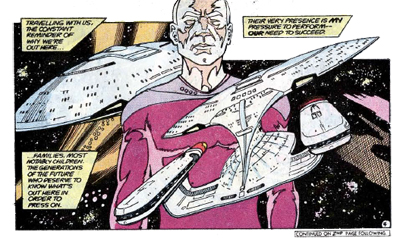
These are the voyages…
Filed under: Comics, The Next Generation | Tagged: Beverly Crusher, Crusher, Geordi La Forge, jean-luc picard, picard, Star Trek Next Generation, William Riker, Worf | 2 Comments »






 the m0vie blog