• Following Us

  • Categories

  • Check out the Archives


  • Awards & Nominations

Star Trek: Deep Space Nine – The Jem’Hadar (Review)

Star Trek: Deep Space Nine is twenty years old this year. To celebrate, I’m taking a look at the first and second seasons. Check back daily for the latest review or retrospective.

In terms of sheer quality of execution, The Jem’Hadar is probably the weakest of Star Trek: Deep Space Nine‘s season finalés. It lacks the gut punch of A Call to Arms, the shock twist of Broken Link, the atmosphere of The Adversary or even the timeliness of In the Hands of the Prophets. It is, at its most basic level, a story about a disastrous first contact that occurs during a father-son bonding trip that goes horribly wrong, ending with precious little actually advanced.

However, in terms of conceptual ideas, The Jem’Hadar is a game-changer. It is the cornerstone upon which Deep Space Nine would construct its most iconic narrative arc. It caps off two years of trying to develop the Ferengi as more than one-note jokes. It’s a bold statement about the freedom that Deep Space Nine would enjoy with Star Trek: The Next Generation retiring from the airwaves. It cemented the notion that Deep Space Nine never really dealt in two-part episodes to bridge seasons.

For Deep Space Nine, season finalés did not exist simply as pieces of Lego designed to snugly fit those other pieces at the start of the following season, crafting some illusion of continuity flow between two different seasons of television. Instead, cliffhangers on Deep Space Nine changed the rules, shook up the status quo, and teased the changing face of things to come.
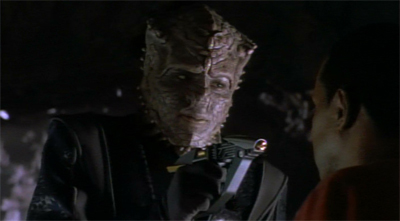
A Jem?

A Jem?

Continue reading

Star Trek: Deep Space Nine – The Alternate (Review)

Star Trek: Deep Space Nine is twenty years old this year. To celebrate, I’m taking a look at the first and second seasons. Check back daily for the latest review or retrospective.

Well, at least the second season of Star Trek: Deep Space Nine is experimental. It might not always pay-off, but there’s a clear sense that the show is trying new things, bending various genres to make them fit within the broad outline of a Star Trek show. Necessary Evil was a fascinating attempt to construct a noir episode, while Rivals was a less-than-successful sit-com in space. The Alternate is very much doing “Star Trek as monster movie”, which is surprisingly fun.

To be fair, it’s not a subgenre new to the franchise. Indeed, the first episode of the original show to air, The Man Trap, was essentially a monster horror in space. Still, The Alternate feels a bit more sinister and dark than  anything that Star Trek: The Next Generation might attempt. (Schisms probably comes closest, but – even then – there’s no sense that the monsters are stalking the starship. They have to abduct their victims to experiment on them.)

More than that, though, The Alternate is also a fascinating exploration of Odo as a character, looking at the relationship that Odo has with his co-workers and how that is rooted in his relationship with the man who claims to be his “father.”

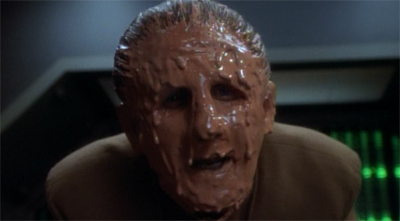
Melting! Melting! Oh what a world!

Melting! Melting! Oh what a world!

Continue reading

Star Trek: Deep Space Nine – Rules of Acquisition (Review)

Star Trek: Deep Space Nine is twenty years old this year. To celebrate, I’m taking a look at the first season. Check back daily for the latest review or retrospective.

The Nagus was a surprising high-point of the first season of Star Trek: Deep Space Nine. It represented a conscious effort to rehabilitate and reappraise the Ferengi, the aliens introduced as potentially major adversaries in the first season of Star Trek: The Next Generation, only to wind up as mostly unfunny comic relief. The Nagus dared to suggest that the Ferengi might not be the monsters the Federation considers them to be, suggesting that their culture – while different – was no less worthy of respect or consideration than that of the Klingons.

Rules of Acquisition is a clear follow-up, right down to the way that it includes Grand Nagus Zek. However, it’s nowhere near as charming and successful as The Nagus, because it feels like it’s just treading water. It teases potential developments down the line, but the story seems locked in a familiar holding pattern – right down to the rather convenient ending that inevitably sees Quark snatching defeat from the jaws of victory.

It’s not quite a bad episode, certainly not on the scale of the colossal misfire that was Melora, but it’s also not a particularly good one.

Nothing to see here...

Nothing to see here…

Continue reading

Star Trek: Deep Space Nine – Invasive Procedures (Review)

Star Trek: Deep Space Nine is twenty years old this year. To celebrate, I’m taking a look at the first and second seasons. Check back daily for the latest review or retrospective.

Invasive Procedures is an interesting episode. It has a great high concept, some nice character beats, and offers an inside glimpse at an astonishingly interesting alien culture. Verad is a compelling guest character and Sisko gets to be pretty badass, continuing the presentation of the character as some weird composite of James T. Kirk and Jean-Luc Picard.

There are however, a number of very sizeable flaws. The most obvious being that – despite this is nominally a “Dax” story – Dax winds up feeling more like a plot point than a character in her own right.

Slugging it out...

Slugging it out…

Continue reading

Star Trek: Myriad Universes – Echoes and Refractions: A Gutted World by Keith R. A. DeCandido (Review)

Star Trek: Deep Space Nine is twenty years old this year. To celebrate, I’m taking a look at the first and second seasons. Check back daily for the latest review or retrospective.

We’ll be supplementing our coverage of the episodes with some additional materials – mainly novels and comics and films. This is one such entry.

“What if” stories are inherently fascinating. Naturally, they are predicated on investment in the original story, but it’s always fascinating to imagine the branching possibilities, the ripples in the stream. Sometimes, these are used to explore the grand philosophical questions of Star Trek in a new light; to imagine how, were you to change one variable in a complex formula, the answer might be radically different.

However, Keith R. A. DeCandido’s A Gutted World feels different. It is a massive story, spanning a huge amount of time and space, drawing in a massive ensemble cast and gently probing the politics of five or six different Star Trek culture, as DeCandido explores what might have happened if the Cardassians never withdrew from Bajor, if Terok Nor never became Deep Space Nine.

To put it more succinctly, if the show never happened, but its central storyline still did.

st-myriaduniverses

Continue reading

Star Trek: Deep Space Nine – If Wishes Were Horses… (Review)

Star Trek: Deep Space Nine is twenty years old this year. To celebrate, I’m taking a look at the first season. Check back daily for the latest review or retrospective.

And after Progress gives us the most Deep-Space-Nine-y” episode yet, If Wishes Were Horses… offers the most generic Star Trek episode this side of The Passenger. The plot here should be very familiar. Like in Imaginary Friend or Shore Leave, the characters find their imaginations seem to be bringing things to life. Of course, it turns out to be an advanced alien intelligence that really just wants to study our crew, like in The Observer Effect or Scientific Method or even Schism. What I’m getting at here is that there’s really very little in this premise which hasn’t been done before or since on Star Trek, and nothing which wouldn’t feel more at home on Star Trek: The Next Generation or Star Trek: Voyager.

While it’s not as bad as The Passenger or Move Along Home, it is terribly generic and it feels like a waste of an episode in an already truncated season.

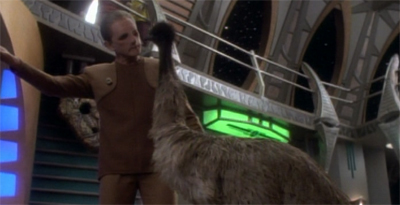
If wishes were emus...

If wishes were emus…

Continue reading

Star Trek: Deep Space Nine – Vortex (Review)

Star Trek: Deep Space Nine is twenty years old this year. To celebrate, I’m taking a look at the first season. Check back daily for the latest review or retrospective.

Something very interesting happens in the second half of Star Trek: Deep Space Nine‘s first season. It seems like the writers and producers are making a conscious effort to develop the show’s characters, themes and the world that these inhabit. Plot threads are hinted at, only to be left dangling. Ideas are broached, and tucked away for another day. Given that Star Trek: The Next Generation waited until the third season to broach serialisation in Sins of the Father, the approach taken here is quite striking.

These three episodes are more notable for what they set up rather than what they actually accomplish on their own terms. These adventures lay groundwork, or at least hint at laying groundwork, that will pay off throughout the show’s extended seven-year run. Okay, not exactly. There are some redundant elements here that never actually pay off, but Vortex, Battle Lines and The Storyteller all play into the show’s bigger story arc, even if it seems the writers aren’t entirely sure what those story arcs are.

It's murky out there...

It’s murky out there…

Continue reading

Star Trek: Deep Space Nine – The Nagus (Review)

Star Trek: Deep Space Nine is twenty years old this year. To celebrate, I’m taking a look at the first season. Check back daily for the latest review or retrospective.

The Nagus starts what turns out to be an annual tradition for Star Trek: Deep Space Nine. It introduces the concept of a “Ferengi” episode, where once (or twice) a year, the show would take time out from other on-going concerns to focus on the state of affairs in the Ferengi Alliance. In a way, it’s quite like what Star Trek: The Next Generation did for the Klingons, taking an episode every once in a while to delve into the alien culture and offer a bit of exploration of a species originally created as a two-dimensional cardboard stand-in for a philosophy the franchise found unappealing.

Starting with Heart of Glory, The Next Generation developed Klingons from “those bad guys with the ridges” into a fully functioning and multi-faceted culture, largely driven by writer Ronald D. Moore from the third season. Deep Space Nine did largely the same thing with the Ferengi, largely spearheaded by producer Ira Steven Behr. Although, given the fact that the episodes concerned amoral capitalists instead of imposing warriors, Deep Space Nine opted for comedy as the genre of choice when developing the Ferengi.

He's got the lobes for business...

He’s got the lobes for business…

Continue reading

Star Trek: Deep Space Nine – A Man Alone (Review)

Star Trek: Deep Space Nine is twenty years old this year. To celebrate, I’m taking a look at the first season. Check back daily for the latest review or retrospective.

To be fair to Star Trek: Deep Space Nine, it’s clear that the show’s heart is in the right place. After all, a Star Trek television show isn’t quite the gambit that it was in 1987. The producers expect that the series will be going for quite some time. After all, the regulars signed six-year contracts, one of the reasons that the show managed to make it to its penultimate season without losing a primary cast member.

As such, a lot of the early episodes of Deep Space Nine seem prudent – they effectively amount to good housekeeping. While Star Trek: The Next Generation got its cast together and couldn’t wait to start telling bold Star Trek stories, you can see that Deep Space Nine is laying a lot of groundwork. The ensemble doesn’t gel instantly. Episodes are devoted to little more than set-up for something that will pay off over the coming year. A vast supporting cast is systematically established.

This is world-building, and it’s world-building to a purpose, even if Deep Space Nine doesn’t seem to really know what that purpose is yet. So it’s quite hard to fault these early episodes, even if they feel more like set-up for delayed pay-off.

The writing's on the wall for Odo...

The writing’s on the wall for Odo…

Continue reading

Star Trek: The Next Generation – Heart of Glory (Review)

To celebrate the twenty-fifth anniversary of Star Trek: The Next Generation, and also next year’s release of Star Trek: Into Darkness, I’m taking a look at the recent blu ray release of the first season, episode-by-episode. Check back daily for the latest review.

I think Heart of Glory is, ironically, one of the first times that Star Trek: The Next Generation is consciously trying to force its way out of the shadows of its illustrious predecessor. Episodes like The Naked Now and Justice felt like hold-overs from the classic sixties Star Trek, with little acknowledgement that the world (both inside and outside the show) had dramatically changed in the two decades since Star Trek appeared. I used the adjective “ironically”, because Heart of Glory actually sees the return of one of the most classic Star Trek aliens, and one of the most recognisable pop culture extraterrestrials.

The series bible famously stated the show had no real interest in going back to the Klingons, but Heart of Glory suggests that following up with the funky foreheaded aliens might have been the smartest thing that the first season did.

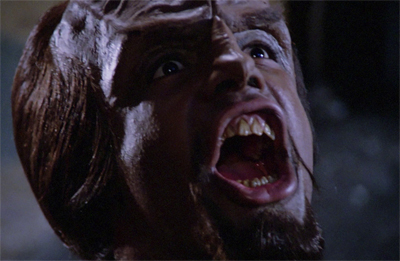
I am Klingon, hear me roar!

I am Klingon, hear me roar!

Continue reading