• Following Us

  • Categories

  • Check out the Archives


  • Awards & Nominations

Star Trek: Deep Space Nine – The Search, Part II (Review)

The September and October, we’re taking a look at the jam-packed 1994 to 1995 season of Star Trek, including Star Trek: Deep Space Nine and Star Trek: Voyager. Check back daily for the latest review.

In a way, The Search feels almost like a parody of the classic Star Trek season-bridging cliffhanger. It is a story told under the same title, but with both halves of the story feeling distinct enough to stand on their own two feet. Written by two different writers and directed by two different directors, it very much feels like two very different stories linked primarily by an efficient cliffhanger.

It’s not radically dissimilar to the two-parters from Star Trek: The Next Generation. Redemption and Descent come to mind, two-part adventures that very much feel like two different stories melded together rather than one single over-arching story. This disjointedness makes a great deal of sense, given the standard operating procedure when it came to Star Trek cliffhangers, as established by Michael Piller with The Best of Both Worlds, Part I. The logic is simple: write part one; go away for a few months; return and try to write part two.

Of course, The Search very clearly isn’t a season-bridging cliffhanger. It’s a season-opening two-parter. And it’s so cleverly and consciously structured as two very different episodes that it can’t help but feel like a sly nod at the inevitable outcome of that approach to writing – playfully self-aware of how disjointed the whole experience feels as a single story.

A whole new Vorta problem...

A whole new Vorta problem…

Continue reading

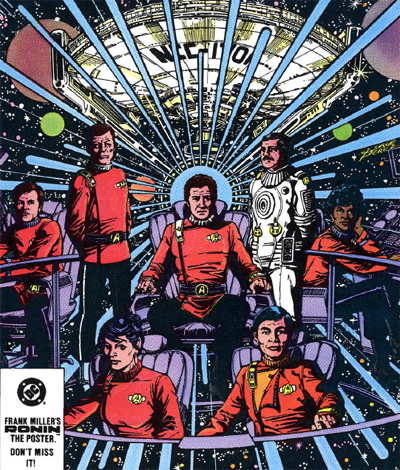
Star Trek (DC Comics, 1984) #1-6 – Errand of War! (Review)

This July, we’re taking a look at some classic Star Trek movie tie-ins. Check back daily for the latest reviews and retrospectives.

After Marvel lost the Star Trek license in 1982, there was a period where no monthly Star Trek comics were being published. One of the consequences of this was that Star Trek II: The Wrath of Khan didn’t receive an official comic book adaptation, until IDW decided to go back and fill in the blanks in 2009. Eventually, DC comics managed to secure the license for Star Trek comics, and they began publishing in 1984, the year that saw the release of Star Trek III: The Search for Spock. DC would maintain the license into the mid-nineties, making it one of the most stable licensing agreements ever reached about Star Trek comics.

Unlike Marvel’s 1979 agreement with Paramount, DC reached an agreement that allowed them full access to the Star Trek mythology. Marvel had been restricted to using characters and concepts from Star Trek: The Motion Picture, a rather restrictive agreement. In contrast, DC had access to the whole of the Star Trek canon. Indeed, reading Mike Barr and Tom Sutton’s run on Star Trek, it seems like their opening six issues were designed to showcase the sheer breadth of continuity available to them.

At the same time, Barr’s scripts have a pulpy charm that makes them highly enjoyable, even as trying to tell an unfolding Star Trek story set between the events of The Wrath of Khan and The Search for Spock seems ill-advised.

Warp speed ahead...

Warp speed ahead…

Continue reading

Star Trek: The Next Generation – The Last Generation (Review)

This January and February, we’ll be finishing up our look at the second season of Star Trek: The Next Generation and moving on to the third year of the show, both recently and lovingly remastered for high definition. Check back daily for the latest review.

We’ll be supplementing our coverage of the episodes with some additional materials – mainly novels and comics and films.

The Last Generation, a five-issue miniseries written by Andrew Steven Harris and illustrated by the wonderful Gordon Purcell, feels like a companion piece to Harris’ Alien Spotlight: Borg issue. Both are essentially stories about the morality of using time travel to re-write history, and both can be read as a reflection on Star Trek continuity as a whole.

Published from November 2008 through to March 2009, The Last Generation feels like something of a preemptive rebuttal to JJ Abrams’ May 2009 reboot of Star Trek. Much like Alien Spotlight: Borg before it, it feels like a conscious attempt to vindicate and validate the franchise from the era of Star Trek: The Next Generation onwards.

Given the fact that the “reboot-in-all-but-name” back-to-Kirk nature of Abrams’ film was openly discussed well ahead of the release, it’s hard not to read The Last Generation and Alien Spotlight: Borg as protests against the decision to set the clock back on the franchise and start with Kirk yet again.

A shot in the dark...

A shot in the dark…

Continue reading

Star Trek: The Next Generation – Yesterday’s Enterprise (Review)

This January and February, we’ll be finishing up our look at the second season of Star Trek: The Next Generation and moving on to the third year of the show, both recently and lovingly remastered for high definition. Check back daily for the latest review.

Yesterday’s Enterprise is one of the best-loved pieces of Star Trek ever produced. Its inclusion is a given in absolutely any “best of” poll being run for Star Trek: The Next Generation or even the franchise as a whole. A rather thoughtful piece of high-concept science-fiction exploring the importance of the right people in the right time, Yesterday’s Enterprise is proof that The Next Generation has truly come of age. After two years of wandering in the wilderness, the show has finally found its feet.

Of course, the production of Yesterday’s Enterprise was quite traumatic. The story and script went through multiple iterations between the original pitch and the version presented on the screen. The episode was written by pretty much the entire writing staff over the Thanksgiving weekend, racing against the clock to get it finished. Due to scheduling issues with Denise Crosby and Whoopi Goldberg, it was filmed in late December instead of early January.

As with so much of the third season, there’s a sense that the episode was held together by chewing gum and rubber bands. However, also like most of the third season, that sense only comes from those delving into the behind-the-scenes stories. Looking at the episode itself, this was a show on the top of its game.

The battle bridge...

The battle bridge…

Continue reading

Star Trek: The Next Generation – The High Ground (Review)

This January and February, we’ll be finishing up our look at the second season of Star Trek: The Next Generation and moving on to the third year of the show, both recently and lovingly remastered for high definition. Check back daily for the latest review.

The High Ground is a rather earnest issue-driven episode of Star Trek: The Next Generation, dealing with one of the big issues of the day: international terrorism. However, the moral ambiguity of terrorism was a decidedly more contentious and controversial issue in early 1990 than the plight of Vietnam veterans explored in The Hunted or the Cold War politics of The Defector.

The High Ground is an allegory for the Troubles in Northern Ireland at a point in time where the Troubles were on-going. 1990 saw a number of high-profile terrorist actions conducted by the IRA. They bombed the London Stock Exchange in July. Using an explosive device, they murdered Sergeant Charles Chapman in May. Nobody has ever been prosecuted for his death. In February 1991, the IRA launched a mortar attack on 10 Downing Street. So this was the context in which The High Ground aired.

And, to be fair, there’s something admirable about the show’s willingness to engage with a controversial issue, even if the end result leaves a lot to be desired.

Holding hands around the universe...

Holding hands around the universe…

Continue reading

Star Trek: The Next Generation – The Defector (Review)

This January and February, we’ll be finishing up our look at the second season of Star Trek: The Next Generation and moving on to the third year of the show, both recently and lovingly remastered for high definition. Check back daily for the latest review.

The Defector is the script that earned Ronald D. Moore his place on the writing staff of Star Trek: The Next Generation. The writer had contributed the first script produced by Michael Piller, The Bonding, but it was his second pitch – improvised in the heat of the moment – that cemented Moore’s place with the franchise. He would stay on The Next Generation until it finished, before moving on to Star Trek: Deep Space Nine and eventually Star Trek: Voyager, although he departed Voyager quite quickly.

Although Moore retains the credit on the finished episode, apparently – like so many third season scripts – the final draft of The Defector was a collaborative effort involving the whole writing staff. The episode, the first instalment of The Next Generation to air in the nineties, turned out surprisingly well. Indeed, The Defector is one of the strongest episodes of a very strong season.

A defective defector?

A defective defector?

Continue reading

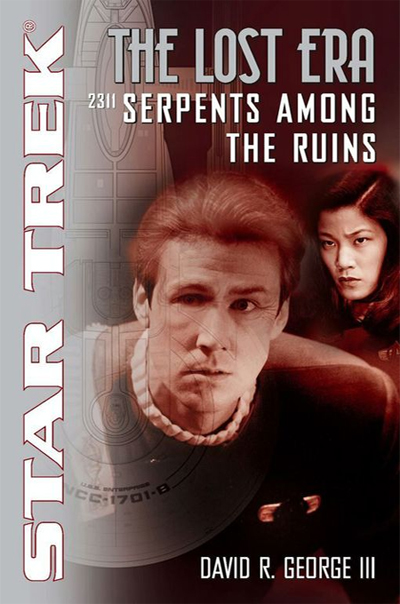
Star Trek: The Lost Era – Serpents Among the Ruins by David R. George III (Review)

This January and February, we’ll be finishing up our look at the second season of Star Trek: The Next Generation and moving on to the third year of the show, both recently and lovingly remastered for high definition. Check back daily for the latest review.

We’ll be supplementing our coverage of the episodes with some additional materials – mainly novels and comics and films. This is one such entry. This is actually supplementary to the first season of the Next Generation, specifically the episode The Neutral Zone.

The first year of Star Trek: The Next Generation was a little rocky when it came to continuity. Skipping roughly a century on from the adventures of James T. Kirk, there were times when it seemed like the writers weren’t entirely sure what had happened during that gap. Early on, for example, it was suggested that the Klingons had joined the Federation, a decision reversed by the show’s third season. Even within the first year of the show, it seemed like the writers hadn’t quite cemented the wider Star Trek universe. In Angel One, we discover that the Romulans are threatening war, only to hear in The Neutral Zone that they’ve actually been absent from galactic affairs for quite some time.

Serpents Among the Ruins is an attempt to explain that absence established in 1988, and contextualise it against the eighteen years of Romulan stories that would follow from the early appearances in Star Trek: The Undiscovered Country through to the end of Star Trek: Deep Space Nine and beyond.

st-serpentsamongtheruins

Continue reading

Star Trek: The Next Generation (DC) Annual #3 – The Broken Moon (Review)

This January and February, we’ll be finishing up our look at the second season of Star Trek: The Next Generation and moving on to the third year of the show, both recently and lovingly remastered for high definition. Check back daily for the latest review.

We’ll be supplementing our coverage of the episodes with some additional materials – mainly novels and comics and films. This is one such entry. This is actually supplementary to the first season of the Next Generation, specifically the episode Conspiracy.

If you were to construct a list of the most niggling unresolved plot threads in the history of the Star Trek franchise, “what was up with those things from Conspiracy?” would likely rank up there alongside “so, did Bajor ever join the Federation?” Funnily enough, author S.D. Perry would tie those two dangling plot points up in her Deep Space Nine relaunch book, Unity.

However, several other writers have tried to figure out what exactly was going on with those mind-controlling parasites who appeared at the end of the first season of Star Trek: The Next Generation and were never heard from again. According to Ronald D. Moore on Inside the Writers’ Room on the third Next Generation blu ray box set, various writers for the show tried to revisit the idea, but Roddenberry hated that episode so much nothing was ever developed.

The Broken Moon, the third annual for DC’s Next Generation comic book series, offers its own take on the mind-controlling parasites. While writer Michael Jan Friedman wisely avoids revealing too much about these creatures, the story suffers because it never figures out anything interesting to do with them.

It always bugged me...

It always bugged me…

Continue reading

Star Trek: The Next Generation – The Emissary (Review)

This January and February, we’ll be finishing up our look at the second season of Star Trek: The Next Generation and moving on to the third year of the show, both recently and lovingly remastered for high definition. Check back daily for the latest review.

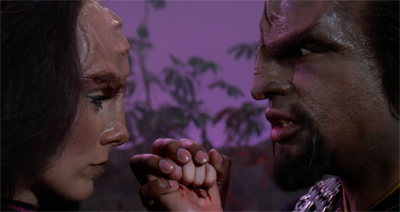
The Emissary is one of the stronger episodes from the tail end of Star Trek: The Next Generation‘s second season. An interesting meditation on heritage and race, as well as an insightful character piece for Worf, The Emissary is an interesting exploration of Worf’s relationship to his culture – and how his experience is far from universal. It’s the sort of story that The Next Generation should have been producing on a more consistent basis, but it’s better late than never.

Bonded by blood...

Bonded by blood…

Continue reading

Star Trek: The Next Generation – Q Who? (Review)

This January and February, we’ll be finishing up our look at the second season of Star Trek: The Next Generation and moving on to the third year of the show, both recently and lovingly remastered for high definition. Check back daily for the latest review.

Q Who? throws down the gauntlet for Star Trek: The Next Generation. It serves as a fitting reminder that Picard and his crew are still amateurs when it comes to space exploration. They don’t even win the day – they suffer “a bloody nose” before limping away from their strange new opponents to lick their wounds. For a crew that never seemed to sweat before, who never seemed like they were under pressure, this is a shocking development.

More interestingly, it’s something unknown in a universe that has become far too familiar. Three of the four episodes leading into Q Who? ended with the crew accepting that there were some things they’d never fully understand or comprehend, and – while it’s unlikely this was intentional – it seems like a nice bit of thematic foreshadowing rather than haphazard plotting. For the first season-and-a-half of the show, it seemed like the Enterprise was always dealing with the familiar, always in control of the situation.

With Q Who?, everything is put into perspective.

Borg to death...

Borg to death…

Continue reading