• Following Us

  • Categories

  • Check out the Archives


  • Awards & Nominations

Doctor Who: The Ark in Space (Review)

To celebrate the fiftieth anniversary of the longest-running science-fiction show in the world, I’ll be taking weekly looks at some of my own personal favourite stories and arcs, from the old and new series, with a view to encapsulating the sublime, the clever and the fiendishly odd of the BBC’s Doctor Who.

The Arc in Space originally aired in 1975.

I’ll have to link in my own cerebral cortex. That’s the only thing.

That is highly dangerous.

I know. Two more leads, Rogin.

The power could burn out a living brain!

I agree. An ordinary brain. But mine is exceptional.

– the Doctor demonstrates his tremendous ego to Vira

It really is amazing how quickly Philip Hinchcliffe and Robert Holmes established their mark on Doctor Who. Barry Letts finished up his time as producer working on Tom Baker’s first serial, Robot. The Ark in Space was the second adventure to star the Fourth Doctor, and certainly a lot more indicative of the shape of things to come. While you could argue that Holmes and Hinchcliffe did improved over the following years – for one thing, this first season still has the odd pothole – it is clear that they immediately knew what they were doing.

Hinchcliffe and Holmes would cast a tremendous shadow over Doctor Who, and it’s no coincidence that so much of that influence can be traced back to The Ark in Space, the first indication of their plan for Doctor Who.

The Wirrn really bug the Doctor...

The Wirrn really bug the Doctor…

Continue reading

Doctor Who – The Ark (Review)

To celebrate the fiftieth anniversary of the longest-running science-fiction show in the world, I’ll be taking weekly looks at some of my own personal favourite stories and arcs, from the old and new series, with a view to encapsulating the sublime, the clever and the fiendishly odd of the BBC’s Doctor Who.

The Ark originally aired in 1966.

Yes, I bet it’ll take some time to get the whole of the population down here, so the sooner you get started, the better, I should think.

Don’t worry. It may not take as long as you think.

What do you mean? Are you up to something?

Em… no.

– Dodo (yes, Dodo) outwits a Monoid

The Ark is an interesting piece of Doctor Who, both in terms of structure and in terms of theme. It’s a very clever concept, with the four-parter effectively split into two halves as the Doctor and his companions join the same story at two different intervals. It’s a wonderful high concept, with the action jumping from across time while keeping a fixed location. However, The Ark is also notable because of its less-than-subtle political under-currents, one of the relatively rare times where Doctor Who has seemed reactionary, conservative and downright colonial in its attitudes.

The end of the world as we know it...

The end of the world as we know it…

Continue reading

Doctor Who: Destiny of the Daleks (Review)

To celebrate the fiftieth anniversary of the longest-running science-fiction show in the world, I’ll be taking weekly looks at some of my own personal favourite stories and arcs, from the old and new series, with a view to encapsulating the sublime, the clever and the fiendishly odd of the BBC’s Doctor Who.

The Last of the Time Lords originally aired in 1979.

Oh, look! Rocks!

– the Doctor

Destiny of the Daleks is a bit crap. I know that there’s a whole bunch of “a bit crap” Dalek episodes, but Destiny of the Daleks doesn’t suffer because it doesn’t make sense, or it hangs on plot contrivance. Instead, it’s just a little bit dull. At least Resurrection of the Daleks bangs along making no sense in a reasonably exciting manner. In contrast, Destiny of the Daleks just sort of… is. In a way, it serves as the perfect opener to Graham Williams’ final year as producer, perfectly capturing the gap between the production staff the cast and the writers that so often led to bit of a mismatch in this part of the show’s history.

While I have a fondness for Terry Nation, I think it’s perfectly reasonable to argue that his style was hardly progressive or dynamic when he first wrote for the show in 1963. Indeed, my fondness for his work in the early years of the show is mostly down to how it harks backwards to pulpy classic science-fiction. If Nation wasn’t the most forward-looking of writers in 1963, then perhaps he really wasn’t best suited to open a season for Graham Williams and Douglas Adams in 1979.

Romana II goes through one of the oldest companion rites of passage...

Romana II goes through one of the oldest companion rites of passage…

Continue reading

Doctor Who: Evolution of the Daleks (Review)

To celebrate the fiftieth anniversary of the longest-running science-fiction show in the world, I’ll be taking weekly looks at some of my own personal favourite stories and arcs, from the old and new series, with a view to encapsulating the sublime, the clever and the fiendishly odd of the BBC’s Doctor Who.

Evolution of the Daleks originally aired in 2007.

Caan, let me help you. What do you say?

Emergency temporal shift!

– sadly the Doctor doesn’t follow this with a dramatic “CAAAAAAAN!!!”

Well, that went off the rails rather quickly. Okay, to be fair, the problems here were all hinted at in the first part, with those potential obstacles only turning into gaping flaws as this two-part adventure galloped toward the finish line. And, again, Evolution of the Daleks fails because it has too much ambition, rather than a complete lack of it. Still, the episode is a mess, full of mismatched ideas and crazy concepts that really don’t work especially well within the context of a Dalek episode. It’s not too hard to imagine a lot of these elements being recycled into a working story for the show, but the main problem seems to be that none of those elements work especially well with the Daleks.

I can see it in its eye-stalk...

I can see it in its eye-stalk…

Continue reading

Doctor Who: Remembrance of the Daleks (Review)

To celebrate the fiftieth anniversary of the longest-running science-fiction show in the world, I’ll be taking weekly looks at some of my own personal favourite stories and arcs, from the old and new series, with a view to encapsulating the sublime, the clever and the fiendishly odd of the BBC’s Doctor Who.

Remembrance of the Daleks originally aired in 1988.

You can always judge a man by the quality of his enemies.

– the Doctor explains why the Daleks needed to be badass again

I think Sylvester McCoy’s tenure in the lead role has been vindicated by history. While he may have been the title character as the show slid quietly into cancellation, there’s no denying the massive impact that the show has had on the hugely popular revival. It’s quite something that the McCoy era managed not only inspire both Russell T. Davies and Steven Moffat, but in two radically different ways. Although it kicks off his second year in the role, you could make the argument that all of that really kicks off with Remembrance of the Daleks, which was also a hell of a way to celebrate the show’s twenty-fifth birthday.

They’ll never keep them clean…

Continue reading

Doctor Who: Daleks in Manhattan (Review)

To celebrate the fiftieth anniversary of the longest-running science-fiction show in the world, I’ll be taking weekly looks at some of my own personal favourite stories and arcs, from the old and new series, with a view to encapsulating the sublime, the clever and the fiendishly odd of the BBC’s Doctor Who.

Daleks in Manhattan originally aired in 2007.

We must evolve! Evolve! Evolve!

– Dalek Sec has perhaps the most out-of-character moment for a Dalek ever

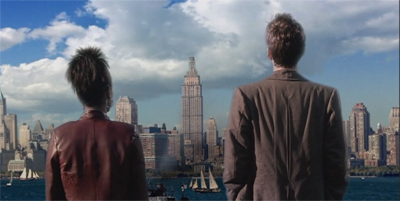
The concept of Daleks in the past is a great idea. However, with the exception of Evil of the Daleks, it is also a bit of a tricky one. Steven Moffat found that out with the first Dalek story of his tenure, Victory of the Daleks, bringing the Daleks to the Second World War. However, Russell T. Davies tried telling a Dalek story set in the past as part of the show’s third season. The Parting of the Ways had featured a Dalek story set in the future, while Doomsday saw the fiends lay siege to modern-day London. Placing the Daleks in 1930s New York seems a staggeringly ambitious proposition.

It's a hell of a town...

It’s a hell of a town…

Continue reading

Doctor Who: The Dalek Invasion of Earth (Review)

To celebrate the fiftieth anniversary of the longest-running science-fiction show in the world, I’ll be taking weekly looks at some of my own personal favourite stories and arcs, from the old and new series, with a view to encapsulating the sublime, the clever and the fiendishly odd of the BBC’s Doctor Who.

The Dalek Invasion of Earth originally aired in 1964.

We are the masters of Earth. We are the masters of Earth. We are the masters of Earth.

– who are the Daleks trying to convince?

Watching the early years of Doctor Who, I often find myself struggling to measure the quality of a show as against its importance to the series as a whole. Sixties Doctor Who has perhaps an unfair reputation when it comes to quality. In fact, as a rule, I’ve been pleasantly surprised on my trips back to the archives for these reviews. However, it’s often much more interesting to look at the context and the legacy of these classic episodes, as the show begins to define what it is and what it isn’t, what it can do and what it can’t do.

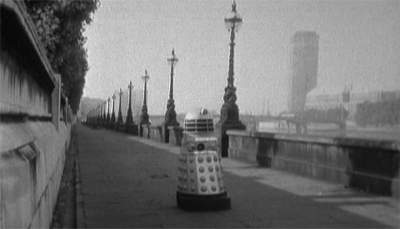
In that context, The Dalek Invasion of Earth is a massively important story. It features the first returning monsters of the series (go on, guess!), the first departure of a companion, the first invasion of Earth, the first aliens in London. The list goes on and on. There’s an incredibly vast influence that The Dalek Invasion of Earth has on the half-century of Doctor Who that follows. It’s nearly impossible to deny the shadow that this adventure casts.

However, it’s also a very flawed piece of television, for all its iconic status. Indeed, watching these six episodes I’m more often struck by what is important rather than what is good.

The Daleks of London...

The Daleks of London…

Continue reading

Doctor Who: The Dæmons (Review)

To celebrate the fiftieth anniversary of the longest-running science-fiction show in the world, I’ll be taking weekly looks at some of my own personal favourite stories and arcs, from the old and new series, with a view to encapsulating the sublime, the clever and the fiendishly odd of the BBC’s Doctor Who.

The Dæmons originally aired in 1971.

I’ve bought you a nice cuppa, Sergeant. I hope you like china.

For goodness sake, Miss Hawthorne.

What’s the matter? Don’t you like tea?

Something’s gone badly wrong. We’ve no idea what’s happening to Miss Grant and the Captain, the Doctor should be back here by now, I can’t get through to the Brigadier and you’re nattering on about tea.

You must learn the art of waiting, Sergeant. The Doctor will come, or else he won’t, and that’s all that can be said. Now, milk or lemon?

– Miss Hawthorne helps Sergent Benton get his priorities straight

Barry Letts was a very talented man. I feel like I don’t stress that often often. I’ll freely concede that the UNIT era isn’t my favourite part of Doctor Who history, but there are times when you really have to admire the skill and competence of Letts as the show’s producer. In fact, he served as both a director and a writer on the series. He had a very clear vision for the show, and he implemented it remarkably well, to the point where his work on the show still stands out as something quite distinguished from the work of other producers.

The Dæmons is a very clear illustration of just how carefully and how thoughtfully Letts had overhauled the show for the seventies. While it’s not the most Letts-ian episode ever produced (he would produce, write and direct Pertwee’s final episode, Planet of the Spiders), but it is a great illustration of Letts’ approach to the programme and perhaps a testament to his lasting legacy.

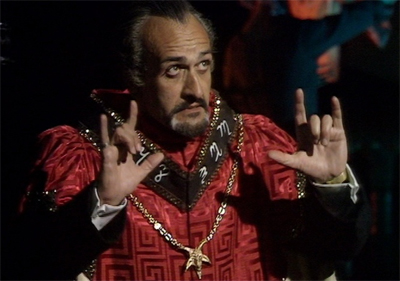
Rock on, you crazy Master...

Rock on, you crazy Master…

Continue reading

Doctor Who: Colony in Space (Review)

To celebrate the fiftieth anniversary of the longest-running science-fiction show in the world, I’ll be taking weekly looks at some of my own personal favourite stories and arcs, from the old and new series, with a view to encapsulating the sublime, the clever and the fiendishly odd of the BBC’s Doctor Who.

Colony in Space originally aired in 1971.

Are you some kind of scientist?

I’m every kind of scientist.

– Caldwell and the Doctor

Colony in Space is an interesting story for many reasons. For one thing, it’s the first colour adventure to travel to another world. It was the first time since Jon Pertwee took over the title role that the character had been allowed to leave the surroundings of modern-day Earth. Even if he did land in a quarry. Colony in Space demonstrated the possibilities to tell futuristic and extraterrestrial stories in the new and remodelled version of Doctor Who, and the show began to slowly venture further and further afield over the next few years, with the Doctor finally regaining control of his TARDIS in The Three Doctors a little under two years later.

However, Colony in Space is also interesting because it is a script from Malcolm Hulke, who has really become one of the more Doctor Who script writers more inclined to pepper his scripts with political and moral philosophy. Colony in Space is an interesting exploration of those themes, even if it does run a little bit long in places. (That said, Hulke is one of the better writers of the six-part format in the show’s history.)

Go on, try to fight the urge to pronounce the episode title like "colony... IN SPACE!"

Go on, try to fight the urge to pronounce the episode title like “colony… IN SPACE!”

Continue reading

Doctor Who: The Claws of Axos (Review)

To celebrate the fiftieth anniversary of the longest-running science-fiction show in the world, I’ll be taking weekly looks at some of my own personal favourite stories and arcs, from the old and new series, with a view to encapsulating the sublime, the clever and the fiendishly odd of the BBC’s Doctor Who.

The Claws of Axos originally aired in 1971.

Are you trying to tell me you can absorb the total output of this complex in a police box?

Yes.

– Hardiman and the Master discover that self-confidence is a genetic Time Lord trait

The Claws of Axos tends to come in for a fair bit of criticism for pretty much being the quintessential Earth-based Jon Pertwee story, with very little exceptional to distinguish it from the pack. Personally, I’m actually quite fond of it, perhaps precisely for that reason. I think you’re hard-pressed to find an adventure in the early part of Jon Pertwee’s tenure that so effectively and so efficiently captures the spirit of the show – both good and bad. That kind of makes The Claws of Axos stand out if only because it so perfectly embodies those early Pertwee years.

Eye see you…

Continue reading