• Following Us

  • Categories

  • Check out the Archives


  • Awards & Nominations

Doctor Who: The Witch’s Familiar (Review)

“Of course, the real question is where I got the cup of tea. Answer: I’m the Doctor, just accept it.”

– the Doctor tells it how it is

As is the norm for Moffat-era Dalek episodes, The Witch’s Familiar is a mess… but it is an interesting mess.

The Witch’s Familiar works best as a collection of intersecting character moments than a narrative in its own right. In some respects, The Witch’s Familiar feels like a season premiere in the same way that The Magician’s Apprentice did; it is light and breezy, with more energy devoted to character dynamics than to dramatic stakes. The Witch’s Familiar is quite blatantly set-up; it is all about establishing things that might possibly become more important later on. Davros is revived; the Hybrid is mentioned; Skaro is back in play.
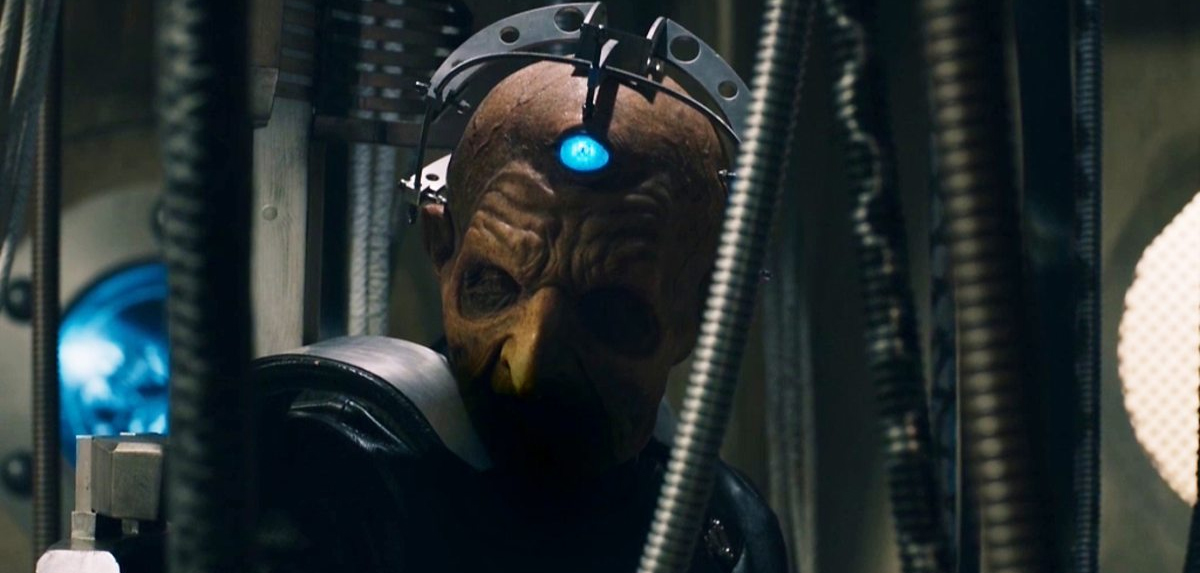
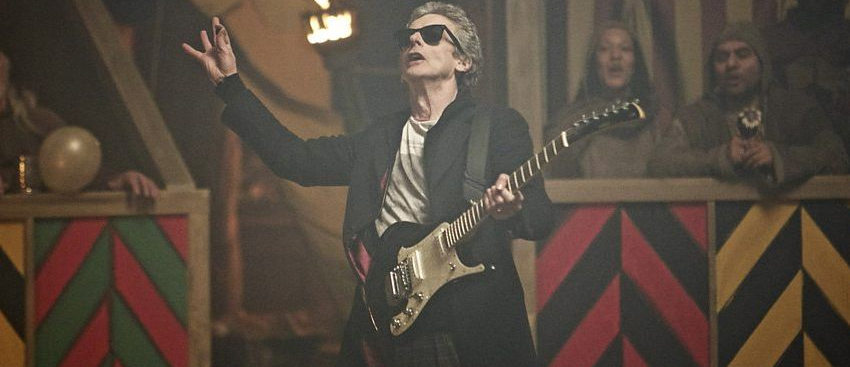
Destiny of the Davros...

Destiny of the Davros…

The plot is all over the place, with Moffat’s script avoiding retreading old thematic ground about “the Oncoming Storm” and justifiable genocide by barely alluding to the moral quandaries that The Magician’s Apprentice set-up. When Davros alludes to the idea of the Doctor wiping out the Daleks through a single act of murder, or harnessing all that power for his own ends, it feels like Davros is just barreling through a check list of cheap shots that any major adversary is expected to land when facing the Doctor. The Dalek Emperor did it more convincingly in The Parting of the Ways.

Still, this familiarity does allow The Witch’s Familiar to lock the Doctor and Davros in a room together for an extended period of time. It affords the pair the chance to trade barbs and to understand one another in a way that no previous story has attempted. One of the more interesting aspects of a season of ninety-minute stories told across multiple episodes in 2015 is that the format is remarkably different than a season of ninety-minute stories told across multiple episodes in 1989. This is a season of serialised stories, but it is not a return to the classic model.
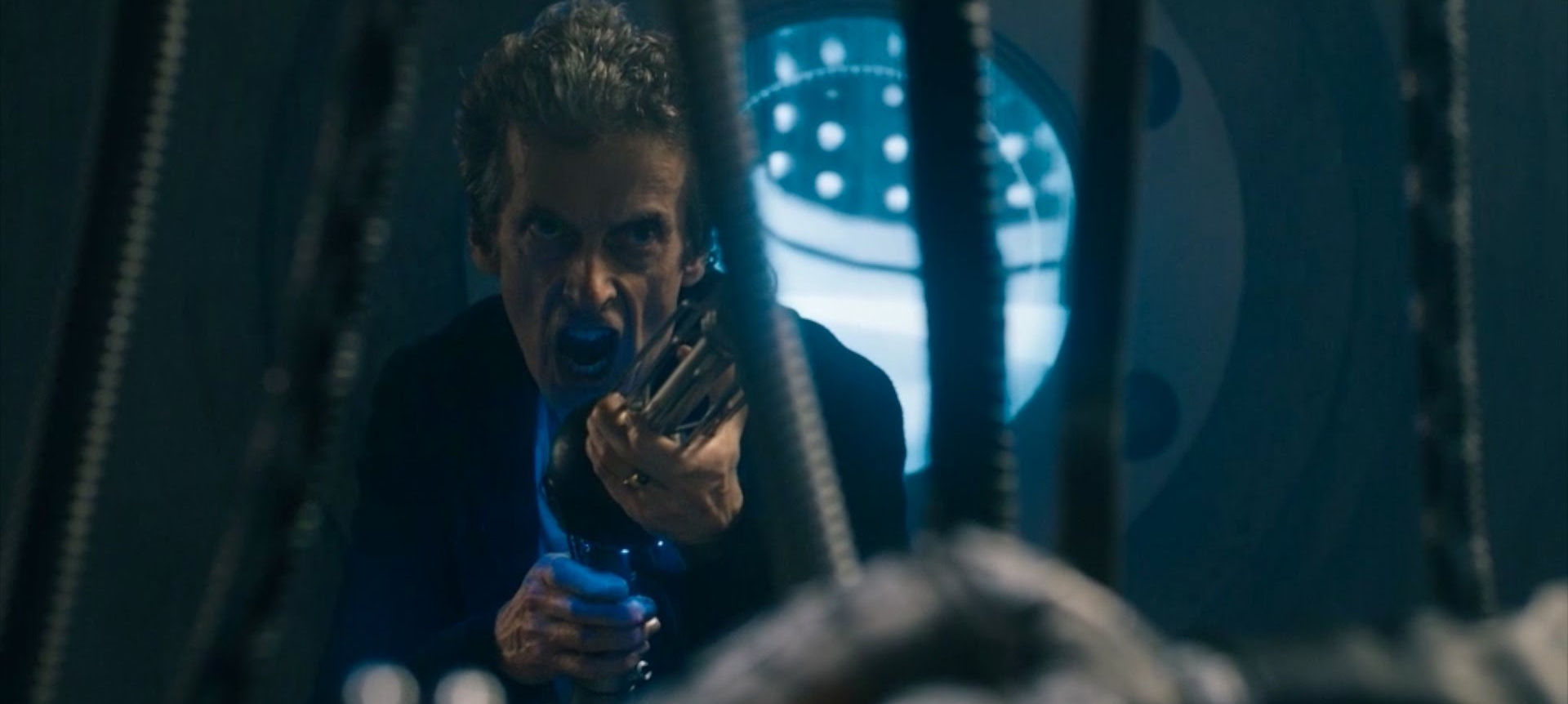
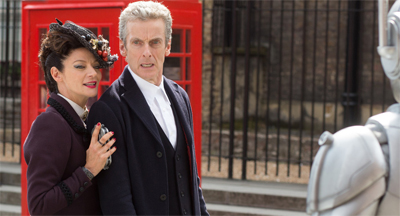
Exterma- wait a minute!

Exterma- wait a minute!

The classic series would never have been able to pull off this sort of quiet and understated interaction between the Doctor and Davros. The nature of a classic Dalek story was to build to a climax of the Doctor and Davros screaming at each other across the room; the pleasure of The Witch’s Familiar is the space that it affords both characters to move past the shouting and to something towards mutual comprehension. It helps that The Witch’s Familiar has two fantastic central performers in Peter Capaldi and Julian Bleach.

The Witch’s Familiar might be yet another example of the Moffat era trying and failing to construct an entirely functional Dalek story, but it is quite possibly the single best Davros story ever told. (Give or take a Revelation of the Daleks.)

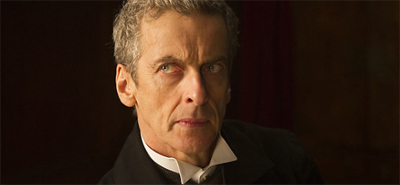
Shades of grey...

Shades of grey…

Continue reading

Doctor Who: The Magician’s Apprentice (Review)

“The TARDIS will not be entered. The TARDIS will be destroyed.

“Good luck with that. She’s indestructible.”

“Did the Doctor tell you that? Because you should never believe a man about a vehicle.”

 – The Daleks, Clara and Missy share some truths

The ninth season is certainly ambitious.

The idea of building an entire season around a series of interconnected two-parters is a departure from the show’s traditional format. It certainly makes it a lot harder to review the show on a week-by-week basis, if only because it means that reviewers are talking about each episode having only seen around half the story. That is not the way that people typically consume Doctor Who. Even modern DVD releases of the classic series package whole series together so it is not so much a four- (or six-) part episode as a single story.

Battlefield.

Battlefield.

Since it returned to television in 2005, Doctor Who has adopted an approach to narrative driven by the single episode as the default narrative unit. Sure, there were multi-part stories; but they were the exception rather than the rule. Sure, there were season long arcs; but they were largely driven by arc words and core themes as much as plot. This was, after all, the big controversy over Moffat’s “Impossible Girl” arc, which was presented as a plot mystery only to be revealed as a clever thematic point.

During the Davies era, the two-parters were typically allocated for big “event” episodes. There were roughly three in a season, and they allowed the show to adopt a bigger sense of scale and spectacle. The first two-parter was typically lighter and little bit toyetic (the “toy monster” two-parter) and the second was a lot darker and ominous (the “highlight of the season” two-parter). Davies would then use a two-parter to provide a suitably bombastic conclusion to the season, offering “blockbuster” family entertainment at the height of summer.

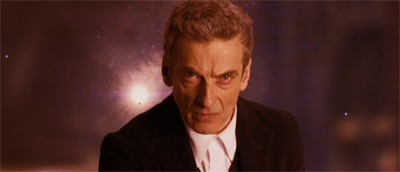
An axe to grind...

An axe to grind…

Continue reading

Star Trek: Enterprise – Future Tense (Review)

Next year, Star Trek is fifty years old. We have some special stuff planned for that, but – in the meantime – we’re reviewing all of Star Trek: Enterprise this year as something of a prequel to that anniversary. This April, we’re doing the second season. Check back daily for the latest review.

The Temporal Cold War arguably works better as a metaphor than a plot.

There is something quite compelling about the imagery of Star Trek‘s past and future doing battle within the confines of a troubled prequel, of outside forces meddling in a narrative, of the characters caught in the grip of forces they cannot understand. To expect the Temporal Cold War to make sense is to miss the point; to expect clear resolution is foolhardy. Instead of serving as a strong narrative thread running through Star Trek: Enterprise, it serves as a visual manifestation of the troubles haunting the show. It also serves as a very effective story backdrop.

Let's do the time warp again...

Let’s do the time warp again…

Future Tense has a pretty straightforward story. Archer and his crew discover a piece of floating space debris. They bring it aboard, discovering it is not what it appears to be. The Suliban show up, claiming salvage rights. The Tholians arrive, demanding the same. A chase ensues, as Archer tries to outrun the two alien species desperate to get their hands on the technology. Future Tense is a classic chase narrative, as multiple parties fight over what Hitchcock described as a “macguffin.” Little is revealed, nothing is proven, everything is resolved so neatly that it seems divine intervention is at work. Maybe it is.

And yest, despite – or perhaps because – of this narrative simplicity, Future Tense stands as a highlight of the troubled second season. Future Tense leaves almost every question about the Temporal Cold War unanswered, but it is a tight and efficient action adventure. Like Cold Front before it, it recognises that the Temporal Cold War is a story as much as a backdrop. The fact that it is mysterious and nonsensical and arbitrary make it all the more compelling. After all, that is how it must appear to Archer.

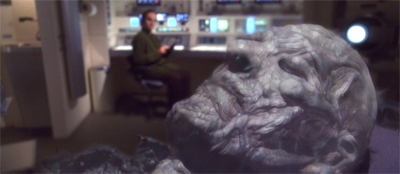
Alien bodies...

Alien bodies…

Continue reading

Doctor Who: Series Eight (or Thirty-Four) (Review/Retrospective)

You asked me if you’re a good man and the answer is, I don’t know. But I think you try to be and I think that’s probably the point.

Peter Capaldi’s first season of Doctor Who is astonishingly linear.

That feels like a very weird thing to type, but it’s true. Executive producer Steven Moffat backed away from the ambitious structural experiments that defined the two previous seasons, pushing the show back towards a fairly conventional and logical structure. Between Deep Breath and Death in Heaven, there was a clear logical progression. The season did not begin at the end like The Impossible Astronaut did, or end at the beginning like The Name of the Doctor.

doctorwho-deepbreath2

Instead, things progressed cleanly and logically. Character arcs evolved in a very clear and structured way; themes built organically; the season’s central mysteries had little to do with the intricacies of time travel and more to do with guessing the nature of the returning threat. The result was perhaps the most accessible and linear season of Doctor Who since Steven Moffat’s first year as executive producer. In fact, it was the first season not to be split since Steven Moffat’s first season as executive producer.

To be fair, it is easy to see why such an approach was taken. While Peter Capaldi might be one of the most high profile and most successful actors to ever take on the lead role, changing the lead actor on successful television show is always a risky proposition; it is impossible to be too careful in managing the transition. The actor’s first season in the role is an endearing effort; a rather safe first half of the season giving way to a more adventurous and playful second half. While the season has a few flaws, it is hard to consider it anything but a massive success.

doctorwho-intothedalek17

Continue reading

Doctor Who: Last Christmas (Review)

There’s a horror movie called Alien? That’s really offensive. No wonder everyone keeps invading you.

Last Christmas is perhaps the most Moffat-esque Christmas Special of the Moffat era.

As such, it is an episode that will inevitably provoke a strong reaction, playing as it does to the writer’s strengths and interests in Doctor Who. As a show, Doctor Who has a long history of crashing genres into one another. One of the most endearing aspects of the show is the way that it can be a completely different show from week to week. One week, it is a western; the next, it is a horror film. One episode is a period adventure; another is a science-fiction comedy. Doctor Who is a show about a mad man in a box who crashes into random stories.

doctorwho-lastchristmas4

Last Christmas is quite overt about this. When Shona wakes up towards the end of the episode, we are treated to a glimpse of her “to do” list for Christmas Day, which happens to feature a variety of clear influences on the episode. Strangely, she plans to open her Christmas Day binge with a double-bill of Alien and The Thing From Another World, before taking a breather and returning for Miracle on 34th Street – you really do need a bit of space before properly digesting the truly heavy stuff. (She’s also marathoning the Hugo-winning Game of Thrones.)

Last Christmas is a story that is incredibly (and almost cheekily) aware of its own fictionality. As with so much of Moffat’s Doctor Who, it is a story about stories. And dreams, which are really the same thing. “Time travel is always possible in dreams,” the Doctor observes, to borrow a quote from The Name of the Doctor. Dreams and stories.

doctorwho-lastchristmas Continue reading

Doctor Who: Death in Heaven (Review)

Welcome to the only planet in the universe where we get to say this. “He’s on the payroll.”

Am I?

Well, technically.

How much?

Shush.

Death in Heaven doesn’t work quite as well as Dark Water. Then again, it has a lot more to do.

After all, Dark Water was a sublimely extended joke – a forty-five minute gag. It is easier to affectionately parody the excess of the Davies-era finalés in the first part than it is to offer a straight-up imitation of those same finalés in the second. This simply isn’t the sort of season finalé to which Moffat’s style lends itself. This is very much a return to the scale and mood of The Parting of the Ways, Doomsday, The Last of the Time Lords or Journey’s End – the type of big emotive farewell season-ender that the show hasn’t done in quite a while.

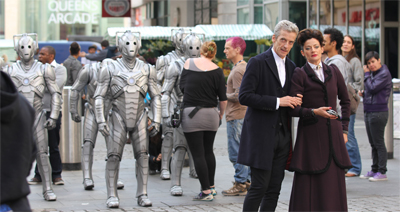
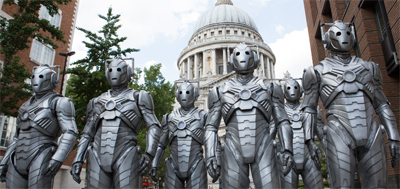
"Hm. It used to be a lot easier to inspire terror. Time was five Cybermen marching around St. Paul's Cathedral..."

“Hm. It used to be a lot easier to inspire terror. Time was five Cybermen marching around St. Paul’s Cathedral…”

This is a different beast than The Name of the Doctor, The Wedding of River Song or even The Big Bang. After all, although The Big Bang was the second part of a season finalé with the entire universe at stake, the bulk of the story featured familiar characters in a relatively confined space. In contrast, Death in Heaven is very much structured as an “event” story built around an iconic adversary and teasing the departure of a long-term companion. It is full of big emotional beats and stunning set-pieces, placing the entire Earth at the mercy of a massive extraterrestrial threat.

Most of Death in Heaven feels like Moffat is writing in a strange language; he knows the words, but the grammar does not entirely fit. And yet, despite that, Death in Heaven mostly works. It doesn’t work as well as it might; it isn’t the strongest script of the season by any stretch; it is a little disjointed, a little all over the place, a little too giddy with itself in places. However, it is as clever as viewers have come to expect from the show and the writer, remaining in tune with the season’s core themes and putting an impressive capstone in Peter Capaldi’s first season as the Doctor.

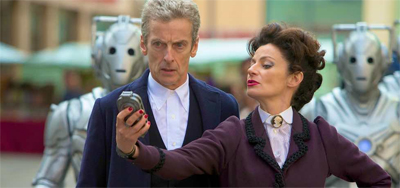
Psycho selfie!

Psycho selfie!

Continue reading

Doctor Who: Dark Water (Review)

I presume you have stairs?

I’m not a Dalek.

Dark Water is downright provocative in places, and rather ingenious.

On the surface, Dark Water is the first part of a season-ending two-parter building to the return of two very obvious pieces of Doctor Who continuity. In doing so, it cleverly demonstrates one of the most obvious issues with the two-part structure in contemporary Doctor Who. The episode spends forty-five minutes building to a game-changing cliffhanger that is quite easy to figure out ahead of time. (Not least because the BBC’s publicity department loves Cybermen.) As such, the typical first part of a two-parter ends where the Doctor Who story actually begins.

doctorwho-darkwater9

However, there’s something far shrewder happening beneath the surface. While Dark Water spends most of its runtime affectionately mocking the inevitability of the two revelations at the climax, it is very in keeping with the aesthetic of the Moffat era around it; it is much more interested in the intimate than the epic. The climax beautifully subverts the classic Davies era “global invasion” cliffhanger by dismissing the Doctor as “another mad Scot” while the public look on bemused at the six Cybermen wandering down from St. Paul’s Cathedral.

In contrast, the juicy parts of Dark Water are those defined by the personal relationships at play. For all the iconic visuals and soaring music, the episode doesn’t close on the Cybermen or the Master; it closes on Danny and the reflection of the young child he killed. The episode’s big dramatic beat is that final conversation between Danny and Clara. The reveal that Missy is really the Master is obvious, but it is more interesting for her re-contextualising her relationship with the Doctor as that of a spurned and abandoned lover. It’s all personal.

doctorwho-darkwater13 Continue reading

Doctor Who: In the Forest of the Night (Review)

There are some things I have not seen. That’s usually because I’ve chosen not to see them. Even my incredibly long life is too short for Les Misérables.

On paper, In the Forest of the Night should be a highlight of the season. Frank Cottrell-Boyce is quite a sizeable “get” for the show, one of the most significant guest writers to work on Doctor Who in quite some time. Cottrell-Boyce is on the same level as Richard Curtis or Neil Gaiman, as far as “special guest writers” go. Coupled with the fact that this is the first time that the Twelfth Doctor has wandered into the “fairy tale” aesthetic that defined his predecessor, In the Forest of the Night should be a classic waiting to happen.

However, In the Forest of the Night never quite comes together as well as it should. At its best, it riffs on concepts already very thoroughly and thoughtfully explored in Kill the Moon. At its worst, it feels ill-judged and an awkward fit for the characters in the show. In the Forest of the Night comes at the end of a highly successful stretch of late-season episodes all credited to writers working on Doctor Who for the first time; it is quite endearing that In the Forest of the Night is the only stumbling block; ironically arriving at the latest possible moment.

Tyger, Tyger...

Tyger, Tyger…

Still, there is some interesting material here. It is also a sly and affectionate homage to the work of William Blake. Blake was famed author, illustrator and poet. In the Forest of the Night takes its title from a line in Blake’s most famous poem Fearful Symmetry. There are points where the episode goes out of its way to reference that work. The Doctor makes a reference to the year of its most popular publication, assuring the assembled audience that “a tiny little bit of 1795 still alive inside of it.” There is a tiger; there is burning bright.

However, these allusions towards Blake ultimately lead In the Forest of the Night into some very questionable ideas. William Blake was haunted throughout his life by visions and hallucinations. He saw things that were not real, but which informed and inspired his work. In the Forest of the Night tries to borrow from this aspect of Blake’s life in its characterisation of Maebh, a young girl with visions. It is a story that falls right back on the rather clichéd narrative about how medicating people suffering with mental illness is in effect destroying what makes them special or unique.

... burning bright.

… burning bright.

Continue reading

Doctor Who: Flatline (Review)

Same time, same place… ish.

…ish? Don’t give me an ish.

These readings are very… ish-y.

In many respects, Flatline can be seen as the flipside of Turn Left.

Turn Left was twinned with Midnight towards the end of David Tennant’s final year in the lead role. If Midnight was a story about the Doctor trapped in an adventure without his faithful companion, Turn Left was very much the story of the companion trapped in an adventure without the Doctor. Both of those stories seem to stress the need for both a Doctor and a companion to form a functioning team, building very consciously towards the merging of the two in the season finalé, Journey’s End.

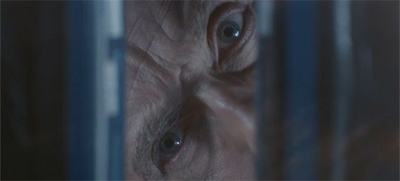
Eyebrows!

Eyebrows!

While Midnight suggests that the Doctor would have great difficulty without a companion to help ground him, Turn Left is even more pessimistic. It seems to set a ceiling for the role of the companion. Without the Doctor, the best that his companions can do is fight to a depressing stalemate and hope to rescue some alternate universe where the Doctor is still alive. As far as Turn Left is concerned, the companion fills a very important function – but that function is very clearly secondary to the Doctor.

In contrast, Flatline seems to suggest that the companion can step up to fill the vacancy left by the Doctor. Flatline builds off the climax of Kill the Moon in positioning Clara as a character who could step in to the role of the Doctor. It is an interesting idea, arguably one that the show has been teasing from as early as Ace’s character during the final season of the classic show. Here, Clara suggests that it might be possible for a companion to elevate themselves to such a position. However, it remains questionable if such a possibility would be desirable.

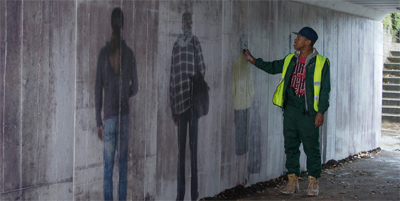
Drawn together...

Drawn together…

Continue reading

Doctor Who: Mummy on the Orient Express (Review)

“You know, Doctor, I can’t tell if you’re ingenious or just incredibly arrogant.”

“On a good day, I’m both.”

Mummy on the Orient Express is Doctor Who in a blender. It’s classic period piece, genre pastiche and science-fiction spectacle, mixed with a healthy dose of creature feature horror and a solid development of the themes running through the eighth season so far. It’s clever, witty and energetic. The episode is a delight from beginning to end, beating out Robot of Sherwood and Time Heist to claim the title of the year’s best “romp” – as you might expect from a story that is a Hammer Horror murder on the Orient Express in Space.

doctorwho-mummyontheorientexpress8

Continue reading