• Following Us

  • Categories

  • Check out the Archives


  • Awards & Nominations

Marvel 1602 (Review)

After spending the tail end of last year looking at the tangled inter-continuity crossovers at Marvel, I thought I’d spend January looking at some of the looser “out of continuity” tales at the major companies.

Although DC invented the term “elseworlds” to describe alternative continuities featuring familiar characters in unfamiliar settings, it was really Marvel who ran with it. Even discounting the Ultimate line, Marvel has produced any number of alternative continuity worlds within the past decade or so – not stories or chapters, but worlds. Tales spin-off in so many different directions that these stories become viable alternative versions of the Marvel Universe, just with a variation upon a theme. Marvel Noir offers us the Marvel Universe as seen through a smokey glass-half-empty lens, with tales of Daredevil, X-Men and Spider-Man changed to fit in this strange new setting. Writer Neil Gaiman, however, crafted an especially interesting alternative to mainstream Marvel with 1602. It pretty much does exactly what it says on the tin, transposing the modern day Marvel Universe to 1602.

Take these broken wings...

Continue reading

Brian Michael Bendis’ Avengers – New Avengers Vol. 3-4 (Hardcover) (Review/Retrospective)

This is the eighth in a series of comic book reviews that will look at the direction of Marvel’s continuity (and, in particular at their “Avengers” franchise) over the past five or so years, as they’ve been attempting to position the property at the heart of their fictional universe. With The Avengers planned for a cinematic release in 2012, I thought I’d bring myself up to speed by taking a look at Marvel’s tangled web of continuity.

And now we’re entering a continuity-heavy area. You have been warned. As if we’ve been in a continuity-free zone for the past couple of weeks, remarks you, trusted reader. This is where my little experiment to venture deep into the heart of Marvel’s comic book continuity becomes a little bit more complicated and a little bit more difficult. Whereas the first part of Bendis’ run on New Avengers was relatively stand-alone (while still drawing on decades of events and continuity), it’s at this point the series becomes irrevocably intertwined with the on-going events at the heart of the Marvel Universe. It’s been described as “a spine”, and that’s pretty much exactly what it is: it’s a support structure which ties together the big Marvel events year-on-year, a thread that joins events like Civil War and Secret Invasion and Siege to each other and the greater fictional universe.

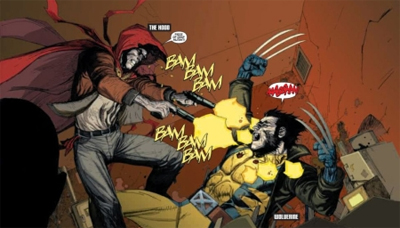
Wolverine learns the hard way not to bring claws to a gun fight...

Continue reading