• Following Us

  • Categories

  • Check out the Archives


  • Awards & Nominations

Star Trek VI: The Undiscovered Country (DC Comics, 1992) (Review)

This June, we’re taking a look at some classic Star Trek movie tie-ins and other interesting objects. Check back daily for the latest reviews and retrospectives.

In many respects, adapting a Star Trek feature film into comic book form is very much an editorial function. With so little space available, particularly as compared to a feature film or novel, the assignment is more about whittling the script down to something that can be covered in fifty-five pages of a comic book. While those adapting the features films into novels frequently have to expand and flesh out the material to make it fit within the allocated page count and account for plot hole and logic error, the comic book adaptations just have to keep everything ticking over.

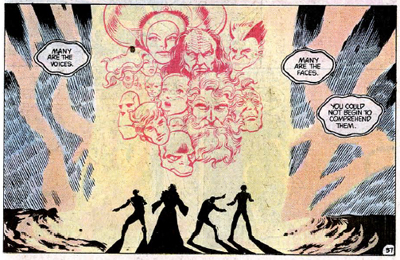
So Peter David and Gorden Purcell’s adaptation of Star Trek VI: The Undiscovered Country plays quite well as a condensed version of the narrative, covering the requisite story beats in the available space.

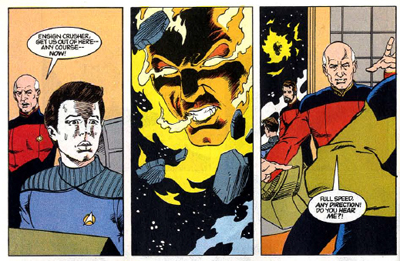
In space, everybody can hear you scream...

In space, everybody can hear you scream…

Continue reading

Star Trek (DC Comics, 1989) #1-12 – The Trial of James T. Kirk! (Review)

This June, we’re taking a look at some classic Star Trek movie tie-ins and other interesting objects. Check back daily for the latest reviews and retrospectives.

The late eighties and early nineties saw a change in the world of Star Trek tie-ins. During the eighties, tie-in writers had typically been afforded a great deal of freedom in telling their stories – allowed to explore the fringes of the Star Trek universe with little regard to how things matched up. The period saw a number of truly spectacular Star Trek tie-ins that count among the best work ever released with the Star Trek brand on it – John Ford’s The Final Reflection or Diane Duane’s My Enemy, My Ally.

However, with the release of Star Trek V: The Final Frontier and the broadcast of the third season of Star Trek: The Next Generation, there was a shift in how the franchise approached tie-in novels and comic books. Gene Roddenberry had arguably lost control of his creation, with the Harve Bennett and Nicholas Meyer taking control of the feature films while Rick Berman and Michael Piller were the driving creative forces on the television show.

Crossing swords...

Crossing swords…

As such, the tie-ins became a place where Roddenberry and his “people” – including Richard Arnold and Susan Sackett – could make their influence most heavily felt. So, in the late eighties and early nineties, a conscious effort was made to re-tool the novels and the comic book tie-ins, with Richard Arnold maintaining a much tighter grip on the reigns. DC’s first volume of Star Trek comics was cancelled after fifty-six issues, and another volume was launched to coincide with the launch of the Next Generation comic.

Writer Peter David had closed out the first volume of the Star Trek comic, and was drafted in as the writer of the new on-going series. However, he almost immediately came into conflict with Richard Arnold. Pages of the first issue had to be hastily re-drawn when Richard Arnold vetoed the use of a supporting character from Star Trek: The Animated Seriesafter the comic had been drawn. In many respects, this set the tone for the comic, which was victim to all sorts of weird editorial mandates.
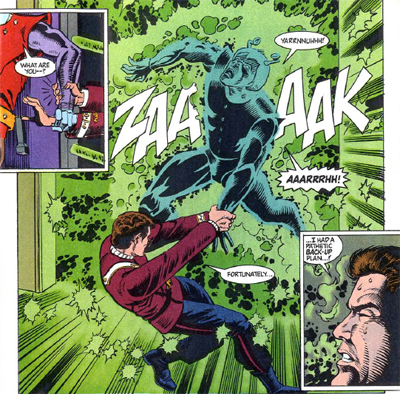
The Andorian Incident...

The Andorian Incident…

While writer Michael Jan Friedman remained the writer on the on-going Next Generation comic for most of its run – only occasionally getting another writer to fill in – Peter David departed the Star Trek comic before the end of the book’s second year on the stand. This is especially frustrating when one considers the pedigree of Peter David. An accomplished novelist and comic book writer, David had a wealth of experience in the medium that was being maliciously squandered by Arnold.

It’s a shame, because the opening twelve issues of DC’s second volume of Star Trek make for a delightful read and a fitting substitute for a live-action Star Trek television show unfolding between the movies.
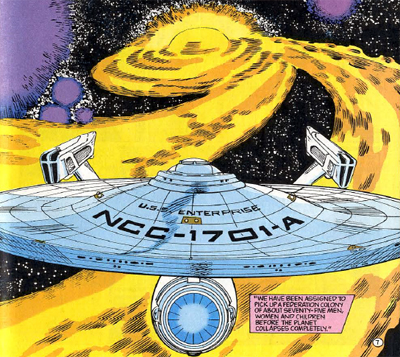
Warp speed ahead...

Warp speed ahead…

Continue reading

Star Trek V: The Final Frontier (DC Comics, 1989) (Review)

This June, we’re taking a look at some classic Star Trek movie tie-ins and other interesting objects. Check back daily for the latest reviews and retrospectives.

In many respects, the late eighties represented a changing of the guard when it came to Star Trek. The feature films had been relatively serialised. The events of Star Trek II: The Wrath of Khan led into the events of Star Trek III: The Search for Spock, which itself led directly into the events of Star Trek IV: The Voyage Home. At the same time, the expanded universe was generally left free to its own devices. Novelists and writers were given the freedom to do whatever they wanted.

In the late eighties, things changed. Directed by William Shatner, Star Trek V: The Final Frontier stood quite clearly apart from the events of the last three Star Trek films. At the same time, the franchise had found its way back to weekly television in the form of Star Trek: The Next Generation. Whereas comic books and novels had served to fill a gap when there was a scarcity of “official” Star Trek material, they were now very clearly of secondary importance to the “real” (or simply “live action”) versions of Star Trek.

Oh your God...

Oh your God…

There was a rather seismic shift in the nature and tone of tie-ins and adaptations. Rather notably, the creators who had adapted the last couple of films into prose and comic book form did not return to translate The Final Frontier across different media. Vonda McIntyre had written the novelisations of the last three Star Trek films, but was replaced by J.M. Dillard. Mike W. Barr and Tom Sutton had produced the comic book adaptations of the last two Star Trek films, but were replaced by Peter David and James W. Fry. Both Dillard and David would find themselves tasked with adaptation of Star Trek VI: The Undiscovered Country.

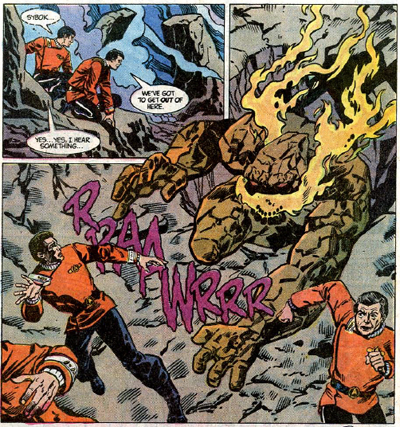
Peter David and James W. Fry’s adaptation of The Final Frontier is clearly intended as a launchpad for their new on-going Star Trek series that would debut only a few months later. Indeed, the final page of The Final Frontier includes an advertisement for that new series. In many respects, this adaptation of The Final Frontier seems to serve as a pilot for a new comic book series, a starting point for a bold new beginning to DC’s Star Trek line. Opening with the The Final Frontier, you might be forgiven for assuming it was doomed from the outset.

Here there be rock monsters...

Here there be rock monsters…

Continue reading

Star Trek IV: The Voyage Home (DC Comics, 1986) (Review)

This June, we’re taking a look at some classic Star Trek movie tie-ins and other interesting objects. Check back daily for the latest reviews and retrospectives.

The comic book adaptation of Star Trek IV: The Voyage Home does a surprisingly good job of translating the comedy adventure into comic book form. Relying the creative team of Mike W. Barr and artist Tom Sutton to produce a one-shot comic book adaptation of the feature film, DC Comics have reached a point where they are able to consistently and reliably churn out comic books based around the Star Trek franchise.

Indeed, one might imagine that the somewhat lighter tone of The Voyage Home would pose a challenge for the duo, eschewing the grand space opera of Star Trek III: The Search for Spock in favour of something more firmly rooted in modern sensibilities. However, Barr and Sutton do a wonderful job adapting the screenplay into a charming comic, even if it does seem to be aimed more squarely at hardcore Star Trek fans than casual viewers.

Standing tall...

Standing tall…

Continue reading

Star Trek (DC Comics, 1984) #1-6 – Errand of War! (Review)

This July, we’re taking a look at some classic Star Trek movie tie-ins. Check back daily for the latest reviews and retrospectives.

After Marvel lost the Star Trek license in 1982, there was a period where no monthly Star Trek comics were being published. One of the consequences of this was that Star Trek II: The Wrath of Khan didn’t receive an official comic book adaptation, until IDW decided to go back and fill in the blanks in 2009. Eventually, DC comics managed to secure the license for Star Trek comics, and they began publishing in 1984, the year that saw the release of Star Trek III: The Search for Spock. DC would maintain the license into the mid-nineties, making it one of the most stable licensing agreements ever reached about Star Trek comics.

Unlike Marvel’s 1979 agreement with Paramount, DC reached an agreement that allowed them full access to the Star Trek mythology. Marvel had been restricted to using characters and concepts from Star Trek: The Motion Picture, a rather restrictive agreement. In contrast, DC had access to the whole of the Star Trek canon. Indeed, reading Mike Barr and Tom Sutton’s run on Star Trek, it seems like their opening six issues were designed to showcase the sheer breadth of continuity available to them.

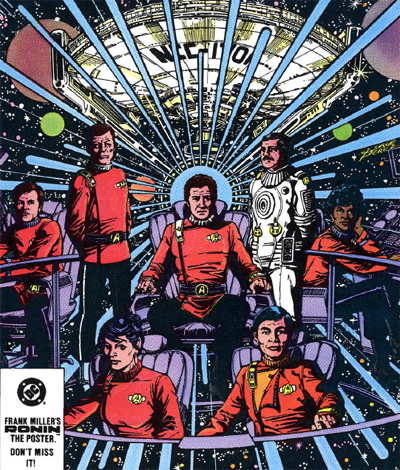
At the same time, Barr’s scripts have a pulpy charm that makes them highly enjoyable, even as trying to tell an unfolding Star Trek story set between the events of The Wrath of Khan and The Search for Spock seems ill-advised.

Warp speed ahead...

Warp speed ahead…

Continue reading

Harlan Ellison’s 7 Against Chaos (Review)

This June, we’re taking a look at some classic Star Trek movie tie-ins and other interesting objects. Check back daily for the latest reviews and retrospectives.

Star Trek: The Motion Picture went through a variety of iterations before settling on the version finally produced – a revised version of In Thy Image, the proposed pilot for the aborted Star Trek: Phase II television series. The story was devised by noted science-fiction author Alan Dean Foster, who had enjoyed a long relationship with the franchise – novelising episodes of Star Trek: The Animated Series earlier in the decade. Decades later, he would novelise the JJ Abrams films.

However, Foster was not the only noted science-fiction author who consulted on the development of what would become The Motion Picture. Theodore Sturgeon, who had contributed to the show, was among those contributing. Ray Bradbury, who Roddenberry had pursued to write for the show on several occasions but never did, also pitched. However, one of the more interesting ideas came from Harlan Ellison.

Ellison is a writer who will forever be associated with the franchise. He contributed the original teleplay for The City on the Edge of Forever, but was infamously displeased with how the episode turned out. He and Roddenberry had an acrimonious relationship after that point, with both sides prone to make cutting remarks and accusations across the aisle at one another. Roddenberry was fond to exaggerating or lying about Ellison’s original script, while Ellison was quite candid about his opinion of Roddenberry as a writer.

7againstchaos7

Continue reading

Star Trek: The Next Generation (DC, 1989) Annual #1 – The Gift (Review)

This January and February, we’ll be finishing up our look at the second season of Star Trek: The Next Generation and moving on to the third year of the show, both recently and lovingly remastered for high definition. Check back daily for the latest review.

We’ll be supplementing our coverage of the episodes with some additional materials – mainly novels and comics and films.

You can see why DC comics jumped at the chance to publish The Gift. After all, a comic about Q written by the actor playing Q is a hell of a hook. The publisher had already done something similar, with actor Walter Koenig providing a script for the nineteenth issue of DC’s first Star Trek comic book series. At the same time that The Gift was published, George Takei collaborated with Peter David on a Star Trek annual story, So Near the Touch.

John deLancie isn’t a bad storyteller. Indeed, his published tie-in novel – I, Q written with Peter David – is quite enjoyable. However, The Gift is just an absolute mess of a story, with a couple of interesting high concepts buried beneath two horrible clichés tied together to create a rather unfortunate narrative. The Gift is a disappointment on just about every level.

Cue Q!

Cue Q!

Continue reading

Star Trek: The Next Generation (DC Comics, 1989) #19 – The Lesson (Review)

This January and February, we’ll be finishing up our look at the second season of Star Trek: The Next Generation and moving on to the third year of the show, both recently and lovingly remastered for high definition. Check back daily for the latest review.

We’ll be supplementing our coverage of the episodes with some additional materials – mainly novels and comics and films. This is one such entry.

One of the biggest problems that the writing staff had on Star Trek: The Next Generation was the insistence that the show was episodic. Themes and characters were rarely carried from week to week. Occasionally, a plot point or character might recur, but the bulk of the show was intentionally designed to be readily accessible in just about any order imaginable. In the era of HBO and “televisual novels”, this approach seems quite quaint, but it was very much the reality of late eighties and early nineties television.

However, there were no such restrictions on comic book story telling. Far from downplaying continuity and long-term plotting, mainstream American comics pride themselves on their serialised nature. It’s quite common for characters to suddenly reappear after absences of considerable time, and for writers to make callbacks to events that occurred decades ago. Publishing twelve issues a year, typically from the same author, The Next Generation comic book did afford the opportunity for a slightly different type of storytelling.

All set...

All set…

And, to be fair, that was one of the strengths of Michael Jan Friedman’s approach to The Next Generation comic book. He was fond of focusing on supporting characters, or giving page space to characterisation, or even basking in the show’s continuity in a way that wasn’t possible on television. Sure, Friedman could occasionally get a little obsessive in his continuity references, and could occasionally have difficulty tying everything into a cohesive story, but this was one way the author capitalised on the shift in the medium.

The Lesson is a single-issue story that is all the more intriguing for essentially existing as a series of character moments, with little in the way of an over-arching plot. The writing is a little clumsy and on-the-nose, with the comic earnestly offering its readers a rather ham-fisted message of the week, but it’s notable for the way that Friedman seems to bask in the freedom afforded to him by virtue of the fact that he’s writing a comic book (rather than an episode) of The Next Generation.

They've really bonded...

They’ve really bonded…

Continue reading

Star Trek: The Next Generation (DC Comics, 1989) #1-2 – Return to Raimon/Murder, Most Foul (Review)

This January and February, we’ll be finishing up our look at the second season of Star Trek: The Next Generation and moving on to the third year of the show, both recently and lovingly remastered for high definition. Check back daily for the latest review.

We’ll be supplementing our coverage of the episodes with some additional materials – mainly novels and comics and films. This is one such entry.

DC Comics’ limited six-issue tie-in to the launch of Star Trek: The Next Generation might have made an interesting read, but it was a success for the company. It was such a success that the company decided to launch an on-going monthly series tying into Star Trek: The Next Generation. It launched in October 1989, just as the show’s third season was starting on television. It continued throughout the show’s run, wrapping up eighty issues later in February 1996, when Marvel bought the license.

For the bulk of its run, The Next Generation was written by Michael Jan Friedman. Barring a couple of fill-ins scattered across the six-and-a-half year run, Friedman churned out monthly stories with remarkable consistency. Indeed, DC’s second volume of Next Generation would be the most consistent comic book tie-in published during any of the spin-off shows, with the licence for the franchise bouncing around Marvel, Malibu, Wildstorm and IDW in the late nineties and early years of the twenty-first century.

There’s something strangely appropriate about publishing Return to Raimon in tandem with the launch of The Next Generation‘s third season. The third season of The Next Generation is generally regarded as the point where the show really came of age, and the season that laid the foundation for that entire generation of Star Trek spin-offs. It was the point at which the vision of Star Trek proposed by The Next Generation finally came into its own, so it seems fitting that it’s also the point at which one of the franchise’s most consistent and long-running tie-ins begins.

New worlds...

New worlds…

Continue reading

West Coast Avengers Omnibus, Vol. 1 (Review/Retrospective)

To celebrate the release of Thor: The Dark World towards the end of next month, we’ll be looking at some Thor and Avenger-related comics throughout September. Check back weekly for the latest reviews and retrospectives.

I’ve never been especially fond of the classic Avengers. The group has always seemed particularly insular and self-centred for a comic book superhero team, with so much emphasis on their by-laws and regulations, their posh fifth avenue mansion and the strange sense of pride that second-tier characters like Hawkeye seem to place on their own importance within the Avengers franchise. There have been great runs, and there have been comics that I have enjoyed a great deal, but I will concede that I am not a fan of the Silver and Bronze Age Avengers aesthetic.

West Coast Avengers is a clear attempt to develop the franchise, to give Marvel a second high-profile Avengers book. Launched in 1984 and running for a decade, the book followed the establishment of a second superhero team branded on the classic Avengers model. Of course, part of me suspects that this was all just a plan to get Hawkeye out of the mansion (“you and Mockingbird can relocate quickly… and the sooner you do — the sooner our west coast team is operational — the better!” Vision insists).

There are moments of wry self-awareness in West Coast Avengers, but far too much of it reads far too earnestly.

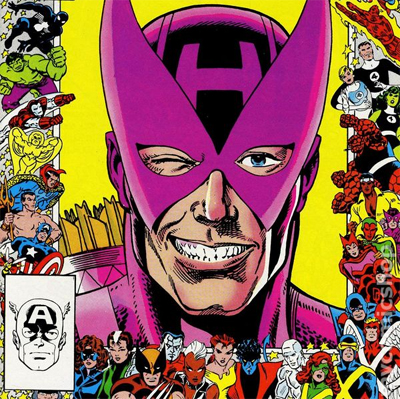
And yet somehow this guy has appeared in two of the biggest superhero blockbusters of the past five years...

And yet somehow this guy has appeared in two of the biggest superhero blockbusters of the past five years…

Continue reading