• Following Us

  • Categories

  • Check out the Archives


  • Awards & Nominations

Grant Morrison’s Run on Action Comics (Review/Retrospective)

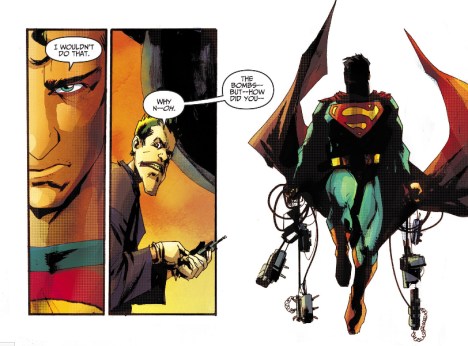
This March sees the release of Batman vs. Superman. To celebrate, we’ll be looking at some iconic and modern Batman and Superman stories over the course of the month.

On paper, Grant Morrison and Rag Morales’ Action Comics should have been a slam dunk.

The title was announced as part of DC’s “new 52” relaunch, a resetting of the comic book giant’s continuity beginning in September 2011. Designed to revitalise the line, shoring up sales numbers and providing a clear point of entry, the “new 52” was clearly intended as a “jumping on” point for new and lapsed comic fans. It was bold and radical, an even greater departure for the company than their reboot following Crisis on Infinite Earths back in 1986. The comic book publisher gave themselves a blank slate.

Wow, he IS more powerful than a locomotive...!

Wow, he IS more powerful than a locomotive…!

In theory, this was a great idea; anything was possible and everything was on the table. In practice, the execution was more muddled; the massive experiment curtailed by a very conservative aesthetic. In many respects, the “new 52” felt like more of the same; familiar mid-tier talent working on familiar mid-tier ideas. The most interesting books were those that dared to do things differently; Scott Snyder inverting Alan Moore’s brilliant twist on Swamp Thing made for iconoclastic reading, as did Brian Azzarello’s ground-up reimagining of Wonder Woman.

In contrast, a lot of the line felt like hedging. Hellblazer was cancelled so that John Constantine could be dragged under the corporate umbrella in Justice League Dark, all in the name of coporate synergy. The Wildstorm characters were ported over into mainstream continuity, in spite of the fact that they were largely redundant or incompatible. Instead of courting either exciting new talent or industry veterans, the company had difficulty drawing top-tier talent. Scott Lobdell and Rob Liefeld were among the relaunch’s heavy hitters.

... And what was that about speeding bullets?

… And what was that about speeding bullets?

To be fair, there were bright spots. But the ideas and concepts that were interesting were frequently hobbled by the demands of the publisher. All-Star Western was diminished by having to tie to Gotham City continuity, while attempts at genre diversity in books like Demon Knights or I, Vampire were under-promoted. Emphasis was placed squarely on monthly print sales numbers, with little patience for books to grow their audiences whether online or through collected editions.

In spite of all the confusion and chaos of the relaunch, Grant Morrison writing Action Comics was the cause of considerable excitement. Morrison was one of few comic book writers who could legitimately be described as a superstar, arguably with a higher profile outside mainstream comics than executives Jim Lee and Geoff Johns. Having Morrison on a monthly book was a big deal, particularly a monthly book as important to the company’s legacy as Action Comics. (Then again, the relaunch also chose to put Tony Daniel on Detective Comics, so there’s that.)
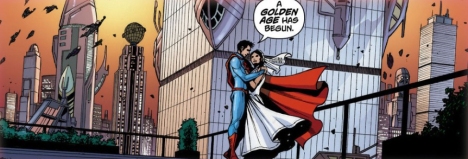
Happily never after...

Happily never after…

More than that, the book represented something of a homecoming for Morrison. Although the character of Superman had struggled with issues of relevance in the twenty-first century, Morrison had been the architect of one of the character’s most beloved stories. All-Star Superman is widely regarded as one of the best Superman stories ever published. Having its author writing a monthly book as part of the relaunch was a big deal. Following high-profile misfires like New Krypton or Grounded, it seemed like the perfect opportunity to put Superman back on the right course.

In many respects, Grant Morrison’s run on Action Comics typifies the sort of push-and-pull at the publisher as part of the relaunch. The great ideas smothered by corporate mandates, the tension between familiarity and novelty, the burden of expectation even while trying to chart a new course. For better or worse, Action Comics could be seen as the flagship of DC’s “new 52” initiative. This seems entirely appropriate, given the title’s historical significance to DC comics.

Running jump...

Running jump…

Continue reading

The Adventures of Superman – The Sound of One Hand Clapping (Review)

This March sees the release of Batman vs. Superman. To celebrate, we’ll be looking at some iconic and modern Batman and Superman stories over the course of the month.

Max Landis has a relatively unique path to writing for Superman.

Landis is one of the most striking young writers to emerge from Hollywood in quite some time, making a strong impression through his collaboration with Josh Trank in the low-budget found-footage superhero film Chronicle. Landis has diversified somewhat since that original screenplay; a filmography that includes films like Mr. Right, American Ultra and Victor Frankenstein suggests that Landis’ interests lie more in unconventional pairings than in the superhero genre itself.

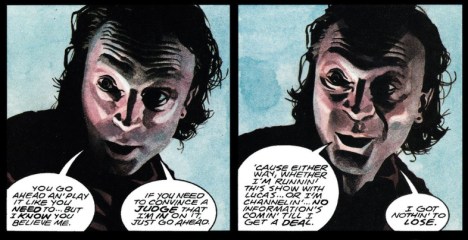
The Joker's gags really bombed...

The Joker’s gags really bombed…

Nevertheless, Landis is a writer who does seem fascinated with the mechanics and underlying logic of superhero storytelling. A year before the release of Chronicle, Landis put together a short film that served as an extended discussion of The Death and Return of Superman featuring a variety of top tier talent like Mandy Moore, Elijah Wood, Ron Howard and Simon Pegg. At once reveling in the absurdity of the massive nineties comic book crossover and interrogating its central character’s identity crisis, it was a potent piece of pop culture criticism.

In the years following his initial success, Landis has remained relatively connected with the Man of Steel. He drafted an eight-page origin for the Atomic Skull for the first annual of DC comics’ relaunched Action Comics run, and would get a change to craft his own origin story for Clark Kent in American Alien. However, he also wrote a short two-issue story as part of DC’s digital-first The Adventures of Superman comic, scripting Superman’s first encounter with the Clown Prince of Crime.

Last laugh...

Last laugh…

Continue reading

Night Stalker – Into Night (Review)

This January, to prepare for the release of the new six-part season of The X-Files, we’re wrapping up our coverage of the show, particularly handling the various odds and ends between the show’s last episode and the launch of the revival.

Night Stalker was cancelled after only six episodes had aired.

The Source was the last episode broadcast during its initial run, closing the show on a cliffhanger. There were four additional episodes produced, but not aired on ABC. There were also two more scripts written, but not produced. While the six episodes of Harsh Realm that had been produced but not aired felt reasonably coherent and finished, there is something very different about the final stretch of Night Stalker. Harsh Realm was not finished, but it felt oddly complete.

Oh, it's a crime scene alright...

Oh, it’s a crime scene alright…

The final stretch of Night Stalker after The Source has a decidedly rough and unpolished quality to. Everything after The Source takes on the feeling of a rough draft, occasionally intriguing but undoubtedly incomplete. As packaged on the DVD, it all feels like bonus content: Frank Spotnitz elaborating on his plans for the show, the .pdf of Darin Morgan’s script, even the final four episodes. It has become a cliché to compare modern television to a novel, but perhaps the best comparison for Night Stalker is a comparison to a studio album.

If that comparison holds, everything after The Source has the feel of a second disc or a reissue. Linear notes, rough cuts of tracks that did not make the original release, snippets of demos that informed the work. The DVD of Night Stalker is not as interested in concluding or wrapping up the show as it is elaborating or expanding upon it; offering a glimpse into its production and context for its decisions.

Nothing to report...

Nothing to report…

Continue reading

Roy Thomas’ Run on The X-Files: Season One (Topps) (Review)

We’ve recently finished our reviews of the nine seasons of The X-Files. Along the way, we tried to do tie-ins and crossovers and spin-offs. However, some of those materials weren’t available at the right time. So this week will be spent finishing Topps’ line of “Season One” comics, published during the fifth season in the lead up to The X-Files: Fight the Future.

It is hard to figure out what exactly the point of the Season One line was meant to be.

In a very superficial way, the point was obvious. The intent was to add a second regular series to Topps’ line of comics based around The X-Files. Even during the comic book bubble burst of the mid- to late-nineties, The X-Files was a good seller for the company. The monthly book sold well enough that Topps’ eagerly supplemented it. New stories were published as Digest editions, published alongside the less successful Ray Bradbury comics. Annuals were published alongside the monthly book. Collections were published frequently.

xfiles-beyondthesea13

However, this was not enough to satisfy market demand. Topps wanted to publish more X-Files material with greater frequency. However, Ten Thirteen were less interested with the supervision that the line required. A compromise seemed in order. Rather than creating a new original series of comic books, they flooded with market with new adaptations of existing X-Files media. Writer Kevin J. Anderson and artist Gordon Purcell offered a four-part comic book miniseries adapting Anderson’s Ground Zero prose novel.

The publisher also decided to put out a series of adaptations of classic first season episodes, released once every two months. These would be adaptations of stories that had already been properly vetted by Ten Thirteen, having been produced in-house. The trick would simply be translating them into comic books.

Burn with me.

Continue reading

The X-Files – Audrey Pauley (Review)

This December, we’re taking a trip back in time to review the ninth season of The X-Files.

One of the surprising aspects of the ninth season is just how strong the episodes centring on Doggett and Reyes are.

True, there are not necessarily too many “all-time classic” episodes to be found across the length and breadth of the ninth season; that is arguably true of every season since the sixth. The strongest episodes of the ninth season tend to be those focusing on the two new lead characters actually doing their jobs and navigating the weird world around them. 4-D, John Doe, Hellbound and Audrey Pauley rank among the very best that the ninth season has to offer. The biggest problem with the ninth season is the difficulty that the show has maintaining that level of quality.

Into the void...

Into the void…

The ninth season never manages any real consistency. It never commits to one vision of the show or the other. While the stronger episodes suggest that The X-Files might be ready to move on past Mulder and Scully to embrace Doggett and Reyes, the show always returns to insisting that Mulder is still the most important character on the show despite David Duchnovny’s reluctance to return. Nothing Important Happened Today I featured David Duchovny’s stunt butt before Gillian Anderson, Robert Patrick or Annabeth Gish. That is the show’s priority.

This becomes particularly troublesome in the second half of the season. Steven Maeda seems to have a great deal of luck in his ninth season writing assignment, tackling episodes that wind up taking on a larger symbolic importance. 4-D was the first episode to be both produced and broadcast after the events of 9/11, due to scheduling choices that pushed Hellbound later into the season. Although Nothing Important Happened Today I was broadcast nearly two months after the attacks, the production team were actually working on Dæmonicus when news broke.

"Woops. Sorry. Wrong wall."

“Woops. Sorry. Wrong wall.”

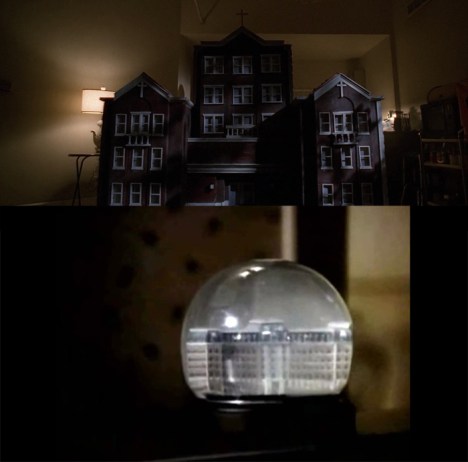
Audrey Pauley winds up being the first episode to be produced and broadcast after the cancellation of The X-Files had been announced. The public had been informed of the cancellation between the broadcast of John Doe and Hellbound. The production team had found out while working on Scary Monsters. Due to scheduling choices, Scary Monsters had been pushed back later into the season and Audrey Pauley was aired first. Although it is quite likely Maeda was working on Audrey Pauley long before the cancellation, it still echoes through the work.

Audrey Pauley plays into some of Maeda’s core themes, suggesting alternate and pocket realities that navigate the void between life and death. As with 4-D, Audrey Pauley is very much a post-9/11 episode of The X-Files. However, it is also very much a post-cancellation episode of The X-Files.

Now, where have I seen this before?

Now, where have I seen this before?

Continue reading

The X-Files – John Doe (Review)

This December, we’re taking a trip back in time to review the ninth season of The X-Files.

A man without a past on a show without a future.

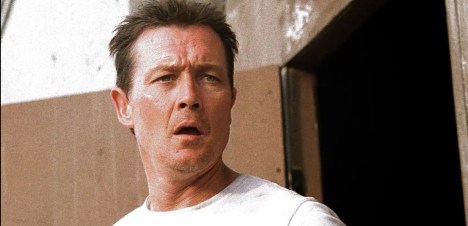
John Doe opens with John Doggett on the floor of a dusty warehouse, an addict stealing his shoes. Doggett chases the thief out of the warehouse, stunned to realise that he is actually in Mexico. His pursuit of the addict culminates in his arrest by local law enforcement, a couple of cops demanding to see his identification papers. Doggett pats himself down looking for something, but the horror of his situation seems to dawn on him. Asked for his name, all Doggett can offer is an awkward “I don’t know.” His past has been stolen from him.

"Woah, boy. Computer-generated film grain. I'm either in Mexico or a CSI flashback."

“Woah, boy. Computer-generated film grain. I’m either in Mexico or a CSI flashback.”

Four days after the initial broadcast of John Doe, it was announced that there would be no tenth season of The X-Files. Fox and Chris Carter were retiring the show after a phenomenal nine-season run. Of course, production had wrapped on John Doe long before the decision had been made; the crew were working on Scary Monsters when news filtered down about the looming end of the show. However, there was something quite appropriate about the timing of all this. John Doggett lost his past in the same week that The X-Files lost its future.

There is almost a weird poetry in that.

Breaking Decent.

Breaking Decent.

Continue reading

The X-Files – Alone (Review)

This October/November, we’re taking a trip back in time to review the eighth season of The X-Files and the first (and only) season of The Lone Gunmen.

In a way, the entire final third of the eighth season is an extended finalé for The X-Files – or, at the very least, an extended finalé for a version of The X-Files starring Mulder and Scully.

This seems quite ironic, considering the confusion that existed towards the end of the seventh season, when it seemed like the production team were unsure whether they could (or should) commit to the idea of The X-Files coming to an end. The seventh season was never entirely sure what (if anything) was going to come next, and so it did not have the opportunity to gracefully set up all of its plot points. As a result, the eighth season had to retroactively incorporate elements like Mulder’s brain illness or Scully’s fertility treatment.

Cue cliché marriage jokes.

Cue cliché marriage jokes.

In contrast, the eighth season seemed quite conscious of the end. The entire eighth season is structured as a strange hybrid; it feels like it could serve as both the final season of the show as it aired for seven years, while also serving as a launching pad to something new and exciting. The final eight episodes of the eighth season are largely about tidying away the character arcs and dangling plot thread associated with Mulder and Scully so that their journey might finally end. If the ratings are strong enough, then Doggett might get to launch his own show.

As such, Alone is positioned very much like Je Souhaite had been and like Sunshine Days would be. It is potentially the “one last monster of the week” story marking the end of an era. While Je Souhaite had marked the end of the Mulder and Scully era of the show, Alone seems to mark the end of the transitional period between Mulder and Scully and whatever is supposed to come next. It is a very light episode, no less effective for that. As with a lot of the late eighth season, its biggest problem is the way that the nineth season creative decisions retroactively undercut it.

Leyla... L-E-Y-L-A... Leyla.

Leyla… L-E-Y-L-A… Leyla.

Continue reading

The Lone Gunmen – The Lying Game (Review)

This October/November, we’re taking a trip back in time to review the eighth season of The X-Files and the first (and only) season of The Lone Gunmen.

The Lying Game is perhaps most well known for its central guest star.

The Lying Game is the episode in which the Lone Gunmen find themselves crossing paths with Assistant Director Walter Skinner. It was a pretty big deal, to the point that Skinner’s appearance towards the end of the season was being hyped in the media immediately following the broadcast of The Pilot, almost two months before the episode actually aired. It wasn’t the first crossover between two Ten Thirteen shows, but it was still a pretty big deal. It makes sense that discussion of The Lying Game would focus on its visiting supporting player.

Some hot Skinner-on-Skinner action...

Some hot Skinner-on-Skinner action…

However, The Lying Game is also notable for featuring a significant transgender guest character. Carol Strode is most significant transgender character to appear in a Ten Thirteen production. As one might expect given the production company’s awkward history with the portrayal of homosexual characters, the results are mixed. There is no question that the episode is well-intentioned, but it is also clumsy and occasionally ill-judged. Even the title would suggest as much, albeit more through absent-minded insensitivity than outright malice.

The Lying Game has its heart in the right place, but doesn’t necessarily have its head in gear.

Surviving by the Skin of his teeth...

Surviving by the Skin of his teeth…

Continue reading

The X-Files – DeadAlive (Review)

This October/November, we’re taking a trip back in time to review the eighth season of The X-Files and the first (and only) season of The Lone Gunmen.

The X-Files is dead. Long live The X-Files.

What is dead may never die...

What is dead may never die…

Continue reading

The X-Files – The Gift (Review)

This October/November, we’re taking a trip back in time to review the eighth season of The X-Files and the first (and only) season of The Lone Gunmen.

Sweeps have arrived. And so has David Duchovny.

David Duchovny appeared in three of the four episodes of The X-Files broadcast in February 2001. (The fourth, Medusa, is very much the “blockbuster” episode of this stretch of the season, with a large budget and impressive scale.) This was very much a conscious choice on the part of the production team. Although Duchovny’s shooting schedule meant that the episodes were filmed across the season, the show made a choice to broadcast them all as part the February Sweeps.

He's back...

He’s back…

Indeed, even the order of the episodes in question has been jumbled around. The Gift is the third broadcast episode of the eighth season to feature an appearance by David Duchovny; it was filmed before Badlaa, but broadcast after it so as to open the Sweeps season. However, Per Manum would be the fourth broadcast episode of the eighth season to feature an appearance by David Duchovny; not only was it filmed before The Gift, it was actually filmed between Via Negativa and Surekill.

There is a sense, looking at the differences between the production and broadcast orders of the eighth season, that the production team were well aware of just how big a deal the return of David Duchovny would be. In fact, the decision to broadcast The Gift before Per Manum seems like a very canny attempt to tease those viewers excited about the return of Mulder. The character is much more prominent in Per Manum, so it feels like the decision to air his smaller supporting role in The Gift earlier is an effort in building suspense and excitement.

"The name's Doggett, John Doggett."

“The name’s Doggett, John Doggett.”

The Gift doesn’t offer much in the way of advancement for the season’s on-going story arcs. Although the teaser is smart enough to build to the reveal of David Duchovny, the character only appears in quick flashes throughout the episode. Mulder has less than half-a-dozen lines over the course of the show’s forty-five minutes. He does not directly encounter (or engage with) Doggett or Scully, only appearing for a brief moment as a vision in the basement at the end of the episode. Fans eagerly anticipating Mulder’s return would undoubtedly be frustrated.

However, there is something almost endearing in the show’s playful teasing of its fanbase. It feels almost like the show getting comfortable with itself once again. Indeed, the structure of the episode – paralleling Mulder’s investigation with that of Doggett rather than intersecting them – seems to suggest that perhaps the show might be in good hands without the need to have Mulder literally validate his successor.

Now that's branding...

Now that’s branding…

Continue reading