• Following Us

  • Categories

  • Check out the Archives


  • Awards & Nominations

The X-Files (Topps) #25-26 – Be Prepared (Review)

This February and March, we’re taking a trip back in time to review the fourth season of The X-Files and the first season of Millennium.

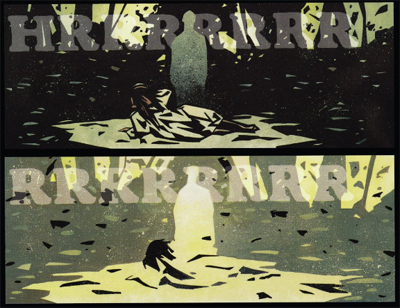
What’s interesting about Be Prepared is how much it feels like an episode of The X-Files.

A lot Rozum’s earlier scripts felt like Mulder and Scully had wandered into old E.C. horror stories, cautionary supernatural tales about vengeful ghosts and poetic justice. In contrast, Be Prepared feels very much in tune with the aesthetic of the show itself. Mulder and Scully investigate a uniquely American piece of folklore, finding themselves in an isolated location dealing with human monstrosity at least as much as any paranormal element.
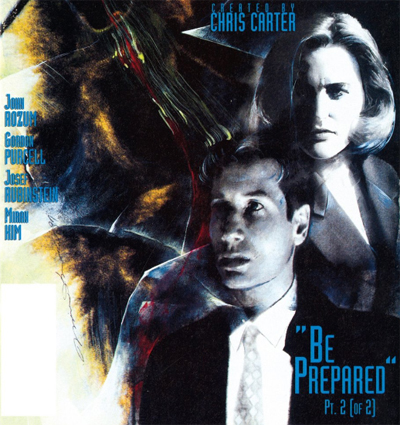
If you go down to the woods today...

If you go down to the woods today…

Indeed, Be Prepared feels very much like an episode from the first two seasons of the show, evoking stories like Ice or Darkness Falls or Firewalker. Indeed, Be Prepared arguably sits comfortably alongside Topps’ range of Season One comics – feeling like a lost episode from the show’s early years. Be Prepared feels like the first time that Rozum is constructing a story specifically from tropes associated with The X-Files, rather than from horror tropes in general.

The result is a fun little adventure that feels more like The X-Files than the comic has in quite a while.
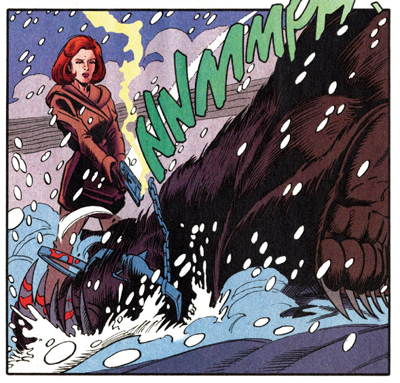
The right to bear arms...

The right to bear arms…

Continue reading

The X-Files (Topps) #24 – Silver Lining (Review)

This February and March, we’re taking a trip back in time to review the fourth season of The X-Files and the first season of Millennium.

After the wacky and delightful excess of Donor, John Rozum steers the comic back into much more traditional fare.

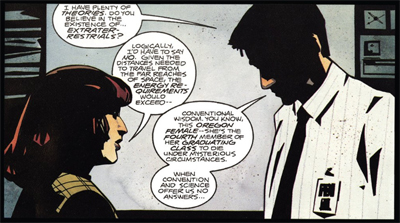
There is little in Silver Lining that the comic hasn’t touched on quite recently. Guest writer Kevin J. Anderson already wrote a “vampiric object” story about a killer camera the two-part Family Portrait story only a few months earlier. John Rozum had already drafted a “haunted object drives a man to kill, but the voices are only in his head” story for The Silent Blade, a short story written specifically for The X-Files Magazine. As a result, Silver Lining feels a little overly familiar. There is nothing here that the reader hasn’t seen before; and recently, too.

Fashioning a story...

Fashioning a story…

Silver Lining reinforces the sense that Topps and Ten Thirteen are making a conscious effort to frame The X-Files as a classic horror comic book. Certainly, Silver Lining adopts the same basic storytelling elements associated with those pulpy adventures from the fifties; there is a scientist who unwittingly unleashes a horror upon the world, a physically deformed villain, a moral about how beauty is only skin deep and that vanity is called a “deadly” sin for a reason. There’s even a poetic justice to the story, where the guest villain finds themselves tormented in an ironic fashion.

There’s nothing particularly objectionable about Silver Lining, beyond how repetitive it feels. It feels like The X-Files has taken something of a step backwards since Topps and Ten Thirteen decided to part ways with writer Stefan Petrucha. The first sixteen issues of The X-Files felt like something of a Vertigo comic book, an ambitious horror anthology with no shortage of big ideas. Now the comic feels very much like an old E.C. comic without the nostalgia factor. The decline is quite striking, but no less disheartening for it.

Moral decay...

Moral decay…

Continue reading

The X-Files (Topps) #20-21 – Family Portrait (Review)

This February and March, we’re taking a trip back in time to review the fourth season of The X-Files and the first season of Millennium.

Kevin J. Anderson is a very experienced hand when it comes to tie-in fiction.

Although Assemblers of Infinity was nominated for a Nebula Award in 1993, Anderson is perhaps best known for his work with licenced properties. He has written a significant number of Star Wars novels. He has published a trio of books set in the world of The X-Files. Indeed, Anderson would even adapt his first novel – Ground Zero – into a comic book miniseries for Topps. When Brian Herbert decided to finish his father’s Dune series, he collaborated with Anderson.

Photo finish...

Photo finish…

So Anderson is very much a safe pair of hands. He is a writer you can trust to construct a functional two-part X-Files story with a logical structure and a solid central premise. Anderson knows how to work within the boundaries of tie-in media, and he knows how to write a solid science-fiction or fantasy story. Pairing him with artist Gordon Purcell makes a great deal of sense, particularly for comic book that is trying hard to cement its place as a good old-fashioned tie-in.

Family Portrait is not exceptional, but it doesn’t try to be. Instead, it is functional. It is more efficient than ambitious, feeling very much like a classic horror comic that just happens to feature Mulder and Scully than a compelling episode of The X-Files in its own right.

Let's see what develops...

Let’s see what develops…

Continue reading

The X-Files (Topps) – The Silent Blade (Review)

This February and March, we’re taking a trip back in time to review the fourth season of The X-Files and the first season of Millennium.

The Silent Blade is filler – one of those short stories that Topps produced as promotional material for wider consumption. In this case, as with The Pit, The Silent Blade was written as a short story to feature in the summer issue of The X-Files Magazine.

Writing a short story is tough. In some respects, writing a nine-page comic strip with a clear beginning, middle and end is harder than plotting a full-length issue or an entire arc. There is only so much space available, particularly when dealing with an exposition-heavy franchise like The X-Files. It can be tough to fit all the necessary ingredients in, let alone to put a novel twist on them. The temptation is to try to do too much with so little.

He won't be drawn on the matter...

He won’t be drawn on the matter…

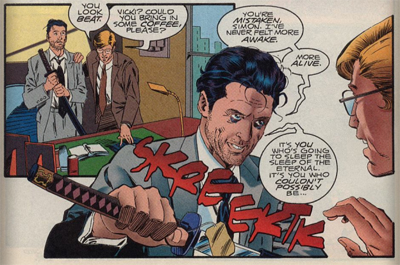
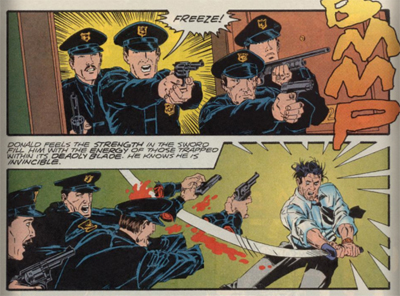
Writer Stefan Petrucha and artist Charles Adlard had generally done well by their short stories, treating them as light and throwaway. They were not the strongest stories of the run, but they were aware of the limitations of the format and the expectations of the target audience. They were functional pieces of writing, aware of the limitations of the form. John Rozum’s first (and only) abridged X-Files story strains against those limitations.

After all, Rozum’s script for Thin Air had tried to fit too much into a full-length issue, so it makes sense that The Silent Blade is also a little too busy for its own good. This would be the last feature that Topps would produce for The X-Files Magazine, and the last of these sorts of short stories.

You have to do a lot of cutting to make a story this tight...

You have to do a lot of cutting to make a story this tight…

Continue reading

The X-Files (Topps) #18-19 – Night Lights (Review)

This February and March, we’re taking a trip back in time to review the fourth season of The X-Files and the first season of Millennium.

With Night Lights, incoming X-Files writer John Rozum teams up with veteran X-Files artist Charles Adlard. While Stefan Petrucha’s involvement in the line was pretty much finished, pending the release of Afterflight, Adlard would work as part of the book’s rotating art team for a while longer.

Thin Air made it quite clear that Rozum was going to be writing a more traditional X-Files comic book than his predecessor. Stefan Petrucha seemed happy to stretch the series as far as possible, to tease out big ideas about The X-Files and to play with the show’s sacred cows. The result was always intriguing, even if it sometimes went a little beyond what readers would have expected from a comic book based on The X-Files.

We will be gods, on night lights...

We will be gods, on night lights…

Rozum’s stories tend to be a bit more straightforward. They are very much conventional X-Files stories. They hue closer to the standard formula, and feature a whole host of expected ingredients. Thin Air was a very conventional and fairly rote X-Files story, particularly following on from stories like Falling or Home of the Brave. Rozum appeared to have some teething troubles, particularly when it came to pacing and characterisation.

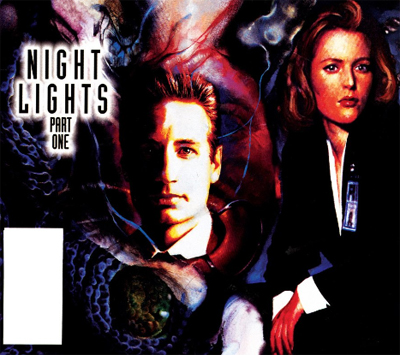
While Night Lights feels a little too jumbled and confused to really work, it does seem a lot more confident and assured. The comic has a host of good ideas, and moves considerably smoother than Thin Air did. In fact, there is a rather brilliant idea nestled at the heart of the story. Rozum just buries it a little too well.

Keep watching the skies...

Keep watching the skies…

Continue reading

The X-Files: Season One (Topps) #0 – Pilot (Review)

This February and March, we’re taking a trip back in time to review the fourth season of The X-Files and the first season of Millennium.

Given the success of the monthly comic book series, it made sense for Topps to try to capitalise on The X-Files as much as possible. The series was exploding into the mainstream. Chris Carter was launched a second television show, Millennium, to capitalise on the success. Fox were planning to move the series to Sunday nights. There was already talk about a possible movie franchise. This was a great time to be publishing X-Files comics.

Topps had already used the series to sell “digests” packed with unrelated comics, and had published annuals to get a little extra sales revenue into the fiscal year. However, there was a clear desire to publish more X-Files work with more consistency. Ideas began to percolate – Kevin J. Anderson would pen a miniseries based on his Ground Zero novel during the show’s fifth season, for example. The company also decided to publish a series of comic books adapting early episodes of the series.

The truth is out there...

The truth is out there…

The series didn’t properly launch until the following year, with a series of monthly adaptations of first season episodes running from the start of the fifth season through to the month following the release of X-Files: Fight the Future. Conveniently titled Season One, these comics were only cancelled when Topps folded its comic book division – vanishing quite suddenly from the stands, with little warning.

The adaptation of The Pilot was actually released a year earlier than the monthly series – it was re-packaged and re-released once Topps committed to a monthly series of adaptations. As such, it makes for a strange teaser of things to come.

This could be the start of a beautiful friendship...

This could be the start of a beautiful friendship…

Continue reading

Star Trek (DC Comics, 1984) #39-40 – The Return of Mudd (Review)

The first Star Trek pilot, The Cage, was produced in 1964. To celebrate its fiftieth anniversary, this December we are reviewing the second season of the original Star Trek show. You can check out our first season reviews here. Check back daily for the latest review.

By its nature, Star Trek had very few recurring guest stars – outside of recurring extras and the supporting senior staff.

Star Trek was a prime-time science-fiction show in the sixties. As such, it was strongly episodic. More than that, it was a show that included its stated goal – “to explore strange new worlds” – in a narration over the opening credits. As such, the show did not tend to bring back too many recurring characters. Gene L. Coon had tried to introduce a recurring foil for Kirk in the second season, but Robert Justman had vetoed the reappearance of Kor in A Private Little War and Coon would depart before he could follow through on plans to make Koloth a recurring adversary.

Our man Mudd...

Our man Mudd…

Of course, this has not stopped Star Trek fans from seizing on various one-shot characters from the three seasons of the original Star Trek. Despite only appearing in Errand of Mercy, Kor has become a frequently recurring character in the Star Trek mythos. Gary Seven has spun off from Assignment: Earth into a string of novels and comics. Christopher Pike only appeared with Kirk in one single story, but there is a huge amount of literature dedicated to him. Still, this means that the elements which do recur are given a bit more weight.

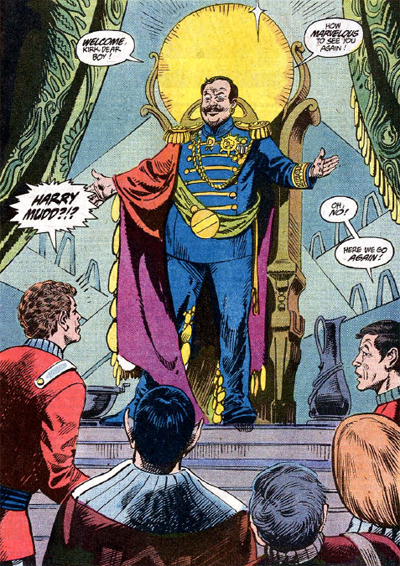
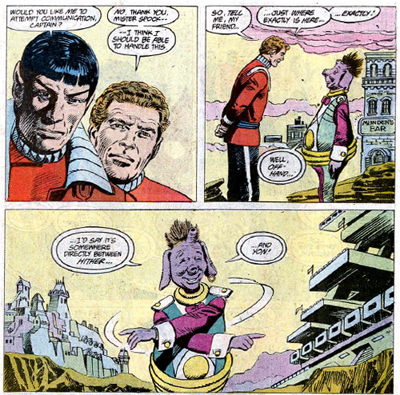
Klingons, Romulans and Vulcans are a vital part of the Star Trek mythos. Khan Noonien Singh only appeared in Space Seed and Star Trek II: The Wrath of Khan, but his memory haunts the franchise to the point where he was revived for Star Trek Into Darkness. Harry Mudd has the distinction of being the only non-crewmember to recur within the original run of eighty episodes. So it is no surprise that Harry Mudd has become one of the most frequently recurring guest stars in the history of the franchise.

Kirk meets quirky...

Kirk meets quirky…

Continue reading

Star Trek – New Visions #1: The Mirror, Cracked (Review)

The first Star Trek pilot, The Cage, was produced in 1964. To celebrate its fiftieth anniversary, this December we are reviewing the second season of the original Star Trek show. You can check out our first season reviews here. Check back daily for the latest review.

It is interesting the ideas that wind up becoming the focal points for fans and tie-in fiction.

For example, there is a wealth of tie-in material based around individual episodes of the Star Trek franchise. Despite the fact that Gary Seven only appeared in Assignment: Earth, the character has inspired tie-in novels and comic books about his exploits from a wealth of different writers. Similarly, the history of Khan Noonien Singh has been thorough explored (and re-explored) in various novels and comic books as well, despite the fact that he only appeared in one episode of the classic television show and one of the theatrical films – his popularity grew to the point where he reappeared in the rebooted series.

Boom, boom, boom, shake the bridge!

Boom, boom, boom, shake the bridge!

There is a lot of fixation on the perceived “missing” adventures from Kirk’s five-year mission, a revisionism that occasionally seems intended to downplay the two seasons of Star Trek: The Animated Series. Michael Jan Friedman wrote a series of novels exploring Captain Picard’s tenure commanding the Stargazer. There is a wealth of material filling the gaps between The Turnabout Intruder and Star Trek: The Motion Picture; and from there to Star Trek II: The Wrath of Khan.

In contrast, there is less material filling the gap between the opening sequences of Star Trek: Generations and Encounter at Farpoint; particularly if you exclude material focusing on Captain Sulu or Captain Picard. The Lost Era novel series was short-lived, and the comics have little interest in it. Similarly, the tie-in novels may have expanded continuity past Endgame, but there is an incredible “safeness” to it all. Sure, Deep Space Nine might be destroyed; but it will be rebuilt with most of the same craft. Voyager may be home, but it’ll be sent out again. Janeway may die, but she’ll be back.

A transporter, darkly...

A transporter, darkly…

Continue reading

Stefan Petrucha and Charles Adlard’s Run on The X-Files (Topps) (Review)

This November (and a little of December), we’re taking a trip back in time to review the third season of The X-Files and the first (and only) season of Space: Above and Beyond.

Topps’ X-Files comic was a massive success in the nineties.

The monthly series ran for forty-one issues between January 1995 and September 1998. In that time, Topps also produced an X-Files graphic novel, three digests, two annuals, a spin-off line of Season One comics and a miniseries adaptation of a Kevin Anderson novel. They also reprinted the series in quite a few formats, indicating that the comic sold well even outside the monthly schedule. The only reason that the series came to an end was because Topps eventually decided to retire from comic book publishing.

xfiles-feelingsofunreality4

After Topps withdrew from the comic book market following the Great Comic Crash of the mid-to-late nineties, the X-Files license lay fallow. Barring two Lone Gunman comics published by Dark Horse in 2001, there would be no new officially licensed X-Files comics written between September 1998 and September 2008, when Frank Spotnitz scripted a miniseries for Wildstorm. It is incredible to look back on the success of the Topps line for those three-and-a-half years when it held the license.

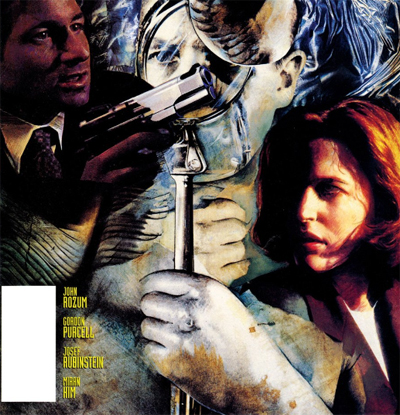
A lot of the credit for that success is owed to writer Stefan Petrucha, cover artist Miran Kim and interior artist Charles Adlard.

xfiles-homeofthebrave17

Continue reading

Star Trek – New Visions #3: Cry Vengeance (Review)

The first Star Trek pilot, The Cage, was produced in 1964. To celebrate its fiftieth anniversary, this December we are reviewing the second season of the original Star Trek show. You can check out our first season reviews here. Check back daily for the latest review.

These Are the Voyages… aired in May 2005. Star Trek has been off the air for almost a decade; longer in the eyes of certain fans who have their own earlier cut-off dates. Although JJ Abrams brought Star Trek back to the big screen, it is not quite the same. It is not simply that – as Ronald D. Moore has arguedStar Trek feels more at home on the small screen. There is also a sense that there is a dearth of “new” stories in the Star Trek universe. One two-hour movie ever three years does not cut it, after all.

A whole cottage industry has developed around trying to sate Star Trek fans – to deliver the new episodes that it seems so many fans so desperately want. There are month comic books set within the continuity of the recent movies. There are novels that unfold in a loosely serialised format building off the end of the various twenty-fourth century shows. There are numerous fan projects churning out their own new Star Trek stories, whether featuring the original characters or a novel twist on the franchise.

Shaking things up a bit...

Shaking things up a bit…

This desire for new Star Trek is understandable. Given the rate at which the franchise was produced during the nineties, it is hard to imagine living in a world where new Star Trek arrives by drip-feed. In a way, John Byrne’s New Visions series is the most candid attempt to cater to this impulse among Star Trek fans. Using a wealth of images from the original Star Trek series, some photoshop skills, and years of experience writing comic books, John Byrne is literally able to stitch together new stories from the eighty classic Star Trek shows.

It is a bizarre blend of storytelling and cannibalism that serves as a fairly cynical metaphor for a particular approach to tie-in Star Trek material.

"Use your indoor voice..."

“Use your indoor voice…”

Continue reading