• Following Us

  • Categories

  • Check out the Archives


  • Awards & Nominations

Star Trek: Deep Space Nine – Profit and Loss (Review)

Star Trek: Deep Space Nine is twenty years old this year. To celebrate, I’m taking a look at the first and second seasons. Check back daily for the latest review or retrospective.

It seems we’ve reached the point where Star Trek: Deep Space Nine has figured out a base level of quality, an “average” zone that it can pitch to without too much effort or breaking a sweat. We’ve had three episodes in a row now that haven’t been brilliant, but have been far from terrible. Solid, watchable stuff. That might sound like damning with faint praise, but it took Star Trek: The Next Generation longer to find that base level of quality, while Star Trek: Voyager settled into a zone where that “average” was a lot lower.

Profit and Loss is unlikely to be anybody’s favourite episode, but it remains thoroughly unobjectionable. It features the cast playing their roles reasonably well, some hints at world-building and even a guest spot for Garak. Nobody will really remember Profit and Loss as a brilliant piece of television after completing a lengthy Deep Space Nine rewatch, but they also won’t curse its name. It’ll simply be an episode in the middle-to-end section of the second season that wasn’t too bad and wasn’t too great.

Love him and leave him...

Love him and leave him…

Continue reading

Star Trek: Deep Space Nine – Playing God (Review)

Star Trek: Deep Space Nine is twenty years old this year. To celebrate, I’m taking a look at the first and second seasons. Check back daily for the latest review or retrospective.

Playing God is – structurally – quite similar to Shadowplay. The episode follows the same basic format. We have three plots running concurrently. One of these plots is a science-fiction plot while the other two are centred around character development. What’s interesting about Playing God is that the script essentially changes the priority of these plot threads. In Shadowplay, the central plot concerned the science-fiction mystery in the Gamma Quadrant, while here the ethical quandary is pushed firmly to the background. (Much to the chagrin of writer Jim Trombetta.)

Instead, Playing God brings the character plotline to the front, giving us the first Dax-centric episode firmly based around Jadzia rather than the symbiote inside of her.

Quark smells a rat... er... I mean vole...

Quark smells a rat… er… I mean vole…

Continue reading

Star Trek: Deep Space Nine – The Alternate (Review)

Star Trek: Deep Space Nine is twenty years old this year. To celebrate, I’m taking a look at the first and second seasons. Check back daily for the latest review or retrospective.

Well, at least the second season of Star Trek: Deep Space Nine is experimental. It might not always pay-off, but there’s a clear sense that the show is trying new things, bending various genres to make them fit within the broad outline of a Star Trek show. Necessary Evil was a fascinating attempt to construct a noir episode, while Rivals was a less-than-successful sit-com in space. The Alternate is very much doing “Star Trek as monster movie”, which is surprisingly fun.

To be fair, it’s not a subgenre new to the franchise. Indeed, the first episode of the original show to air, The Man Trap, was essentially a monster horror in space. Still, The Alternate feels a bit more sinister and dark than  anything that Star Trek: The Next Generation might attempt. (Schisms probably comes closest, but – even then – there’s no sense that the monsters are stalking the starship. They have to abduct their victims to experiment on them.)

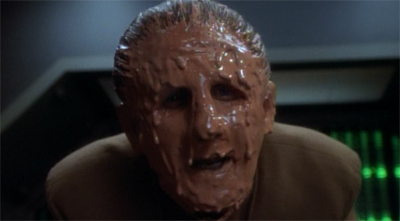
More than that, though, The Alternate is also a fascinating exploration of Odo as a character, looking at the relationship that Odo has with his co-workers and how that is rooted in his relationship with the man who claims to be his “father.”

Melting! Melting! Oh what a world!

Melting! Melting! Oh what a world!

Continue reading

Star Trek: Deep Space Nine – Second Sight (Review)

Star Trek: Deep Space Nine is twenty years old this year. To celebrate, I’m taking a look at the first and second seasons. Check back daily for the latest review or retrospective.

You know, this the first real Sisko-heavy episode we’ve had since Emissary. He’s the lead, so he’s never too far from the heart of the story, and episodes like Dramatis Personae and Invasive Procedures gave Avery Brooks an opportunity to demonstrate his acting chops (and ability to be just as bad-ass, albeit in a different way, as Kirk and Picard). However, Sisko never really dominates or towers over Star Trek: Deep Space Nine in the same way that Kirk and Picard seemed to anchor their shows. Deep Space Nine is closer to an ensemble show than any other Star Trek series, and characters like Odo and Kira (and even Quark) have received as much (if not more) definition than Sisko, despite the fact he is the lead.

That’s not a bad thing. Over the run of the series, Deep Space Nine would produce a number of classic hours of television centred around Sisko as a character. The Visitor, Far Beyond the Stars, and In the Pale Moonlight are all hours that lean heavily on Brooks and can all be counted among the very best episodes of Star Trek ever produced.

Second Sight, on the other hand, is not.

Burning passion...

Burning passion…

Continue reading

Star Trek: Deep Space Nine – Necessary Evil (Review)

Star Trek: Deep Space Nine is twenty years old this year. To celebrate, I’m taking a look at the first season. Check back daily for the latest review or retrospective.

Commence Station Security log. Stardate 47282.5. At the request of Commander Sisko, I will hereafter be recording a daily log of law enforcement affairs. The reason for this exercise is beyond my comprehension, except perhaps that humans have a compulsion to keep records and lists and files. So many, in fact, that they have to invent new ways to store them microscopically, otherwise their records would overrun all known civilisation. My own very adequate memory not being good enough for Starfleet, I am pleased to put my voice to this official record of this day. Everything’s under control. End log.

Necessary Evil continues to deliver on the promise of “things you can’t do anywhere but Star Trek: Deep Space Nine that Michael Piller made at the start of the show’s second season. It’s a genuinely ambitious piece of Star Trek, all the stronger for the fact that it’s idea that could go horribly and spectacularly wrong. Movies like Blade Runner demonstrated that it is possible to blend the aesthetics of science-fiction and film noir, but it seems like a mix that would sit rather uncomfortably in the bright utopian future of Star Trek.

However, Deep Space Nine was never afraid to experiment with its format. This wasn’t always successful, but it did give the show a unique flavour. And when it did work, as it does here, it offered something new and exciting to the franchise’s playbook.

Time for a Changeling...

Time for a Changeling…

Continue reading

Star Trek: Deep Space Nine – Terok Nor #0 (Review)

Star Trek: Deep Space Nine is twenty years old this year. To celebrate, I’m taking a look at the first season. Check back daily for the latest review or retrospective.

We’ll be supplementing our coverage of the episodes with some additional materials – mainly novels and comics and films. This is one such entry.

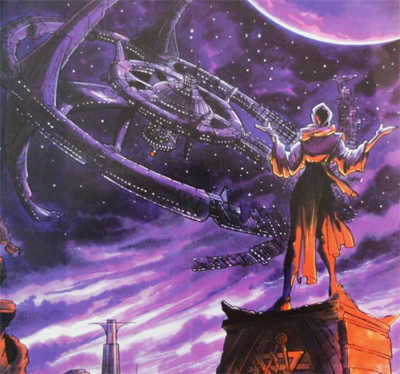
Terok Nor might be the best of Malibu Comics’ Star Trek: Deep Space Nine range, a one-shot written by Mark A. Altman and illustrated by Trevor Goring. It isn’t so much the plot that makes Terok Nor so distinctive – there is a lot of running around, some betrayals, some action sequences – but rather the execution of Altman’s story and the atmosphere provided by Goring’s pencils. The origin story of the space station Terok Nor, Altman very shrewdly frames the story as something of an oral history. It’s almost mythic and grand and epic, drawn in broad strokes rather than finer detail.

It serves quite well as the story of the construction of the central hub of the Star Trek show most concerned with legacy and history.

A monument to the Bajoran people...

A monument to the Bajoran people…

Continue reading

Star Trek: Deep Space Nine – Melora (Review)

Star Trek: Deep Space Nine is twenty years old this year. To celebrate, I’m taking a look at the first season. Check back daily for the latest review or retrospective.

It’s hard to believe, based on what we’ve witnessed so far, but one day viewers will be able to think “oh, a Bashir episode!” without an involuntary shudder. There will come a time when the writing staff figure out how to write a Bashir-centric episode. In fact, they’ll even revisit this central premise in the show’s final season, in a way that is much less creepy because at least it acknowledges the creepiness. However, we’re a long way from that.

It’s not that Bashir is a bad character. In fact, I’m very fond of him. I think that this version of the character works very well as part of an ensemble, or even teamed up with another major character to carry a story. However, I don’t think that the show has quite figured out how to tell a Bashir-centric story yet. Most notably because – like The Passenger before it – Melora isn’t really about Bashir. At least not in a way that isn’t creepy and disturbing and unnerving.

Instead, Bashir is mostly a vehicle for the guest character of the week, who lends the episode her name and serves as the focal point of some incredibly condescending and patronising writing which doesn’t make the optimistic future of Star Trek look particularly bright.

Floating in a most peculiar way...

Floating in a most peculiar way…

Continue reading

Star Trek: Deep Space Nine – Cardassians (Review)

Star Trek: Deep Space Nine is twenty years old this year. To celebrate, I’m taking a look at the first and second seasons. Check back daily for the latest review or retrospective.

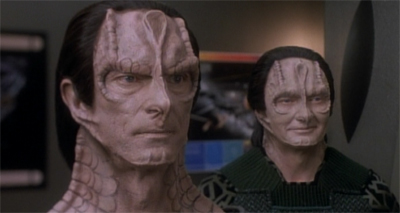
Cardassians suffers a bit from the same problems that haunt Invasive Procedures. Here’s another solidly constructed piece of world-building featuring a wonderful guest cast and an intriguing high concept. However, in the midst of all this, it seems like the human (er, Cardassian) element gets a bit lost. It’s great to have Garak and Dukat back on the show, and it’s great to deal with more fallout from the Occupation, but Cardassians never makes the emotional connection that a story about war orphans probably should.

Keeping up with the Cardassians...

Keeping up with the Cardassians…

Continue reading

Star Trek – Worlds of Deep Space Nine: Unjoined (Trill) by Michael A. Martin and Andy Mangels (Review)

Star Trek: Deep Space Nine is twenty years old this year. To celebrate, I’m taking a look at the first and second seasons. Check back daily for the latest review or retrospective.

We’ll be supplementing our coverage of the episodes with some additional materials – mainly novels and comics and films. This is one such entry.

Worlds of Deep Space Nine was an ambitious project, but one that existed as a testament to the world-building that defined Star Trek: Deep Space Nine. A series of six novellas published in three books, each covering one of five planets associated with the television show (plus Andor), the book series was intended to launch the unofficial “ninth season” of the show. Beginning unofficially with The Lives of Dax and A Stitch in Time, the idea was for the spin-off novels to continue to develop and expand the series’ loose threads.

It’s quite something that Deep Space Nine left enough fertile ground to support a relaunch that ran so long, covering story beats that couldn’t necessarily be included in the television show – Bajor’s admittance to the Federation, the rebuilding of Cardassia, the aftermath of the war. Unjoined builds off the Trill storylines running through Deep Space Nine, using the events from the “eighth season” (the books through Unity) as a stepping stone to explore Trill culture.

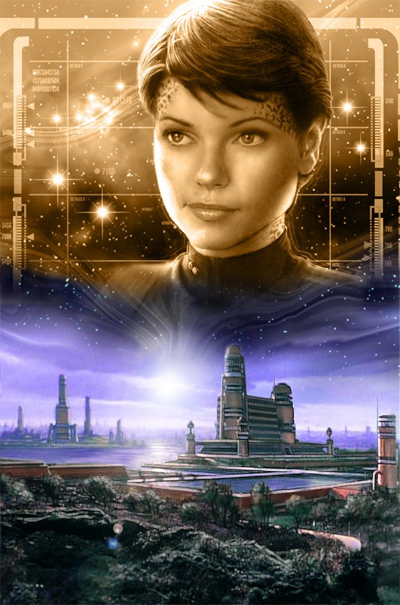
ds9-unjoined

Continue reading

Star Trek: Deep Space Nine – Invasive Procedures (Review)

Star Trek: Deep Space Nine is twenty years old this year. To celebrate, I’m taking a look at the first and second seasons. Check back daily for the latest review or retrospective.

Invasive Procedures is an interesting episode. It has a great high concept, some nice character beats, and offers an inside glimpse at an astonishingly interesting alien culture. Verad is a compelling guest character and Sisko gets to be pretty badass, continuing the presentation of the character as some weird composite of James T. Kirk and Jean-Luc Picard.

There are however, a number of very sizeable flaws. The most obvious being that – despite this is nominally a “Dax” story – Dax winds up feeling more like a plot point than a character in her own right.

Slugging it out...

Slugging it out…

Continue reading