• Following Us

  • Categories

  • Check out the Archives


  • Awards & Nominations

Star Trek: Deep Space Nine – Sanctuary (Review)

Star Trek: Deep Space Nine is twenty years old this year. To celebrate, I’m taking a look at the first and second seasons. Check back daily for the latest review or retrospective.

Sanctuary is a very weird little episode, a nice concept with too much padding, reserving its best hook and twist for the final ten minutes, but capping it off with an attempt to soften the harsh blow somewhat. It’s another of those “shows we could only do on Star Trek: Deep Space Nine from the series’ second season, and it’s certainly more interesting and ambitious than Second Sight. However, for all the clever stuff that it does, it feels somewhat oddly structured and paced, as if the writing staff knew there were good ideas wrapped up inside here, but weren’t exactly sure how to get them out.

A blip on the radar...

A blip on the radar…

Continue reading

Star Trek: Deep Space Nine – Second Sight (Review)

Star Trek: Deep Space Nine is twenty years old this year. To celebrate, I’m taking a look at the first and second seasons. Check back daily for the latest review or retrospective.

You know, this the first real Sisko-heavy episode we’ve had since Emissary. He’s the lead, so he’s never too far from the heart of the story, and episodes like Dramatis Personae and Invasive Procedures gave Avery Brooks an opportunity to demonstrate his acting chops (and ability to be just as bad-ass, albeit in a different way, as Kirk and Picard). However, Sisko never really dominates or towers over Star Trek: Deep Space Nine in the same way that Kirk and Picard seemed to anchor their shows. Deep Space Nine is closer to an ensemble show than any other Star Trek series, and characters like Odo and Kira (and even Quark) have received as much (if not more) definition than Sisko, despite the fact he is the lead.

That’s not a bad thing. Over the run of the series, Deep Space Nine would produce a number of classic hours of television centred around Sisko as a character. The Visitor, Far Beyond the Stars, and In the Pale Moonlight are all hours that lean heavily on Brooks and can all be counted among the very best episodes of Star Trek ever produced.

Second Sight, on the other hand, is not.

Burning passion...

Burning passion…

Continue reading

Star Trek: Deep Space Nine – Necessary Evil (Review)

Star Trek: Deep Space Nine is twenty years old this year. To celebrate, I’m taking a look at the first season. Check back daily for the latest review or retrospective.

Commence Station Security log. Stardate 47282.5. At the request of Commander Sisko, I will hereafter be recording a daily log of law enforcement affairs. The reason for this exercise is beyond my comprehension, except perhaps that humans have a compulsion to keep records and lists and files. So many, in fact, that they have to invent new ways to store them microscopically, otherwise their records would overrun all known civilisation. My own very adequate memory not being good enough for Starfleet, I am pleased to put my voice to this official record of this day. Everything’s under control. End log.

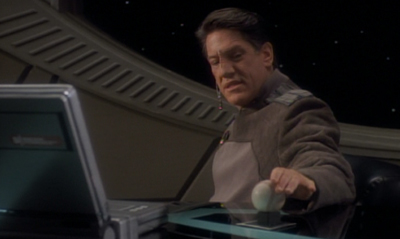
Necessary Evil continues to deliver on the promise of “things you can’t do anywhere but Star Trek: Deep Space Nine that Michael Piller made at the start of the show’s second season. It’s a genuinely ambitious piece of Star Trek, all the stronger for the fact that it’s idea that could go horribly and spectacularly wrong. Movies like Blade Runner demonstrated that it is possible to blend the aesthetics of science-fiction and film noir, but it seems like a mix that would sit rather uncomfortably in the bright utopian future of Star Trek.

However, Deep Space Nine was never afraid to experiment with its format. This wasn’t always successful, but it did give the show a unique flavour. And when it did work, as it does here, it offered something new and exciting to the franchise’s playbook.

Time for a Changeling...

Time for a Changeling…

Continue reading

Star Trek: Deep Space Nine – Terok Nor #0 (Review)

Star Trek: Deep Space Nine is twenty years old this year. To celebrate, I’m taking a look at the first season. Check back daily for the latest review or retrospective.

We’ll be supplementing our coverage of the episodes with some additional materials – mainly novels and comics and films. This is one such entry.

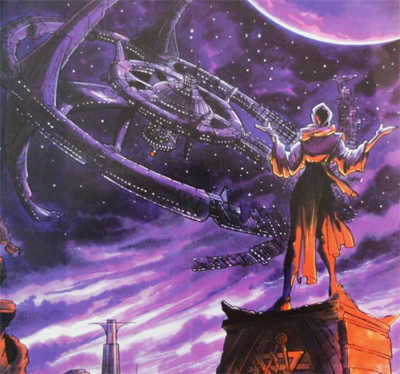
Terok Nor might be the best of Malibu Comics’ Star Trek: Deep Space Nine range, a one-shot written by Mark A. Altman and illustrated by Trevor Goring. It isn’t so much the plot that makes Terok Nor so distinctive – there is a lot of running around, some betrayals, some action sequences – but rather the execution of Altman’s story and the atmosphere provided by Goring’s pencils. The origin story of the space station Terok Nor, Altman very shrewdly frames the story as something of an oral history. It’s almost mythic and grand and epic, drawn in broad strokes rather than finer detail.

It serves quite well as the story of the construction of the central hub of the Star Trek show most concerned with legacy and history.

A monument to the Bajoran people...

A monument to the Bajoran people…

Continue reading

Star Trek: Deep Space Nine – Cardassians (Review)

Star Trek: Deep Space Nine is twenty years old this year. To celebrate, I’m taking a look at the first and second seasons. Check back daily for the latest review or retrospective.

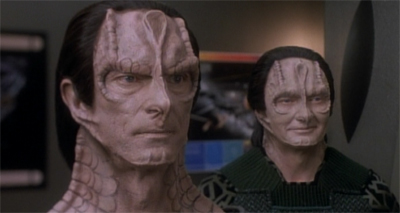
Cardassians suffers a bit from the same problems that haunt Invasive Procedures. Here’s another solidly constructed piece of world-building featuring a wonderful guest cast and an intriguing high concept. However, in the midst of all this, it seems like the human (er, Cardassian) element gets a bit lost. It’s great to have Garak and Dukat back on the show, and it’s great to deal with more fallout from the Occupation, but Cardassians never makes the emotional connection that a story about war orphans probably should.

Keeping up with the Cardassians...

Keeping up with the Cardassians…

Continue reading

Star Trek – Worlds of Deep Space Nine: Unjoined (Trill) by Michael A. Martin and Andy Mangels (Review)

Star Trek: Deep Space Nine is twenty years old this year. To celebrate, I’m taking a look at the first and second seasons. Check back daily for the latest review or retrospective.

We’ll be supplementing our coverage of the episodes with some additional materials – mainly novels and comics and films. This is one such entry.

Worlds of Deep Space Nine was an ambitious project, but one that existed as a testament to the world-building that defined Star Trek: Deep Space Nine. A series of six novellas published in three books, each covering one of five planets associated with the television show (plus Andor), the book series was intended to launch the unofficial “ninth season” of the show. Beginning unofficially with The Lives of Dax and A Stitch in Time, the idea was for the spin-off novels to continue to develop and expand the series’ loose threads.

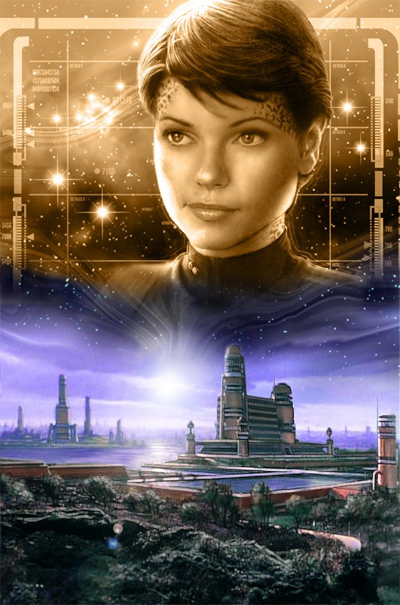
It’s quite something that Deep Space Nine left enough fertile ground to support a relaunch that ran so long, covering story beats that couldn’t necessarily be included in the television show – Bajor’s admittance to the Federation, the rebuilding of Cardassia, the aftermath of the war. Unjoined builds off the Trill storylines running through Deep Space Nine, using the events from the “eighth season” (the books through Unity) as a stepping stone to explore Trill culture.

ds9-unjoined

Continue reading

Star Trek: Deep Space Nine – The Siege (Review)

Star Trek: Deep Space Nine is twenty years old this year. To celebrate, I’m taking a look at the first and second seasons. Check back daily for the latest review or retrospective.

The Siege wraps up the first ever three-part episode of Star Trek in a surprisingly efficient manner. There are a few missteps, a lack of nuance and an over abundance of convenience and simplicity. However, it succeeds in doing what this opening three-parter set out to do. It tells a single story which could only ever have been told on Star Trek: Deep Space Nine. It gives a sense of scale to the show which is unique to the series, and it creates a palpable sense of uncertainty about the Federation’s mission to Bajor.

"He's letting me know, he'll be back..."

“He’s letting me know, he’ll be back…”

Continue reading

Star Trek: Deep Space Nine – The Circle (Review)

Star Trek: Deep Space Nine is twenty years old this year. To celebrate, I’m taking a look at the first and second seasons. Check back daily for the latest review or retrospective.

Drama naturally lends itself to a neat three-act structure. At the most basic level, it’s as simple as beginning, middle and end. However, it’s also a format taught in just about every screenwriting course, and it’s even used as the conventional model for those with more innovative approaches. With that in mind, it’s interest that Star Trek has done relatively few three-part stories. The Circle sits in the middle of the first such attempt, in the second season of the second spin-off. The format would not see use again for over a decade, when it would become a feature of the final season of Star Trek to air on television.

Given the franchise is relatively fond of two-parters, it seems strange that there haven’t been more attempts to extend that out an episode. Perhaps the reason is obvious. Of the three acts, the beginning and the end are the most essential. Both come with a certain in-built amount of energy. The first part introduces the problem, while the conclusion deals with it. However, it’s the middle which proves problematic. It’s the point in the story after you’ve set up the conflict, but before you resolve it. Given how much difficulty Star Trek: The Next Generation had with conclusions, imagine how difficult the second part of a three-parter would be.

Even when Star Trek: Enterprise adopted the three-parter format it ran into basic structural difficulties, with a couple feeling like a two-part episode with an additional prologue or epilogue added on. The Circle isn’t a terribly flawed piece of television, but it suffers from the fact that Star Trek has never really tried storytelling in this mode before.

The writing's on the wall...

The writing’s on the wall…

Continue reading

Star Trek: Deep Space Nine – The Homecoming (Review)

Star Trek: Deep Space Nine is twenty years old this year. To celebrate, I’m taking a look at the first and second seasons. Check back daily for the latest review or retrospective.

The Homecoming is notable for a number of reasons. It kicks off the franchise’s first three parter. Sure, Family provided a nice epilogue to The Best of the Both Worlds, but The Homecoming, The Circle and The Siege represents the first explicit three-part story in the history of the franchise. Star Trek: Enterprise would develop a fondness for the format in its final season and one of those three-parters (The Forge, The Awakening and Kir’Shara) would owe a conscious debt to this opening trilogy.

It also pretty much sets the tone of season premieres on Star Trek: Deep Space Nine. Star Trek: The Next Generation and Star Trek: Voyager would both display a fondness for bridging their seasons with two-part adventures. The opening episode would air as a season finalé, with the resolution airing as the opening episode of the following season. Deep Space Nine was not so literal minded. While each season premiere was informed by the themes and events of the last season’s closing episode, Deep Space Nine tended to favour opening with multi-part episodes rather than conclusions to narrative hooks.

Rather than wrapping up the threads hinted at in In the Hands of the Prophets, The Homecoming only builds on them. It suggests that the problems and the difficulties facing Bajor won’t magically disappear because ninety minutes of screen time have elapsed.

Dynamic Kira action pose!

Dynamic Kira action pose!

Continue reading

Star Trek: Deep Space Nine – In the Hands of the Prophets (Review)

Star Trek: Deep Space Nine is twenty years old this year. To celebrate, I’m taking a look at the first season. Check back daily for the latest review or retrospective.

Both Star Trek and Star Trek: The Next Generation allowed their first seasons to run an episode too long. The City on the Edge of Forever, the penultimate episode of the first ever season of Star Trek, is a genuine classic. I don’t envy any story that has to follow it, especially not something as mediocre as Operation — Annihilate! While Conspiracy, the second-to-last episode of the first season of The Next Generation, is hardly a classic in the same league, it does up the stakes on the show’s first year, and tie up a dangling plot thread. The Neutral Zone, on the other hand, is a bland return to form, with a particularly insufferable b-plot.

So the excellence of Duet might offer the viewer cause to worry. A penultimate first-season episode which is significantly above average? One would be forgiven for wondering if the first season might have been best served to wrap itself up at that point, going out in a high, safe in the knowledge that it had contributed one classic episode to the Star Trek mythos and with the potential to offer quite a few more. Quit while you’re winning, and don’t tempt fate with another superfluous episode.

In the Hands of the Prophets, however, puts those fears to rest. Serving as a companion piece to Duet, it’s another one of those “only on Deep Space Nine stories, closing out the first season with a reminder of what makes the show unique. In the Hands of the Prophets is another classic piece of Deep Space Nine. It might not pack quite the punch that Duet did, but it’s a compelling piece of drama which demonstrates just how much Deep Space Nine has to offer the Star Trek mythos.

Beyond belief...

Beyond belief…

Continue reading