• Following Us

  • Categories

  • Check out the Archives


  • Awards & Nominations

Star Trek: Deep Space Nine – The Collaborator (Review)

Star Trek: Deep Space Nine is twenty years old this year. To celebrate, I’m taking a look at the first and second seasons. Check back daily for the latest review or retrospective.

It’s surprising how long we’ve had since a solid Bajoran episode of Star Trek: Deep Space Nine. Barring the dark reflection of Bajor as a power-broker (and brief allusion to a colony in the Gamma Quadrant) in Crossover, the last episode to really explore the planet’s political and religious structure was probably Sanctuary, which aired more than half a season earlier. After a reasonably high concentration of Bajoran political adventures in the first season and the first half of the second, it seems that further explorations will be more broadly spaced.

Indeed, the first season ended (and the second season began) with a five-episode run that was heavily anchored in the show’s Bajoran surroundings. However, as of late, it feels we’ve been strangely disengaged from the show’s stated objective of welcoming Bajor to the Federation. With episodes like The Maquis, it seems like the show is making a conscious effort to disentangle Cardassian politics from those of Bajor.

In a way, this probably represents Deep Space Nine growing into the form that it will take for the rest of its run. The second season has really been about Deep Space Nine figuring out what it wants to be, and what it doesn’t want to be. With The Collaborator‘s focus on Bajoran politics feeling conspicuous by the lack of other Bajor-centric episodes in this half of the season, it seems like Deep Space Nine doesn’t want to be a show about Bajor.

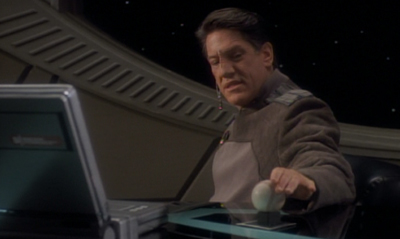
Enough rope to hang himself...

Enough rope to hang himself…

Continue reading

Star Trek: Deep Space Nine – Sanctuary (Review)

Star Trek: Deep Space Nine is twenty years old this year. To celebrate, I’m taking a look at the first and second seasons. Check back daily for the latest review or retrospective.

Sanctuary is a very weird little episode, a nice concept with too much padding, reserving its best hook and twist for the final ten minutes, but capping it off with an attempt to soften the harsh blow somewhat. It’s another of those “shows we could only do on Star Trek: Deep Space Nine from the series’ second season, and it’s certainly more interesting and ambitious than Second Sight. However, for all the clever stuff that it does, it feels somewhat oddly structured and paced, as if the writing staff knew there were good ideas wrapped up inside here, but weren’t exactly sure how to get them out.

A blip on the radar...

A blip on the radar…

Continue reading

Star Trek: Deep Space Nine – Terok Nor #0 (Review)

Star Trek: Deep Space Nine is twenty years old this year. To celebrate, I’m taking a look at the first season. Check back daily for the latest review or retrospective.

We’ll be supplementing our coverage of the episodes with some additional materials – mainly novels and comics and films. This is one such entry.

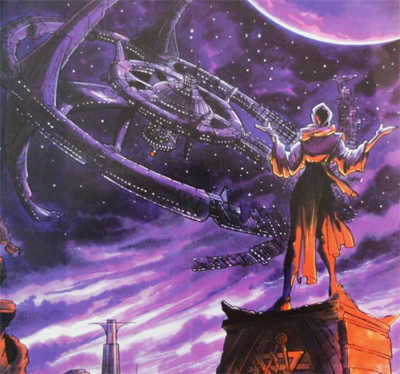
Terok Nor might be the best of Malibu Comics’ Star Trek: Deep Space Nine range, a one-shot written by Mark A. Altman and illustrated by Trevor Goring. It isn’t so much the plot that makes Terok Nor so distinctive – there is a lot of running around, some betrayals, some action sequences – but rather the execution of Altman’s story and the atmosphere provided by Goring’s pencils. The origin story of the space station Terok Nor, Altman very shrewdly frames the story as something of an oral history. It’s almost mythic and grand and epic, drawn in broad strokes rather than finer detail.

It serves quite well as the story of the construction of the central hub of the Star Trek show most concerned with legacy and history.

A monument to the Bajoran people...

A monument to the Bajoran people…

Continue reading

Star Trek: Deep Space Nine – The Siege (Review)

Star Trek: Deep Space Nine is twenty years old this year. To celebrate, I’m taking a look at the first and second seasons. Check back daily for the latest review or retrospective.

The Siege wraps up the first ever three-part episode of Star Trek in a surprisingly efficient manner. There are a few missteps, a lack of nuance and an over abundance of convenience and simplicity. However, it succeeds in doing what this opening three-parter set out to do. It tells a single story which could only ever have been told on Star Trek: Deep Space Nine. It gives a sense of scale to the show which is unique to the series, and it creates a palpable sense of uncertainty about the Federation’s mission to Bajor.

"He's letting me know, he'll be back..."

“He’s letting me know, he’ll be back…”

Continue reading

Star Trek: Deep Space Nine – The Circle (Review)

Star Trek: Deep Space Nine is twenty years old this year. To celebrate, I’m taking a look at the first and second seasons. Check back daily for the latest review or retrospective.

Drama naturally lends itself to a neat three-act structure. At the most basic level, it’s as simple as beginning, middle and end. However, it’s also a format taught in just about every screenwriting course, and it’s even used as the conventional model for those with more innovative approaches. With that in mind, it’s interest that Star Trek has done relatively few three-part stories. The Circle sits in the middle of the first such attempt, in the second season of the second spin-off. The format would not see use again for over a decade, when it would become a feature of the final season of Star Trek to air on television.

Given the franchise is relatively fond of two-parters, it seems strange that there haven’t been more attempts to extend that out an episode. Perhaps the reason is obvious. Of the three acts, the beginning and the end are the most essential. Both come with a certain in-built amount of energy. The first part introduces the problem, while the conclusion deals with it. However, it’s the middle which proves problematic. It’s the point in the story after you’ve set up the conflict, but before you resolve it. Given how much difficulty Star Trek: The Next Generation had with conclusions, imagine how difficult the second part of a three-parter would be.

Even when Star Trek: Enterprise adopted the three-parter format it ran into basic structural difficulties, with a couple feeling like a two-part episode with an additional prologue or epilogue added on. The Circle isn’t a terribly flawed piece of television, but it suffers from the fact that Star Trek has never really tried storytelling in this mode before.

The writing's on the wall...

The writing’s on the wall…

Continue reading

Star Trek: Deep Space Nine – Progress (Review)

Star Trek: Deep Space Nine is twenty years old this year. To celebrate, I’m taking a look at the first season. Check back daily for the latest review or retrospective.

Progress is the best episode of Star Trek: Deep Space Nine‘s first season to date. Of course, there are better episodes ahead – two of them clustered at the end of the show’s truncated first year – but Progress still represents a considerable improvement over anything that has come before. It isn’t quite perfect, but it does have a nice character focus and takes advantage of the show’s unique perspective and position. It’s evidence that the writing staff were at least engaging with the show’s status quo and trying to work with it to tell interesting stories, with Progress offering an early pure example of what Deep Space Nine story should probably look like.

While the first season has been quite bumpy (although notably less bumpy than any of the opening seasons of the other three Star Trek spin-offs), Progress offers a demonstration that we are getting somewhere. The title might apply as much to the status of the show itself as to the themes of the episode.

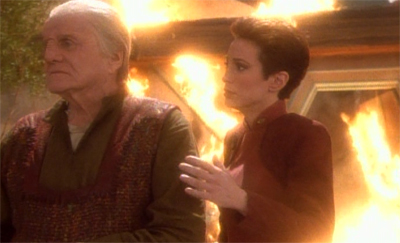
Burning down the house...

Burning down the house…

Continue reading

Star Trek: Terok Nor – Day of the Vipers by James Swallow (Review)

Star Trek: Deep Space Nine is twenty years old this year. To celebrate, I’m taking a look at the first season. Check back daily for the latest review or retrospective.

We’ll be supplementing our coverage of the episodes with some additional materials – mainly novels and comics and films. This is one such entry.

Star Trek: Deep Space Nine comes with back story. A lot of back story. In fact, the opening scene of Emissary establishes the show in the context of The Best of Both Worlds, Part II, introducing a lead character whose tragic origin is rooted in an encounter that we had only fleetingly glimpse in Star Trek: The Next Generation. Due to the setting and nature of the show, history and continuity were major parts of Deep Space Nine‘s identity, and a large part of what set the show apart from its predecessors. (And successors, for that matter.)

Although the Klingons would dominate the show’s fourth season and remain a presence throughout the show’s run, and the Romulans might occasionally be glimpsed lurking in the back ground, the series largely focused on two alien races that had been introduced in The Next Generation. The Cardassians had been introduced in the show’s fourth season, in The Wounded, and the Bajorans first appeared during the fifth season in Ensign Ro.

Officially part of The Lost Era series of novels designed to flesh out the history of the shared Star Trek universe, the Terok Nor trilogy exists as a bridge into Emissary, something of an extended history lesson that contextualises the events of Deep Space Nine by providing an account of the Occupation of Bajor, an atrocity that only ended shortly before Emissary actually began.

teroknordayofthevipers1

Continue reading