• Following Us

  • Categories

  • Check out the Archives


  • Awards & Nominations

Doctor Who: The Web of Fear (Review)

To celebrate the fiftieth anniversary of the longest-running science-fiction show in the world, I’ll be taking weekly looks at some of my own personal favourite stories and arcs, from the old and new series, with a view to encapsulating the sublime, the clever and the fiendishly odd of the BBC’s Doctor Who.

The Web of Fear originally aired in 1968.

See, now this is interesting.

The Enemy of the World had the luxury of arriving almost unannounced, a genuine honest-to-goodness classic story that had been written off by all but a minority of fans as a generic run-around James Bond pastiche. It was recovered, it turned out to be quite brilliant, and so was a massive surprise. Indeed, even if it had been merely “good” or “fine”, it would have been a joy to watch, because the episode was being measured against a popular imagination that had never really been too bothered with it. I don’t think it was too near the top of the majority of fans’ “would love to recover…” lists.

There were no expectations, so The Enemy of the World didn’t have to worry about measuring up to anything. The fact that it was quite brilliant was icing on the cake. In contrast, The Web of Fear has a lot of expectations to live up to. It is being measured not against the weight of continuity – featuring a much loved monster and introducing a recurring character – nor the sky-high expectations of fans. It is measured against the popular imagination. While The Enemy of the World probably seemed like an after-though to most Doctor Who fans, The Web of Fear is a massive part of what Doctor Who is to the general public.

Fur and loathing...

Fur and loathing…

Continue reading

The X-Files – Gender Bender (Review)

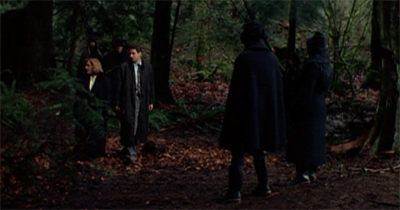
Gender Bender is weird. As an atmospheric moody piece of television, it’s pretty phenomenal – the script manages to tap into a whole bunch of basic nineties fears and uncertainties, while director Rob Bowman layers on the sense that something is not quite right here. On the other hand, as a narrative, the episode comes up short. From the cop-out ending to the laziness of putting Scully in peril twice, the story for Gender Bender is nowhere near as tight as it needs to be.

And yet, despite that, there’s a pervading sense of dread and unease that makes it far more compelling than it should be.

In the woods...

In the woods…

Continue reading

Doctor Who: The Enemy of the World (Review)

To celebrate the fiftieth anniversary of the longest-running science-fiction show in the world, I’ll be taking weekly looks at some of my own personal favourite stories and arcs, from the old and new series, with a view to encapsulating the sublime, the clever and the fiendishly odd of the BBC’s Doctor Who.

The Enemy of the World originally aired in 1967-68.

One chance, my friend. I said one chance.

– Patrick Troughton gets his David Tennant on

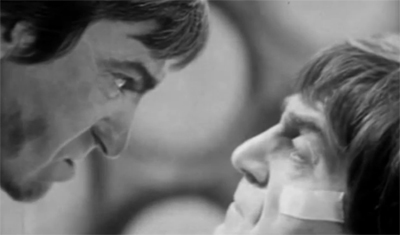
The Enemy of the World is an absolute joy from start to finish. Far too often, six-part Doctor Who serials tend to feel over-padded or over-stuffed, more a result of budget and production constraints than of any creative imperative to tell a story spread across six weeks. Instead, The Enemy of the World is a thoughtful, playful and fin six-part adventure that shows off Patrick Troughton at his best, with Dennis Whitaker’s script toying with various genre expectations and some interesting ideas about who the Doctor really is.

Face to face...

Face to face…

Continue reading

The X-Files – Beyond the Sea (Review)

Ah, Beyond the Sea. My favourite episode of the first season. Maybe my favourite episode of the first two seasons, although I’ll confess that my opinion is prone to change. I’m in good company. Darin Morgan points to it as his favourite episode. Chris Carter has (again and again) singled it out as the best episode of the show’s first season – a piece of television that works “on every level.”

It’s easy to point out all the exceptional stuff in Beyond the Sea. Gillian Anderson is phenomenal, as we’ve come to suspect from spending half a season with her. David Duchovny is quite happily relegated to a supporting role, willing to allow his co-star room to breathe. Brad Dourif is sensational. Glenn Morgan and James Wong’s script is phenomenal. David Nutter’s direction is absolutely top-notch.

However, what always struck me about Beyond the Sea was just how incredibly confident and casual it was. It was bold and clever and provocative, but it was also tight and controlled. It’s brilliant, but it never feels like this isn’t a level of craft the show can’t consistently hit.

We are the dead...

We are the dead…

Continue reading

Non-Review Review: Escape Plan

Escape Plan doesn’t demand too much. It doesn’t demand too much from its lead actors, and it doesn’t demand too much from its audience. A film about watching two of the biggest action stars of the eighties teaming up should be a celebratory occasion – a trip down memory lane, one last go-around for old time’s sake as we watch this dynamic duo escape a mysterious “off the grid” prison which seems quite like the place I imagined all eighties action stars go in the end.

Instead, Escape Plan feels like the middle section of John Woo’s Face/Off extended out to a two-hour feature film, the story of a man who shouldn’t be in prison forced to escape from a futuristic science-fiction gulag through a series of overly-elaborate action set-pieces. There is, quite frankly, not enough here to support the movie’s extended runtime, with the script never daring to swerve sharply away from expectations or clichés. Escape Plan delivers exactly what the premise promises, but nothing more and never with anything approaching enthusiasm.

Old-timer hard-timers...

Old-timer hard-timers…

Continue reading

Doctor Who: The Ice Warriors (Review)

To celebrate the fiftieth anniversary of the longest-running science-fiction show in the world, I’ll be taking weekly looks at some of my own personal favourite stories and arcs, from the old and new series, with a view to encapsulating the sublime, the clever and the fiendishly odd of the BBC’s Doctor Who.

The Ice Warriors originally aired in 1967.

It’s strange that the Jon Pertwee era tends to attract so much criticism for adhering so rigidly to formula, with Barry Letts and his team rigidly working within well-defined lines and trying hard to produce television that doesn’t suck. Outside of the political criticism of the Pertwee era, there’s a train of thought that suggests the show became a little too formulaic, a little too predictable, failing to really push its own boundaries, with a few scattered exceptions.

And yet the Patrick Troughton era was arguably just as much a slave to routine and formula. The Troughton era is defined by its “base under siege” stories, so massively influential that they’ve become a Doctor Who subgenre unto themselves. Episodes like Earthshock and The Almost People arguably serve as homages to the genre that peaked during the late sixties. Indeed, allowing for some measure of flexibility, six of the seven adventures in this season could be described as “base under siege” stories.

I can’t help but wonder if the destruction of so many Troughton-era stories has led many Doctor Who fans to become blinded by nostalgia reflecting on the era. The Tomb of the Cybermen is, after all, much more exciting as the sole surviving “base under siege” story of the fifth season than it as the first of six adventures loosely adhering to the same structure and conventions.

Ice to meet you...

Ice to meet you…

Continue reading

The X-Files – Fire (Review)

Well, Fire is probably Chris Carter’s strongest script since The Pilot. I suppose we should be grateful for that, at least.

All fired up...

All fired up…

Continue reading

Star Trek: Deep Space Nine – Season 2 (Review)

Star Trek: Deep Space Nine is twenty years old this year. To celebrate, I’m taking a look at the first and second seasons. Check back daily for the latest review or retrospective.

Well, that’s more like it. The second season of Star Trek: Deep Space Nine might not rank with the very best of the franchise, but it doesn’t have to. Deep Space Nine is still a young show, and Star Trek spin-offs have a long history of taking their time to find their feet. The second season of Deep Space Nine contains its fair share of classic or memorable episodes, but it’s defined by a sense that the producers are still trying to figure out what works and what doesn’t.

While the first season occasionally felt like the series was stumbling back towards safety, trying to become a lighter version of Star Trek: The Next Generation as faith in its premise wavered, the second season is a lot more confident in itself. It’s willing to play around a bit to figure out how to be the show that it wants to be. And there’s a sense, as the season winds to a close, that we’re almost there.

By the time we hit the second half of the season, it seems the show has learned to churn out inoffensive episodes that feel unique and distinctively Deep Space Nine – episodes like Playing God or Shadowplay. However, it’s in the final third that the show seems to figure out how make truly great episodes of Deep Space Nine.

ds9-playinggod22

Continue reading

Star Trek: Deep Space Nine – The Jem’Hadar (Review)

Star Trek: Deep Space Nine is twenty years old this year. To celebrate, I’m taking a look at the first and second seasons. Check back daily for the latest review or retrospective.

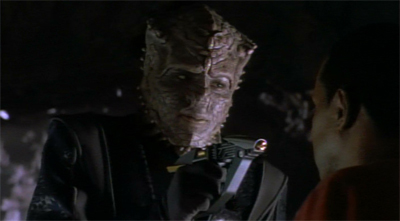
In terms of sheer quality of execution, The Jem’Hadar is probably the weakest of Star Trek: Deep Space Nine‘s season finalés. It lacks the gut punch of A Call to Arms, the shock twist of Broken Link, the atmosphere of The Adversary or even the timeliness of In the Hands of the Prophets. It is, at its most basic level, a story about a disastrous first contact that occurs during a father-son bonding trip that goes horribly wrong, ending with precious little actually advanced.

However, in terms of conceptual ideas, The Jem’Hadar is a game-changer. It is the cornerstone upon which Deep Space Nine would construct its most iconic narrative arc. It caps off two years of trying to develop the Ferengi as more than one-note jokes. It’s a bold statement about the freedom that Deep Space Nine would enjoy with Star Trek: The Next Generation retiring from the airwaves. It cemented the notion that Deep Space Nine never really dealt in two-part episodes to bridge seasons.

For Deep Space Nine, season finalés did not exist simply as pieces of Lego designed to snugly fit those other pieces at the start of the following season, crafting some illusion of continuity flow between two different seasons of television. Instead, cliffhangers on Deep Space Nine changed the rules, shook up the status quo, and teased the changing face of things to come.

A Jem?

A Jem?

Continue reading

The X-Files – Eve (Review)

The X-Files owes a conscious debt to Twin Peaks, in quite a few ways. David Lynch’s landmark television series perfectly blended the mundane with the surreal, creating a world that managed to be both incredibly familiar and hauntingly ethereal. One of the hallmarks of Lynch’s approach to Twin Peaks – and of his work in general including, most obviously, Blue Velvet and Dumbland – was the sense that there was something quite horrid and rotten lurking beneath the flowerbeds and picket fences of those lovely suburban houses.

Eve is the show’s first real exploration of suburbia, hitting on all manner of rich Cold War anxieties and fears lurking just behind those neatly-trimmed hedges.

Breaking up families...

Breaking up families…

Continue reading