• Following Us

  • Categories

  • Check out the Archives


  • Awards & Nominations

Star Trek: The Next Generation – The Price (Review)

This January and February, we’ll be finishing up our look at the second season of Star Trek: The Next Generation and moving on to the third year of the show, both recently and lovingly remastered for high definition. Check back daily for the latest review.

Well, the streak had to end some time. After seven episodes ranging from “flawed but still interesting” to “pretty great”, the third season of Star Trek: The Next Generation hits a bit of a snag. The Price is the weakest episode of the show’s third season to this point, and confirmation that the writers really have no idea how to write for Deanna Troi. It’s still the best episode to focus on the ship’s half-Betazoid counsellor, but being better than Haven or The Child is hardly an accomplishment for the ages.

All that glitters...

All that glitters…

Continue reading

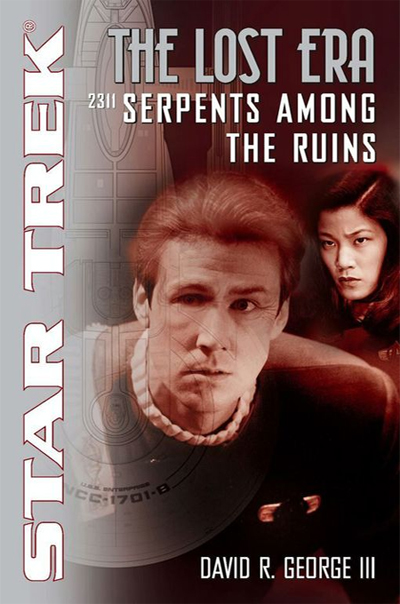
Star Trek: The Lost Era – Serpents Among the Ruins by David R. George III (Review)

This January and February, we’ll be finishing up our look at the second season of Star Trek: The Next Generation and moving on to the third year of the show, both recently and lovingly remastered for high definition. Check back daily for the latest review.

We’ll be supplementing our coverage of the episodes with some additional materials – mainly novels and comics and films. This is one such entry. This is actually supplementary to the first season of the Next Generation, specifically the episode The Neutral Zone.

The first year of Star Trek: The Next Generation was a little rocky when it came to continuity. Skipping roughly a century on from the adventures of James T. Kirk, there were times when it seemed like the writers weren’t entirely sure what had happened during that gap. Early on, for example, it was suggested that the Klingons had joined the Federation, a decision reversed by the show’s third season. Even within the first year of the show, it seemed like the writers hadn’t quite cemented the wider Star Trek universe. In Angel One, we discover that the Romulans are threatening war, only to hear in The Neutral Zone that they’ve actually been absent from galactic affairs for quite some time.

Serpents Among the Ruins is an attempt to explain that absence established in 1988, and contextualise it against the eighteen years of Romulan stories that would follow from the early appearances in Star Trek: The Undiscovered Country through to the end of Star Trek: Deep Space Nine and beyond.

st-serpentsamongtheruins

Continue reading

Star Trek: The Next Generation – The Enemy (Review)

This January and February, we’ll be finishing up our look at the second season of Star Trek: The Next Generation and moving on to the third year of the show, both recently and lovingly remastered for high definition. Check back daily for the latest review.

The Enemy is just a fantastic piece of television. The third season of Star Trek: The Next Generation has maintained an impressive consistency up to this point, despite all the difficulties bubbling away behind the scenes. However, The Enemy is the point where everything seems to have finally settled down and the show is truly comfortable churning out episodes of this sort of quality.

It’s a very typical Star Trek plot, with one of our leads trapped on the planet surface and forced to team up with an enemy soldier in order to survive. It’s a very standard morality tale about how the enemy is not as different as we might like to think; it’s an exploration – in a very Star Trek style – of how two people can overcome their differences in order to survive  a suitably desperate situation.

The Enemy is a demonstration of just how well-oiled The Next Generation had become at this point in time, and how even the most standard of plots could be executed with considerable skill.

The show's quality is climbing...

The show’s quality is climbing…

Continue reading

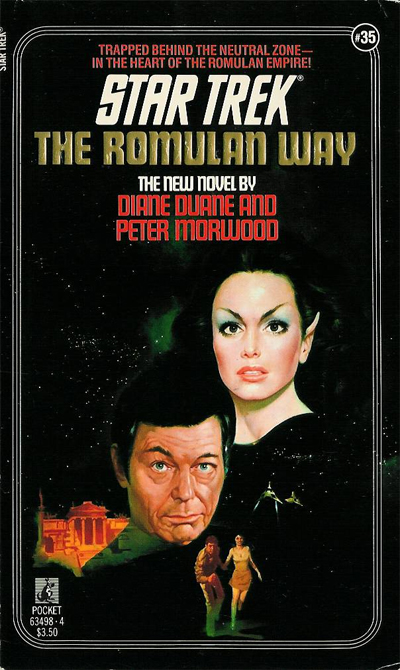
Star Trek – The Romulan Way by Diane Duane and Peter Morwood (Review)

This January and February, we’ll be finishing up our look at the second season of Star Trek: The Next Generation and moving on to the third year of the show, both recently and lovingly remastered for high definition. Check back daily for the latest review.

We’ll be supplementing our coverage of the episodes with some additional materials – mainly novels and comics and films. This is one such entry.

The Romulan Way is the second book in Diane Duane’s “Rihannsu” cycle – although the first book in the series, My Enemy, My Ally was only retroactively distinguished from standard Star Trek tie-ins. Much like My Enemy, My Ally had been roughly contemporaneous with John M. Ford’s The Final Reflection, Duane’s follow-up was published around the same time as Ford’s own sequel to his earlier work, How Much for Just the Planet? Expanding on My Enemy, My Ally, The Romulan Way sees Duane delving more thoroughly into Romulan history and culture.

The Romulan Way was published amid a sea of change at Paramount and Pocket Books in the late eighties, with shifting mandates and objectives for these tie-in books that represented a conscious effort to hem in some of the more creative tendencies of mid-eighties Star Trek novelist. To demonstrate how rapidly things were changing, both The Romulan Way and How Much for Just the Planet? were both published within three years of their predecessors. After this point, it would take Duane another thirteen years to write the third volume in her saga, and John M. Ford would never write another Star Trek tie-in again.

It’s very hard to condone any publishing philosophy that leads to results like that.

tos-theromulanway

Continue reading

Star Trek: The Next Generation – Booby Trap (Review)

This January and February, we’ll be finishing up our look at the second season of Star Trek: The Next Generation and moving on to the third year of the show, both recently and lovingly remastered for high definition. Check back daily for the latest review.

Booby Trap is a bit of a mess. The writing credits for the episode, featuring four different writers credited with getting the idea from basic story to finished script. This wasn’t at all unusual in the show’s third season – consider the writing credits for Yesterday’s Enterprise – but it gives an indication of the chaos unfolding behind the scenes on the third season of Star Trek: The Next Generation.

It’s Michael Piller’s second credited script, and his first writing credit since he took over the writers’ room. (Although he did, along with Melinda Snodgrass, do a pass on Ronald D. Moore’s script for The Bonding.) As such, it is written with a very clear idea of where Piller wants to take the show, one that shines through a somewhat uneven and all-over-the-place plot, which often feels like several different scripts blended into one.

Building on what came before...

Building on what came before…

Continue reading

Star Trek: The Next Generation (DC Comics, 1989) #19 – The Lesson (Review)

This January and February, we’ll be finishing up our look at the second season of Star Trek: The Next Generation and moving on to the third year of the show, both recently and lovingly remastered for high definition. Check back daily for the latest review.

We’ll be supplementing our coverage of the episodes with some additional materials – mainly novels and comics and films. This is one such entry.

One of the biggest problems that the writing staff had on Star Trek: The Next Generation was the insistence that the show was episodic. Themes and characters were rarely carried from week to week. Occasionally, a plot point or character might recur, but the bulk of the show was intentionally designed to be readily accessible in just about any order imaginable. In the era of HBO and “televisual novels”, this approach seems quite quaint, but it was very much the reality of late eighties and early nineties television.

However, there were no such restrictions on comic book story telling. Far from downplaying continuity and long-term plotting, mainstream American comics pride themselves on their serialised nature. It’s quite common for characters to suddenly reappear after absences of considerable time, and for writers to make callbacks to events that occurred decades ago. Publishing twelve issues a year, typically from the same author, The Next Generation comic book did afford the opportunity for a slightly different type of storytelling.
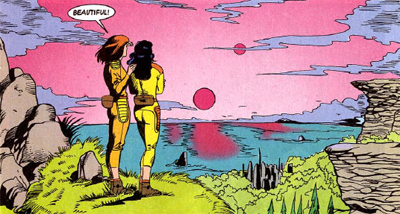
All set...

All set…

And, to be fair, that was one of the strengths of Michael Jan Friedman’s approach to The Next Generation comic book. He was fond of focusing on supporting characters, or giving page space to characterisation, or even basking in the show’s continuity in a way that wasn’t possible on television. Sure, Friedman could occasionally get a little obsessive in his continuity references, and could occasionally have difficulty tying everything into a cohesive story, but this was one way the author capitalised on the shift in the medium.

The Lesson is a single-issue story that is all the more intriguing for essentially existing as a series of character moments, with little in the way of an over-arching plot. The writing is a little clumsy and on-the-nose, with the comic earnestly offering its readers a rather ham-fisted message of the week, but it’s notable for the way that Friedman seems to bask in the freedom afforded to him by virtue of the fact that he’s writing a comic book (rather than an episode) of The Next Generation.

They've really bonded...

They’ve really bonded…

Continue reading

Star Trek: The Next Generation – The Bonding (Review)

This January and February, we’ll be finishing up our look at the second season of Star Trek: The Next Generation and moving on to the third year of the show, both recently and lovingly remastered for high definition. Check back daily for the latest review.

The Bonding is a pretty pivotal and momentous episode for Star Trek: The Next Generation. On one hand, it’s the first episode overseen by incoming executive producer Michael Piller. Piller would go on to become one of the most influential producers to work on Star Trek. Aside from steering The Next Generation towards success, he also created Star Trek: Deep Space Nine and Star Trek: Voyager, as well as overseeing the production of the first three Next Generation films.

However, The Bonding is also the first script written by Ronald D. Moore. Obviously, the version that made it to screen had been revised and tweaked by Melinda Snodgrass and Michael Piller, but The Bonding still feels like a Moore script. Ronald D. Moore would go on to be one of the more influential writers on The Next Generation and Deep Space Nine. He also worked (very) briefly on Voyager, before departing and heading up his own reboot of Battlestar Galactica.

So The Bonding is the beginning of something new, an original direction for The Next Generation. Featuring a powerful and wonderful opening half, The Bonding suffers a bit from falling into conventional Star Trek tropes towards the end of the episode. However, it’s still a clever and powerful piece of television.

A bit of shadow...

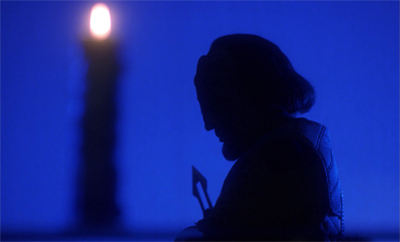
A bit of shadowplay…

Continue reading

Star Trek (DC Comics, 1989) #19 – Once a Hero… (Review)

This January and February, we’ll be finishing up our look at the second season of Star Trek: The Next Generation and moving on to the third year of the show, both recently and lovingly remastered for high definition. Check back daily for the latest review.

We’ll be supplementing our coverage of the episodes with some additional materials – mainly novels and comics and films. This is one such entry.

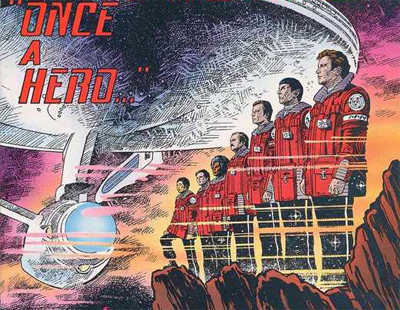
Once a Hero… is a notable story for a number of reasons. The most obvious is that it’s Peter David’s last issue of DC’s monthly Star Trek comic, departing the comic book after a pretty bitter disagreement with Richard Arnold, who was overseeing Star Trek licensing at the time. Given that David wrote The Incredible Hulk for twelve years and remains a prolific and well-liked comic book creator among the comic community, as well as a guiding light in Star Trek tie-in fiction, that’s a pretty damning indictment of Richard Arnold right there.

However, Once a Hero… is also notable for being an in-depth exploration and reflection on the “red shirt” narrative convention that the franchise loved so dearly.

A grave adventure...

A grave adventure…

Continue reading

Star Trek: The Next Generation – Who Watches the Watchers? (Review)

This January and February, we’ll be finishing up our look at the second season of Star Trek: The Next Generation and moving on to the third year of the show, both recently and lovingly remastered for high definition. Check back daily for the latest review.

Who Watches the Watchers? continues a strong start to the third season of Star Trek: The Next Generation. It is the last episode of the third season produced by Michael Wagner. He would depart the show and leave Michael Piller in charge of the scripts for the rest of the season. It’s also the third-to-last credit for writers Hans Beimler and Richard Manning, who had both been around from the first season.

The writing duo would work on Yesterday’s Enterprise with Ira Steven Behr and Ronald D. Moore, but also finish Allegiance before departing the show at the end of the third season. (They were rather enraged by Piller’s tactless “writing 101” memo, sent later in the season.) Manning and Beimler would go on to write Paradise for Star Trek: Deep Space Nine, and Behr would convince Beimler to return to the franchise for the fourth season of Deep Space Nine. Beimler would be Behr’s most faithful writing partner on that spin-off, teaming with Behr throughout the sixth and seventh seasons in particular.

In many ways, Who Watches the Watchers? returns to some of the themes that the duo had touched upon in their strongest script of the first season, Symbiosis. It’s a complicated morality tale about the ethics of Starfleet and the burden of the Prime Directive.

The answer, apparently, is Liko.

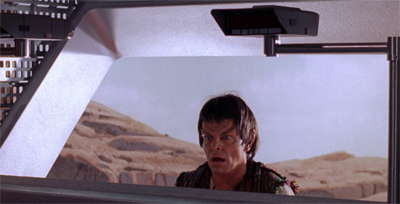
The answer, apparently, is Liko.

Continue reading

Star Trek – Operation Assimilation (Review)

This January and February, we’ll be finishing up our look at the second season of Star Trek: The Next Generation and moving on to the third year of the show, both recently and lovingly remastered for high definition. Check back daily for the latest review.

We’ll be supplementing our coverage of the episodes with some additional materials – mainly novels and comics and films. This is one such entry.

In many ways, Operation Assimilation feels like a cynical cash-in. It’s a one-shot Marvel comic book published in the wake of the release of Star Trek: First Contact that doesn’t seem to go anywhere, doesn’t seem to seed any story points that might pay off later and doesn’t seem like it has anything particularly insightful to say. It really feels like Marvel just wanted to reaffirm the fact that they had the license to publish Star Trek comics towards the end of First Contact‘s theatrical release cycle and before the film’s home media release.

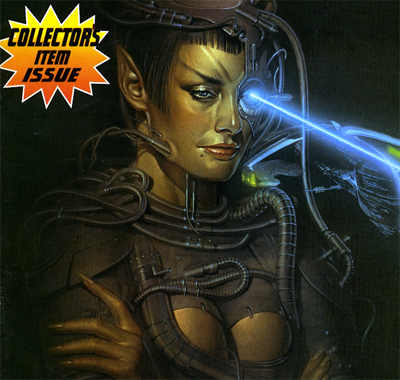
The cover does little to help this impression. Several months before Star Trek: Voyager would introduce the world to a sexy Borg drone, the cover of Operation Assimilation features a female Borg drawn in a pose (and with a costume) intended to emphasise her cleavage. “Collector’s Item Issue!” the cover boasts, reminding the reader that it is a product of the late nineties comic speculation boom that almost destroyed the industry. The shiny “1” on the cover makes it feel like more of a marketing exercise, along with a fairly light interview with Jonathan Frakes on the last few pages.

It feels almost like Operation Assimilation says more about late nineties comic books than it does about Star Trek.

Cue cheap joke about implants...

Cue cheap joke about implants…

Continue reading