• Following Us

  • Categories

  • Check out the Archives


  • Awards & Nominations

The X-Files – Herrenvolk (Review)

This February and March, we’re taking a trip back in time to review the fourth season of The X-Files and the first season of Millennium.

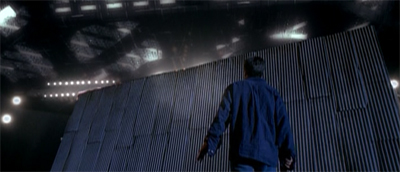
After Talitha Cumi, Herrenvolk cannot help but seem like a little bit of a disappointment.

Towards the end of the episode, the Alien Bounty Hunter hunts down Jeremiah Smith. Mulder begs for mercy, but the Bounty Hunter will hear nothing of it. “He shows you pieces, but tells you nothing of the whole,” the Bounty Hunter remarks to Mulder. It feels like that sentiment encapsulates Herrenvolk in a nutshell. Mulder goes on the run with Jeremiah Smith and sees a collection of vague but compelling things that may or may not tie into colonisation.
"Now you're thinking, 'I hope that's shepherd's pie in my knickers!'"

“Now you’re thinking, ‘I hope that’s shepherd’s pie in my knickers!'”

Like a lot of the mythology in the fourth and fifth seasons, it feels like a holding pattern. Talitha Cumi was surprisingly candid in its revelations. The aliens were plotting to colonise Earth in collaboration with the human conspirators. The date had been set, the plot was in motion. That was a pretty big bombshell, confirmed in unequivocal terms. It was arguably the clearest and most transparent that the conspiracy arc would ever be. There was a clear goal, a deadline, and a sense of purpose.

Almost immediately, Herrenvolk works to muddy the water. It stalls, it procrastinates, it delays, it evades. It is a plot structured around a collection of ominous conspiracy buzz words (DNA, smallpox, colonies, clones) without a clear purpose or objective.
A bloody mess...

A bloody mess…

Continue reading

The X-Files – Season 3 (Review)

This November (and a little of December), we’re taking a trip back in time to review the third season of The X-Files and the first (and only) season of Space: Above and Beyond.

The second season of The X-Files was quite experimental in nature. Not all of that experimentation was intentional or planned, but the second season worked quite hard to demonstrate what the show could do. Gillian Anderson’s pregnancy forced the show to plot a relatively long-form arc, with Scully getting abducted and the X-files remaining closed for the first six episodes of the season. In essence, Anderson’s absence forced the show to embrace serialisation.

Other second-season experiments seemed more relaxed. The show discovered that big two-part mythology episodes did well during sweeps. Die Hand Die Verletzt and Humbug proved that the series could do comedy. David Nutter, Rob Bowman and Kim Manners became the show’s go-to directors. The show’s alien conspiracy arc became a recurring thread rather than a subset of the monsters of the week. There was a lot learnt during that second season.

xfiles-paperclip26

The third season of The X-Files feels a lot more relaxed, and a lot more comfortable. The third season seems to be largely about reinforcing the lessons learned during the second season. The third season gives more work to writers, directors and actors who made an impression during the second season. It works hard to solidify the concept of The X-Files. It seems like Chris Carter and his collaborators have finally figured out exactly what The X-Files should be, and are delivering it consistently.

The result is one of the most impressive seasons of television produced in the nineties, beginning a hot streak for the show. Chris Carter and Ten Thirteen would manage to produce three consistently fantastic seasons of television between September 1995 and May 1998. The third season of The X-Files really gets that ball rolling in a very profound and meaningful sense.

xfiles-josechungsfromouterspace5 Continue reading

Stefan Petrucha and Charles Adlard’s Run on The X-Files (Topps) (Review)

This November (and a little of December), we’re taking a trip back in time to review the third season of The X-Files and the first (and only) season of Space: Above and Beyond.

Topps’ X-Files comic was a massive success in the nineties.

The monthly series ran for forty-one issues between January 1995 and September 1998. In that time, Topps also produced an X-Files graphic novel, three digests, two annuals, a spin-off line of Season One comics and a miniseries adaptation of a Kevin Anderson novel. They also reprinted the series in quite a few formats, indicating that the comic sold well even outside the monthly schedule. The only reason that the series came to an end was because Topps eventually decided to retire from comic book publishing.

xfiles-feelingsofunreality4

After Topps withdrew from the comic book market following the Great Comic Crash of the mid-to-late nineties, the X-Files license lay fallow. Barring two Lone Gunman comics published by Dark Horse in 2001, there would be no new officially licensed X-Files comics written between September 1998 and September 2008, when Frank Spotnitz scripted a miniseries for Wildstorm. It is incredible to look back on the success of the Topps line for those three-and-a-half years when it held the license.

A lot of the credit for that success is owed to writer Stefan Petrucha, cover artist Miran Kim and interior artist Charles Adlard.

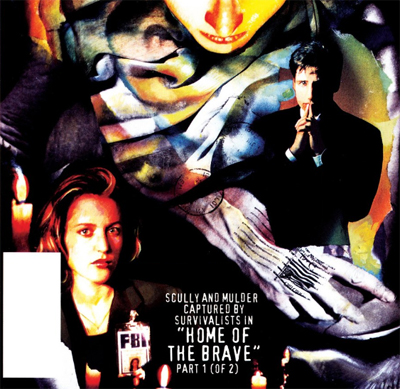
xfiles-homeofthebrave17

Continue reading

The X-Files (Topps) #15-16 – Home of the Brave (Review)

This November (and a little of December), we’re taking a trip back in time to review the third season of The X-Files and the first (and only) season of Space: Above and Beyond.

And so, we approach the end of an era.

The end of the third season of The X-Files brought down the curtain in a number of different ways. It was the last season of The X-Files to air beginning-to-end on Friday nights, turning it into a truly global phenomenon. It was the last season to air before Chris Carter launched Millennium and the last season broadcast before the show began to focus on The X-Files: Fight the Future; perhaps making it the last season of the show to have Chris Carter’s completely undivided attention for quite some time.

This is the end...

This is the end…

Amid all these changes, the shifting of the creative team on the tie-in comic book is not the biggest change taking place, but it contributes to a larger sense that The X-Files is changing. Writer Stefan Patrucha and artist Charles Adlard had worked on The X-Files since Topps launched the comic. On top of their sixteen issues of the regular series, the duo had worked on an annual, two digests and a variety of short (and special) stories during their tenure.

It is very strange to see the pair departing, because their work on X-Files tie-in comic book ranks as one of the most consistently interesting tie-ins published in mainstream comics.

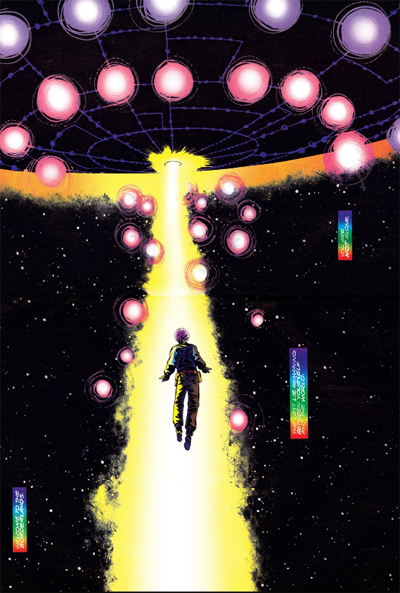
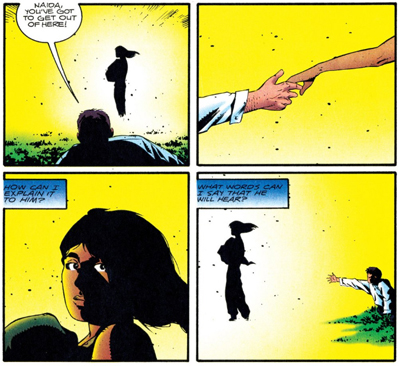
Don't go into the light...

Don’t go into the light…

Continue reading

The X-Files – Quagmire (Review)

This November (and a little of December), we’re taking a trip back in time to review the third season of The X-Files and the first (and only) season of Space: Above and Beyond.

Quagmire is a delightful little episode, one of third season episodes that most effectively embodies what casual fans (or even those who have never seen the show) think of when they hear the words The X-Files.” In Wanting to Believe, author Robert Shearman describes Quagmire as something akin to a “live action Scooby Doo, and he’s not far wrong. This is Mulder and Scully searching together in the darkness, looking for a monster that may or may not be there. You don’t get more archetypical X-Files than that.

One of the defining features of the third season of The X-Files has been a sense of consolidation. It feels like the show experimented a great deal in its first two years, but the third season is very much about cementing and solidifying its identity. It is no wonder, then, that the third season has such a high concentration of archetypal episode – episodes you can show an interested viewer and say this is The X-Files in a forty-five minute nutshell.” In that respect, Quagmire ranks with D.P.O. or Pusher or Clyde Bruckman’s Final Repose as a great introduction to the show.

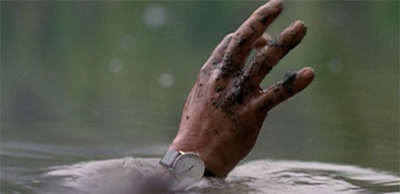
There's something in the water!

There’s something in the water!

Of course, Quagmire is a very good introduction to The X-Files for new viewers, but it is also something of a farewell. It is Kim Newton’s last script for the show. Newton had joined the writing staff at the start of the third season. Her other major credit was Revelations. Like Revelations, there is a sense that Quagmire was heavily re-written before it made it in front of the cameras. In this case, it is something of an open secret that Quagmire received a fairly significant polish from departing story editor Darin Morgan, whose fingerprints are all over the finished draft.

If Darin Morgan bid farewell to The X-Files with Jose Chung’s “From Outer Space”, then Quagmire serves as something of a coda to his time on the show. If that is the case, it makes for an uncharacteristically upbeat postscript to Morgan’s work on the show.

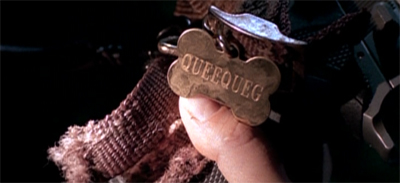
They really collared the bad guy...

They really collared the bad guy…

Continue reading

The X-Files (Topps) Digest #2 – Dead to the World (Review)

This November (and a little of December), we’re taking a trip back in time to review the third season of The X-Files and the first (and only) season of Space: Above and Beyond.

Stefan Petrucha and Charles Adlard are winding at this point in their curatorship of Topps’ The X-Files comic book. The duo have contributed an absolutely staggering volume of work to the line. On top of monthly issues and short stories, there have been annuals and digests. The volume of the output has been staggering. All of it has been written by Petrucha and the vast majority was illustrated by Adlard. The quality has – generally speaking – been quite impressive.

Dead to the World is the headline story in the second “digest” published by Topps comics. As with Big Foot, Warm Heart before it, the format of the “digest” feels a little strange. There is a single (and rather long) comic written by Petrucha and illustrated by Adlard, following by a collection of shorts taken from Ray Bradbury Comics, a somewhat less popular feature of Topps’ comic book publishing line. There is a sense that the format might have worked better as a collection of short X-Files-themed stories for a variety of creators.

Face to face...

Face to face…

Nevertheless, the result is interesting. In many ways, Big Foot, Warm Heart seemed to point at where Petrucha and Adlard would go when they wrapped up their massive twelve-part “Aquarius” mega-arc. With its reflections on human failings and human abuses, it seemed like Big Foot, Warm Heart set the tone for the stories that would follow – like One Player Only or Falling. It offered a tease of things to come, suggesting the humanity could be more monstrous than any mythological creature.

In contrast, it is very tough to see where Dead to the World might have been pointing. Then again, Petrucha and Adlard would be gone from the comic a month after its publication. So perhaps the story’s funereal atmosphere feels appropriate.

Here there be monsters...

Here there be monsters…

Continue reading

The X-Files – Avatar (Review)

This November (and a little of December), we’re taking a trip back in time to review the third season of The X-Files and the first (and only) season of Space: Above and Beyond.

Avatar is really the first time that The X-Files relies on a member of its supporting cast to carry a story all by themselves.

Later seasons will get a bit more adventurous when it comes to sharing screen time. Musings of a Cigarette-Smoking Man and En Ami both offer viewers a glimpse at the man behind the cigarette. The Lone Gunmen prepare for their own spin-off with The Unusual Suspects and Three of a Kind. Even Skinner gets a couple more character-centric episodes with Zero Sum and S.R. 819. In a way, Hungry is a day-in-the-life episode of a monster of the week.

Pushing Mulder to the background...

Pushing Mulder to the background…

Avatar is an episode that demonstrates that these kinds of stories are possible – that The X-Files can lift the focus off of Mulder and Scully for a week and flesh out those characters who exist at the periphery of the series. Just under two years after he was first introduced, Mitch Pileggi has proven himself invaluable to the series. Asking him to carry an episode like this demonstrates the show’s faith in the character.

Avatar is a bit rough around the edges, struggling to decide whether it is part of the show’s conspiracy mythology or a stand-alone monster tale in a season that has worked hard to delineate the two types of show. Still, it’s an ambitious late-season installment that makes a lasting impression on what The X-Files can be.

Don't look now...

Don’t look now…

Continue reading

The X-Files (Topps) #14 – Falling (Review)

This November (and a little of December), we’re taking a trip back in time to review the third season of The X-Files and the first (and only) season of Space: Above and Beyond.

Falling is a delightfully nasty piece of work.

It is, to be fair, something that has been gestating for quite a while in Petrucha and Adlard’s extended run on The X-Files. If their first year on the title explored the loose boundary between reality and unreality, their final few issues shifted to more grounded and cynical themes. Most explicitly, the idea that humanity makes the best monsters. It is a gleefully subversive twist on one of the core elements of The X-Files: the idea that monsters are real.

Falling to pieces...

Falling to pieces…

Petrucha and Adlard had broached this before. This was the key point in Big Foot, Warm Heart, where the eponymous creature shows more humanity than the human antagonist of the story. One Player Only featured a delightful red herring when it suggested a murderous artificial intelligence had driven a developer to a killing spree at a software company, only to reveal that the developer’s actions were entirely his own. It will be taken to the logical extreme in Home of the Brave, essentially the duo’s grand finalé.

Blending together the Americana and nostalgia of Stand By Me with the brutal cynicism of Lord of the Flies, Falling is a compelling and unsettling read.

If a tree falls in the woods...

If a tree falls in the woods…

Continue reading

The X-Files – Hell Money (Review)

This November (and a little of December), we’re taking a trip back in time to review the third season of The X-Files and the first (and only) season of Space: Above and Beyond.

Hell Money is an oft-overlooked episode of The X-Files.

The positioning in the third season probably doesn’t help. It comes directly after Teso Dos Bichos, probably the season’s weakest episode. It is also positioned in the gap between Pusher and Jose Chung’s “From Outer Space”, two broadly-loved episodes that serve as pitch-perfect examples of The X-Files both on- and off-format. In contrast, Hell Money is something a little stranger. It is not as conventional as Pusher, nor as radical as Jose Chung’s “From Outer Space.”

Seeing is believing...

Seeing is believing…

Instead, Hell Money is an episode of The X-Files that loosely fits the show’s format. Mulder and Scully investigate a bunch of macabre murders where sinister forces are at work. However, in keeping with the broad themes of the third season, the evil in Hell Money takes a particularly banal form. There are no monsters here; at least, not any supernatural monsters. The only ghosts that haunt the narrative are metaphorical. There is a culture alien to our leads, but one a bit more grounded than extraterrestrials.

Hell Money is a clever and thoughtful piece of television that feels subtly and harrowingly subversive.

The writing is on the wall...

The writing is on the wall…

Continue reading

The X-Files – Teso Dos Bichos (Review)

This November (and a little of December), we’re taking a trip back in time to review the third season of The X-Files and the first (and only) season of Space: Above and Beyond.

It happens.

Every once in a while, there is a misfire. This is especially true when producing a genre television series churning out over twenty episodes a year. Inevitably, some of those episodes will fail; a few will fail spectacularly. Such is the way of things. It is hard to think of a twenty-odd episode season of anything that managed to maintain consistent levels of brilliance for a full season. All you can really hope is that the eventual and inevitable misfire is mostly technical.

No bones about it...

No bones about it…

Teso Dos Bichos is a terrible episode of The X-Files. It is a terrible episode of television in general. However, it is terrible in ways that are mostly banal. This isn’t a failure of overreaching ambition, like Fearful Symmetry. It isn’t a missed opportunity, like 3. It isn’t even a racist and sexist nightmare, like Excelsis Dei. Instead, Teso Dos Bichos is just bad television. It is an episode that probably didn’t work on paper, containing elements that were unlikely to work on film either.

Given how strong the third season has been, there’s a desire to brush past Teso Dos Bichos, and pretend it simply did not happen.

Cat people!

Cat people!

Continue reading