• Following Us

  • Categories

  • Check out the Archives


  • Awards & Nominations

The X-Files – The X-Files Game (Review)

This May and June, we’re taking a trip back in time to review the fifth season of The X-Files and the second season of Millennium.

At the end of its fifth season, with the release of The X-Files: Fight the Future looming large, it was the perfect time to cash in the popularity of The X-Files. The show had already branded comic books and music albums, so an honest-to-goodness video game was the next logical step. The X-Files Game was released at the end of May 1998, right between the broadcast of The End and the theatrical release of Fight the Future. Fans who could not wait three weeks to see the big budget feature film would have the game to keep them occupied.

To be fair, The X-Files Game was not the first digital project to cash in on the success of The X-Files. Unrestricted Access had been released over a year earlier – a database of information relating to the show that could be read in Internet Explorer 4. Spanning seven discs, The X-Files Game was a much more ambitious project, a series of live-action sequences stitched together to form an interactive video game narrative. However, the game suffers from a somewhat repetitive design and the fact that, while it tries to emulate the look and feel of the show, it simply can’t.

xfiles-game4

Continue reading

The X-Files – The End (Review)

This May and June, we’re taking a trip back in time to review the fifth season of The X-Files and the second season of Millennium.

The End is a watershed moment for the show.

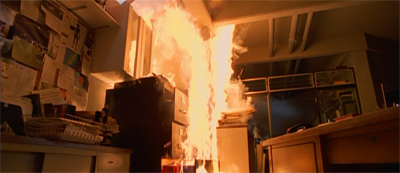
There is a reasonable argument to be made that The End accomplishes very little in terms of narrative. It doesn’t really do a great job bridging to The X-Files: Fight the Future. It certainly doesn’t do a great job wrapping up any of the show’s long-running concerns. Indeed, it adds two characters who will go on to become major (if controversial) players in the show’s overarching mythology. Even the big dramatic twist at the end of the episode feels familiar, with The End closing on a more memorable visualisation of the cliffhanger to The Erlenmeyer Flask.

Burn, baby, burn...

Burn, baby, burn…

Nevertheless, The End does feel like an end of sorts. It closes out five seasons of The X-Files. Carter had suggested in interviews that he only wanted to do five seasons of the show before transitioning into feature films, and so The End marks the conclusion of the run that Carter had originally planned for the show. After all, The X-Files had crossed the hundred episode mark earlier in the year. It was ripe for syndication. It was at the stage where Fox and Ten Thirteen did not need to keep the show on the air to keep printing money.

At the same time, The End marks another more definitive sort of end. It would be the last piece of The X-Files to be filmed in Vancouver until The X-Files: I Want to Believe a decade later. Vancouver was a part of the show’s DNA. It had been the show’s production hub since The Pilot. More than two decades later, The X-Files would return to Vancouver for its six-episode wrap-up miniseries. Discussing the revival, Carter argued that Vancouver was “a natural place to make a show like The X-Files.” Certainly, the mood and atmosphere lent itself to the series.
"My video collection!"

“My video collection!”

So The End marks a fond farewell from the production team to a city and region that had served them well.  In that respect, it feels like a more definitive sort of ending. The End opens with a scene that is confident enough to let Canada be Canada. As with the opening scene of Herrenvolk, it is almost comical how hard The End flags its “and starring Canada as Canada” cred, to the point where a mountie rushes to the aid of an assassination victim. The closing scene of The End burns down the show’s most iconic and memorable sets.

While The End is not necessarily a satisfying mythology episode or season finalé in its own right, it does feel like a suitably big moment in the evolution of the show.
Smoking gun...

Smoking gun…

Continue reading

The X-Files – Folie à Deux (Review)

This May and June, we’re taking a trip back in time to review the fifth season of The X-Files and the second season of Millennium.

Folie à Deux is the last stand-alone episode of the fifth season, and the last stand-alone episode to be produced in Vancouver. It is also a pretty essential episode before The X-Files: Fight the Future, reinforcing just how essential Mulder and Scully are to one another shortly before the movie threatens to break them up for good.

Folie à Deux is also one of Vince Gilligan’s most underrated scripts from the show’s entire run, a thoughtful examination of the relationship between Mulder and Scully that provides a clever counterpoint to his script of Bad Blood. If Bad Blood was essentially a story about how Mulder and Scully see the universe differently, then Folie à Deux represents an attempt to heal that rift, perhaps suggesting that Mulder and Scully have come to share their own unique form of madness.

Bugging Skinner...

Bugging Skinner…

Continue reading

The X-Files (Topps) #40 – Devil’s Advocate (Review)

This May and June, we’re taking a trip back in time to review the fifth season of The X-Files and the second season of Millennium.

Devil’s Advocate is a perfectly serviceable comic.

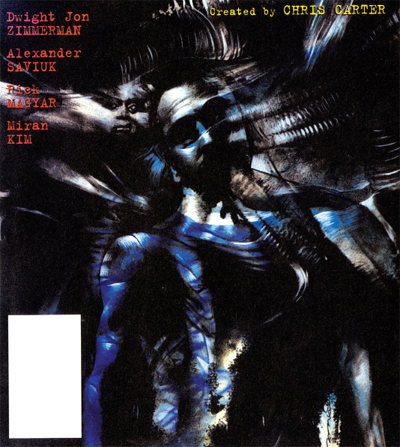
Its most distinguishing feature is the fact that it was not written by John Rozum, even though the art is provided by Alex Saviuk. This is not the first time that Rozum had taken a break from the monthly title. Writer Kevin J. Anderson had substituted in for Family Portrait, providing a quick two-issue fill-in rather early in the run. Here, executive editor Dwight Jon Zimmerman steps in to script the issue, possibly freeing up Rozum to finish work on the adaptation of The X-Files: Fight the Future that Topps planned to publish to mark the release of the film.

Ghosts in the machine...

Ghosts in the machine…

Dwight Jon Zimmerman was an industry veteran. He had worked at Marvel during the late eighties, writing for characters like Spider-Man and Wolverine. He joined Topps when they announced their plan to expand into the world of comic book publishing. Zimmerman worked as both an executive editor and as a writer. He worked on the company’s Mars Attacks! line. He also wrote Once Upon a Time…, the illustrated biography of Princess Diana that was published by the company in 1997.

Zimmerman’s interests tend towards the military. He has written articles on American military history for American Heritage, the Naval Institute Press, and Vietnam Magazine. He served as President of the Military Writers’ Society of America. As such, it is no surprise that Devil’s Advocate plays to those strengths. It is an old-fashioned “military cover-up” story, with little to distinguish or define it from dozens of similar stories told using these characters over years and years.

"This is why we should go rafting in the daytime, Scully."

“This is why we should go rafting in the daytime, Scully.”

Continue reading

The X-Files – The Pine Bluff Variant (Review)

This May and June, we’re taking a trip back in time to review the fifth season of The X-Files and the second season of Millennium.

The Pine Bluff Variant is probably John Shiban’s best solo script for The X-Files.

It is the kind of story that the show does very well, a taut conspiracy thriller packed with sharp twists and turns. Not all of those twists and turns make a great deal of sense, but there is an incredible momentum to the episode that keeps it moving forward. John Shiban’s script is beautifully brought to life by Rob Bowman’s direction, with Bowman demonstrating once again why he was the perfect choice to direct The X-Files: Fight the Future. The Pine Bluff Variant is a well-constructed piece of television.

He who hunts monsters...

He who hunts monsters…

It also fits quite comfortably in the context of where the show is at this point in time. The fourth and fifth seasons of The X-Files saw the show really engaging with the dark underbelly of conspiracy culture just as Mulder when through his own dark midnight of the soul. After three seasons of endorsing paranoia and skepticism, The X-Files was ready to deal with the sorts of organised groups that believed in such conspiracies. The Pine Bluff Variant has Mulder infiltrating a militia a few months before the release of Fight the Future would recreate the Oklahoma City Bombing.

It is a thread with which the show had been playing since The Field Where I Died early in the fourth season. The Pine Bluff Variant is the last time that the series pushes these sorts of militia groups to the fore, with Mulder reaffirming and regaining his faith at the climax of Fight the Future. It is a suitably satisfying farewell to this recurring thematic motif.

Fleshing out the threat...

Fleshing out the threat…

Continue reading

The X-Files (Topps) #39 – Scum of the Earth (Review)

This May and June, we’re taking a trip back in time to review the fifth season of The X-Files and the second season of Millennium.

Scum of the Earth taps right into the sweet spot for John Rozum’s sensibilities.

Rozum’s work on Topps’ monthly X-Files comic book might not have been quite as ambitious as that of his predecessor, but he had his own areas of interest and recurring themes. Scum of the Earth provides the perfect intersection between the classic horror comic aesthetic of stories like The Kanashibari and Donor and the more environmentally-conscious storytelling of scripts like Skybuster or Cam Rahn Bay. It is essentially a retelling of The Blob starring Mulder and Scully, in which the blob is created by toxic waste and bio-terrorism.

The green death...

The green death…

Scum of the Earth is not particularly elegant in its storytelling. Rozum’s script covers a lot of ground in the space of a single issue, presenting Mulder and Scully with a crisis that could easily threaten the entirety of the United States. it genuinely feels like Mulder and Scully have wandered into some lost fifties b-movie, capturing a lot of the atmosphere to which Ivan Reitman seemed to aspire by casting David Duchovny in Evolution a few years later. Scum of the Earth is an exceedingly silly comic book, and unashamedly so.

It is also great fun, which is something that really can’t be undersold when you are talking about an X-Files tie-in comic book.

Swamp Thing!

Swamp Thing!

Continue reading

The X-Files – All Souls (Review)

This May and June, we’re taking a trip back in time to review the fifth season of The X-Files and the second season of Millennium.

There are a lot of aspects of The X-Files that mark it as an artifact of the nineties.

It is easy to point to all the visual cues and indicators – the mobile phones, the suits, the cars. The political elements are all in play as well – the unquestioned assumption that the United States is the global superpower, the indulgence in a paranoia that exists in sharp contrast to the material prosperity surrounding it. There are even any number of pop cultural references buried within episodes themselves – from Byers and Frohike joking about Bill Clinton’s haircut in Fearful Symmetry to Scully quoting Babe in Home.

Angels in America...

Angels in America…

However, perhaps the most obvious indicator of the nineties is the way that The X-Files seems to fetishise absolute and unquestioning faith. Through episodes like Miracle Man, RevelationsAll Souls and Signs and Wonders, there is the recurring sense that giving oneself over absolutely and completely to religious faith is a sign of strength and certainty. At times, it seems like the writers are almost envious of those who have unwavering conviction in their beliefs amid the wry cynicism of the nineties.

The X-Files finds something romantic in such pure and uncompromised faith. After all, Gethsemane had proved that even Mulder has his doubts. This fixation on unquestioning religious belief made a great deal of sense against the backdrop of nineties disillusionment, but it a lot more uncomfortable when examined in hindsight through the prism of the early twenty-first century.

Scully has seen the light...

Scully has seen the light…

Continue reading

The X-Files – Mind’s Eye (Review)

This May and June, we’re taking a trip back in time to review the fifth season of The X-Files and the second season of Millennium.

Likely as a result of the peculiar factors around its production, the fifth season of The X-Files is a rather strange cocktail.

There are only twenty episodes in the season. Seven of those are mythology episodes – Redux I, Redux II, Christmas Carol, Emily, Patient X, The Red and the Black, The End. The rest of the season devotes considerable space to experimentation and adventurous storytelling. Episodes like Unusual Suspects and Travelers take the focus off Mulder and Scully. Shows like The Post-Modern Prometheus and Bad Blood are experimental in their storytelling. Episodes like Chinga and The Pine Bluff Variant focus almost exclusively on one or other of the leading duo.

Locked out...

Locked out…

Even the remainder are not what might be described as typical “monster of the week” stories. Both Detour and Folie a Deux focus on the relationship between Mulder and Scully as much as the monster at the heart of the story. Kill Switch is an episode written by a special guest writing team, one that defines itself by how odd it feels. All Souls is a meditation on Scully’s faith. The fifth season doesn’t really have a lot of room left for the classic episodic no-frills-attached “monster of the week” stories.

Which is part of what makes Mind’s Eye so fascinating. In any other season, Mind’s Eye would stand as a pretty solid example of the form – a pretty solid “this is what The X-Files does” episode of television like Pusher or Leonard Betts before it. However, the fifth season is so strange and weird in structure and form that Mind’s Eye stands out all the more. The best of the season’s straight-down-the-middle standalone stories, Mind’s Eye throws the rest of the season into contrast. It demonstrates just how odd the fifth season actually is.

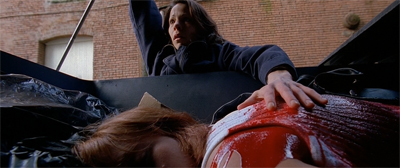
A bloody disaster...

A bloody disaster…

Continue reading

The X-Files (Topps) #38 – Cam Rahn Bay (Review)

This May and June, we’re taking a trip back in time to review the fifth season of The X-Files and the second season of Millennium.

Cam Rahn Bay returns to one of the recurring themes of John Rozum’s run on Topps’ X-Files tie-in comic book.

It is essentially a cautionary tale amount mankind tampering with nature and the unforeseeable repercussions of such meddling. As such, it feels very much in keeping with scripts like Skybuster or Scum of the Earth. This idea of human hubris is a theme that is very much in keeping with The X-Files as a franchise, perhaps most keenly reflected in Chris Carter’s deep affection for Mary Shelley’s Frankenstein and for environmental causes. Cam Rahn Bay is very much in keeping with that aesthetic.

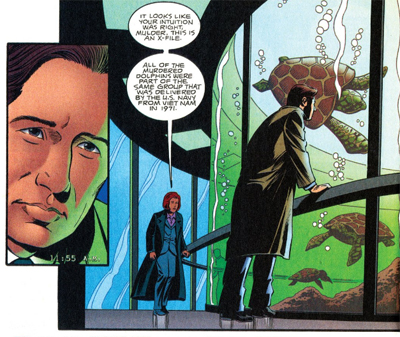
All at sea...

All at sea…

However, there are problems with the story. Most obviously, Rozum’s prose seems a little clunky and awkward. Cam Rahn Bay is a heavy-handed and clumsy meditation on mankind’s fixation with imposing its will over the natural world. However, there is also something slightly hypocritical about the story. As much as Cam Rahn Bay criticises the use of animals in a military capacity, it never seems to question the use of animals in captivity. While the training of dolphins to do military work is treated as deplorable, training them to do tricks for entertainment is lauded.

Cam Rahn Bay feels a little tonally ill-judged, with this fairly significant blindspot undermining a lot of Mulder’s impassioned rhetoric about how mankind treats the natural world.

"Sorry, I was just thinking abotu Deep Throat..."

“Sorry, I was just thinking abotu Deep Throat…”

Continue reading

The X-Files – Travelers (Review)

This May and June, we’re taking a trip back in time to review the fifth season of The X-Files and the second season of Millennium.

For all that the fifth season of The X-Files is building towards a major summer movie release, the production team seem surprisingly relaxed about it.

The fifth season is as experimental and as loose as the show ever got. Patient X and The Red and the Black suggested that Chris Carter didn’t even feel beholden to the continuity of The X-Files: Fight the Future, introducing new characters and concepts to the mythology that could not possibly be inserted into the film at this late stage. Similarly, the show was willing to play around with special guest writers like Stephen King and William Gibson, film an entire episode in black and white, focus on relatively minor characters, and reveal two separate secret histories of the X-files.

What do you call a baby Fox?

What do you call a baby Fox?

Of course, some of these innovations were driven by necessity or large goals. Patient X and The Red and the Black represent the beginning of the end for this stage of the mythology. Stories like Unusual Suspects and Travelers focus on characters other than Mulder or Scully because David Duchovny and Gillian Anderson were otherwise engaged. Nevertheless, there is a very relaxed vibe to the fifth season, as if the show is taking an extended moment to enjoy the peak of its popularity. As well it should.

Travelers is an episode that is far from essential in many respects. It is clunky in places, indulgent in others. It feels like the production teams are just happy to root through the old costuming wardrobe and prop departments, delighted to compose over-written monologues and stock characters. Travelers is light and fun, with its indulgence and its relative lack of substance making it more enjoyable than it would otherwise be.

He'll (Garret Dilla)hunt you down...

He’ll (Garret Dilla)hunt you down…

Continue reading