• Following Us

  • Categories

  • Check out the Archives


  • Awards & Nominations

The X-Files (Topps) – Trick of the Light (Review)

This August (and a little of September), we’re taking a trip back in time to review the second season of The X-Files. In November, we’ll be looking at the third season. And maybe more.

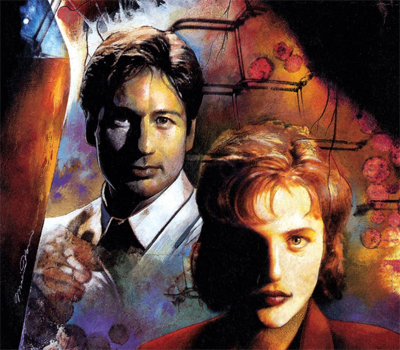
The X-Files tie-in comic book was a massive success for Topps. It’s interesting to note the amount of cross-promotion that went into the comic. Factoring in short stories and tie-ins and annuals and other obligations, the output from writer Stefan Petrucha and Charles Adlard was nothing short of astounding. Topps worked very hard to promote the book, an approach that paid off – the comic would frequently appear in Diamond’s top 100 and was the publisher’s most successful monthly book.

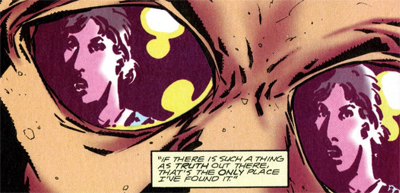
Trick of the Light was a short twelve-page comic that was published as part of the The X-Files/Hero Illustrated Special, featuring an interview with Petrucha and packaged with Hero Illustrated #22 in March 1995. It was something of a glorified advertising gimmick, but one that demonstrates the popularity of the comic in question.

Don't go into the light!

Don’t go into the light!

Continue reading

The X-Files – Humbug (Review)

This August (and a little of September), we’re taking a trip back in time to review the second season of The X-Files. In November, we’ll be looking at the third season. And maybe more.

The world is a weird place, but it seems to get a little less weird all the time.

One of the great recurring themes of The X-Files is that globilisation and rapid development have cast light on the deepest nooks and crannies, having a homogenising effect. There’s little room in the world for the eccentric and the strange, as Starbucks opens an average of two stores every day and access to the internet in the United States doubling between 2000 and 2014. In 2009, the furthest a person could be from a McDonalds in the United States was 107 miles. The world is getting smaller.

Funhouse mirror...

Funhouse mirror…

Paradoxically, this only winds up pushing people further apart. This happens on both a community and an individual level. Small towns find themselves struggling to survive in the current economic climate, despite the increased accessibility. Despite the growth of social media to make interpersonal communication easier than ever, the number of people feeling socially isolated has doubled since 1985.

Humbug is the show’s first script from writer Darin Morgan. While not as polished as his later work, it perfectly captures that mournful sense that a certain kind of weirdness is passing.

Something fishy is going on...

Something fishy is going on…

Continue reading

The X-Files (Topps) #3 – A Little Dream of Me/The Return (Review)

This August (and a little of September), we’re taking a trip back in time to review the second season of The X-Files. In November, we’ll be looking at the third season. And maybe more.

There are inevitable challenges in working on a licensed property. You are effectively playing with somebody else’s toys. Since these tie-ins cannot drive a narrative currently unfolding in another medium, it’s often a challenge to maintain the illusion of forward momentum while existing at the behest of a story that can change from week-to-week. While The X-Files was a massive coup for Topps comics, and while Stefan Petrucha and Charles Adlard did a wonderful job, the comic had to face these constraints.

A Dismembrance of Things Past had brushed up against those limitations in trying to tell a U.F.O. story without meddling in the television show’s continuity. Petrucha used some fiendishly clever sleight of hand there, suggesting that the story would be about an alien visitation and possible cover-up, only to reveal that the story was actually an intimate meditation on the ideas of truth and memory. It was a rather ingenious bait-and-switch, resulting in a wonderful little story.

Pictures in his head...

Pictures in his head…

A Little Dream of Me is not quite as efficient in dealing with the external limitations imposed on a tie-in comic book. The unfortunate realities of comic book scheduling meant that A Little Dream of Me had the misfortune to hit the stands very shortly after the broadcast of Colony and End Game. Of course, the script for A Little Dream of Me would have been written long before the episodes aired (about six months), but the scheduling causes the comic to suffer.

After all, Colony and End Game had made it abundantly clear that Samantha Mulder was unlikely to be returning to her family any time soon. And that was in the television show. The third issue of the comic book teasing the return of Samantha Mulder seems like a rather cynical cheat.

The "X" file...

The “X” file…

Continue reading

The X-Files – Død Kälm (Review)

This August (and a little of September), we’re taking a trip back in time to review the second season of The X-Files. In November, we’ll be looking at the third season. And maybe more.

Død Kälm is probably the most explicitly “science-fiction-y” premise that we’ve had in the show’s run to date. And by “science-fiction-y”, I don’t necessarily mean “anchored in any meaningful science.” After all, the amount of sense that Død Kälm makes is questionable at best. Instead, the term “science-fiction-y” means “most likely to pop up in a pulpy science-fiction television show.”

The past few episodes have seen the show on a bit of a science-fiction kick, with clones and colonists and invisible abducted zoo animals. However “accelerated aging” is such a science-fiction staple that it feels like The X-Files is enthusiastically embracing science-fiction conventions at this point in the second season.

Old school...

Old school…

Continue reading

The X-Files – Fearful Symmetry (Review)

This August (and a little of September), we’re taking a trip back in time to review the second season of The X-Files. In November, we’ll be looking at the third season. And maybe more.

Fearful Symmetry is an embarrassing mess of an episode. It’s ambitious, but it’s clumsy and over-wrought. It aspires to great things, but is instead completely banal. For a show featuring an invisible elephant, that’s no small accomplishment.

Tyger, Tyger...

Tyger, Tyger…

Continue reading

The X-Files – End Game (Review)

This August (and a little of September), we’re taking a trip back in time to review the second season of The X-Files. In November, we’ll be looking at the third season. And maybe more.

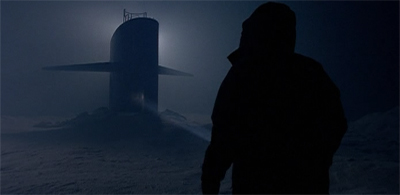
Towards the end of End Game, Mulder stumbles across a nuclear submarine that was attacked in the episode’s teaser. The craft was disabled by a strange craft it picked up in the ocean. Now, following a mysterious alien figure across the world in a quest to find his sister, Mulder approaches the location of the lost American submarine. As he does, he notices the submarine’s coning tower, bursting through the ice.

It’s one of those beautifully iconic television moments. It’s an image that is audacious and stunning and beautiful and breathtaking. It immediately gives End Game (and Colony) a sense of scale. All of a sudden, this isn’t just a bunch of stuff happening under the radar in some small town somewhere. This is the hijacking of a nuclear submarine by a hostile entity. This is Mulder going to the ends of the Earth to get his sister back.

Not so green any longer...

Not so green any longer…

It’s also worth noting that the symbolism is beautiful. Even looking at a picture of Mulder on the ice conjures up all manner of associations. Coupled with the non-linear storytelling employed by Colony and End Game, it calls Frankenstein to mind – Frankenstein serving as a massively influential text on Chris Carter. However, the idea of Mulder finding important existential answers on an Arctic soundstage also evokes Clark Kent’s self-discovery in Richard Donner’s Superman films, playing into the sense that this is an episode framed in cinematic terms.

The rest of the episode could just be dead air, and End Game would still work impressively well. However, End Game remains a fantastic piece of work in its own right, effectively codifying how a two-parter is meant to work.

The truth is out there...

The truth is out there…

Continue reading

The X-Files – Colony (Review)

This August (and a little of September), we’re taking a trip back in time to review the second season of The X-Files. In November, we’ll be looking at the third season. And maybe more.

Colony is another second season game changer. As with other episodes in the second season, there’s a sense that the production team are really getting to grips with what works with the show – laying groundwork and defining a template that they can work with into the show’s third season. While the Duane Barry and Ascension two-parter had been an act of desperation to work around Gillian Anderson’s pregnancy, Colony and End Game is a two-parter that the show embraced entirely of its own volition.

These two two-part episodes really set the template for the show going forward. There’s a sense that Chris Carter and his team were really defining what a season of The X-Files should look like, giving them a blueprint that they might build on in the years ahead. From the second season through to the sixth, the show would stick quite rigidly to the idea of two big two-parters in the middle of the season, quite apart from any multi-part stories bridging the seasons.

Lights in the sky...

Lights in the sky…

These two parters were typically broadcast as part of the “sweeps”, and inevitably focused on the show’s alien conspiracy mythology. Even the more stand-alone two-parters like A Christmas Carol and Emily or Dreamland Part I and Dreamland Part II still build off the series’ central mythology. Given those were the points at which the show got the highest exposure, and the point where the show worked hardest to draw in an audience, it’s no surprise that the mythology arc rose to such prominence.

Duane Barry and Ascension undoubtedly set a precedent, but those episodes were prompted by factors outside the control of the creative team. However, Colony and End Game really solidified that precedent into a guiding principle for the show. This two-parter comes to codify and cement a lot of the things that the show’s mythology comes to take for granted. For better and worse.

Quite pointed...

Quite pointed…

Continue reading

The X-Files (Topps) #2 – A Dismembrance of Things Past (Review)

This August (and a little of September), we’re taking a trip back in time to review the second season of The X-Files. In November, we’ll be looking at the third season. And maybe more.

A Dismembrance of Things Past is an absolute delight, and a nice demonstration of how well writer Stefan Petrucha and Charles Adlard could tell stories set within The X-Files universe.

There are many interesting things about A Dismembrance of Things Past. It’s a fine piece of work, deftly balancing the demands on a new comic book set within the world of The X-Files with an urge to tell a story that fits very clearly and very comfortably within the show’s basic structure. It is easy to imagine A Dismembrance of Things Past receiving a live-action adaptation. Indeed, Petrucha’s script feels like something of a tribute to writer Darin Morgan before Darin Morgan had even written for the show, half-way between Blood and Jose Chung’s “From Outer Space.”

Something to remember them by...

Something to remember them by…

A Dismembrance of Things Past confronts the difficulties of writing a tie-in comic book to The X-Files, while using those constraints to tell an interesting story in its own right. After all, the comic book would have to tell an alien or U.F.O. story eventually. The words “The X-Files” are written on the cover, and that comes with the territory. At the same time, Petrucha and Adlard have to acknowledge the fact that the tie-in comic book cannot advance the on-screen mythology arc. Indeed, it seems unlikely Carter had shared too much of that arc with Petrucha or Adlard.

It takes a lot of skill to balance these competing demands of a tie-in comic book – to remain connected to the source material, but never pulling too far away or ahead, while remaining interesting. A Dismembrance of Things Past manages to satisfy all of its obligations and then some.

Through alien eyes...

Through alien eyes…

Continue reading

The X-Files – Fresh Bones (Review)

This August (and a little of September), we’re taking a trip back in time to review the second season of The X-Files. In November, we’ll be looking at the third season. And maybe more.

Written by Howard Gordon and directed by Rob Bowman, Fresh Bones is a superbly constructed piece of television. Indeed, there’s an argument to be made that Fresh Bones is the best “traditional” episode of The X-Files produced since Scully returned to the fold. While episodes like Irresistible and Die Hand Die Verletzt have been bold and adventurous in their attempts to expand the show’s comfort zone, Fresh Bones is perhaps the best example of what the show was missing while Gillian Anderson was unavailable – proof the familiar formula still works.

It’s a great example of what might be termed “the standard X-Files episode” – a demonstration of how all the moving parts come together to produce an episode of the show, offering an example of the series’ standard operating practice. If you were to pick an episode of the second season to demonstrate how a “standard” episode of The X-Files should work, Fresh Bones would be perhaps the most appropriate example. (Aubrey and Our Town are perhaps the only two other examples.)

Grave danger...

Grave danger…

In keeping with Bowman’s approach to the series, Fresh Bones feels like a forty-five minute movie. The show atmospherically shot with some wonderful kinetic sequences – such as Mulder’s pursuit of Chester on the pier or Scully’s attack in the car. The Voodoo subject matter lends Fresh Bones a wonderfully pulpy atmosphere, although it seems like Howard Gordon has done his homework. The script to Fresh Bones averts many of the awkward stereotypes you’d expect in a show about Voodoo starring two white leads produced in Vancouver.

The result is a superb piece of television, an example of what The X-Files is capable of.

A bone to pick...

A bone to pick…

Continue reading

The X-Files – Die Hand Die Verletzt (Review)

This August (and a little of September), we’re taking a trip back in time to review the second season of The X-Files. In November, we’ll be looking at the third season. And maybe more.

Die Hand Die Verletzt is a fascinating piece of work, for a number of reasons. The most striking reason, however, is that it is essentially a comedy episode. While The X-Files has always had a wry sense of humour – Mulder’s viewing habits are a recurring joke, after all – this is the first time the series has tried to produce a full-length comedy episode. Die Hand Die Verletzt is still a horror story, and the comedy is pretty black, but it does seem to prove that the show can do an entire episode that is funny.

The implications of this are far-reaching. At its height, the beauty of The X-Files was its versatility. The show could tell just about any sort of story imaginable, flitting between prestige drama, out-and-out horror, pastiche, broad comedy, political thriller, satire or even romance. While you could always bet on at least a hint of the supernatural and a dash of horror, The X-Files could really be anything that Chris Carter and his writers wanted it to be. It was even a show that could collide with other shows, as in The Springfield Files or X-Cops.
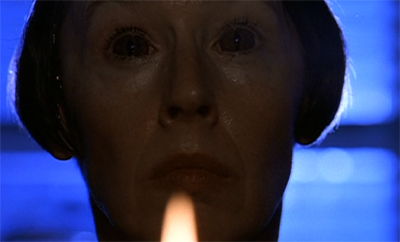
She's the devil in disguise...

She’s the devil in disguise…

To be fair, the second season is already reaching towards that approach to The X-Files. Although he has yet to produce a script for the series, the show has hired Darin Morgan to work on the writing team; his sensibilities would be proven truly and brilliantly gonzo. Irresistible proved that you could produce an episode of The X-Files without an overt supernatural horror, focusing on a more grounded horror. Red Museum provided an “almost crossover” with another television series.

However, Die Hand Die Verletzt is the point at which the show does something that looks truly weird in the context of what has come before, yet feeling strangely comfortable in light of what has followed. The script may mark the departure of Glen Morgan and James Wong from the show – the duo leaving to produce Space: Above & Beyond – but it isn’t the end of an era so much as the start of a new one.
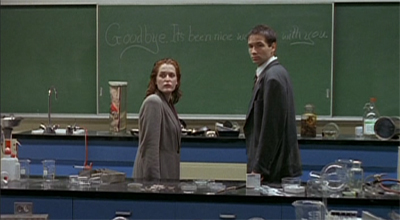
The writing's on the... er... chalkboard...

The writing’s on the… er… chalkboard…

Continue reading