• Following Us

  • Categories

  • Check out the Archives


  • Awards & Nominations

Star Trek: The Next Generation – Sins of the Father (Review)

This January and February, we’ll be finishing up our look at the second season of Star Trek: The Next Generation and moving on to the third year of the show, both recently and lovingly remastered for high definition. Check back daily for the latest review.

Sins of the Father is another watershed moment for Star Trek: The Next Generation and Star Trek as a whole. It’s really the first time that the franchise has invested in proper long-form world-building, rather than treating continuity as something that occasionally built up by sheer narrative momentum. It’s an episode that ends on an ambiguous note, suggesting more to come. It’s also an episode that nails down a lot of Klingon culture and tradition.

In a way, it’s the logical conclusion of a narrative style that has been building since The Enemy and The Defector earlier in the season; creating a sense that The Next Generation isn’t just the story of the crazy adventures that or crew have week in and week out, but a window into a much larger fictional universe. There’s a sense that the adventures of the Enterprise are set against a much larger and vaster universe, and Sins of the Father really gives us a glimpse at that.

It broadens the scope of The Next Generation, in terms of subject matter and also in terms of narrative possibilities.

Picard gets his Palpatine on...

Picard gets his Palpatine on…

Continue reading

Star Trek: The Next Generation – Q-Squared by Peter David (Review)

This January and February, we’ll be finishing up our look at the second season of Star Trek: The Next Generation and moving on to the third year of the show, both recently and lovingly remastered for high definition. Check back daily for the latest review.

We’ll be supplementing our coverage of the episodes with some additional materials – mainly novels and comics and films. This is one such entry.

Q-Squared is probably Peter David’s most ambitious Star Trek: The Next Generation novel. “Q-Squared is almost my challenge to the reader to keep up with me,” he boasted in Voyages of the Imagination. Essentially a meditation on reality and free will within that construct, Q-Squared is a breathtakingly confident endeavour. It’s an interesting reflection on the potentiality embraced by The Next Generation, the broadening of the franchise’s perspective to embrace the best of all possible worlds.

Q-Squared hit stands in early July 1994, just over a month after All Good Things… brought the curtain down on The Next Generation for one last time. It’s tempting to look at the two stories as companion pieces. All Good Things… is an exploration of the time that the crew spent together – jumping backwards and forwards to trace our heroes over the course of their lives. In contrast, Q-Squared jumps sideways – looking at what might have been, or what could have been.

tng-q-squared

Continue reading

Star Trek: The Next Generation – The Offspring (Review)

This January and February, we’ll be finishing up our look at the second season of Star Trek: The Next Generation and moving on to the third year of the show, both recently and lovingly remastered for high definition. Check back daily for the latest review.

The Offspring is an absolutely wonderful piece of Star Trek. In many ways, it is a spiritual successor to The Measure of a Man, the breakout show of the second season. (This similarity was one of the factors that led writer and script editor Melinda Snodgrass to harshly dismiss it as “fairly obvious and tired and stupid” in Captains’ Logs: The Unauthorized Complete Trek Voyages.) Sitting between two of the more epic and sweeping stories in the third season, The Offspring is a touching little story about parenting and childhood, and a nice character episode for Data.

It remains one of the most touching episodes of Star Trek: The Next Generation ever produced, and a fitting debut for both future staff writer René Echevarria and soon-to-be-prolific Star Trek director Jonathan Frakes.

Building a loving family...

Building a loving family…

Continue reading

Star Trek: The Next Generation – The Last Generation (Review)

This January and February, we’ll be finishing up our look at the second season of Star Trek: The Next Generation and moving on to the third year of the show, both recently and lovingly remastered for high definition. Check back daily for the latest review.

We’ll be supplementing our coverage of the episodes with some additional materials – mainly novels and comics and films.

The Last Generation, a five-issue miniseries written by Andrew Steven Harris and illustrated by the wonderful Gordon Purcell, feels like a companion piece to Harris’ Alien Spotlight: Borg issue. Both are essentially stories about the morality of using time travel to re-write history, and both can be read as a reflection on Star Trek continuity as a whole.

Published from November 2008 through to March 2009, The Last Generation feels like something of a preemptive rebuttal to JJ Abrams’ May 2009 reboot of Star Trek. Much like Alien Spotlight: Borg before it, it feels like a conscious attempt to vindicate and validate the franchise from the era of Star Trek: The Next Generation onwards.

Given the fact that the “reboot-in-all-but-name” back-to-Kirk nature of Abrams’ film was openly discussed well ahead of the release, it’s hard not to read The Last Generation and Alien Spotlight: Borg as protests against the decision to set the clock back on the franchise and start with Kirk yet again.

A shot in the dark...

A shot in the dark…

Continue reading

Star Trek: The Next Generation – Yesterday’s Enterprise (Review)

This January and February, we’ll be finishing up our look at the second season of Star Trek: The Next Generation and moving on to the third year of the show, both recently and lovingly remastered for high definition. Check back daily for the latest review.

Yesterday’s Enterprise is one of the best-loved pieces of Star Trek ever produced. Its inclusion is a given in absolutely any “best of” poll being run for Star Trek: The Next Generation or even the franchise as a whole. A rather thoughtful piece of high-concept science-fiction exploring the importance of the right people in the right time, Yesterday’s Enterprise is proof that The Next Generation has truly come of age. After two years of wandering in the wilderness, the show has finally found its feet.

Of course, the production of Yesterday’s Enterprise was quite traumatic. The story and script went through multiple iterations between the original pitch and the version presented on the screen. The episode was written by pretty much the entire writing staff over the Thanksgiving weekend, racing against the clock to get it finished. Due to scheduling issues with Denise Crosby and Whoopi Goldberg, it was filmed in late December instead of early January.

As with so much of the third season, there’s a sense that the episode was held together by chewing gum and rubber bands. However, also like most of the third season, that sense only comes from those delving into the behind-the-scenes stories. Looking at the episode itself, this was a show on the top of its game.

The battle bridge...

The battle bridge…

Continue reading

Star Trek: The Lost Era – Well of Souls by Ilsa J. Bick (Review)

This November and December, we’ll be finishing up our look at the second season of Star Trek: The Next Generation and moving on to the third year of the show, both recently and lovingly remastered for high definition. Check back daily for the latest review.

We’ll be supplementing our coverage of the episodes with some additional materials – mainly novels and comics and films. This is one such entry.

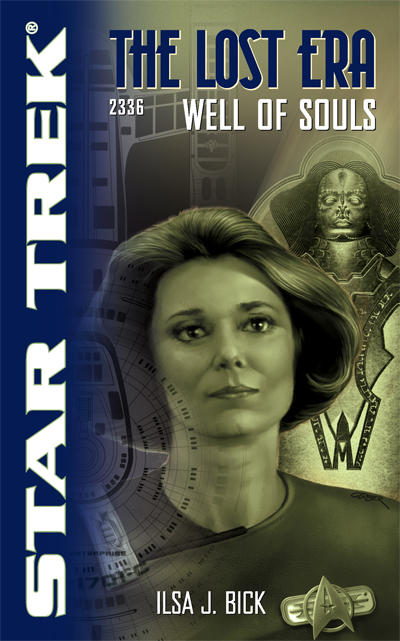
Well of Souls is a story of the Enterprise-C, the ship introduced in Yesterday’s Enterprise. One of the best-received episodes in the history of Star Trek: The Next GenerationYesterday’s Enterprise established Rachel Garrett’s ship as the troubled Enterprise, the tragic flagship, the doomed space craft. Ilsa J. Bick builds on that characterisation in Well of Souls, one small story from some point in Garrett’s command of the Federation flagship.

While Well of Souls feels like a rather unconventional Star Trek novel, it is charming in its own way. Bick connects her tale to the themes of Well of Souls, suggesting a troubled ship manned by a struggling crew. The novel returns time and again to the theme of unfortunate choices, the weight of making the best decision of the options open. Unlike Kirk or Picard, Bick seems to suggest, this version of the iconic starship doesn’t get that many lucky breaks, with her crew repeatedly forced to accept the least bad of a selection of unappetising choices.

Well of Souls is  a thoughtful, introspective piece. It doesn’t flow or pace itself as well as it might, but Bick crafts a compelling picture the never-the-less. While not quite the best of the Lost Era tie-in novels, it’s ambitious and insightful. It lacks the energy of Serpents Among the Ruins or The Art of the Impossible, but it’s still a very worthy read for anybody looking to sketch out a gap in the Star Trek mythos.

tng-wellofsouls

Continue reading

Star Trek: The Next Generation – A Matter of Perspective (Review)

This January and February, we’ll be finishing up our look at the second season of Star Trek: The Next Generation and moving on to the third year of the show, both recently and lovingly remastered for high definition. Check back daily for the latest review.

A Matter of Perspective is a bit of a disappointment. However, it’s a disappointment for the same reason that The High Ground is a disappointment. The third season of Star Trek: The Next Generation is at least trying new things, and playing with big ideas for a syndicated television science-fiction show in the late eighties and early nineties. There is some charm to the episode’s basic premise (Rashomon in space… with the holodeck!”), but the script never quite manages to deliver on that wonderful set up.

Instead, we end up with a show that lacks the nuance to follow through on its central themes, and a mystery that confuses techno-babble for a satisfying solution.

Painting a pretty picture...

Painting a pretty picture…

Continue reading

Star Trek: The Next Generation – I, Q by John deLancie & Peter David (Review)

This January and February, we’ll be finishing up our look at the second season of Star Trek: The Next Generation and moving on to the third year of the show, both recently and lovingly remastered for high definition. Check back daily for the latest review.

We’ll be supplementing our coverage of the episodes with some additional materials – mainly novels and comics and films. This is one such entry.

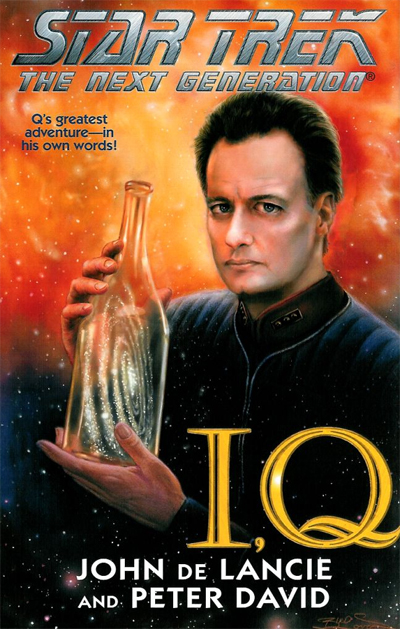
I, Q is John deLancie’s second attempt to write a story featuring his popular and iconic Star Trek: The Next Generation character. As with The Gift, he is teamed with an experienced Star Trek tie-in writer to help bring his vision to life. While Michael Jan Friedman’s collaboration with deLancie for the first annual of DC’s first Next Generation series was a less than promising debut for the actor-turned-writer, I, Q works a lot better.

It’s hard to tell if this is because deLancie works better with Peter David as a collaborator, or that his style works better in prose, or simply that he has developed as a writer in the years since that first comic was published. I, Q is far from the perfect Star Trek novel, but it’s an enjoyable enough read – it captures the voice of its celebrity author quite well, and breezes along inoffensively. There are moments when the novel seems to bask a little too heavily in its central character’s filibustering, but it’s a perfectly serviceable read.

tng-iq

Continue reading

Star Trek: The Next Generation – Déjà Q (Review)

This January and February, we’ll be finishing up our look at the second season of Star Trek: The Next Generation and moving on to the third year of the show, both recently and lovingly remastered for high definition. Check back daily for the latest review.

Déjà Q is, in a way, the most quintessential of Star Trek: The Next Generation stories, one of the most perfect embodiments of the show’s philosophy. It’s the story about an alien who engages on a voyage of self-discovery, with the Enterprise crew serving as guides. It’s essentially an episode about what it means to be human, and is built upon the fundamentally assumption that being human allows a person the capacity for altruism and self-sacrifice.

It’s easy to imagine Déjà Q turning out unwatchable. This sort of “humans are brilliant!” storytelling was a staple of the show’s troubled first season, leading to episodes like The Last Outpost and Lonely Among Us. However, Déjà Q turns out to be quite the treat. It’s helped by the presence of John de Lancie’s superbly sardonic Q and Richard Danus’ decidedly wry script. Both of these help to temper the episode’s earnestness, leading to a show that is endearing rather than irritating.

Watching Déjà Q, there’s a sense that this is very much what Gene Roddenberry wanted the first two seasons of The Next Generation to be, but – at that stage in its young life – the show was never quite capable of producing something this charming.

Well, he knows how to make an entrance...

Well, he knows how to make an entrance…

Continue reading

Star Trek: The Next Generation (DC, 1989) Annual #1 – The Gift (Review)

This January and February, we’ll be finishing up our look at the second season of Star Trek: The Next Generation and moving on to the third year of the show, both recently and lovingly remastered for high definition. Check back daily for the latest review.

We’ll be supplementing our coverage of the episodes with some additional materials – mainly novels and comics and films.

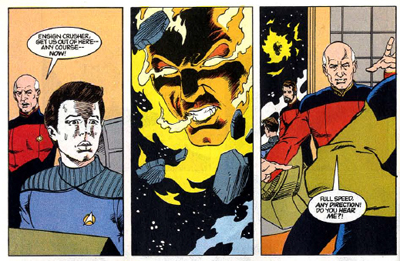
You can see why DC comics jumped at the chance to publish The Gift. After all, a comic about Q written by the actor playing Q is a hell of a hook. The publisher had already done something similar, with actor Walter Koenig providing a script for the nineteenth issue of DC’s first Star Trek comic book series. At the same time that The Gift was published, George Takei collaborated with Peter David on a Star Trek annual story, So Near the Touch.

John deLancie isn’t a bad storyteller. Indeed, his published tie-in novel – I, Q written with Peter David – is quite enjoyable. However, The Gift is just an absolute mess of a story, with a couple of interesting high concepts buried beneath two horrible clichés tied together to create a rather unfortunate narrative. The Gift is a disappointment on just about every level.

Cue Q!

Cue Q!

Continue reading