• Following Us

  • Categories

  • Check out the Archives


  • Awards & Nominations

Star Trek: Deep Space Nine – Doctor Bashir, I Presume (Review)

Doctor Bashir, I Presume is a strange little episode.

It directly follows In Purgatory’s Shadow and By Inferno’s Light, a two-part story in which it was revealed that Doctor Julian Bashir had been abducted by the Dominion at some point during the fifth season and replaced with a changeling infiltrator. Although the maths can be a little difficult to work out, it is suggested that Bashir was replaced by a changeling at some point before Rapture. With that in mind, it seems strange that the very next episode of Star Trek: Deep Space Nine should reveal that the recently returned Julian Bashir is himself an imposter.

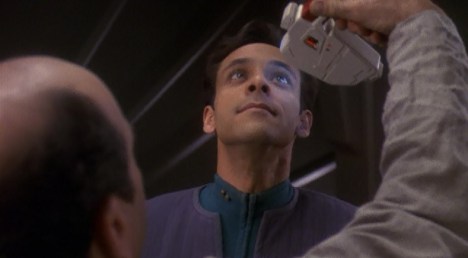
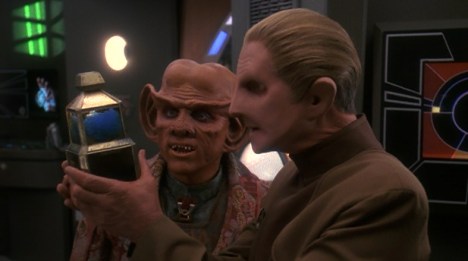
"Oh, shiny."

“Oh, shiny.”

However, even on its own terms, Doctor Bashir, I Presume is a very odd piece of television. The hook of the episode is a guest appearance from Robert Picardo as Lewis Zimmerman. Picardo is making a crossover appearance from Star Trek: Voyager where he played the EMH, who had also made an appearance in Star Trek: First Contact. Picardo is a fine dramatic actor, but the character is notable for being comic relief. Doctor Bashir, I Presume begins as a light-hearted quirky piece, turning sharply at the half-way point to become a gritty science-fiction family drama.

All of this is quite jarring. However, Doctor Bashir, I Presume works surprising well. A large part of that is down to how strange the episode is, often feeling like an intimate family drama about recrimination and disappointment set against the backdrop of a massive science-fiction franchise.

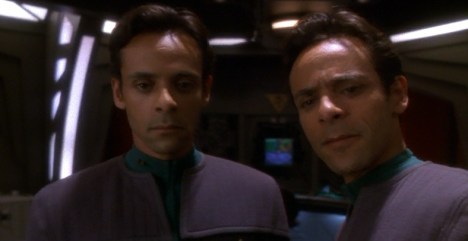
A selfie with himself.

A selfie with himself.

Continue reading

Star Trek: Voyager – Darkling (Review)

There is something to be said for the pulpier side of Star Trek: Voyager, the aspect of the show that plays like a cheesy sci-fi b-movie.

Brannon Braga is very much the driving force behind this aspect of the show, as evidenced by his scripts for the belated Cold War body-swapping horror of Cathexis or the psychological nightmare of Projections or the trashy psychedelic terror of Cold Fire or even the weird evolutionary anxieties of Threshold and Macrocosm. These sorts of episodes often feel like they belong in a late night movie slot reserved for forgotten horror flicks from the fifties and sixties. Of course, Braga is not alone in this; episodes like Meld and The Thaw also fit the pattern.

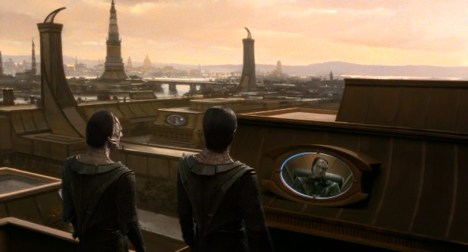
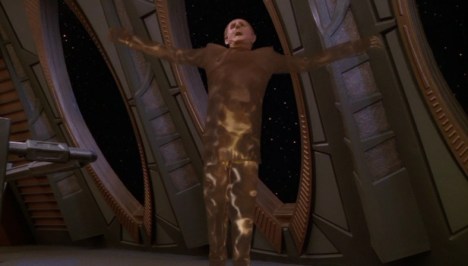
Blurred lines.

Blurred lines.

Of course, these episodes do not always hit the mark. Charitably, it could be argued that they land about half the time and misfire spectacularly about one third of the time. However, there is something strangely compelling about these episode. They feel distinct from what audiences expect from Star Trek. Even if they are arguably just an extension of late Star Trek: The Next Generation episodes like Sub Rosa or Genesis or Eye of the Beholder, they feel like something different from the show’s more conventional “let’s do archetypal Star Trek” plotting.

Darkling is an episode that doesn’t quite work, but which is oddly endearing in its dysfunction. It is a ridiculous central premise executed in a deeply flawed (and occasionally uncomfortable) manner. However, there is something weirdly compelling about wedding the show’s science-fiction premise to gothic horror through the fractured psyche of a computer program.

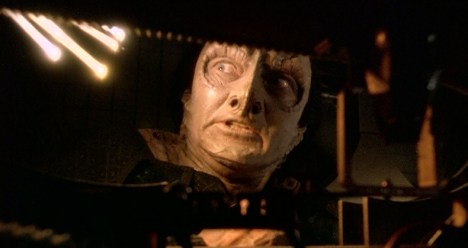
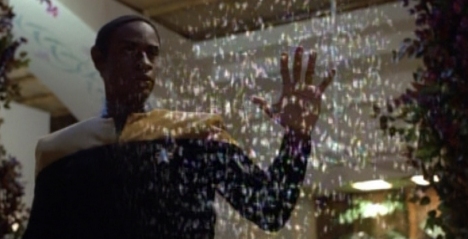
Patchy.

Patchy.

Continue reading

Star Trek: Deep Space Nine – By Inferno’s Light (Review)

In Purgatory’s Shadow and By Inferno’s Light represent a fantastic accomplishment for Star Trek: Deep Space Nine.

The two-parter demonstrates the care and skill that went into characterisation on the show. The later Star Trek series often struggled to define their core ensembles as effectively as this series defined its secondary players. Star Trek: Voyager often reduced its characters to cogs within a plot-driven machine, capable of whatever a given plot required from them at a given moment. The same was true of Star Trek: Enterprise, which spent most of its first two years slotting cookie-cutter characters into very conventional narratives.

"I, for one, welcome our new Dominion overlords."

“I, for one, welcome our new Dominion overlords.”

In contrast to Voyager and Enterprise, the bulk of plotting on Deep Space Nine seemed to flow from the characters themselves rather than forcing the characters to conform to the demands of the plot. All the big storytelling decisions on Deep Space Nine are rooted in the agency of the characters in question, to the point that the fate of the entire Alpha Quadrant seems to hinge upon the fragility of Gul Dukat’s ego. It is a very clever (and very ahead of its time) approach to plotting a science-fiction series, just one reason that Deep Space Nine has aged so well.

As a result, In Purgatory’s Shadow and By Inferno’s Light are both rooted in what the audience already knows about the characters populating Deep Space Nine. All the decisions that are taken feel very much in character, and in keeping with what the audience knows about these individuals. This only serves to make it all the more impressive that the two-parter so radically revises the show’s status quo.

Leave a light on.

Leave a light on.

Continue reading

Star Trek: Voyager – Unity (Review)

The autopsy of the Borg corpse is underway.

– Janeway about sums it up

If the third season of Star Trek: Voyager is about the show embracing its place in the shadow of Star Trek: The Next Generation, then it makes sense that the third season would bring the crew into conflict with the Borg. The first two seasons of Voyager had leaned rather heavily upon the mythology of The Next Generation, featuring guest appearances from Q and Riker in Death Wish or Barclay in Projections, not to mention a recurring Cardassian foe and enemies heavily influenced by The Next Generation era Klingons.

However, the first two seasons had made an effort to introduce new and exciting foes for Voyager, new recurring species to reflect that the ship was traveling through an unknown part of space. For all the show featured guest appearances from Romulans and Ferengi, the first two years at least tried to do their own thing. The Kazon might have been a questionable idea horribly executed, but at least they were a new species. The Vidiians were underutilised and remain one of the most fascinating recurring aliens in the entire franchise.
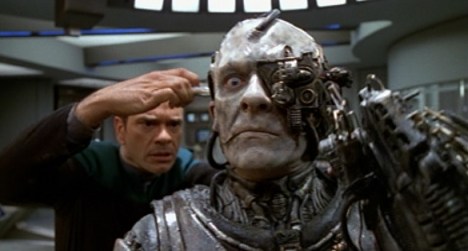
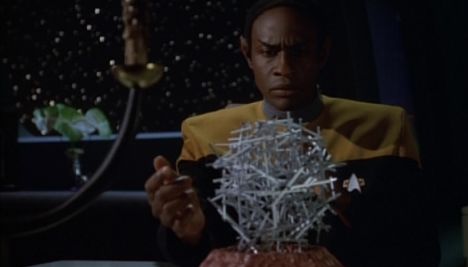
The brains of the operation.

The brains of the operation.

The third season only features a few token appearances of the recurring Delta Quadrant species. The Kazon disappear from the show after Basics, Part II. The Vidiians appear within a nightmarish time loop in Coda. A lost Talaxian pops up on a space station in Fair Trade. However, these aliens are no longer a recurring presence. There is an obvious vacancy that needs to be filled. Voyager needs a new recurring alien species. With that in mind, it is telling that the third season does not create a new alien menace like the Hirogen or the Malon.

The third season of Voyager decides that the Borg are to be the shows recurring adversaries. It makes a certain amount of sense. After all, the Borg are arguably the most iconic and effective aliens created by The Next Generation. They were a massive part of the spin-off really coming into its own with The Best of Both Worlds, Part I and The Best of Both Worlds, Part II. They were also a major part of the hugely successful feature film Star Trek: First Contact. There was definitely an appetite for more Borg stories. There always would be.

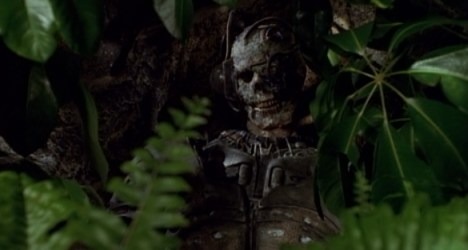
Corpsing...

Corpsing…

At the same time, the presence of the Borg feels very much like a concession or a surrender. This is Voyager effectively surrendering itself to becoming a pale imitation of The Next Generation, acknowledging that it will never create any alien species as memorable or as iconic as the Borg. That is not an unreasonable thing to accept. After all, Star Trek: Deep Space Nine did fantastic work with the Dominion, but that collection of alien species could never hope to have the same cultural penetration as the Borg.

Still, it is disheartening to see Voyager give up on itself so completely. Indeed, Unity is not even a particularly innovative Borg story, feeling very much like a retread of their last television story in Descent, Part I and Descent, Part II. This is a recurring problem for the third season of Voyager, which has spent a lot of time emulating various Next Generation episodes. However, there is also a sense that Voyager is not terrible at this imitation, even as it is lessened by it. Unity is a flawed episode, but an intriguing one.

Just what every Borg story needs! A Chakotay romance!

Just what every Borg story needs! A Chakotay romance!

Continue reading

Star Trek: Deep Space Nine – In Purgatory’s Shadow (Review)

In Purgatory’s Shadow and By Inferno’s Light represent a fantastic accomplishment for Star Trek: Deep Space Nine.

In keeping with the television of the time, the first Star Trek show had been firmly episodic, to the point that there are arguments about the order in which episodes happened. Even in the context of the early nineties, Star Trek: The Next Generation tended to shy away from making dramatic decisions with huge consequences. The Klingon Civil War is resolved in Redemption, Part I and Redemption, Part II. The failed Romulan invasion of Vulcan in Unification, Part I and Unification, Part II is never mentioned again.

"Mister Worf, we really shouldn't have mounted this mission during Sweeps."

“Mister Worf, we really shouldn’t have mounted this mission during Sweeps.”

Deep Space Nine grew increasingly adventurous over the course of its run. The series had flirted with up-ending the status quo before, from the introduction of the Defiant and the Founders in The Search, Part I and The Search, Part II through to the dismantling of the Khitomer Accords in The Way of the Warrior. While those decisions had very long-term consequences for the show, their impact was not as dramatic and immediate as that seen here. Even the defeat of the Cardassians and Romulans in Improbable Cause and The Die is Cast took time to ripple down.

In contrast, In Purgatory’s Shadow and By Inferno’s Light change a lot of what the audience think they know about Deep Space Nine. The fifth season pivots on this two-parter, which serves to enable just about every major dramatic development between this point and the end of the series. This only serves to make it all the more impressive that the two-parter is so firmly rooted in its characters and characterisation.

Gripping drama.

Gripping drama.

Continue reading

Star Trek: Voyager – Blood Fever (Review)

Blood Fever is a strange and dysfunctional episode.

By this point in the third season, Star Trek: Voyager has abandoned any sincere attempt to develop or define its own identity. Instead, the series has committed itself to being the most generic Star Trek show imaginable. In many ways, this represents a disappointing betrayal of an interest premise and a fascinating cast of characters. In other ways, this allows the show to focus on telling archetypal Star Trek stories like Remember or Distant Origins or Living Witness, stories that deal with broad themes through science-fiction allegory.

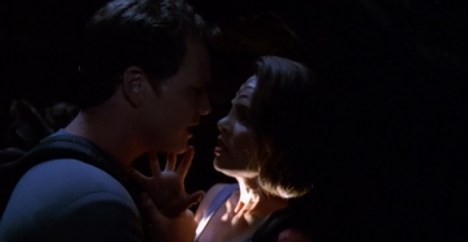
Tunnels of love.

Tunnels of love.

In its strongest moments, Blood Fever feels like it wants to be that kind of classic Star Trek metaphorical exploration of contemporary society. In many ways, Blood Fever is an exploration of contemporary attitudes towards sex and sexuality, of the damage that can be wrought by sexual repression on levels both personal and societal. It is building upon the idea of pon’farr as introduced by Theodore Sturgeon (and refined by D.C. Fontana) in Amok Time, as the volcanic eruption of sexual desire following years of repression.

Unfortunately, Blood Fever lacks the courage of its convictions. The script feels like a victim of the same social mores that it seeks to critique, either unable or unwilling to talk about sex and sexuality in a manner that is suitably candid. As a result, Blood Fever ends up a muddled and ineffective piece of television that seems unwilling to call out its characters and which inevitably builds towards a tired rehash of an iconic Star Trek scene. Waiting seven seasons for this must be very unsatisfying.

Droning on.

Droning on.

Continue reading

Star Trek: Deep Space Nine – For the Uniform (Review)

For the Uniform forms the second entry in a loose trilogy of Michael Eddington stories, sitting between For the Cause and Blaze of Glory.

Much like The Begotten before it, For the Uniform feels like Star Trek: Deep Space Nine is tidying up a bunch of loose ends before it barrels into the second half of the season with In Purgatory’s Shadow and By Inferno’s Light. It is offering one last story built on the status quo established by The Maquis, Part I and The Maquis, Part II before things change dramatically. It is also quite heavy on the kind of impressive space battles that will become a major part of the final two seasons.

Terrorise this!

Terrorise this!

The episode even puts an increased emphasis upon the series’ military themes, with much made of the crippling blow dealt to the Defiant by Eddington’s virus and the operational protocols that this attack necessitates. With Nog standing on the edge of the bridge echoing Sisko’s orders to Engineering, For the Uniform occasionally feels more like like a submarine movie than an episode of Star Trek. This is to say nothing of the attention paid to the Defiant’s departure from Deep Space Nine itself, which plays up the military protocol of such a launch.

However, there is more to For the Uniform than all of that. It is an episode that touches upon a number of key themes for Deep Space Nine. It is a story about moral compromise and ambiguity, about narrative and mythmaking. It is a tale about obsession and vindictiveness, rooted in the flaws of its central character. For the Uniform struggles a little bit in how it approaches Sisko’s monomaniacal pursuit of Eddington, wrapping up so fast that the closing lines offer a sense of tonal whiplash. Nevertheless, it is a bold and breathtaking piece of television.

Shadow boxing...

Shadow boxing…

Continue reading

Star Trek: Voyager – Coda (Review)

In many ways, the Jeri Taylor era of Star Trek: Voyager represented a reaction to the direction that the show had taken under Michael Piller.

Michael Piller had imagined a more dynamic and adventurous version of the show, focusing on two crews thrown together by fate and forced to coexist while journeying through uncharted territory. After seven seasons of Star Trek: The Next Generation, Piller was understandably (and perhaps justifiably) concerned that the second iteration of Star Trek might have been growing somewhat stale. Star Trek: Deep Space Nine was in the process of breaking new ground, and Piller felt that it was necessary for the franchise to find a new direction and identity.

Daddy's home.

Daddy’s home.

This is a good idea in theory. In practice, Michael Piller’s vision was disastrous. Piller wanted to do new things, but found himself working with a staff vehemently opposed to his vision of the series and phoning in scripts that should have been provocative like Alliances or Investigations. More than that, Piller was unable to properly realise his own ambitions, citing scripts like Tattoo as incredibly accomplishments rather than recognising them for the embarrassing failures that they were. When Piller was ousted after the second season, Jeri Taylor took over.

Jeri Taylor would oversee the third and fourth seasons of Voyager. She had a very clear vision of what Voyager should be, a rather conservative and generic iteration of the larger Star Trek franchise. Traditionally, the third season had served as a point of transition for the Star Trek spin-offs. It was in their third seasons that The Next Generation and Deep Space Nine really broke the mould and discovered their own unique identities. In contrast,t he third season of Voyager marked a point of retreat from the basic premise of the show.

Carry on regardless.

Carry on regardless.

Taylor wanted to focus on telling very safe and familiar Star Trek stories, ones that did not necessarily rely upon the premise of the show. There are any number of episodes where this approach simply did not work, with episodes like Warlord or The Q and the Grey or Alter Ego feeling like reheated Star Trek leftovers. However, there were points at which Taylor’s approach paid off. Future’s End, Part I and Future’s End, Part II were pure popcorn, but they worked on those terms. It didn’t matter that nobody seemed too bothered at getting Voyager back to Earth.

Coda is another example of the strengths of Taylor’s approach to Voyager. It is a very familiar and archetypal episode of Star Trek, one that might have been assembled from the leftover pieces of Cause and Effect or Tapestry. However, that relative simplicity becomes a strength, allowing Taylor to craft a script focusing on Janeway and giving Kate Mulgrew some meaty material into which she might sink her teeth. There is nothing particularly new or exciting here, but there is something to be said for executing old standards with such charm.

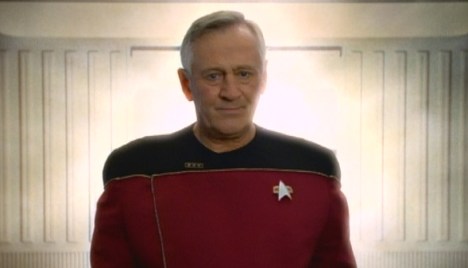
Of course he's evil. He's an admiral.

Of course he’s evil. He’s an admiral.

Continue reading

Star Trek: Deep Space Nine – The Begotten (Review)

From a mechanical perspective, The Begotten is very much about clearing up the leftover pieces from the first half of the season before the second half can really begin.

Watching the fifth season of Star Trek: Deep Space Nine with the benefit of hindsight demonstrates just how carefully the production team have paced the season. The fifth season clearly turns on a number of different points, pivoting over In Purgatory’s Shadow and By Inferno’s Light in the middle of the year. However, a lot of the first half of the season can be seen as a build to that two-parter. The production team are very consciously lining up the remaining dominoes for that big plot development.

A life in his hands.

A life in his hands.

The most obvious example is the prophecy of Rapture, which foreshadows the events of both By Inferno’s Light and Call to Arms while keeping Bajor neutral for what is to come. But there are others. Apocalypse Rising folds the Klingon War into the looming battle with the Dominion. The Ship and … Nor the Battle to the Strong are proofs of concept for a Star Trek series about war. Things Past and The Darkness and the Light keep the Cardassian Occupation fresh in the viewers’ mind. The Ascent is a story that could only work while Odo is humanoid.

There is a clear purpose to most of the storytelling decisions made during this stretch of the season, designed to streamline what is to come. The Begotten takes care of two rather major plot points that need to be addressed; Odo’s status as a humanoid following Broken Link and Kira’s surrogate pregnancy from Body Parts. Sure, For the Uniform sits between this episode and the big mid-season twist, providing the opportunity to do one last Maquis story before the political board is reset. But that feels almost like an afterthought.

Soaking it in.

Soaking it in.

The Begotten dedicates itself to wrapping up the two biggest plot elements hanging over from the end of the fourth season, closing that chapter of the show before a new one is opened. There is a certain functional quality to The Begotten, a utilitarian approach to plotting. It would be very easy for The Begotten to feel stale or trite, contrived or obligatory. It is to the credit of writer René Echevarria that The Begotten never feels forced. The subplot focusing on Kira’s birth has a number of very serious issues, but the primary plot driven by Odo is genuinely affecting.

It is a testament to the writers working on Deep Space Nine that even the act of decluttering the long-form narrative can lead to affecting television.

Free as a bird.

Free as a bird.

Continue reading

Star Trek: Voyager – Alter Ego (Review)

Following on from the aborted promise of a new beginning in Fair Trade, things get back to normal.

Alter Ego is another episode of Star Trek: Voyager that feels like it might have been wholly repurposed from an earlier Star Trek show. On the surface, it is a fairly standard “holodeck run amok” story in the style of earlier episodes like Heroes and Demons or Projections. However the contours of the plot recall a very specific (and very good) episode of Star Trek: The Next Generation. As Alter Ego seems to suggest that a holographic character has achieved sentience and threatens to destroy the ship, it recalls the far superior Ship in a Bottle.

Forced attraction.

Forced attraction.

There are differences, of course. Ship in a Bottle is a far stronger episode, one of the best holodeck stories ever produced. More than that, the climax of Alter Ego reveals that the holodeck programme has not become sentient but is instead being used as the avatar of an outside force. Still, this twist is confined to the last act of the episode, and so it feels more like an embellishment than a revision. For the bulk of its runtime, Alter Ego plays as a pale imitation of a much stronger piece of television.

It does not help matter that Alter Ego‘s novel twist on that central premise is to paint its central guest star as a psychotic stalker with a crush.

A whole ball of crazy.

A whole ball of crazy.

Continue reading