• Following Us

  • Categories

  • Check out the Archives


  • Awards & Nominations

Star Trek: Deep Space Nine – The Way of the Warrior (Review)

This February and March, we’re taking a look at the 1995 to 1996 season of Star Trek, including Star Trek: Deep Space Nine and Star Trek: Voyager. Check back daily Tuesday through Friday for the latest review.

The third season of Star Trek: Deep Space Nine was really just a dress rehearsal for what lay ahead.

The third season had been a tumultuous time for the show, with Michael Piller departing the franchise to pursue opportunities outside Star Trek. It was the year directly after the end of Star Trek: The Next Generation, and all attention was focused on the pending release of Star Trek: Generations and the launch of Star Trek: Voyager. On top of that, the third season suffered from a great deal of confusion and disorganisation throughout the year, making it very hard for the production team to set an end goal for themselves.
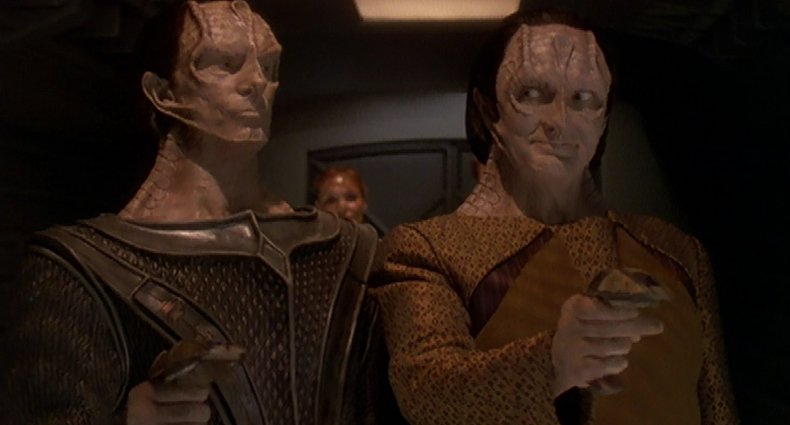
"This could be the start of a beautiful friendship..."

“This could be the start of a beautiful friendship…”

In fact, the third season of Deep Space Nine was such a mess that the production team had not even managed to hit the end of season cliffhanger that they wanted. The Adversary had been drafted at the last possible minute when the studio vetoed the idea of ending the year with a Vulcan withdrawal from the Federation. This is not to discount the long list of impressive episodes produced during the season, but it does illustrate that the third season of Deep Space Nine had not progressed according to plan.

At the same time, it was a vital learning experience for the show. It provided a clear framework for what followed, providing producer Ira Steven Behr with a foundation from which he would build the rest of the run. The work put in during the third season would pay dividends in the fourth and fifth seasons, as the show began to play with and pay off ideas that had been carefully and meticulously established during that most chaotic of seasons. In fact, the show begins paying off those dividends with The Way of the Warrior, the first episode of the fourth season.
Klingons woz 'ere...

Klingons woz ‘ere…

Continue reading

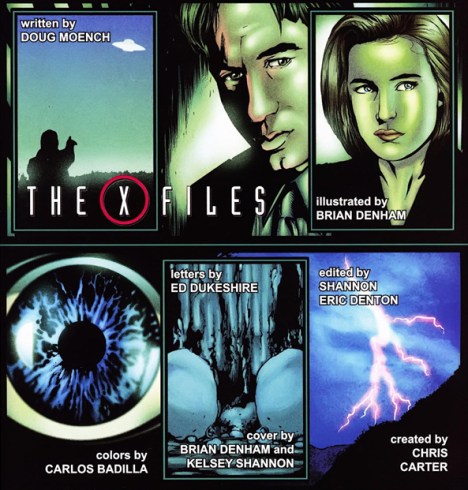
The X-Files (Wildstorm) #5-6 – Dante’s Muse (Review)

This January, to prepare for the release of the new six-part season of The X-Files, we’re wrapping up our coverage of the show, particularly handling the various odds and ends between the show’s last episode and the launch of the revival.

And Wildstorm’s X-Files comic dies a quiet death.

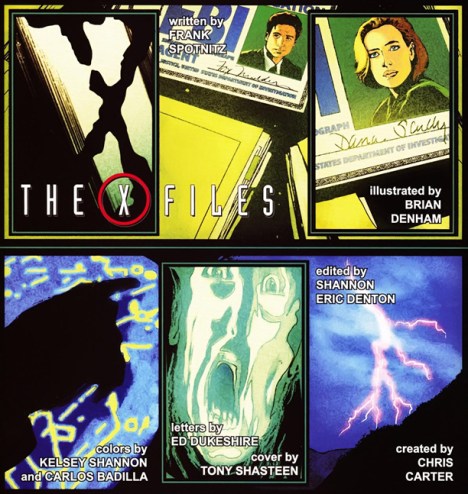
The seven-issue (six monthly issues and a special “zero” comic) miniseries is an oddity. These seven comics tell four self-contained mysteries that stand quite separate from another, even as they echo the show’s creative peak. These four self-contained stories are credited to three different writers; the first two stories are written by producer and writer of the classic show, while each of the final two stories is credited to an established industry veteran with a long history working at DC comics.

THE TRUTH IS OUT THERE

THE TRUTH IS OUT THERE

Still, the miniseries feels like something of a damn squib. Barring that X-Files/30 Days of Night crossover, these seven issues represent everything that Wildstorm chose to do with the license. It certainly pales in comparison to the more comprehensive and thorough exploitation of the property by previous owner Topps and future owner IDW. While part of that is likely down to the simple fact that Wildstorm was in its extended death throes, perhaps it also speaks to where The X-Files was at that point in time.

Perhaps there simply was not that big a market for The X-Files in late 2008 and into 2009. Perhaps the memory of the show’s final season lingered too strongly in the cultural memory, or perhaps the cultural remembrance of show had faded entirely. The spark of nostalgia that would resurrect the show half a decade later had yet to be kindled. For whatever reason, it seemed like The X-Files was not quite ready to return to the popular consciousness.

EVERYTHING DIES

EVERYTHING DIES

Continue reading

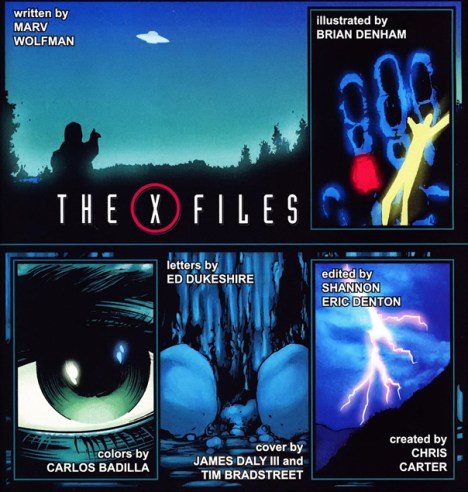
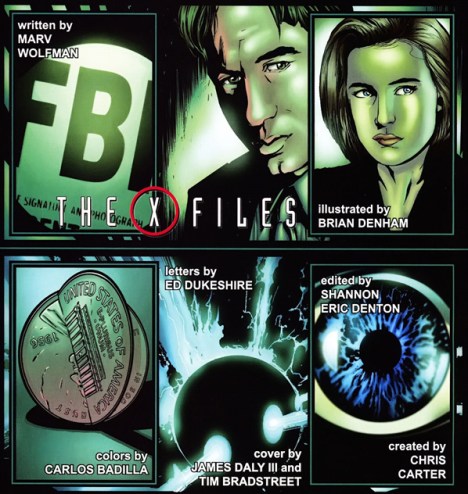
The X-Files (Wildstorm) #3-4 (Review)

This January, to prepare for the release of the new six-part season of The X-Files, we’re wrapping up our coverage of the show, particularly handling the various odds and ends between the show’s last episode and the launch of the revival.

Frank Spotnitz could not stick around forever.

The veteran X-Files writer and producer could not stick around for even half a year. These days, it is customary for “big name” authors to commit to a very short run of comic book issues before jumping off; while comic book veterans like Marv Wolfman or Chuck Dixon or Chris Claremont would have committed to years on a particular title during the seventies and eighties, it became increasingly common for higher profile writers to enjoy shorter stints. While this is the case for high-profile industry veterans like Warren Ellis, it is particularly true of celebrity authors.

THE TRUTH IS OUT THERE

THE TRUTH IS OUT THERE

Brad Meltzer wrote thirteen issues of Justice League of America. Kevin Smith wrote eight (and a bit) issues of Daredevil and fifteen issues of Green Arrow. Richard Donner wrote seven issues of Action Comics, and contributed a short story to the anniversary special. Sam Hamm wrote three issues of Detective Comics. While these creators might have had great stories to tell with these characters, they were also not necessarily comfortable with committing to a month schedule indefinitely. (They also had careers outside the medium, to be fair.)

Still, there is something quite jarring about Frank Spotnitz’s departure from Wildstorm’s X-Files comic book after only three issues. Spotnitz barely had time to define what the comic was supposed to be, beyond a glimpse into a weird alternate universe where Mulder and Scully are trapped in a perpetual 1998. It is debatable whether a licensed tie-in really needs anything more than that, given the tendency to treat such tie-ins as little more than a supplement to a more mainstream iteration of the same basic product.

DECEIVE INVEIGLE OBFUSCATE

DECEIVE INVEIGLE OBFUSCATE

At the same time, it feels like Spotnitz’s departure leaves an already confused monthly series with no strong identity of its own. Quite pointedly, Spotnitz’s name still appears on the full cover to the first issue written by Marv Wolfman; whether this suggests that Spotnitz was intended to write the issue or simply the result of a rush to press is unclear. As a result, Wildstorm ended up passing its X-Files monthly series from one writer to another, with industry (and DC comics) veterans Marv Wolfman and Doug Moench each handling a two-part story.

The results are intriguing, if not particularly compelling. Wildstorm’s X-Files comics are most remarkable for its sense of detachment from anything and everything. It is “unstuck” in a way that none of the franchise’s other flirtations with comic book storytelling are not. In its own way, this feels entirely appropriate; this is The X-Files as published by one of the two most largest and most iconic comic book publishers. Continue reading

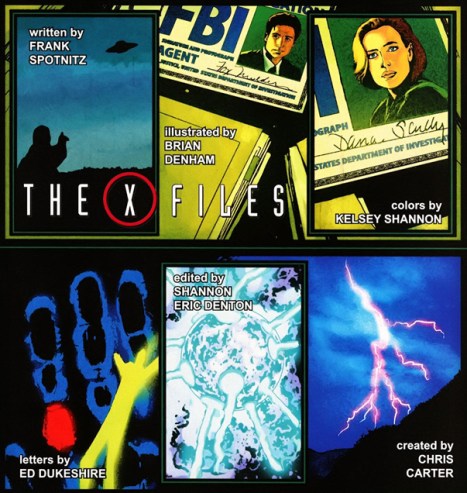
The X-Files (Wildstorm) #1-2 (Review)

This January, to prepare for the release of the new six-part season of The X-Files, we’re wrapping up our coverage of the show, particularly handling the various odds and ends between the show’s last episode and the launch of the revival.

In some respects, comic books represent the perfect medium for The X-Files.

After all, mainstream American superhero comic books seem to exist in a perpetual “now”, a present tense that stretches out indefinitely. Peter Parker might be more than fifty years old, but he will always be a young adult immune to the ravages of time. What little material growth the character had came early in his publication history; he graduated high school just over two years into the run of The Amazing Spider-Man, the rest of his life unfolding at a much slower pace. Batman and Superman are spared the ravages of age.

THE TRUTH IS OUT THERE

THE TRUTH IS OUT THERE

So it is with Wildstorm’s adaptation of The X-Files, a comic book that seems to operate on the same “sliding” time scale as the major superhero universes, where it seems like the characters (and their general status quo) are immune to the passage of the years. Here, it feels like the fifth season has continued indefinitely, to the point that Frank Spotnitz’s second X-Files comic book is very much a sequel to the events of Redux II. The comic picks up from the threads left hanging by that season premiere more than a decade earlier.

This is an approach that seems perfectly suited to The X-Files. Comic book stories are notorious for their long-form (albeit haphazard) serialisation, the fiction that the entirety (or even the bulk) of a fictional character’s history can be condensed down into a single story published over forty years by different creative teams under different creative circumstances. This an elaborate fiction, of course. Attempting to argue that the Marvel or DC universes are a single unified storyline requires some distortion of the truth.

BELIEVE THE LIE

BELIEVE THE LIE

In truth, these universes frequently feel like a backdrop against which individual writers can tell their own stories; a status quo from which a creative team might begin and to which they may return. Batman’s rich decades-long history is perfect fodder for Grant Morrison’s take on the character; Daredevil provides a template against which Frank Miller may define himself; Brian Michael Bendis can use the rich history of the Avengers as a springboard for his own story. These stories frequently contrast and critique, using the background as a jumping off point.

In a way, the same is true of The X-Files. Although there was definite narrative progression to the mythology, with a few major exceptions (Patient X, The Red and the Black, Two Fathers, One Son), the mythology often felt like a backdrop that could be used to tell interesting and unique stories. The X-Files receives (and deserves) a lot of credit for re-popularising serialisation in mainstream genre entertainment, but perhaps the mythology is best examined as a springboard for storytelling rather than a story of itself.

Not alone...

Not alone…

Continue reading

The X-Files (Wildstorm) #0 (Review)

This January, to prepare for the release of the new six-part season of The X-Files, we’re wrapping up our coverage of the show, particularly handling the various odds and ends between the show’s last episode and the launch of the revival.

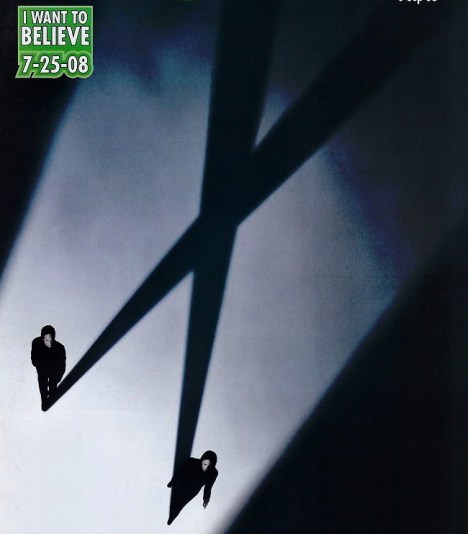
The X-Files: I Want to Believe marks a point of transition for The X-Files.

It seems to represent the point at which The X-Files truly stops its forward momentum; the point at which the show embraces its status as an artifact of the nineties rather than a living (and evolving) entity. There had been indications of this with the release of Resist or Serve, a video game which seemed to treat the seventh season as the “end” of The X-Files, but I Want to Believe embraced it on a much larger scale and on a much larger platform. The X-Files was not so much pushing forward as looking backwards.

THE TRUTH IS OUT THERE

THE TRUTH IS OUT THERE

This reality was reflected in a number of ways. The importance of the eighth and ninth seasons was consciously downplayed, to the point where a gag in I Want to Believe hinges on the audience forgetting that both Mulder and Scully had worked at the FBI during the Bush administration. Doggett and Reyes were consigned to a blu ray bonus feature, an evolutionary branch of The X-Files to be cut off for the sake of convenience. I Want to Believe even took Mulder and Scully back to snowy Vancouver, a literal journey backwards.

The Wildstorm comic book pushes this reconceptualisation of the show to its logical conclusion, as if imaging some alternate world where The X-Files‘ so-called “golden age” of the second through fifth seasons had somehow lasted over a decade. The Wildstorm comics tease a glimpse of The X-Files frozen in amber, trapped for an eternity.

I WANT TO BELIEVE

I WANT TO BELIEVE

Continue reading

Night Stalker (Review)

A new version of Night Stalker from the team behind The X-Files should have been a slam dunk.

Frank Spotnitz was a veteran of The X-Files, the longest serving member of the writing team beyond Chris Carter himself. He had assembled a murderer’s row of X-Files talent. Darin Morgan and Vince Gilligan were veterans of the show, producing some of the show’s best episodes. There is a strong argument to be made for either writer as the strongest staff writer on The X-Files. Spotnitz was also able to bring along Tom Schnauz, who had struggled with his scripts for Lord of the Flies and Scary Monsters, but had done great work on The Lone Gunmen.

kolchak-pilot21

More than that, Spotnitz had pulled a great deal of the behind-the-scenes talent had made The X-Files such a television classic. Daniel Sackheim had directed multiple episodes of The X-Files and had been a driving creative force on Harsh Realm. Rob Bowman had graduated from television to feature films, but returned to helm the show’s second episode. Spotnitz even drafted director Tony Wharmby, who had made a great impression with episodes like Via Negativa. There was considerable talent involved in the show’s production.

On paper, Night Stalker sounds like a slam dunk. Many of the great creative minds of The X-Files offering a modern reimagining of a beloved genre property that had been a huge inspiration; for the character of Carl Kolchak, it seemed like things had come a full circle. What could possibly go wrong?

nightstalker-malum9

Continue reading

Night Stalker – What’s the Frequency, Kolchak? (Review)

This January, to prepare for the release of the new six-part season of The X-Files, we’re wrapping up our coverage of the show, particularly handling the various odds and ends between the show’s last episode and the launch of the revival.

What’s The Frequency, Kolchak? is the episode written by Vince Gilligan.

Gilligan remained one of Frank Spotnitz’s most keen collaborators in the years following the end of The X-Files. Gilligan had worked with Spotnitz as part of the writing staff on the short-lived Robbery Homicide Division before the pair moved on to Night Stalker. After ABC cancelled Night Stalker, the pair would collaborate on the television series A.M.P.E.D. for Spike, writing a pilot that would eventually air as a television movie when the network declined to pick it up for series.

"Wow, ABC really is a tough network to play with..."

“Wow, ABC really is a tough network to play with…”

Sadly, Night Stalker only lasted long enough for Gilligan to script a single episode of the show. Still, he fared better than fellow staffer Darin Morgan; Morgan’s script for The M-Word did not make it into production before the axe fell on the show. This is a shame; the materials available on the DVD that never made it to air on ABC suggest a show more comfortable with itself than the first six episodes would suggest. More than any other episode of the first season of Night Stalker, What’s the Frequency, Kolchak? speaks to the series’ potential.

It is just a shame that it arrives too late.

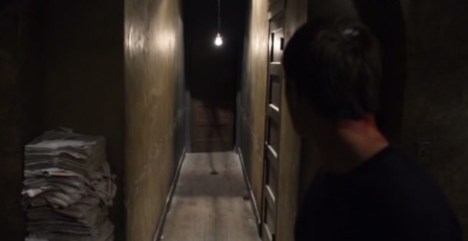
The monster at the end of the hall...

The monster at the end of the hall…

Continue reading

Night Stalker – Timeless (Review)

This January, to prepare for the release of the new six-part season of The X-Files, we’re wrapping up our coverage of the show, particularly handling the various odds and ends between the show’s last episode and the launch of the revival.

The unaired episodes of Night Stalker are fascinating glimpses into what the show might have been.

Into Night was the show’s original second episode, brutally shunted from its original position when ABC decided that they did not want a show focusing on monsters. The version of Into Night that appears on the DVD appears somewhat cobbled together, hastily editted in such a way as to make the show’s second episode sit as its eighth. The result feels like something of a rough cut, a glimpse at the pressures bearing down on the production team to meet various network demands.

It's dead at night in here...

It’s dead at night in here…

In contrast, Timeless and What’s the Frequency, Kolchak? feels like something completely different. These are episodes that were obviously produced while Night Stalker was still airing on ABC, but which did not complete production under the network’s supervision. While Timeless and What’s the Frequency, Kolchak? are ver clearly part of the same show, they feel tangibly different. The two episodes are more horrific, more confident, and less pandering than what came before.

In many respects, the two episodes suggest that Night Stalker benefits from not having to air on ABC.

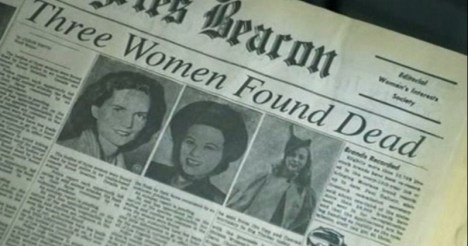
My word!

My word!

Continue reading

Night Stalker – Into Night (Review)

This January, to prepare for the release of the new six-part season of The X-Files, we’re wrapping up our coverage of the show, particularly handling the various odds and ends between the show’s last episode and the launch of the revival.

Night Stalker was cancelled after only six episodes had aired.

The Source was the last episode broadcast during its initial run, closing the show on a cliffhanger. There were four additional episodes produced, but not aired on ABC. There were also two more scripts written, but not produced. While the six episodes of Harsh Realm that had been produced but not aired felt reasonably coherent and finished, there is something very different about the final stretch of Night Stalker. Harsh Realm was not finished, but it felt oddly complete.

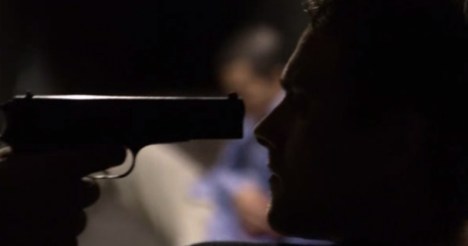
Oh, it's a crime scene alright...

Oh, it’s a crime scene alright…

The final stretch of Night Stalker after The Source has a decidedly rough and unpolished quality to. Everything after The Source takes on the feeling of a rough draft, occasionally intriguing but undoubtedly incomplete. As packaged on the DVD, it all feels like bonus content: Frank Spotnitz elaborating on his plans for the show, the .pdf of Darin Morgan’s script, even the final four episodes. It has become a cliché to compare modern television to a novel, but perhaps the best comparison for Night Stalker is a comparison to a studio album.

If that comparison holds, everything after The Source has the feel of a second disc or a reissue. Linear notes, rough cuts of tracks that did not make the original release, snippets of demos that informed the work. The DVD of Night Stalker is not as interested in concluding or wrapping up the show as it is elaborating or expanding upon it; offering a glimpse into its production and context for its decisions.

Nothing to report...

Nothing to report…

Continue reading

Night Stalker – The Sea (Review)

This January, to prepare for the release of the new six-part season of The X-Files, we’re wrapping up our coverage of the show, particularly handling the various odds and ends between the show’s last episode and the launch of the revival.

One of the interesting aspects of doing a long-running pop culture project is the subtle shifts that you can see taking place over time.

The realities of media consumption change over extended periods; in response, the methods of media production also change. It is not too hard to imagine a world where Night Stalker would have been cancelled by ABC six episodes into its run, ending on a cliffhanger with the remaining four episodes buried for all eternity. Television would have moved on to its next reboot, its next new launch, and the cycle would have continued. Night Stalker would have been dead and buried, even more of a genre curiosity than it is now.

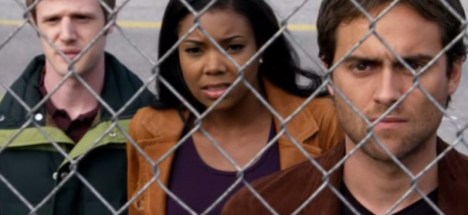
Fenced off...

Fenced off…

There was a time when Night Stalker would have been consigned to history. At best, it might have been a footnote in Frank Spotnitz’s filmography, a point of reference in interviews and conversations about how mainstream American television treats science-fiction history. Had Night Stalker appeared (and been so promptly cancelled) even ten years earlier, it would probably be a curiosity on the IMDb pages of its cast and crew. The name would resonate with genre fans, and t would casually be dropped in career overviews. But it would largely be lost.

However, the reality of television had changed by the twenty-first century, the explosion in home media ensuring that even a six-episode failure like Night Stalker could receive a neatly-packaged DVD release and remain easily accessible to the generations that followed. In some respects, this feels like the worst thing that could have happened. The biggest obstacle between Night Stalker and the status of “cult classic” is ease of access to the show itself; the readiness with which the nostalgic refrain of “cancelled before its time” might be rebutted by simply buying the DVD.

A blast from the past...

A blast from the past…

Continue reading