• Following Us

  • Categories

  • Check out the Archives


  • Awards & Nominations

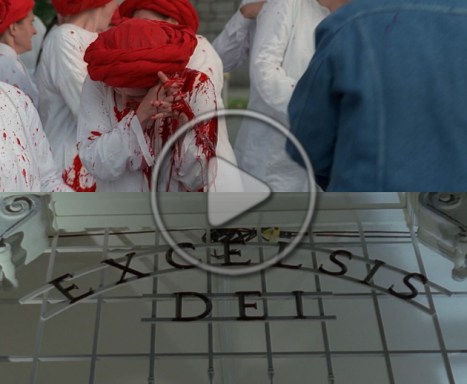
New Podcast! The X-Cast X-Files Podwatch – Episode #18 (Red Museum/Excelsis Dei)

I’m thrilled to be a part of The X-Cast X-Files Podwatch, a daily snippet podcast rewatching the entirety of The X-Files between now and the launch of the new season. It is something of a spin-off of The X-Cast, a great X-Files podcast run by the charming Tony Black. Tony has assembled a fantastic array of guests and hosts to go through The X-Files episode-by-episode. I’m honoured to be a part of it.

My first appearance of the second season is covering the episodes Red Museum and Excelsis Dei with the always insightful Christopher Knowles. I do a couple of episodes with Chris over the course of the podwatch, and very few people understand the workings of the show, its symbolism and its fascinations, as thoroughly as Chris. It was a joy recording these episodes, and I hope it’s as much fun listening to them.

Continue reading

Star Trek: Voyager – Equinox, Part I (Review)

Equinox, Part I works better than it should.

Equinox, Part I is sustained by three important factors. The most obvious is the premise itself. Equinox, Part I and Equinox, Part II tell a story that is baked into the DNA of Star Trek: Voyager, and it is surprising that it took the production team five years to tell it. Secondly, Equinox, Part I and Equinox, Part II have the luxury of a fantastic supporting cast with John Savage and Titus Welliver playing the two most senior officers on the eponymous ship. The third factor is a sense of momentum, with Equinox, Part I and Equinox, Part II moving at a tremendous pace.

A Captain’s Ransom.

These three factors compensate for a lot of potential flaws. Equinox, Part I is an episode of television that spends forty-five minutes consciously building towards its cliffhanger. There is nothing wrong with this approach. Many of the best Star Trek cliffhangers, especially season finales, are structured as relentless build-up. The Best of Both Worlds, Part I builds to Picard’s assimilation and Riker’s command. Call to Arms builds to the Dominion retaking the station and war being declared. Equinox, Part I builds to the reveal of what Rudolph Ransom did.

Equinox, Part I is an episode that works as sheer and unrelenting build-up.

Too many captains.

Continue reading

New Podcast! Discussing Opening The X-Files with The X-Cast!

Hello!

As readers may be aware, I published a book of X-Files criticism this year. The book is called Opening the X-Files, it is published by McFarlands Press, and it comes with a foreword from the great Kumail Nanjiani.

Tony Black very generously invited my on The X-Cast to talk a little bit about the book, and maybe answer some questions about where it came from and what it’s about. It was, as ever, a pleasure and I was very glad of the opportunity. You can hear the podcast below.

In the meantime, if you do want to order yourself a copy of Opening the X-Cast, it is available at the following links.

The eBook is available for purchase at:

The physical book should now be in stock at:

Star Trek: Deep Space Nine – Extreme Measures (Review)

Extreme Measures is the closest thing to a standalone story within this epic ten-part conclusion to Star Trek: Deep Space Nine.

All of the other episodes carry over plot threads and subplots that either develop existing narratives or set-up future twists. This is true even of the more self-contained chapters: When It Rains… and Tacking Into the Wind are something of a two-parter in the middle of the arc, but they pick up in the wake of The Changing Face of Evil; although The Dogs of War has a self-contained subplot focusing on the Ferengi, it deals with baggage from Extreme Measures while setting up What You Leave Behind.

“Well, Miles. If you think it’ll make the episode go easier.”

In contrast, Extreme Measures is practically a bottle show. With the exception of a short one-scene appearance from Garak, Extreme Measures is devoid of the recurring guest stars that populate this final run of episodes. Although Damar and Martok are mentioned, neither Casey Biggs nor J.G. Hertzler appear. Perhaps glad of a week off before his double duty on The Dogs of War, Jeffrey Combs is entirely absent. There is no guest appearance from Louise Fletcher, Marc Alaimo, James Darren, Barry Jenner or Salome Jens.

Indeed, Extreme Measures is very precisely focused on the single story that it wants to tell. Most episodes in this final stretch of the final season have at least two or three plots running through them: Penumbra focuses on the loss of Worf, on Sisko’s retirement plans, on Damar’s growing unease; When It Rains… features the plotting of Dukat and Winn, the development of Damar’s rebellion, and the threat to the Alliance posed by Gowron; The Dogs of War witnesses Ferengi succession, the plan for the invasion of Cardassia, the implosion of Damar’s rebellion.

Journey to the Centre of Sloan’s Mind.

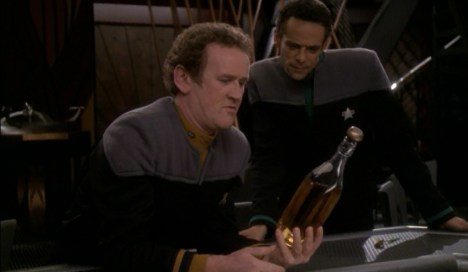
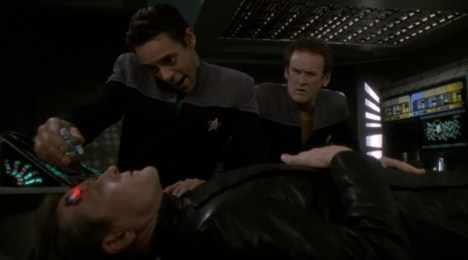
There is so much happening across these ten episodes that it feels strange that Extreme Measures can effectively call a timeout on these recurring plot threads. There are references to the Breen weapon and the Cardassian rebellion, to the ascension of Chancellor Martok and to Bashir’s lingering attraction to Ezri. However, Extreme Measures is an episode without a b-plot or a c-plot. The episode is driven entirely by its primary narrative, the story of how Julian Bashir and Miles O’Brien embark on one last adventure together.

There is something surreal, and almost endearing, about the fact that Deep Space Nine feels comfortable taking time out from its most ambitious experiment with serialisation to make the journey to the centre of Sloan’s mind.

“Julian, are you sure you haven’t been watching too much Star Trek: Voyager?”

Continue reading

Star Trek: Voyager – Relativity (Review)

Relativity is perhaps the most Star Trek: Voyager episode that ever Star Trek: Voyaged.

Of course, there are better episodes of Voyager. Of course, there are episodes of Voyager that more effectively showcase the cast and the premise. Of course, there are episodes of Voyager that do a lot of things that Relativity does, only better. However, there is a sense the episode’s crushing mediocrity is a large part of what makes it so indicative of the show as a whole. Those other stronger episodes stand out from the crowd, and rank among some of the best episodes that Voyager ever produced. In contrast, Relativity is just kinda… there.

Ship of the line.

Relativity clearly belongs to the familiar Voyager subgenre of “timey wimey” action adventures that include epics like Future’s End, Part I and Future’s End, Part II, Year of Hell, Part I and Year of Hell, Part II and Timeless. In fact, the subgenre could be extended to include The Killing Game, Part I and The Killing Game, Part II, even if no literal time travel takes place. Relativity also borrows from the “let’s blow Voyager up!” school of plotting that includes Deadlock and Course: Oblivion. The episode also leans on the “reset” button that has been in integral part of Voyager dating back to Time and Again.

There is a sense that Relativity is a heady cocktail of Voyager storytelling tropes, a reiteration of many stock storytelling elements that have been employed in a variety of important and notable episodes earlier in the run. However, these episodes count among the finest example of Voyager‘s blockbuster storytelling. Relativity is most notable for taking all of these bombastic larger-than-life elements and finding a way to integrate them into a rather lifeless and stale piece of television. In this sense, Relativity is a quintessential Voyager episode.

Keeping those balls in the air.

Continue reading

New Podcast! The X-Cast X-Files Podwatch – Episode #9 (Young at Heart/E.B.E.)

I’m thrilled to be a part of The X-Cast X-Files Podwatch, a daily snippet podcast rewatching the entirety of The X-Files between now and the launch of the new season. It is something of a spin-off of The X-Cast, a great X-Files podcast run by the charming Tony Black. Tony has assembled a fantastic array of guests and hosts to go through The X-Files episode-by-episode. I’m honoured to be a part of it.

My second appearance comes in the second half of the first season, covering the episodes Young at Heart and E.B.E. with the great Zack Moore. He does an amazing Jerry Hardin impression. Give the episode a listen below, and keep your ears open. I should be back a few more times before the podwatch wraps up.

Continue reading

Star Trek: Discovery – Choose Your Pain (Review)

Choose Your Pain is perhaps the most traditional episode of Star Trek: Discovery to date, at least in terms of basic structure.

One of the central tensions of Discovery has been trying to figure out exactly how much to modernise the standard Star Trek storytelling template, the basic model of storytelling that has been in play through Star Trek: The Next Generation, Star Trek: Deep Space Nine, Star Trek: Voyager and Star Trek: Enterprise. These shows were produced over an eighteen-year period running from the second half of the eighties through to the turn of the millennium. However, a lot has happened in the twelve years since These Are the Voyages…
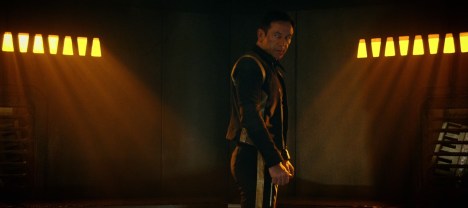
Avenging angel Gabriel.

Quite simply, television has changed phenomenally over the past decade. A number of these changes are obvious even in the way that Discovery is produced. After all, Discovery is the first Star Trek show to premiere on a streaming service. However, Discovery also conforms to other expectations of contemporary television. Discovery is much more tightly serialised than The Next Generation, Deep Space Nine or Voyager. Discovery is also the shortest season of Star Trek ever produced.

There is a sense that times are changing, and that Discovery is attempting to provide an early twenty-first century update to a thirty-year-old template. After all, no other Star Trek series opened its first season with a two-episode prologue before introducing its core setting and premise. No other Star Trek series feature as many extended sequences with characters speaking subtitled Klingon. No other Star Trek series has featured swear words like “piss”, “sh!t” or “f$@k.” These are all new frontiers for televised Star Trek.

An echo chamber.

At the same time, Discovery has proven itself remarkably conservative in other respects. Although the show is very clearly serialised, the production team have worked hard to ensure that each individual episode has its own plot with its own structure and its own agenda. Unlike other streaming dramas, the episodes of Discovery are clear and distinct from one another, each serving as a bullet point in the overall arc of the season. Similarly, Discovery has made a point to use standard Star Trek narratives imbued with standard Star Trek morals built in.

For all the noise being made in certain quarters of the internet that Discovery is not really a Star Trek series, Choose Your Pain is the most conservative and old-fashioned episode of the series to date. Choose Your Pain is an episode that could easily have worked as part of Deep Space Nine or Enterprise, preserving the structure and rhythm with only a few minor tweaks along the way. Ironically, the episode’s biggest issue is that it feels just a little bit too much like classic Star Trek.
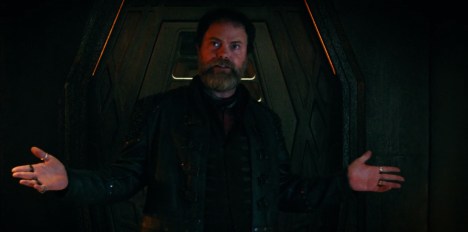
Here’s Mudd in your eye.

Continue reading

Star Trek: Discovery – The Butcher’s Knife Cares Not for the Lamb’s Cry (Review)

The Butcher’s Knife Cares Not for the Lamb’s Cry represents another attempt to reconcile one of the central tensions of Star Trek: Discovery, the conflict that exists between the expectations of a Star Trek series and the demands of a piece of prestige television. It frequently feels like there is a tug of war between these two competing impulses within the series, and the production team are trying desperately to find the right balance between these two very different storytelling models.

Much like Context is for Kings, the basic story at the heart of The Butcher’s Knife Cares Not for the Lamb’s Cry is quintessential Star Trek plotting. The contours of the plot will be recognisable to any viewer with even a passing familiarity with the narrative structures and templates of the larger Star Trek franchise. At the same time, a lot of the episode’s finer details are more recognisable as the hallmarks of contemporary prestige television. The result is a piece of television that tells a very simplistic Star Trek in a manner that feels somewhat dissonant.

Hanging out with the Kol kids.

There is an awkwardness to The Butcher’s Knife Cares Not for the Lamb’s Cry, a sense that the creative team are still working out the proverbial kinks. Much like the engineering and science staff on the Discovery itself, the production team are creating something new and exciting, but something without a clear precedent or blueprint. Discovery often struggles to properly mix its constituent elements, some of its narrative choices feeling clumsy and others struggling to mesh with the story being told.

At the same time, like Context is for Kings before it, The Butcher’s Knife Cares Not for the Lamb’s Cry is an episode that exists primarily to reassure viewers that Discovery is still fundamentally Star Trek, no matter the production design or the prestige trappings. However, Discovery is investing so much time in proving that it is Star Trek, that it is still searching for its own clear voice.

Resting uneasy.

Continue reading

New Podcast! The X-Cast X-Files Podwatch – Episode #6 (Fallen Angel/Eve)

I’m thrilled to be a part of The X-Cast X-Files Podwatch, a daily snippet podcast rewatching the entirety of The X-Files between now and the launch of the new season. It is something of a spin-off of The X-Cast, a great X-Files podcast run by the charming Tony Black. Tony has assembled a fantastic array of guests and hosts to go through The X-Files episode-by-episode. I’m honoured to be a part of it.

My first appearance comes in the middle of the first season, covering the episodes Fallen Angel and Eve with the wonderful Baz Greenland. Give it a listen below, and keep your ears open. I should be back a few more times before the podwatch wraps up.

Continue reading

Star Trek: Discovery – Context is for Kings (Review)

Perhaps what is most surprising about Context is for Kings is just how conventional it is.

The Vulcan Hello and Battle at the Binary Stars were very much atypical episodes of Star Trek, an opening two-parter designed to demonstrate a lot of how Star Trek: Discovery would be different from the earlier series in the franchise. The two-parter introduced a new captain and a new ship, only to kill the captain and destroy the ship at the climax of the story. The primary character ended these opening two episodes as a disgraced mutineer, sentenced to life in prison.

In darkness dwells.

Although the two-parter was traditional in some respects, its structure was consciously designed to subvert a lot of the expectations of previous pilot episodes. Typically, Star Trek pilots find a new crew coming together in a way that sets the tone for the following series. In contrast, The Vulcan Hello and Battle at the Binary Stars joined the Shenzhou at the end of its seven-year mission, and reduced it to floating wreckage. It was a subversive (if not entirely unpredictable) narrative decision, a clear attempt to contextualise Discovery as a modern television series.

All of this means, of course, that Context is for Kings finds itself cast in the role of a conventional Star Trek pilot. In many ways, Context is for Kings is clearly intended as reassurance that Discovery is still fundamentally Star Trek, in spite of the tweaks and alterations that have been made to the framework of the series.

Seeding the future.

Continue reading