• Following Us

  • Categories

  • Check out the Archives


  • Awards & Nominations

Doctor Who: Delta and the Bannermen (Review)

To celebrate the fiftieth anniversary of the longest-running science-fiction show in the world, I’ll be taking weekly looks at some of my own personal favourite stories and arcs, from the old and new series, with a view to encapsulating the sublime, the clever and the fiendishly odd of the BBC’s Doctor Who.

Delta and the Bannermen originally aired in 1987.

Hey, this doesn’t look like Disneyland.

No, well, according to my reckoning, it seems to be somewhere in, er, Wales.

– Murray and the Doctor get in touch with the “real fifties”

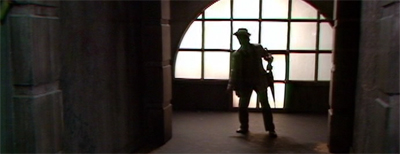
Delta and the Bannermen is quite terrible. That said, it’s not terrible in the same way that, say, Timelash or Attack of the Cybermen or The Twin Dilemma is terrible. It doesn’t offer a demonstration of everything intrinsically wrong with this era of the show, and the frustration isn’t compounded by the sense that nobody producing the show seems interested in watching it and maybe learning from their mistakes.

While that is certainly a promising thing from the perspective of the show, it doesn’t really do the viewer that much good when they are watching it.
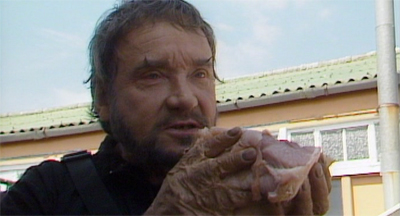
Large ham, incoming!

Large ham, incoming!

Continue reading

The Sopranos: The Legend of Tennessee Moltisanti (Review)

The Legend of Tennessee Moltisanti begins with a dream sequence. We’re not yet at the point where The Sopranos would spend an entire episode inside the head of one of its characters (okay, not literally, at any rate), but it sets a tone for the rest of the episode. The Sopranos attracts attention as an exploration of the American Dream, a look at what life is like in the shadow of all those expectations and aspirations, but it also feels like a black absurdist comedy.

The Sopranos could be one of the funniest shows on the air, and that grim sense of humour is pushed to the fore with The Legend of Tennessee Moltisanti, where the unfunniest thing in the episode is the stand-up comedian working an ageing crowd.

It's a laugh...

It’s a laugh…

Continue reading

Doctor Who: Paradise Towers (Review)

To celebrate the fiftieth anniversary of the longest-running science-fiction show in the world, I’ll be taking weekly looks at some of my own personal favourite stories and arcs, from the old and new series, with a view to encapsulating the sublime, the clever and the fiendishly odd of the BBC’s Doctor Who.

Paradise Towers originally aired in 1987.

Oh, I see. It’s some sort of robotic cleaner with automotive bicurval scraping blades. Impressive workmanship.

You don’t understand.

No, I don’t, but I intend to.

– the Doctor and the Deputy Chief Caretaker

Paradise Towers is brilliant. It’s crazy, it’s overstated, it’s an hour too long and it suffers from the fact that nobody really knows what they’re doing, but there’s a sense of genius at work here. Script editor Andrew Cartmel took over at the start of the season, with no scripts. Time and the Rani came from John Nathan Turner’s reliable Pip and Jane Baker, so Paradise Towers is the first script where Cartmel has been allowed to make his mark.

And it’s precisely what the show needed. The execution is significantly flawed, the pacing is all wrong and there’s a sense that not everybody between the script and the camera realised what was going on, but it has a distinct energy to it. Time and the Rani was essentially Doctor Who struggling to keep its head above water. Paradise Towers sees the show diving right into the eighties.

"... where the grass is green and the girls are pretty..."

“… where the grass is green and the girls are pretty…”

Continue reading

Doctor Who: Time and the Rani (Review)

To celebrate the fiftieth anniversary of the longest-running science-fiction show in the world, I’ll be taking weekly looks at some of my own personal favourite stories and arcs, from the old and new series, with a view to encapsulating the sublime, the clever and the fiendishly odd of the BBC’s Doctor Who.

Time and the Rani originally aired in 1987.

Right, that all seems quite clear. Just three small points. Where am I? Who am I? And who are you?

– the Doctor

A Doctor’s first story is always difficult. Even if it’s not as explicit as it was in Power of the Daleks, the new actor his constantly fighting against the weight of expectation, trying to cast off the spectre of their predecessor and make the show their own. There’s also a sense that the production team is trying to reinvent the show around their new lead. It’s transitional, and it’s not too difficult to see how the task could be daunting.

If that’s a typical first story, imagine how frustrating Time and the Rani must have been at the time. Hastily cobbled together in a rush, coming out of a season that had been a spectacular failure and with the shadow of cancellation looming heavy, there’s a lot of pressure on Time and the Rani. It is a story that is routinely trashed and mocked, and perhaps deservedly so. However, I must concede, it’s not as bad as it could have been and I’d be very reluctant to rank it among the worst Doctor Who serials of all time.

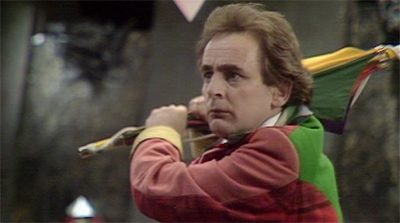
He's got an umbrella and he's not afraid to use it!

He’s got an umbrella and he’s not afraid to use it!

Continue reading

Doctor Who: The Trial of a Time Lord – The Ultimate Foe (Review)

To celebrate the fiftieth anniversary of the longest-running science-fiction show in the world, I’ll be taking weekly looks at some of my own personal favourite stories and arcs, from the old and new series, with a view to encapsulating the sublime, the clever and the fiendishly odd of the BBC’s Doctor Who.

The Trial of a Time Lord originally aired in 1986.

In all my travellings throughout the universe I have battled against evil, against power-mad conspirators. I should have stayed here. The oldest civilisation, decadent, degenerate and rotten to the core. Ha! Power-mad conspirators, Daleks, Sontarans, Cybermen, they’re still in the nursery compared to us. Ten million years of absolute power, that’s what it takes to be really corrupt.

– the Doctor

There really are no excuses for the mess that The Trial of a Time Lord became. I mean, seriously. The producers had eighteen months to plan everything out. The task shouldn’t be that difficult. If you are going to fictionalise the persecution of Doctor Who by the BBC in the form of a trial, you really should have some idea what you plan to do or say at the end of it. If your fourteen episode season-long story arc is about defending a show that is coming close to cancellation, then perhaps it might be a good idea to be able to tell us why it shouldn’t be cancelled. The Trial of a Time Lord is a gigantic mess, and something that makes a stronger case in favour of Michael Grade’s attempts to cancel that show than it does against them.

The Ultimate Foe isn’t as soul-destroyingly horrible as Terror of the Vervoids, but that may be because Pip and Jane Baker only wrote half of it.

Only himself for company...

Only himself for company…

Continue reading

Superman: The Animated Series – Legacy, Parts 1 & 2 (Review)

To celebrate the release of Man of Steel this month, we’re going Superman mad. Check back daily for Superman-related reviews.

It seems like I’ve spent far too long comparing Superman: The Animated Series to its direct predecessor, Batman: The Animated Series. However, it’s interesting how radically different Bruce Timm structured of the two shows. Batman came and went off the air with episodes that could only barely be described as a pilot and a finalé. On Leather Wings featured a Gotham still coming to terms with Batman, but it wasn’t an origin story. Judgment Day teased the possibility of closing Harvey Dent’s arc (and maybe killing off some recurring bad guys), but it didn’t offer too much else in the way of closure.

In contrast, Superman: The Animated Series opened and closed with two large-scale multi-part episodes designed to bookend the show, opening and closing the character’s arc. While Legacy doesn’t feel absolutely final, with plot points leading directly into Timm’s Justice League television show, it does offer a fitting end for Superman: The Animated Series.

He comes in peace.

He comes in peace.

Continue reading

Doctor Who: The Trial of a Time Lord – Terror of the Vervoids (Review)

To celebrate the fiftieth anniversary of the longest-running science-fiction show in the world, I’ll be taking weekly looks at some of my own personal favourite stories and arcs, from the old and new series, with a view to encapsulating the sublime, the clever and the fiendishly odd of the BBC’s Doctor Who.

The Trial of a Time Lord originally aired in 1986.

Mmm. This is a situation that requires tact and finesse. Fortunately, I am blessed with both.

– the Sixth Doctor

Okay, so the “past” and “present” sections of The Trial of a Time Lord haven’t been blow-outs. The Mysterious Planet demonstrated that maybe, once upon a time, Doctor Who had been decidedly average, constructed of a checklist of familiar and inoffensive tropes. Mindwarp demonstrated that Colin Baker’s Doctor was the kind of character who you could probably imagine chaining his companion to a rock on the beach, before leaving her to die… or marry Brian Blessed… or something. But, hey, there was some social commentary! If The Trial of a Time Lord is constructed as a defence by the show to avoid being sentenced to the bleak nether-realms of cancellation, I have to confess that I’m not convinced. And I like the show to begin with.

Still, it’s not a total failure. I mean, whatever the show was or is, it can always be something better, right? And so, this final story, Terror of the Vervoids, could easily prove that the show has a very clear idea of where it’s going next? The future will be better tomorrow, and all that?

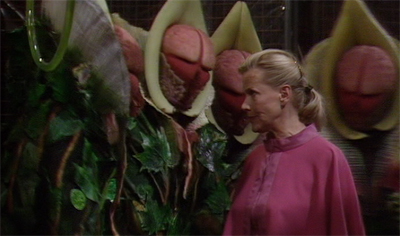
Cue incredibly lame "Pussy Galore" joke...

Cue incredibly lame “Pussy Galore” joke…

Continue reading

Doctor Who: The Trial of a Time Lord – Mindwarp (Review)

To celebrate the fiftieth anniversary of the longest-running science-fiction show in the world, I’ll be taking weekly looks at some of my own personal favourite stories and arcs, from the old and new series, with a view to encapsulating the sublime, the clever and the fiendishly odd of the BBC’s Doctor Who.

The Trial of a Time Lord originally aired in 1986.

Hey, keep together. This is a great day for battle. A great day to die!

Does he always go on like that?

Afraid so.

-Ycranos, Tuza and Peri discover she apparently has a type

The Trial of a Time Lord loosely adheres to the structure of A Christmas Carol. If The Mysterious Planet can be seen as the “past” story, then Mindwarp is very clearly the “present” story. The BBC’s sudden “hiatus” for Doctor Who yanked the series suddenly out of Colin Baker’s first season, to the point where dialogue from Baker referencing the planned series opener had to be dubbed out. As a result, for the eighteen month gap, Colin Baker’s first full season in the role was a perpetual “present.” It was the last Doctor Who that had aired, and – as a result – it was the version of the show that first popped into people’s minds when they thought of the series.

So it seems fitting that The Trial of a Time Lord sees Colin Baker yanked directly from an adventure that looks like it could have been filmed as part of his first full year in the role. If The Mysterious Planet evokes a hazy and romantic past, a story constructed from familiar archetypes and plot points, then Mindwarp is a very clear acknowledgement of what the show had evolved into. Given the difficulties facing the programme after that problematic year, Mindwarp is the segment of this over-arching plot that needs to make the most robust defence of the show, or at least deflect the most criticism.

Despite some interesting strengths, Mindwarp doesn’t quite construct a convincing argument in favour of the show. More than that, though, its deflections prove a little weak.

Out of this world...

Out of this world…

Continue reading

Superman: The Animated Series – Knight Time (Review)

To celebrate the release of Man of Steel this month, we’re going Superman mad. Check back daily for Superman-related reviews.

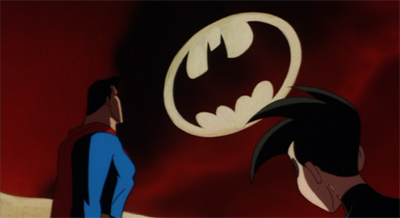
It’s always fun to compare and contrast Superman and Batman, partially because they are two of the oldest and most iconic superheroes in popular culture, but also because the lend themselves to contrast. Superman is all smiles and primary colours, while Batman is shades of grey and shadows. It’s fun to see the worlds of the two superheroes overlap, if only because they are so radically different in tone, atmosphere, mood and content.

While World’s Finest brought Batman and the Joker to Metropolis to play with Superman and Lex Luthor, Knight Time sees the Man of Steel substituting in for an absentee Batman in Gotham.

I gotta get me one of those...

I gotta get me one of those…

Continue reading

Doctor Who: The Trial of a Time Lord – The Mysterious Planet (Review)

To celebrate the fiftieth anniversary of the longest-running science-fiction show in the world, I’ll be taking weekly looks at some of my own personal favourite stories and arcs, from the old and new series, with a view to encapsulating the sublime, the clever and the fiendishly odd of the BBC’s Doctor Who.

The Trial of a Time Lord originally aired in 1986.

Well, this is a charade.

– the Doctor gets the idea quickly enough

The Doctor had been off screens for eighteen months following Revelation of the Daleks. Michael Grade was desperately trying to cancel the show, and it only limped back to screen with a significantly reduced budget and much shorter run of episodes. The show length was also reverted back to its default value. This season would only run for fourteen half-hour episodes – what would become the set length for Doctor Who in the years to come. (Indeed, counting the Christmas Special, the revived series also runs to that length, albeit in forty-five minute episodes.)

By all accounts, the production on the infamous Trial of a Time Lord was a disaster for reasons natural and otherwise. Veteran writer Robert Holmes was to provide the opening and closing scripts, but passed away before his work on the finalé could be finished. Script editor Eric Saward and producer John Nathan-Turner clashed over the climax of the trial, prompting Saward to resign and Nathan-Turner to temporarily become script editor himself. Colin Baker couldn’t make sense of Mindwarp. The last episode of the season was written by two writers wrapping up from Holmes’ first part, but unable to examine his notes on how he planned to conclude it.

Believe me when I state that every last ounce of this behind-the-scenes friction was visible on-screen by the end of the year. Luckily enough, the show does a decent enough job concealing these approaching problems in the first story of the arc. That’s not to say that The Mysterious Planet is an unsung classic, merely to point out that it is at least unburdened by the seemingly real time collapse of Doctor Who.

Ah, it's a fourteen-week adventure about watching Doctor Who!

Ah, it’s a fourteen-week adventure about watching Doctor Who!

Continue reading