• Following Us

  • Categories

  • Check out the Archives


  • Awards & Nominations

The X-Files (Topps) – Afterflight (Review)

This May and June, we’re taking a trip back in time to review the fifth season of The X-Files and the second season of Millennium.

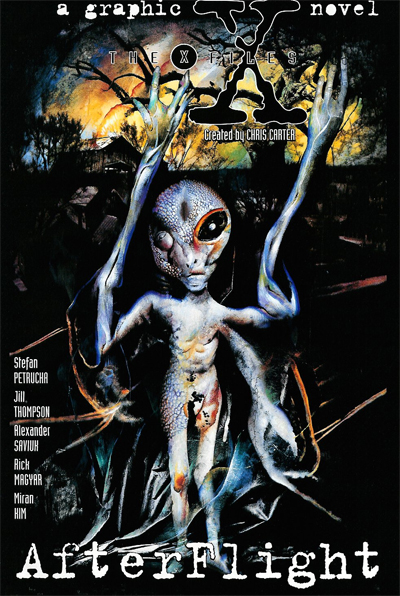
And so we reach the end of Stefan Petrucha’s work on The X-Files.

It is quite a delayed end. Petrucha had originally written Afterflight three months before Home of the Brave, his last script for the monthly tie-in comic book. It was published fifteen months after the publication of Home of the Brave. That meant a year and a half had passed between Petrucha finished and Topps actually publishing it. The delay was rooted in disagreements with Ten Thirteen over the artwork. Still, Afterflight offers just a hint of closure to the sixteen-issue (and more) run that launched Topps’ licensed X-Files comic book line.
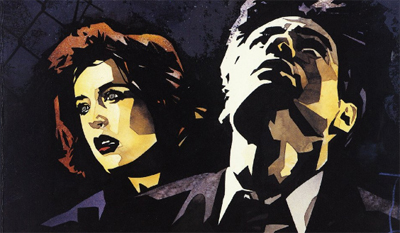
The truth is up there...

The truth is up there…

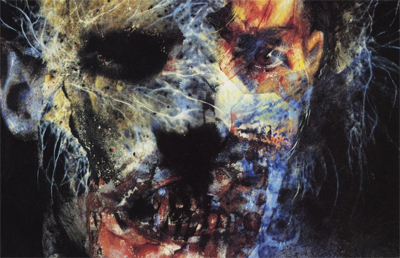
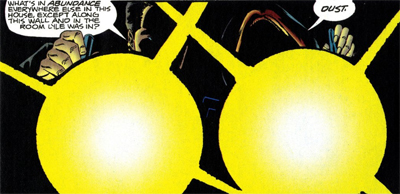
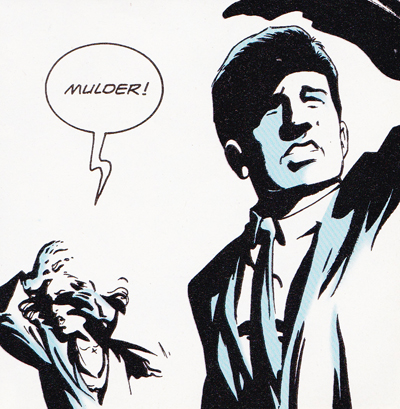
Afterflight is a mournful little comic, a story that takes a lot of the core themes of Petrucha’s X-Files work and distills them down to a single story. Interviewed about his work, Petrucha contended that his writing for The X-Files primarily meditated on themes of “memory, the self and what is reality.” All of these ideas are brought to the fore in Afterflight, a comic that offers a similar thematic resolution to Home of the Brave, suggesting the faintest hint of hope can be found beyond the world of men.

Afterflight is a beautiful piece of work, and a suitable conclusion to a fantastic run.
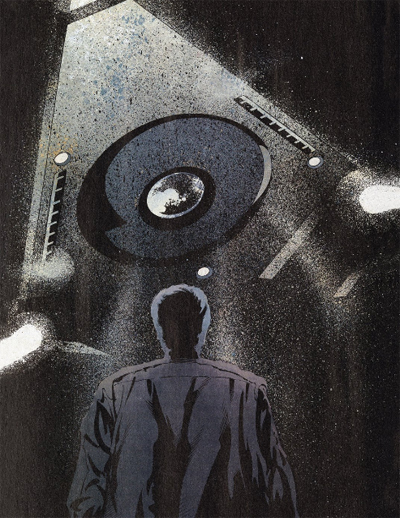
Aliens among us...

Aliens among us…

Continue reading

The X-Files: Season One (Topps) #2 – Deep Throat (Review)

This February and March, we’re taking a trip back in time to review the fourth season of The X-Files and the first season of Millennium.

Season One feels like a very odd way to franchise The X-Files.

Topps had enjoyed tremendous success with their licensed tie-in comic book, so it made a certain amount of sense to try to milk the franchise as much as possible. After all, they had already tried a number of other promotions, like releasing “digests” to supplement that monthly series and releasing tie-in comics to appear with magazines like Wizard. So offering another series that would publish on a regular basis starring Mulder and Scully made perfectly logical sense.

The truth is up there...

The truth is up there…

About a year after the release of their adaptation of The Pilot, Topps decided to push ahead with a series of regular adaptations of first season episodes of The X-Files. They reissued their adaptation of The Pilot as the first comic in the series, and then began publishing new adaptations of those early episodes written by Roy Thomas and illustrated by a rotating team of artists. The comics would be about twice as long as the issues of the monthly series, but would only publish once every two months. The monthly series was priced a $2.50, with Season One priced at $4.95.

It is hard not to feel quite cynical about Season One, particularly in an era where these classic episodes of The X-Files stream of Netflix and entire seasons are available to purchase at very low prices.

The shape of things to come...

The shape of things to come…

Continue reading

The X-Files (Topps) #30-31 – Surrounded (Review)

This February and March, we’re taking a trip back in time to review the fourth season of The X-Files and the first season of Millennium.

Surrounded marks the beginning of the end for Topps’ licensed X-Files tie-in comic book. There are only twelve issues remaining before Ten Thirteen would decided not to renew the contact, making this the last year for the comic. Of course, Topps would rather relentlessly milk the comic for whatever it was worth over the next year, publishing both a range of Season One adaptations and an adaptation of Kevin J. Anderson’s Ground Zero novel. They would also finally get around to releasing Stefan Petrucha and Jill Thompson’s AfterFlight graphic novel.

So there is a lot of content coming in the final year of Topps’ hold on that license. The X-Files was clearly a massive success for the newly-minted comic book wing of the company. Indeed, The X-Files was the last comic standing for Topps, and there is ample evidence that Topps was hoping to continue the line beyond The X-Files: Fight the Future, with several Season One adaptations solicited, but never published. Much like for the show itself, this was a boom time for Topps.

What's eating you?

What’s eating you?

However, the final year of the comic ultimately feels rather safe and generic. John Rozum is a competent comic writer; he understands the medium, and he knows how to play with other peoples’ toys. However, there is a sense that the comic book is really just marking time. There is very little that stands out about this last stretch of the comic; nothing which really demands to be read or to be added to the great X-Files canon. It is not bad, by any measure; it is just there.

Surrounded is a prime example of the comic book marking time. It feels like a retread of familiar ground – both for the comic book and for the parent show. When Stefan Petrucha and Charles Adlard set stories like Silent Cities of the Mind or Home of the Brave in militia compounds, they were very much ahead of the television. By the time that Surrounded was published at the end of the fourth season, the show itself had already told stories about this world in episodes like The Field Where I Died, Tunguska, Terma and Unrequited.

Shining some light on the matter...

Shining some light on the matter…

Continue reading

The X-Files (Topps) #27-29 – Remote Control (Review)

This February and March, we’re taking a trip back in time to review the fourth season of The X-Files and the first season of Millennium.

In many respects, Remote Control is a very “big” story.

It is the biggest story that writer John Rozum has told to date on the comic book, one that spans three issues and seems to brush against the edge of the mythology most associated with The X-Files. Not only does Remote Control feature secret CIA experiments into psychic phenomenon, it also involves a UFO that is being transported through the United States and is hijacked by a foreign power. To top it all off, there is a super-soldier who can render himself invisible and make himself immune to bullets.

Everything is under control...

Everything is under control…

There is a very clear sense of scale to Remote Control, one that suggests this is a blockbuster adventure. This is the comic book equivalent of those mythology episodes that air during sweeps. At the same time, however, Remote Control brushes up against the limitations imposed upon the comic book by Topps and Ten Thirteen. While Remote Control offers the highest stakes that the comic book has seen since Feelings of Unreality, the script is quite clear that this is a story separate and divorced from anything happening in the show.

There are points where it feels like Remote Control goes out of its way to remind readers that this is just a tie-in comic book, and is thus secondary to the television show.

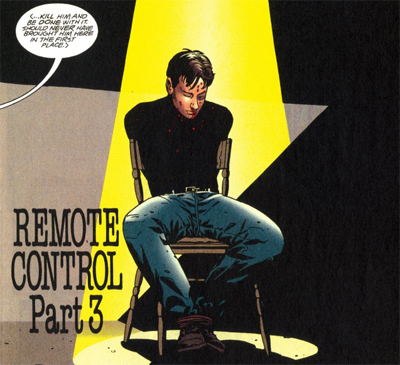
Mulder is a little tied up right now...

Mulder is a little tied up right now…

Continue reading

The X-Files (Topps) #25-26 – Be Prepared (Review)

This February and March, we’re taking a trip back in time to review the fourth season of The X-Files and the first season of Millennium.

What’s interesting about Be Prepared is how much it feels like an episode of The X-Files.

A lot Rozum’s earlier scripts felt like Mulder and Scully had wandered into old E.C. horror stories, cautionary supernatural tales about vengeful ghosts and poetic justice. In contrast, Be Prepared feels very much in tune with the aesthetic of the show itself. Mulder and Scully investigate a uniquely American piece of folklore, finding themselves in an isolated location dealing with human monstrosity at least as much as any paranormal element.

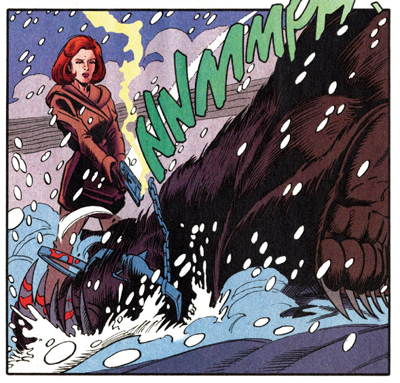
If you go down to the woods today...

If you go down to the woods today…

Indeed, Be Prepared feels very much like an episode from the first two seasons of the show, evoking stories like Ice or Darkness Falls or Firewalker. Indeed, Be Prepared arguably sits comfortably alongside Topps’ range of Season One comics – feeling like a lost episode from the show’s early years. Be Prepared feels like the first time that Rozum is constructing a story specifically from tropes associated with The X-Files, rather than from horror tropes in general.

The result is a fun little adventure that feels more like The X-Files than the comic has in quite a while.

The right to bear arms...

The right to bear arms…

Continue reading

The X-Files (Topps) #24 – Silver Lining (Review)

This February and March, we’re taking a trip back in time to review the fourth season of The X-Files and the first season of Millennium.

After the wacky and delightful excess of Donor, John Rozum steers the comic back into much more traditional fare.

There is little in Silver Lining that the comic hasn’t touched on quite recently. Guest writer Kevin J. Anderson already wrote a “vampiric object” story about a killer camera the two-part Family Portrait story only a few months earlier. John Rozum had already drafted a “haunted object drives a man to kill, but the voices are only in his head” story for The Silent Blade, a short story written specifically for The X-Files Magazine. As a result, Silver Lining feels a little overly familiar. There is nothing here that the reader hasn’t seen before; and recently, too.

Fashioning a story...

Fashioning a story…

Silver Lining reinforces the sense that Topps and Ten Thirteen are making a conscious effort to frame The X-Files as a classic horror comic book. Certainly, Silver Lining adopts the same basic storytelling elements associated with those pulpy adventures from the fifties; there is a scientist who unwittingly unleashes a horror upon the world, a physically deformed villain, a moral about how beauty is only skin deep and that vanity is called a “deadly” sin for a reason. There’s even a poetic justice to the story, where the guest villain finds themselves tormented in an ironic fashion.

There’s nothing particularly objectionable about Silver Lining, beyond how repetitive it feels. It feels like The X-Files has taken something of a step backwards since Topps and Ten Thirteen decided to part ways with writer Stefan Petrucha. The first sixteen issues of The X-Files felt like something of a Vertigo comic book, an ambitious horror anthology with no shortage of big ideas. Now the comic feels very much like an old E.C. comic without the nostalgia factor. The decline is quite striking, but no less disheartening for it.

Moral decay...

Moral decay…

Continue reading

The X-Files (Topps) #23 – Donor (Review)

This February and March, we’re taking a trip back in time to review the fourth season of The X-Files and the first season of Millennium.

Donor is the strongest of John Rozum’s work on The X-Files to this point. It might be his best work overall.

It is a story that very clearly and very strongly plays off the classic horror vibe that has been running through this stretch of episodes, taking the idea of supernatural revenge and poetic justice to almost blackly comic extremes. In many respects, John Rozum has pushed the comics towards a very traditional sort of moralistic storytelling – with characters frequently facing ironic consequences of their actions.

Organ grinder...

Organ grinder…

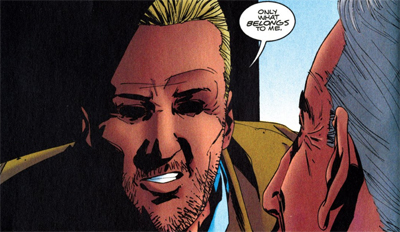
In The Silent Blade, a mass murderer kills himself with the blade that compelled him to kill. In The Kanashibari, a bunch of college kids who terrified an asthmatic classmate to death by locking him in a closet are themselves scared to death by a suffocating spectre. In Silver Lining, a killer murders innocent people to reclaim his good looks, only to lose them almost immediately in a fire while fleeing the FBI.

So Donor pushes this sort of storytelling to its logical extreme, as the resurrected body of Bruce Miller tries to reclaim the organs that his widow donated without his consent. Bruce Miller plans to take back what is rightfully his, harvesting various vital organs from recipients. Donor is a very dark little done-in-one story with a delightfully wry and cynical attitude that elevates it above many of its contemporaries.

"You have something that I need..."

“You have something that I need…”

Continue reading

The X-Files (Topps) #22 – The Kanashibari (Review)

This February and March, we’re taking a trip back in time to review the fourth season of The X-Files and the first season of Millennium.

The Kanashibari confirms what readers should expect from Topps’ licensed comics based on The X-Files. It is another atmospheric and episodic horror story, tightly plotted and written, with a grim sense of moral certainty underpinning it. The Kanashibari feels like something of a throwback, a modern-day take on those classic E.C. Comics horror stories – morality tales where the vengeance is exacted against those who have committed an injustice.

It is a throwback in other ways as well. The Kanashibari and Donor are both old-fashioned “supernatural revenge stories”, the kind of stories that would sit comfortably in the first season of The X-Files. Episodes like Shadows, Lazarus, Young at Heart, Born Again and Roland were all stories about characters seemingly returning from beyond the grave to wreak a terrible revenge against those had wronged them.

Who ya gonna call?

Who ya gonna call?

Continue reading

The X-Files (Topps) #20-21 – Family Portrait (Review)

This February and March, we’re taking a trip back in time to review the fourth season of The X-Files and the first season of Millennium.

Kevin J. Anderson is a very experienced hand when it comes to tie-in fiction.

Although Assemblers of Infinity was nominated for a Nebula Award in 1993, Anderson is perhaps best known for his work with licenced properties. He has written a significant number of Star Wars novels. He has published a trio of books set in the world of The X-Files. Indeed, Anderson would even adapt his first novel – Ground Zero – into a comic book miniseries for Topps. When Brian Herbert decided to finish his father’s Dune series, he collaborated with Anderson.

Photo finish...

Photo finish…

So Anderson is very much a safe pair of hands. He is a writer you can trust to construct a functional two-part X-Files story with a logical structure and a solid central premise. Anderson knows how to work within the boundaries of tie-in media, and he knows how to write a solid science-fiction or fantasy story. Pairing him with artist Gordon Purcell makes a great deal of sense, particularly for comic book that is trying hard to cement its place as a good old-fashioned tie-in.

Family Portrait is not exceptional, but it doesn’t try to be. Instead, it is functional. It is more efficient than ambitious, feeling very much like a classic horror comic that just happens to feature Mulder and Scully than a compelling episode of The X-Files in its own right.

Let's see what develops...

Let’s see what develops…

Continue reading

The X-Files (Topps) – The Silent Blade (Review)

This February and March, we’re taking a trip back in time to review the fourth season of The X-Files and the first season of Millennium.

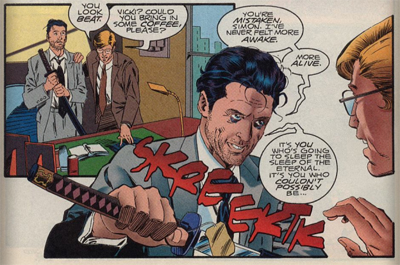
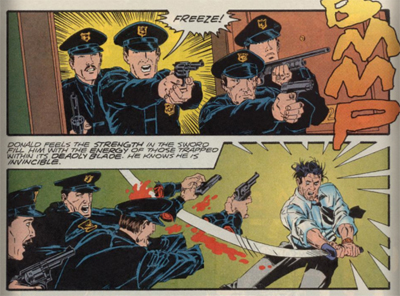
The Silent Blade is filler – one of those short stories that Topps produced as promotional material for wider consumption. In this case, as with The Pit, The Silent Blade was written as a short story to feature in the summer issue of The X-Files Magazine.

Writing a short story is tough. In some respects, writing a nine-page comic strip with a clear beginning, middle and end is harder than plotting a full-length issue or an entire arc. There is only so much space available, particularly when dealing with an exposition-heavy franchise like The X-Files. It can be tough to fit all the necessary ingredients in, let alone to put a novel twist on them. The temptation is to try to do too much with so little.

He won't be drawn on the matter...

He won’t be drawn on the matter…

Writer Stefan Petrucha and artist Charles Adlard had generally done well by their short stories, treating them as light and throwaway. They were not the strongest stories of the run, but they were aware of the limitations of the format and the expectations of the target audience. They were functional pieces of writing, aware of the limitations of the form. John Rozum’s first (and only) abridged X-Files story strains against those limitations.

After all, Rozum’s script for Thin Air had tried to fit too much into a full-length issue, so it makes sense that The Silent Blade is also a little too busy for its own good. This would be the last feature that Topps would produce for The X-Files Magazine, and the last of these sorts of short stories.

You have to do a lot of cutting to make a story this tight...

You have to do a lot of cutting to make a story this tight…

Continue reading