• Following Us

  • Categories

  • Check out the Archives


  • Awards & Nominations

Nick Spencer’s Run on Ultimate Comics: X-Men (Review/Retrospective)

This May, to celebrate the release of X-Men: Days of Future Past, we’re taking a look at some classic and modern X-Men (and X-Men-related) comics. Check back daily for the latest review.

Strangely enough, it’s the second relaunch of the Ultimate comic book line that feels like it is finally dealing with Ultimatum. Jeph Loeb’s “kill ’em all and let editorial sort ’em out” event had served as the catalyst of a relaunch for the entire line, ending long-running books like Ultimate Spider-Man, Ultimate Fantastic Four and Ultimate X-Men. The line was re-tooled and re-focused and relaunched following that event.

However, that relaunch quickly fizzled out. Mark Millar’s run on Ultimate Comics: Avengers could not quite measure up to the dizzying heights of his original run on The Ultimates. Jeph Loeb’s Ultimate Comics: X shipped sporadically at best and his run on Ultimate Comics: New Ultimates was something of a mess. Meanwhile, Brian Michael Bendis continued his run on Ultimate Comics: Spider-Man as if nothing much had changed.
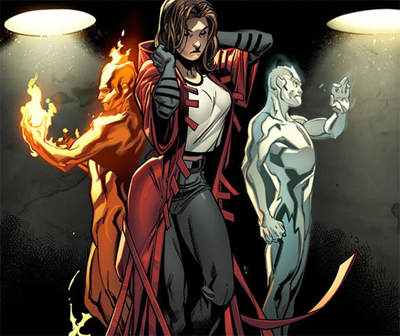
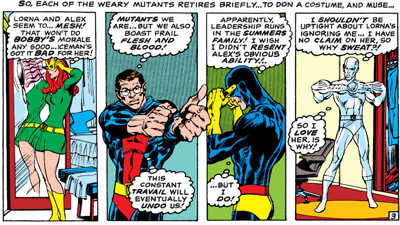
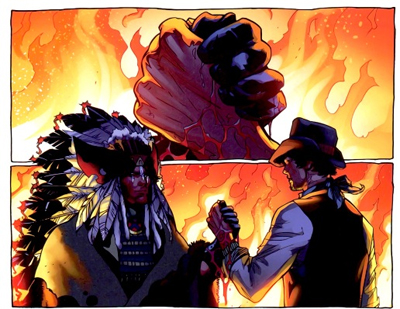
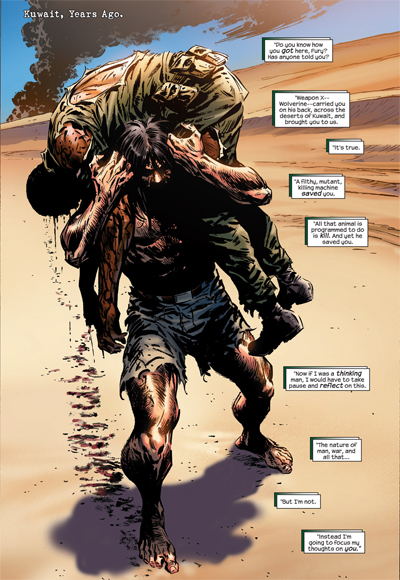
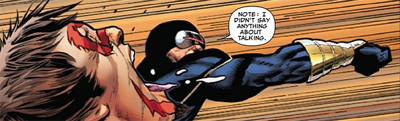
A song of ice and fire...

A song of ice and fire…

Oddly enough, it was the second relaunch that seemed to click. Coming out of The Death of Spider-Man, the slate was cleaned and the various books all got new beginnings. Jonathan Hickman took over Ultimate Comics: The Ultimates, Nick Spencer helmed Ultimate Comics: X-Men, while Brian Michael Bendis launched Miles Morales in a new volume of Ultimate Comics: Spider-Man. This was a very real shift in the status quo, and one that marked a clear departure from what came before, with bold new vision.

One of the more interesting attributes of the latest relaunch of the Ultimate line was the sense of heightened continuity between the various books. In particular, Jonathan Hickman’s run on The Ultimates overlapped quite heavily with Nick Spencer’s work on X-Men. As a result, the first year of each of the three titles seemed to be building towards Divided We Stand, a massive crossover between the various titles.

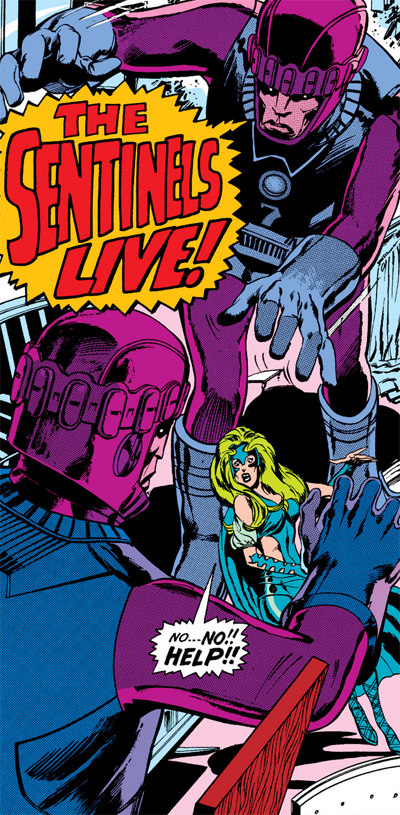
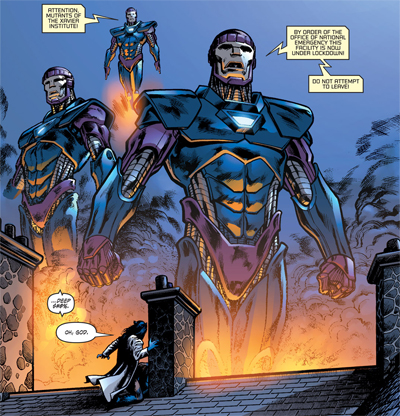
Sentinels-of-not-quite Liberty...

Sentinels-of-not-quite Liberty…

Spencer’s X-Men doesn’t work quite as well as Hickman’s Ultimates, suffering from the fact that nothing seems to get resolved. Dealing with a massive cast and an epic scope, Spencer’s Ultimate Comics: X-Men spends its first year establishing where all of its characters are and how their situations reflect on the larger story that is in motion. It’s an ambitious storytelling model, as Spencer crafts one big story from the ground (or the sewers) to the heights of the Oval Office, but it means that everything is barely set up before it is time to knock it down again.

Spencer’s Ultimate Comics: X-Men is a run with no shortage of great ideas and impressive scale, but one that suffers from the fact that the writer never gets to follow through on the world that he has built.
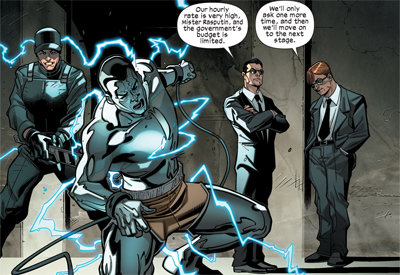
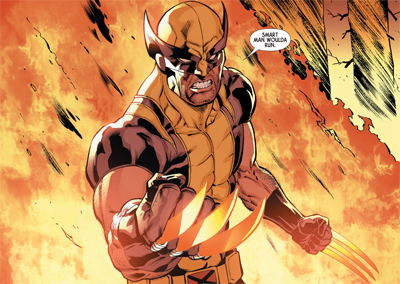
Shocking treatment...

Shocking treatment…

Continue reading

Roy Thomas & Neal Adams’ X-Men – X-Men Omnibus, Vol. 2 (Review/Retrospective)

This May, to celebrate the release of X-Men: Days of Future Past, we’re taking a look at some classic and modern X-Men (and X-Men-related) comics. Check back daily for the latest review.

Roy Thomas and Neal Adams (with the odd fill-in here and there) brought the first era of the X-Men to a close. At the end of their run, editor Martin Goodman would cancel the title due to low sales, only to bring it back as a reprint magazine a few months later. The title would continue as a reprint magazine until the publisher decided to resurrect it with Len Wein and Dave Cockrum’s Giant-Sized X-Men and Chris Claremont and Dave Cockrum’s subsequent revival of the original magazine.

The last stretch of issues on this initial run is fascinating. While it lacks the raw energy and sense of direction of Claremont’s early work on the title, it’s easy to argue that Thomas and Adams helped to pave the way for their successors. Thomas and Adams’ X-Men lacks focus and vision, but it does have its own quirky style. The duo would introduce and tease all sorts of ideas that would remain with the X-Men after the cancellation and into the revival.

Suit up...

Suit up…

It may be too much to credit Thomas and Adams with saving or redeeming the franchise – although, apparently sales were increasing during their run- but their influence on the creators that followed is obvious. There are a number of clever ideas and premises that were effectively introduced by the duo, which would become almost expected from an X-Men comic book. Even if it seemed like Thomas and Adams were really just making it up on the fly, their work fits quite comfortably with what would follow.

It may not have been enough to save the mutants at that moment in time, but one could argue that it did provide Claremont with a solid base to build from.

They certainly do...

They certainly do…

Continue reading

X-Men: The End – Book One: Dreamers & Demons (Review/Retrospective)

This May, to celebrate the release of X-Men: Days of Future Past, we’re taking a look at some classic and modern X-Men (and X-Men-related) comics. Check back daily for the latest review.

Marvel went through a phase of publishing books based around “The End” of various iconic properties. These comics allowed creators to imagine telling the last possible story for a given character or corner of the Marvel universe. Creators like Garth Ennis or Peter David got to write stand-alone one-shot stories for The Punisher and The Incredible Hulk, respectively. Paul Jenkins wrote a six-issue miniseries Wolverine: The End, while Jim Starlin closed off the entire Marvel Universe with Marvel Universe: The End.

However, given the sprawling and expansive continuity of the X-Men franchise, it stands to reason that any attempt to tell the final X-Men story would have to be a rather epic tale. Writer Chris Claremont wrote Uncanny X-Men for well over a decade, so even asking him to close off his own threads and plot points would take up considerable space. However, X-Men: The End is an absolutely sprawling comic book saga that is spread across three miniseries and eighteen issues.

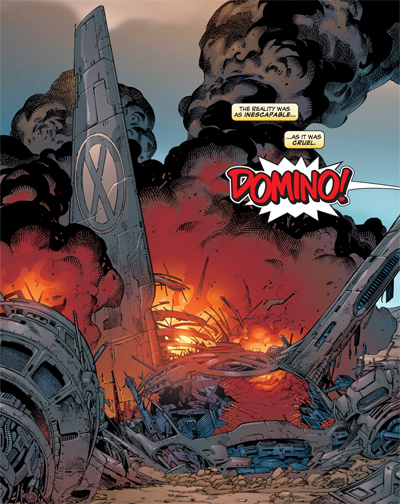
Blackbird down...

Blackbird down…

In a way, it feels like a touching coda for Claremont’s version of The X-Men. The writer defined the X-Men franchise, introducing many of the plot and character elements that readers would come to take for granted when reading an X-Men story. The End isn’t Claremont’s last X-Men story by any stretch – the writer still works on the franchise quite frequently in a variety of different roles, enjoying short runs and long runs.

However, The End does seem to serve as an epic farewell tour of the world that Claremont helped to build and define. As such, it’s fitting that the miniseries is somewhat clunky and awkward and epic and sprawling and melodramatic and overblown and absurd and unexpected. It is a capstone to Claremont’s gigantic X-Men epic, a closing statement and thoughtful summation to decades of work.

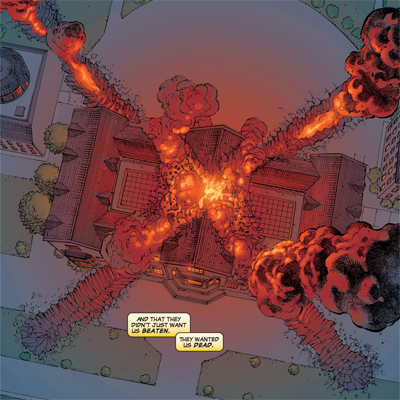
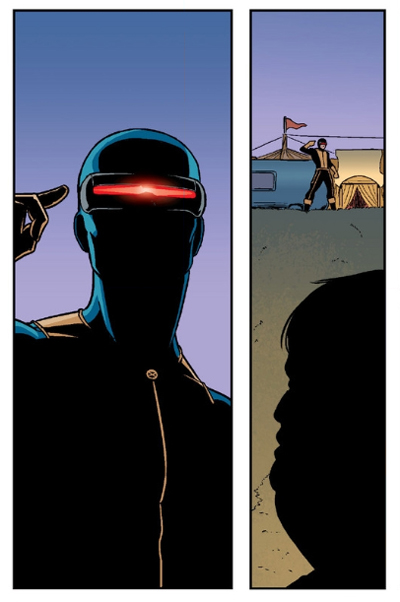
"X" marks the spot...

“X” marks the spot…

Continue reading

Astonishing Spider-Man and Wolverine by Jason Aaron and Adam Kubert (Review/Retrospective)

This May, to celebrate the release of X-Men: Days of Future Past, we’re taking a look at some classic and modern X-Men (and X-Men-related) comics. Check back daily for the latest review.

Astonishing Spider-Man and Wolverine is a beautifully absurd comic book. Writer Jason Aaron and artist Adam Kubert keep the comic moving at a frantic pace, twisting and turning as they introduce crazy concept after crazy concept. There are enough brilliant over-the-top ideas in Astonish Spider-Man and Wolverine to sustain an on-going for years – and yet the duo tear through them with a speed that makes all of Astonishing Spider-Man and Wolverine seem like a delirious blur.

And yet, despite that, Astonishing Spider-Man and Wolverine reads like a tribute to the glorious ridiculousness possible within the confines of mainstream comic books – giant metal-faced sentient planets! robotic dinosaurs! guns that fire the energy of creation! a diamond-encrusted baseball bat as a means of time travel! There’s a surreal magic to Astonishing Spider-Man and Wolverine that marks it as one of the highpoints of Jason Aaron’s work on Wolverine. It’s funny, awe-inspiring and even occasionally moving.

Blood brothers...

Blood brothers…

Continue reading

Ed Brubaker’s Run on Uncanny X-Men – The Extremists (Review/Retrospective)

This May, to celebrate the release of X-Men: Days of Future Past, we’re taking a look at some classic and modern X-Men (and X-Men-related) comics. Check back daily for the latest review.

One of the things that is most striking about Ed Brubaker’s work on Uncanny X-Men is just how disjointed the whole thing is. Announcing his arrival on the franchise with the Deadly Genesis miniseries, it seemed like Brubaker was really planning on shaking things up. Like Brian Michael Bendis had done for The Avengers with Avengers Disassembled, Brubaker’s Deadly Genesis had attacked some of the foundations of the X-Men franchise.

Brubaker’s first arc on Uncanny X-Men did follow up on some of the threads from Deadly Genesis, but not the obvious ones. The Rise and Fall of the Shiar Empire was a twelve-issue story featuring a bunch of X-Men launching themselves into space to recover Gabriel Summers and become embroiled in a galactic power struggle. It was very far from what fans had come to expect from the franchise, and worlds apart from the tone of Deadly Genesis or House of M. It felt strangely disconnected from a book that should have been driving the franchise.

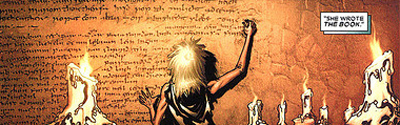
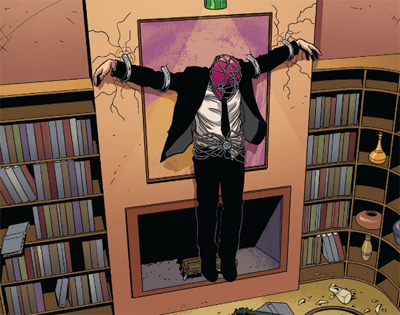
The writing's on the wall...

The writing’s on the wall…

His second story arc on the title, The Extremists comes towards the start of Brubaker’s second year on Uncanny X-Men, and it still feels decidedly uncertain. A five-issue story arc about terrorism and religion, The Extremists is incredibly engaged with contemporary American politics. It feels like an entirely different story from The Rise and Fall of the Shiar Empire, as if Brubaker has suddenly decided to alter the direction of his run.

The Extremists is a story that feels like an orphaned part of an X-Men epic that never quite developed, a small segment of a whole that doesn’t actually exist. It’s easy to imagine The Extremists as part of an untold post-9/11 Uncanny X-Men saga that may have spun off from Deadly Genesis and brought the comic into the twenty-first century. Unfortunately, with Brubaker’s run being pulled in multiple directions around it, it can’t help but feel a little hollow.

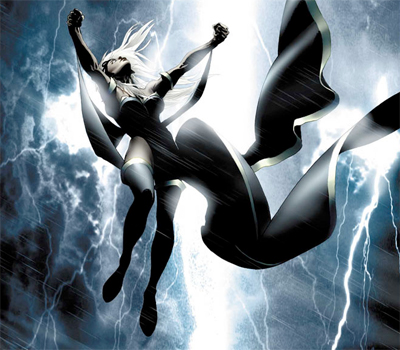
Cooking up a storm...

Cooking up a storm…

Continue reading

Ultimate Origins (Review/Retrospective)

This May, to celebrate the release of X-Men: Days of Future Past, we’re taking a look at some classic and modern X-Men (and X-Men-related) comics. Check back daily for the latest review.

Ultimatum effectively brought an end to the first stage of life for Marvel’s Ultimate Universe. To be fair, Ultimate X-Men and Ultimate Fantastic Four had both cycled through multiple creative teams by that point, but Ultimatum was the book that effectively drew a line under a certain era of Marvel’s Ultimate Universe. Ultimate Spider-Man, Ultimate X-Men and Ultimate Fantastic four were all cancelled in the wake of the massive end, marking it as the end of an era.

As such, it made sense to go back to the start of the line – to task writer Brian Michael Bendis to craft an origin for this shared spin-off universe. With Ultimatum killing off so many characters and so radically altering the status quo, it made sense to go back to the beginning and offer a glimpse at the formative moments of this alternate universe. The Ultimate Universe had been built from the ground up, so it made sense that the continuity all fit together.

A Magnetic personality...

A Magnetic personality…

While Ultimate Origins offered a series of insights and revelations that radically altered (or expanded) the back story of almost every corner of the Ultimate publishing line, Brian Michael Bendis’ Ultimate Origins undoubtedly had the most profound implications for the characters of Ultimate X-Men. While the characters from Ultimate Spider-Man or The Ultimates could go back to something approximating business as usual, those characters would never be the same again.

Offering an explanation for the mutant genome that would alter the context of mutants and play into the climax of Ultimatum, Ultimate Origins represents something radical and distinct from mainstream Marvel publishing. In a way, it feels like it is playing into the mission statement of Ultimatum – redefining the Ultimate line so as to distinguish the Ultimate Universe from its mainstream counterpart. This is no long a streamlined and cleaned up alternative; it is something radically different.

Carry on...

Carry on…

Continue reading

X-Men: Season One by Dennis Hopeless and Jamie McKelvie (Review)

This May, to celebrate the release of X-Men: Days of Future Past, we’re taking a look at some classic and modern X-Men (and X-Men-related) comics. Check back daily for the latest review.

X-Men: Season One is a weird beast. The core of Marvel’s Season One initiative has been offering accessible standalone graphic novels that take their iconic characters back to their roots – as if to have something that you could point a new reader towards, say “this is how [character] got started.” The line hasn’t always lived up to that promise, with the quality of the collection of graphic novels being quite uneven in practice, but it’s a solid starting point.

However, the X-Men were always going to seem a bit strange when this approach was applied. After all, many of the most iconic X-Men character – from Wolverine to Storm to Rogue – didn’t appear for years after Stan Lee and Jack Kirby launched X-Men. Beast didn’t have blue fur for quite some time. Magneto was fairly generic and one-dimensional. For a comic book series about an oppressed minority, the characters were all white, middle-class and straight; Jean Grey often felt like the token girl.

The Tomorrow People...

The Tomorrow People…

So revisiting the roots of the X-Men was going to be different from exploring the origins of The Avengers or Thor or Ant-Man, because a lot of what people take for granted about the X-Men didn’t exist in those early years. Trying to find a way to encapsulate what makes the X-Men so successful and appealing into the context of those early stories is a pretty ambitious task, making X-Men: Season One seem like an almost impossible challenge.

Luckily, Marvel recruited some top-notch talent for the book. Artist Jamie McKelvie is one of the best artists working in comics today. His linework is clear, his action sequences are stylish – but he’s also fantastic with characters. McKelvie can offer a lot in a small amount of space – body language, facial expressions. He’s paired with writer Dennis Hopeless, who has a bit of a knack dealing with potentially troublesome assignments turning Avengers Arena from ruthless Battle Royale (or The Hunger Games) knock-off into a pretty compelling read. The X-Men are in good hands.

The child protection agency is going to crucify Charles for this one...

The child protection agency is going to crucify Charles for this one…

Continue reading

Kieron Gillen’s Run on Uncanny X-Men – Fear Itself (Review/Retrospective)

This May, to celebrate the release of X-Men: Days of Future Past, we’re taking a look at some classic and modern X-Men (and X-Men-related) comics. Check back daily for the latest review.

Kieron Gillen’s Uncanny X-Men run stands as one of the most underrated gems at Marvel over the past decade or so. As with his work on Thor, Gillen’s work on the title is sandwiched between two more high-profile writers. On Thor, Gillen took over from J. Michael Straczynski and handed over to Matt Fraction, while he worked on Uncanny X-Men between the runs of Matt Fraction and Brian Michael Bendis. It’s easy to see how his work on the book might slip under the radar.

Even the run itself feels somewhat disjointed. It isn’t as simple as tracing the first issue he wrote to the last issue he wrote. Gillen was the last writer to work on the first volume of Uncanny X-Men, and the launch of the comic’s second volume bisected his run. He finished up on the second volume of Uncanny X-Men in the midst of the gigantic Avengers vs. X-Men crossover, with Avengers vs. X-Men: Consequences serving as something of a coda to his work on the merry mutants.

All fired up...

All fired up…

Looking at Gillen’s Uncanny X-Men run from outside, it looks like a line trying to connect various events and moments. It almost reads like a checklist of problems that a writer working on a mainstream superhero comic could face from the publisher. However, one of Gillen’s main strengths is his adaptability. Gillen has a unique ability to bend his story to fit whatever is required from the book in question.

He is a flexible writer, more than able to respond to the demands of the publisher – and even incorporate them into his stories. As a case in point, the Uncanny X-Men tie-in to Fear Itself really should be a disjointed mess. Fear Itself was a sprawling event that featured all sorts of tie-ins and spin-offs and crossovers, intersecting with various other stories in all sorts of strange ways. It’s to the credit of Gillen that the whole four-issue tie-in fits perfectly with his work on Uncanny X-Men.

Punching above his weight...

Punching above his weight…

Continue reading

Wolverine: Japan’s Most Wanted (Review/Retrospective)

This May, to celebrate the release of X-Men: Days of Future Past, we’re taking a look at some classic and modern X-Men (and X-Men-related) comics. Check back daily for the latest review.

The only way to read Wolverine: Japan’s Most Wanted is on a personal tablet.

Part of Marvel’s “Infinite Comics” initiative, Japan’s Most Wanted is a comic specifically tailored to the digital experience. Although a print version of the comic is available, it can’t help but seem inferior to the way the comic was meant to be experienced. Demonstrating that digital is not just a new format for comic books, but also a new medium, the work done by Yves Bigerel storyboarding the thirteen-part adventure is nothing short of astounding. It’s a fantastic experience.

A slice of the action...

A slice of the action…

The story Japan’s Most Wanted is fairly light. This makes sense. Japan’s Most Wanted isn’t intended to push Marvel’s continuity forward or to build off a lot of what has come before. Launched in the lead-up to the release of The Wolverine, Japan’s Most Wanted is a rather transparent attempt to appeal to those interested in Wolverine’s second solo trip to the big screen – playing more as a collection of imagery and iconography than a story in its own right.

The adventure is set in Japan and pits our hero against legions of ninja, playing up to Frank Miller and Chris Claremont’s iconic Wolverine miniseries. However, it also features action set pieces on a bullet train and in an abandoned village, two of the more notable action sequences showcased in the trailer for James Mangold’s The Wolverine. The story wrapped around these sequences is almost incidental, perhaps the most basic of Jason Aaron’s Wolverine stories, as scripted by collaborator Jason LaTour.

Run and jump...

Run and jump…

Continue reading

Ed Brubaker’s X-Men – Deadly Genesis (Review/Retrospective)

This May, to celebrate the release of X-Men: Days of Future Past, we’re taking a look at some classic and modern X-Men (and X-Men-related) comics. Check back daily for the latest review.

In 2006, Ed Brubaker was one of the hottest younger writers working at Marvel Comics. He was writing a celebrated run on Captain America. He was about to take over Daredevil following a monumental run by Brian Michael Bendis. He was also going to launch The Immortal Iron Fist with collaborator Matt Fraction. It was a year that cemented Ed Brubaker as one of the primary voices writing at Marvel Comics. In the midst of all that, Brubaker also took over the X-Men franchise.

In the early years of the decade, Marvel had tasked Brian Michael Bendis to reinvent the Avengers franchise, which he had done with Avengers Disassembled and an extended stint on New Avengers. Bendis had done this by tearing down a lot of the elements of The Avengers taken for granted and demonstrating that nothing was safe. The Avengers Mansion was destroyed, Hawkeye and Vision were killed, Wolverine and Spider-Man were recruited. The approach was iconoclastic, but it worked.

Sentinels of liberty...

Sentinels of liberty…

It’s not too hard to see Ed Brubaker’s stint on the X-Men franchise as a not-entirely-successful attempt to emulated Bendis’ reinvention of The Avengers. There was a clear attempt to focus on aspects of the mythology that were outside the comfort zone, and to attack and undermine some of the most sacred areas of the mythology. After all, Brubaker began his run on Uncanny X-Men with The Rise and Fall of the Shiar Empire, a twelve-issue space opera that took the focus of the book off the wake of House of M.

Logically, then, Deadly Genesis serves as the equivalent of Bendis’ Avengers Disassembled. It’s the story that exists as the lead-in to Brubaker’s run, outside the monthly series. It sets the agenda for a lot of what is to follow, shifting the premise and changing the rules. However, Brubaker’s work suffers because he doesn’t have the same freedom that Bendis had with New Avengers. He can’t just clear the board and start anew. Deadly Genesis find him heaping a bold new status quo on top of a bold new status quo.

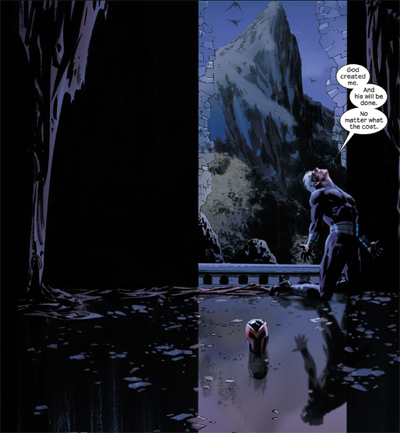
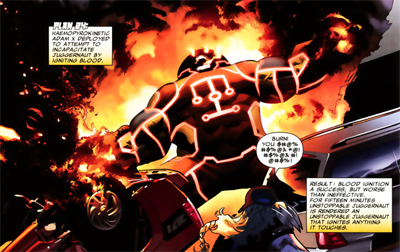
Burning it all down...

Burning it all down…

Continue reading