• Following Us

  • Categories

  • Check out the Archives


  • Awards & Nominations

The Flash (1987-2009) #7-8 – Red Trinity/Purple Haze (Review)

So, I’m considering reviewing this season of The Flash, because the pilot looks interesting and I’ve always had a soft spot for the Scarlet Speedster. I’m also considering taking a storyline-by-storyline trek through the 1987-2009 Flash on-going series as a companion piece. If you are interested in reading either of these, please let me know in the comments.

Red Trinity and Purple Haze are at least plotted a bit more tightly than Mike Baron’s earlier issues of The Flash.

Baron’s first two two-part stories on The Flash had seen Wally West literally running into trouble – encountering both Vandal Savage and the Kilg%re by chance while running across the country. Speed McGee was only slightly more subtle, revealing that Wally was now dating a woman whose husband just happened to be working on attempts to generate super-speed. Wally seemed to spend the first six months of The Flash randomly bumping into trouble that seemed tailor-made for him.
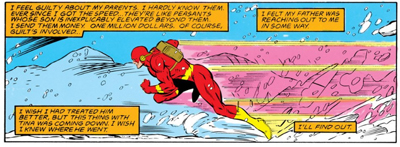
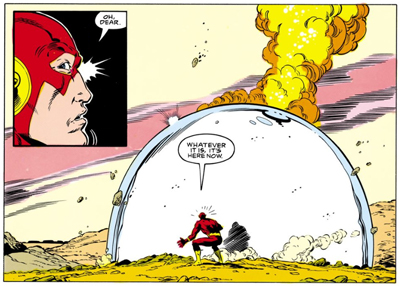
... And we're off!

… And we’re off!

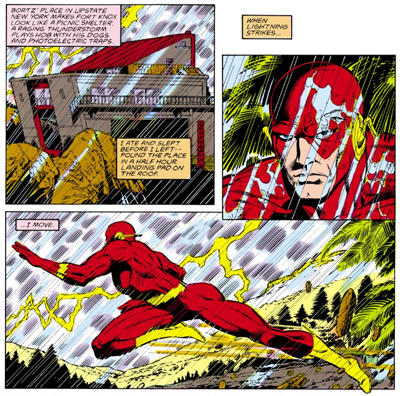
While the plotting of Red Trinity is hardly elegant, it at least makes a bit more sense. Baron builds off the events of Speed McGee to present a story that flows relatively logically – well, according to comic book logic. Instead of conveniently crossing paths with a problem tailored to his abilities, Wally instead sets out specifically to find the problem at the heart of this issue. His encounter with the eponymous trio is as part of his attempts to help find a cure for the self-titled “Speed Demon”, Jerry McGee.

Inevitably, this brings him into conflict with more new opponents perfectly suited to do battle with The Flash.
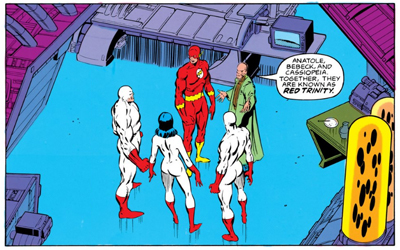
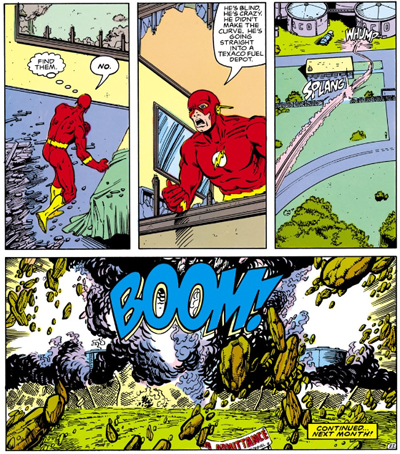
Trio of terror?

Trio of terror?

Continue reading

The Flash (1987-2009) #5-6 – Speed McGee/Super Nature (Review)

So, I’m considering reviewing this season of The Flash, because the pilot looks interesting and I’ve always had a soft spot for the Scarlet Speedster. I’m also considering taking a storyline-by-storyline trek through the 1987-2009 Flash on-going series as a companion piece. If you are interested in reading either of these, please let me know in the comments.

Half-way through its first year, The Flash is still a mess.

It’s easy enough to see what writer Mike Baron is trying to do, but nothing is really gelling together. In theory, The Flash is the story of a twenty-year-old kid who is trying to fill his mentor’s shoes. It’s about a hero who has only just passed from his teenage years into adulthood, and trying to navigate all the problems that come with that. The intent is quite obvious here – to draw in readers who had been alienated by the somewhat generic (and perhaps even “dull”) perception of Barry Allen.

"Hm. This is always much more atmospheric when Batman does it."

“Hm. This is always much more atmospheric when Batman does it.”

This is an approach that clearly owes a lot to Marvel’s reinvention of the superhero genre, and it’s fairly easy to read Mike Baron’s Wally West as an attempt to update the superhero archetype established by Peter Parker for the eighties. Wally is a bit more grounded and real than his predecessor, with a bit of an edge. He finds himself navigating issues and personal problems that Barry Allen never had to worry about.

Unfortunately, the series can’t quite make this work. For every step forwards, there is an awkward step backwards. Every time it seems like The Flash might have a good personal hook into the world of Wally West, it falls back on generic superhero clichés that seem to have been ad-libbed into the script.

"Talk about an explosive relationship."

“Talk about an explosive relationship.”

Continue reading

The Flash (1987-2009) #3-4 – The Killg%re/Kill the Kilg%re! (Review)

So, I’m considering reviewing this season of The Flash, because the pilot looks interesting and I’ve always had a soft spot for the Scarlet Speedster. I’m also considering taking a storyline-by-storyline trek through the 1987-2009 Flash on-going series as a companion piece. If you are interested in reading either of these, please let me know in the comments.

In many respects, The Kilg%re and Kill the Kilg%re are indicative of Mike Baron’s approach to plotting The Flash. There’s never really a sense of an over-arching plot. It often feels like the comic is not being written with a structured story in mind. As the reader follows the story, it seems to develop and grow and move in odd directions. It’s hard to figure out exactly where any of these stories are going, because Baron himself never seems entirely certain from one moment to the next.

In a way, this style of storytelling suits The Flash as a character and as a comic. The Scarlet Speedster is all about forward momentum, a sense of urgency and dynamism. The sense that Baron is making all this up on the spot is energetic at points, because it feels like the comic is being written by the seat of his pants. However, it also means that the character and plot beats can feel arbitrary and illogical, as if to demonstrate that what works in a particular moment is not guaranteed to work in a larger context.

Hate to burst his bubble...

Hate to burst his bubble…

Continue reading

The Flash (1987-2009) #1-2 – Happy Birthday, Wally!/Hearts… of Stone (Review)

So, I’m considering reviewing this season of The Flash, because the pilot looks interesting and I’ve always had a soft spot for the Scarlet Speedster. I’m also considering taking a storyline-by-storyline trek through the 1987-2009 Flash on-going series as a companion piece. If you are interested in reading either of these, please share the link love and let me know in the comments.

Like the rest of the comic book industry, DC comics went through some serious changes in the late eighties. Books like Watchmen and The Dark Knight Returns had re-shaped expectations of the comic book world. There was a sense that things had to change. DC was worried about its own expansive and increasingly convoluted continuity. In order to streamline that continuity, DC decided to stage a massive crossover event. Crisis on Infinite Earths was a truly epic comic that reshaped the shared universe.

It made quite the impression, providing the opportunity for a clean start for many of the characters. George Perez gave Wonder Woman a new origin and back story. John Byrne reinvented The Man of Steel, making several additions to the Superman mythos that have remained in place through to today. Frank Miller offered one of the defining Batman origin stories with Year One. There were obvious continuity issues around certain characters and franchises, but Crisis on Infinite Earths was a new beginning.

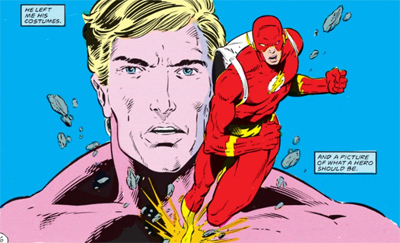
If the suit fits...

If the suit fits…

This was arguably most true for The Flash. Cary Bates had finished up a decade-long run on the title with the mammoth storyline The Trial of the Flash, where Barry Allen was accused of murdering his arch-nemesis in cold blood. Although the arc ended with Barry retiring to the distant future (comics!), the character went straight from that extended arc into Crisis on Infinite Earths, where he eventually gave his life to save the multiverse in what became an iconic death sequence.

More than that, Barry Allen stayed dead for twenty years; a phenomenal amount of time for a comic book character. In the wake of Crisis on Infinite Earths, DC offered a fresh new beginning for the Flash. Wally West, the former “Kid Flash” and sidekick, stepped into the iconic role and headlined a monthly series for over two decades.

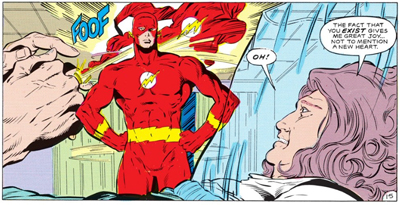
His heart might not be in it, yet...

His heart might not be in it, yet…

Continue reading

Star Trek: Deep Space Nine (Malibu Comics) #29-30 – Enemies and Allies (Review/Retrospective)

This September and October, we’re taking a look at the jam-packed 1994 to 1995 season of Star Trek, including Star Trek: Deep Space Nine and Star Trek: Voyager. Check back daily for the latest review.

Enemies and Allies is a particular brand of oddity. It is the most throwaway story imaginable.

Continuing the trend of recruiting Star Trek actors to write for the comics, Malibu pursued Star Trek: Voyager regular Tim Russ to write for their monthly Star Trek: Deep Space Nine comic. Russ was ably assisted by Mark Paniccia. Paniccia was the editor for Malibu’s Star Trek comics. He co-wrote Rules of Diplomacy with Aron Eisenberg, and also wrote the script for the two-part Sole Asylum headlining the twenty-ninth and thirtieth issues of the Deep Space Nine monthly.

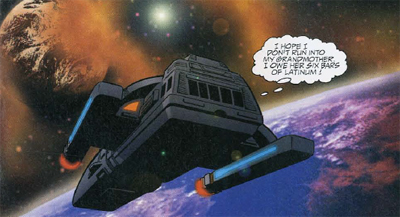
Star Trekkin' across the mirror universe!

Star Trekkin’ across the mirror universe!

As with the other actors to write for the line and the Star Trek actors-turned-writers in general, Russ concentrates on his own character. He crafts a story based around Tuvok. However, it is quite clear that Malibu has not reached the stage where it could launch a Voyager comic. It was in the process of planning such a comic when Marvel bought the rights to license all Star Trek comics in 1996. As such, Tim Russ is tasked with writing a comic centring around Tuvok without taking place in the same continuity of Voyager.

The solution to this problem was quite ingenious, even if the execution was less than satisfying. Tim Russ would write a two-part short story centring around mirror!Tuvok, the character who fleetingly cameo-ed in Through the Looking Glass.

Reflections on Tuvok...

Reflections on Tuvok…

Continue reading

Star Trek: Deep Space Nine (Malibu Comics) – Blood and Honour (Review)

The September and October, we’re taking a look at the jam-packed 1994 to 1995 season of Star Trek, including Star Trek: Deep Space Nine and Star Trek: Voyager. Check back daily for the latest review.

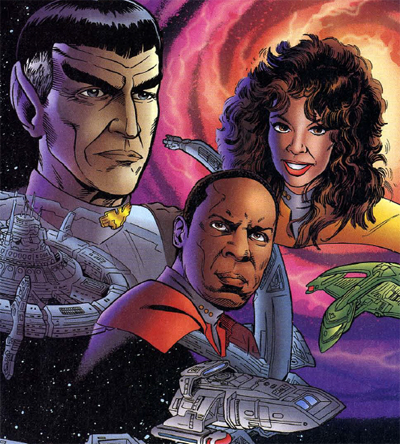
Whatever is to be done about the Romulans?

In space, all warriors are cold warriors...

In space, all warriors are cold warriors…

Continue reading

Star Trek: Deep Space Nine (Malibu Comics) – The Rules of Diplomacy (Review/Retrospective)

The September and October, we’re taking a look at the jam-packed 1994 to 1995 season of Star Trek, including Star Trek: Deep Space Nine and Star Trek: Voyager. Check back daily for the latest review.

One of the more interesting aspects of Star Trek: Deep Space Nine is the way that the cast actively involved themselves in the mythology of the show. Armin Shimerman originally pitched The 34th Rule as an episode of the show, along with Eric A. Sitwell and David R. George III. Andrew Robinson published A Stitch in Time, a novel based on notes he had been making about Garak during the production of the series. Even J.G. Hertzler co-wrote the Left Hand of Destiny duology.

Of course, this was not a unique occurrence. Walter Koenig had written an episode of Star Trek: The Animated Series, an issue of Marvel’s on-going Star Trek comic and even The Machiavellian Principle, a play performed at the Ultimate Fantasy convention. John DeLancie had co-written The Gift, a story published in DC’s Star Trek: The Next Generation comics. Ethan Phillips and Robert Picardo would lend their names to tie-in Star Trek: Voyager books.

However, it seems reasonable to observe that the supporting cast on Deep Space Nine were particularly interested in fleshing out and developing their characters. So it seems appropriate that Aron Eisenberg should co-write The Rules of Diplomacy, a special about Nog earning some credits before shipping off to Starfleet Academy.

You can't go home again...

You can’t go home again…

Continue reading

Star Trek: Deep Space Nine (Malibu Comics) #29-30 – Sole Asylum (Review)

The September and October, we’re taking a look at the jam-packed 1994 to 1995 season of Star Trek, including Star Trek: Deep Space Nine and Star Trek: Voyager. Check back daily for the latest review.

Whatever happened to Thomas Riker?

Star Trek: Deep Space Nine receives a lot of credit for its move towards serialisation as a prime-time genre show. It wasn’t a pioneer in the same way that Babylon 5 was or even Murder One had been, but it was was definitely ahead of the curve. Deep Space Nine arguably holds up better today than any of the other Star Trek shows, and part of that is down to the way that the show leaned into serialisation. Actions had consequences, effects lingered after the credits.

Hostage of fortune...

Hostage of fortune…

The show was very much leaning that way in the second and third season, building up plot threads that would pay off down the line. The Dominion had been seeded in the show since Rules of Acquisition. The Romulan and Cardassian pre-emptive strike was foreshadowed by episodes like Defiant and Visionary. In the third season, it became clear that Deep Space Nine was ready to commit to some long-form storytelling, in a way that was unusual for a high-profile syndicated genre show in the nineties.

However, it is tempting to give Deep Space Nine a little bit too much credit. There were points where the show seemed to struggle with pay-off and arc-building. In Emissary, Sisko was tasked with bringing Bajor into the Federation; that never happened. After Battle Lines, Kai Opaka never appeared again. Characters who seemed important dropped into and out of the show at random; characters like Martok’s son Drex, Bajoran First Minister Shakaar Edon, Subcommander T’Rul… and Thomas Riker.

The welcome wagon...

The welcome wagon…

Continue reading

The X-Files (Topps) Annual #1 – Hallow Eve (Review)

This August (and a little of September), we’re taking a trip back in time to review the second season of The X-Files. In November, we’ll be looking at the third season. And maybe more.

No matter how you cut it, the creative team of Stefan Petruscha and Charles Adlard were prolific. The duo only worked on The X-Files comics book for seventeen months between January 1995 and May 1996, but they put out a phenomenal amount of work. On top of sixteen issues of the monthly series, there were also two digests, a number of short stories and an annual. In most cases, some of this work would be outsourced to another creative team, but Petrucha and Adlard remain the creative team for Topps’ X-Files comic.

While this undoubtedly required a great deal of creative energy from Petrucha, churning out scripts on a regular basis, it is worth pausing to praise artist Charles Adlard. These days, for a variety of reasons, it seems that major comic book artists have difficulty producing twelve twenty-odd-page issues in a year. Not only was Adlard able to meet that objective, he was able to do that while drawing a large volume of supplementary material, including this feature-length annual.

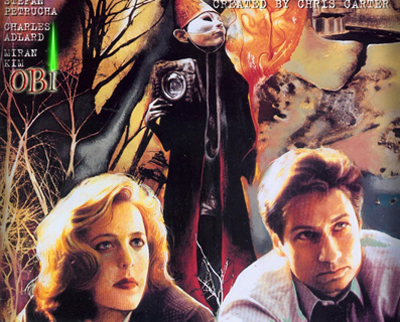
All about Eve...

All about Eve…

It’s remarkable how consistent it all is. One of the advantages of a tie-in comic book with a steady creative theme is that there’s a much clearer authorial voice. Although Chris Carter oversaw the production of The X-Files, the demand of weekly network television mean that some episodes got more attention than others, and that particular voices tend to shine through. Darin Morgan writes his own version of The X-Files, as do Glen Morgan and James Wong or Howard Gordon or Vince Gilligan. (This isn’t a bad thing, by the way.)

On a comic, with all the issues written by the same author and illustrated by the same artist, there is a bit more consistency. Even though Hallow Eve is a stand-alone one-shot story that exists quite separate to Petrucha and Adlard’s twelve-issue meta-arc, it fits quite comfortably with their themes and subtexts. It’s an episode about history and memory, and perception and reality.

Shocking...

Shocking…

Continue reading

The X-Files (Topps) #7 – Trepanning Opera (Review)

This August (and a little of September), we’re taking a trip back in time to review the second season of The X-Files. In November, we’ll be looking at the third season. And maybe more.

Trepanning Opera is something of a one-shot story, albeit the story where Stefan Petrucha begins to concede that his first year writing The X-Files tie-in comic is really one single long-form story. Initially, Trepanning Opera looks like a standard monster-of-the-week (or perhaps that should be “monster-of-the-month”) story, only to eventually reveal that the connections to the rest of Petrucha’s run are more than simply thematic in nature. “Everything is connected, Mulder,” his contact assures him. “Everything.”

Head's up...

Head’s up…

Continue reading