












“Oh, hello.”
Well, Russell T. Davies winds up the Fifteenth Doctor’s era by taking a second shot at The End of Time, Part II.
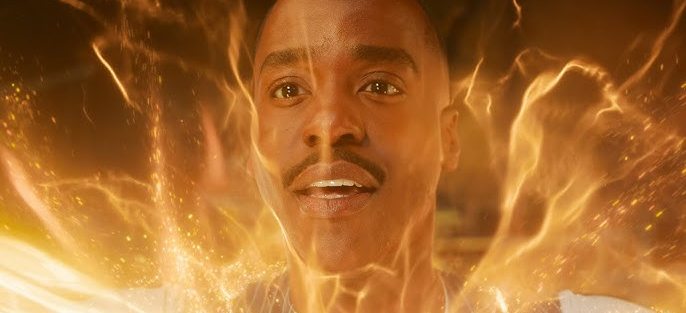
Fifteen’s minutes of fame.
The interesting thing about the structure of these two seasons has been the sense in which the two seasons are designed to explicitly mirror one another. Much has been made of the Davies’ recurring use of imagery, such as parallelling the Doctor and Ruby in The Devil’s Chord with the Doctor and Belinda in Lux, to underscore the idea that the Fifteenth Doctor has a set of “moves” that he employs.
Similarly, fans have observed that each of the three finales of the second Davies era, The Giggle, Empire of Death and The Reality War all make heavy use of the U.N.I.T. set. There is a tendency to overstate these similarities. After all, the U.N.I.T. set is functional identical to the GameStation from The Parting of the Ways, Torchwood One in Doomsday or the Valiant in The Last of the Time Lords. It is a big open space with lots of tech and screens where the finale’s large cast can congregate.
Still, there is a clear sense of recursion and repetition, Davies revisiting and rearticulating ideas across the seasons as a way to reinforce them. At their core, Empire of Death and The Reality War are essentially the same story. The Doctor is confronted by a relic of seventies Doctor Who continuity, who is fairly handily dismissed so the season can build to the reveal that a child what was initially positioned as important to the mythology of Doctor Who is ultimately revealed to be just an ordinary child.
This is an approach that is obviously indebted to Davies’ immediate successor, Steven Moffat, particularly his approach to the character of Clara who became “the Impossible Girl” because of what she would do rather than what she was. Indeed, Moffat’s influence is all over The Reality War, with Anita from Joy to the World serving as the fairly convenient “get out of jail free” card and the Fifteenth Doctor regenerating under the light of the star that Joy ignited at the end of Joy to the World.

Thinking inside the box.
More broadly, this season has lifted several cues directly from Moffat’s tenure. The Doctor’s journey through Belinda’s timeline in The Robot Revolution was obviously indebted to Clara’s fracturing in The Name of the Doctor. At the climax of The Reality War, the Doctor uses his power to essentially will Poppy back into existence, a reversal of what Amy did for the Doctor at the climax of The Big Bang.
And the structure of The Reality War is that classic Moffat season finale structure, where the collapse of reality itself ultimately gives way to a story that is much more firmly anchored in the relationships and the dynamics between a small handful of characters rather than some gigantic slice of Doctor Who continuity. At their core, both Empire of Death and The Reality War are Davies finales that try to flip in Moffat finales.
There is a very obvious problem with this. Davies isn’t as good at basic structure and construction as Moffat is. Most of Davies’ finales are big messy muddles, like Doomsday and The Last of the Time Lords. Even the Davies era finales that work, such as The Parting of the Ways or Journey’s End, work largely because they find a strong enough emotional core to cut through that messiness, rather than because they are any more disciplined.
When it comes to his series finales, Davies has never been an especially disciplined writer or showrunner. His impulse has always been to go big, with the fate of the planet or the cosmos on the line. The additional Disney budget arguably does Davies no favours, instead giving him a blank cheque to indulge his biggest and silliest ideas without any constraints.
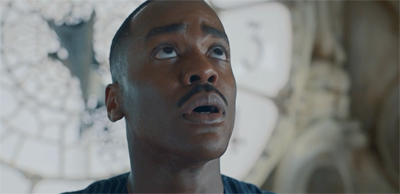
Time’s up.
The first half – hell, the first two thirds – of The Reality War is complete nonsense. It demonstrates the same impulses that have informed Davies’ approach to his season finales for decades, just amplified. There are huge twists that come out of nowhere, elements that were technically set up in that they have appeared on camera before, but never in the context in which the episode plans to use them. There is plenty of nonsensical exposition. To describe the narrative logic as abstract would be to be generous.
There is a sense that these finales have to be “blockbusters” on the largest possible scale, so The Reality War has U.N.I.T. Tower essentially turn into a giant turret to shoot giant boney creatures for no real plot reason. The story would unfold entirely the same way if that element were removed. It is just an attempt to give the story a sense of spectacle with no real stakes or story anchor. It is Davies setting large amounts of Disney cash on fire, but in service of something that is just distracting nonsense.
Setting aside the nonsense internal logic of this sequence – reality blowing in like a crosswind from the Time Hotel, the bone monsters as predators feeding on a dying world, the incredibly convenient literal narrative reset that was barely prefigured by the Rani’s “I love saying this bit” in Wish World – there is something interesting in the underlying story. The Rani is planning to bring back Gallifrey, using Omega as a sort of a cosmic seed bank.
There is an interesting recurring motif in the revival of Doctor Who, with Gallifrey itself serving as the very idea of continuity. It is a place that serves to give the Doctor a back story and a history. It gives the Doctor a context. It arguably imposes a meaning on them. The destruction of Gallifrey in the Time War was a metaphor for the schism between the original show and the revival.
Reality on the Vlinx.
When Moffat brought back Gallifrey in Hell Bent, he worked hard to make sure that the planet’s return – symbolising the unification of the classic series and the revival – was not going to mire the show in lore and continuity. Moffat very pointedly brought back Gallifrey in a story that was about the Doctor and Clara. Indeed, that upset a lot of fans, but it was a deliberate statement of intent. Moffat seemed to be arguing that Gallifrey did not need to represent the gravity of continuity and mythology.
However, Chibnall pushed back on that with The Timeless Children, a story that brought the Doctor back to Gallifrey in an effort to impose continuity on the larger mythos of Doctor Who by revealing that the Doctor was not just a Time Lord, but in fact the Time Lord. The Doctor was the first Time Lord, the cornerstone of Gallifreyian society. As in so many classic stories, like The Three Doctors and The Arc of Infinity, The Timeless Children once again made Gallifrey synonymous with unending exposition dumps about things that do not matter.
As in Empire of Death, The Reality War treats the concept of continuity as suffocating and overwhelming. The bulk of The Reality War is given over to an eighties Doctor Who villain attempting to revive a seventies Doctor Who villain to bring back the Doctor’s home planet. If the return of Sutekh in The Legend of Ruby Sunday suggested that continuity was death, it is notable that Omega emerges from the underworld proclaiming himself the god of time. He is history given form – old, decrypt, decaying. He devours the Rani, the past literally consuming the future. It’s all very Saturn Devouring His Son.
One of the more interesting aspect of Davies’ return to Doctor Who has been its relationship to continuity and history. The Fifteenth Doctor will end his tenure having never faced the Daleks, the Cybermen or the Master. Even the Fourteenth Doctor, in his truncated tenure, found time to face the Daleks in a comic strip portraying his first adventure and visited Skaro in his first on-screen story, Destination: Skaro. It feels strange for a multi-season Doctor have never confronted any of the Daleks, the Cybermen or the Master. Even Eccleston faced the Daleks and confronted a Cyberman.
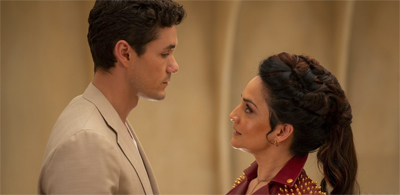
Conrad in arms.
Instead, the Fifteenth Doctor has existed in a liminal space. The big villain of his first season was Sutekh, a character who appeared in a single story from the seventies, Pyramids of Mars. Sutekh used the TARDIS to spread death across the cosmos, meaning that any place the Doctor returned to was dead. The Fifteenth Doctor appeared in a sequel to the story Midnight, in which the monster was reconfigured as something invisible always behind a character, a metaphor for history and continuity.
It often seems like the big thematic preoccupation of this era has been an anxiety about setting anything in stone. Instead, the second Davies era has taken an expansive idea to continuity, suggesting that everything is possible and that nothing is firmly defined. This has been an era of the show that began with The Star Beast, an adaptation of a classic comic book story. It built to a confrontation with the Toymaker, a character from a sixties serial that no longer exists, The Celestial Toymaker. Rogue confirmed that Scream of the Shalka was in continuity. Wish World canonised Dimensions in Time.
As such, the return of Gallifrey and the resurrection of Omega, representing as they do a rigid structure of canon and continuity, serve as an existential threat to this vision of Doctor Who. On paper, this is a fairly logical culmination of the Fifteenth Doctor’s journey. This is a version of the character whose existence began with “bigeneration”, a firm rejection of maybe the single greatest tenet of the show’s continuity. It makes sense for it to build with the Doctor banishing Omega back into the pit.
However, while all of this is theoretically engaging, the execution is complete nonsense. The show inevitably ends up engaging in the sort of continuity that it is critiquing and rejecting. Omega is not a character. Omega is not even an especially compelling concept. Omega has not been properly seeded or set up over the course of the season, so his return doesn’t feel especially weighty. It also only lasts a scene, because the Doctor somehow converts the Vindicator into a gun that he can use to blast Omega.
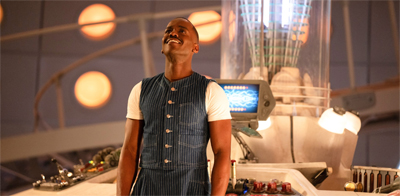
Gatwa’s getaway.
It is complete nonsense. It is just noise, both visually and narratively. There are no compelling emotional stakes in this confrontation between the Doctor and the Rani and Omega, particularly because the Doctor has gone out of his way to put Belinda and Poppy in a magical box that locks them away from any of the actual impact of what is happening on screen. And while that is an effective metaphor for how completely empty these sequences are, it is also not dramatically satisfying television.
There are small moments in the first forty minutes of The Reality War that work. Ruby’s reunion with Conrad is remarkably effective, particularly because Ruby engages with Conrad using empathy and compassion. Ruby acknowledges that Conrad honestly wants people to be happy, even with his extremely narrow definition of what happiness is. Ruby also uses her one wish to wish for Conrad to be happy, which is a really satisfying conclusion to both of their arcs. It demonstrates that Ruby is a good person, despite all that she has suffered.
It also retains an earned optimism, in that it is anchored in the thematic underpinnings of Wish World that a large part of the modern reactionary movement is rooted in the fact that these people are simply not happy but lack the ability to coherent express the source of their discomfort or to clearly articulate constructive solutions. It is, perhaps, overly simplistic, but it is humanist. There is a belief that this sort of reactionary thinking can be overcome through solidarity and by trying to help everybody be happy.
However, the confrontation between Ruby and Conrad is crosscut with the battle between U.N.I.T. and the bone monsters and the Doctor and the Rani and Omega, and neither of those manages to cohere into a set of particularly compelling emotional stakes. It is deeply frustrating, given the amount of time and money being spent to realise those sequences that they effectively amount to nothing.
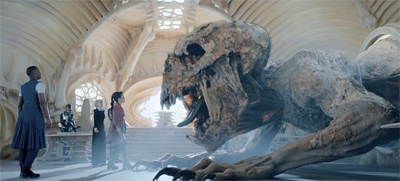
Omega problems.
Still, as much as the opening forty minutes of The Reality War simply do not work and demonstrate Davies’ worse creative impulses, there is something interesting at play. For all that the episode owes to Moffat, it is very clearly Davies taking a second stab at writing The End of Time, Part II. This is the departure of the second Doctor of the era, in a story that sees the return of a classic Time Lord villain and a plan to resurrect the Time Lords, which is ultimately smothered in the crib and leads to the Doctor sacrificing their life for another person rather than the universe itself.
The final third of The Reality War is surprisingly effective, particularly in contrast to what came before. It works because it adopts the language of a classic Moffat finale. Reality gets smaller, the scale narrows rather than broadens. The most effective sequence in the episode is perhaps the Doctor and Belinda continuing to fold Poppy’s jacket to the point where it ceases to exist. (It is also perhaps worth nothing that the disappearing imagined child evokes Donna’s children from Silence in the Library and Forest of the Dead.)
As with the plot involving Omega, this is also a story about the idea of continuity in Doctor Who. After all, the Fifteenth Doctor’s era has been haunted by the ghost of Susan Foreman, to the point that Carole Ann Ford made a surprise return in The Interstellar Song Contest. Susan has long been a question that perplexed Doctor Who fans. How can the Doctor have a granddaughter? What does it mean that the Doctor has a granddaughter?
Susan is a primal part of Doctor Who. She predates so much of the show’s mythology, departing before terms like “regeneration”, “Time Lord” and “Gallifrey” entered the show’s lexicon. One of the great challenges of attempting to build a single cohesive continuity out of Doctor Who is trying to explain how Susan fits within the sixty-plus years that have followed. Hardcore fans know where this leads, to words like “looms.”
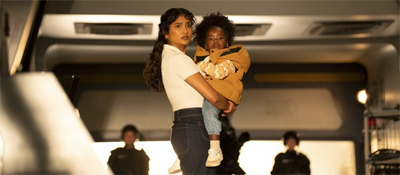
The mother of all continuity issues.
The Reality War introduces Poppy in such a way that she seems like a solution to this continuity issue. She is literally the Doctor’s daughter, but one wished into being and imagined. She is parallelled in the opening stretch of the episode with Omega, as a representative of the possibility of the continuation of the Time Lords, a “sterile” and “barren” species. It is telling that Poppy vanishes quite quickly after the Doctor tosses Omega back into the abyss. Is Poppy any different? She is even “half-human”, on her mother’s side, in what feels like a nod to The TV Movie.
There is, from the outset, something very strange and uncomfortable about this. The Fifteenth Doctor is, after all, an openly queer iteration of the character. Allowing for a brief throwaway line from the Fourteenth Doctor, the Fifteenth Doctor is arguably the first canonically queer Doctor. As such, it is strange to try to force the character into a heteronormative relationship with Belinda. This was one of the central tensions of Wish World, and so the initial implication that Poppy is the Doctor’s biological daughter sits uncomfortably with that.
As the episode builds to the Fifteenth Doctor’s regeneration, it initially seems like his sacrifice is one to effectively restore some strange heteronormative version of Doctor Who. The Fifteenth Doctor, the most queer iteration of the character, dies so that the Doctor can have a daughter. It is perhaps the smartest and most satisfying idea in the episode that this is all a gigantic misdirect. It is essentially the same trick that Davies pulled with Ruby in Empire of Death. The reveal is that Poppy is not the Doctor’s biological daughter. She is, in fact, Belinda’s daughter, the child of a single parent.
To be fair, there is some very obvious clumsy Davies trickery here to make the twist work. The Reality War plays various extended clips from earlier episodes that reference Belinda’s relationship to Poppy, which didn’t actually appear in those respective episodes, showing us the unedited version of reality. There is a handwave logic to this, like Misses Flood explaining that she missed the Time Hotel because she “took Christmas off”, with the implication being that the season unfolds in the reality where Poppy slipped through the cracks, where “gravity” is “mavity” and teal is blue, but it is still a trick that feels a little clumsy.
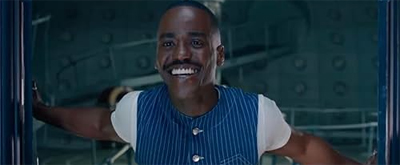
Looking out.
That said, looking back over the season it does feel strangely pointed that the first places the TARDIS took Belinda were to mothers looking for their lost children. In Lux, the Doctor and Belinda meet Renée, a mother pining for her lost son, Tommy Lee. In The Well, an episode very literally about broken mirrors, the recovery team find a mother also yearning to get back to her child. “Can you take me home?” Aliss asks the Doctor in her first line of dialogue. “I have a daughter.” That daughter is currently being minded by a grandparent. Belinda catches a glimpse of Poppy, her lost child, in The Story and the Engine.
Much like The End of Time, Part II set up epic stakes only for the Tenth Doctor to regenerate to save the life of Wilfred Mott, The Reality War rejects the epic spectacle of a battle against Omega to build to a climax where the Fifteenth Doctor dies to save a child that he never met. Poppy is not important because she is Susan’s mother. Poppy is important because she is a child and the Doctor can help her. It’s a much better expression of the thematic idea woven into the Doctor’s battle with Omega, a rejection of epic mythology and continuity in favour of the personal and the intimate.
Indeed, one of the more interesting implications of The Reality War is the way that it offers a resolution to the continuity riddle of Susan Foreman by essentially rejecting the continuity riddle at all. The Doctor cannot have children. However, the characters in The Reality War state that they are all his children. This is not a family constructed by blood, but instead one that has been found and constructed.
The implication would seem to be that Susan was still the Doctor’s granddaughter but was never biologically related to the Doctor. In purely continuity terms, it is a clever squaring of the circle that allows Susan to exist as she did in her original context, quite apart from Time Lords or Gallifrey or regeneration, while still respecting that central dynamic of the show.
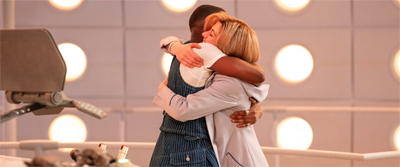
Unlucky Thirteen…
This is perhaps the deftest trick of Davies’ return to Doctor Who. Davies was handed a dense lore and mythology with “the Timeless Child”, a concept that he inherited from Chris Chibnall. Davies could easily have just ignored or deleted that. He could have relegated it to “things that the show never really talks about”, like “half-human on my mother’s side.” However, Davies very magnanimously instead took the concept on board and found a way to make it workable.
Indeed, there is something very charming about the dignity and the respect that Davies has afforded the Chibnall era. He has worked hard to avoid consigning the era to discontinuity. He brought back the Fugitive Doctor for The Story and the Engine. The Thirteenth Doctor makes an extended cameo in The Reality War. Davies has worked very hard to ensure that Chibnall’s contributions to the show aren’t erased or forgotten, even as he finds ways to integrate them more holistically into the framework of the larger series. It is a very dignified approach to a deeply troubled era.
Indeed, this is barely even subtext. The Fifteenth Doctor explicitly tells the Thirteenth Doctor that it is his job to reassure her that she is loved and validated. It is a clumsy and indulgent cameo, but it is coming from a place of obvious and sincere affection, and a clear effort on the part of a new showrunner to heal the damage caused by the previous era.
Davies rightly honed in on the emotional hook of “the Timeless Child”, understanding that the story was not about continuity but about adoption. It was a story about abandoned children. It was a fairy tale. It was a detail that linked the Doctor and Ruby. It connects to the child that the Rani stole from Bavaria. It inevitably ties back into Poppy. It also applies to Susan. When Susan appeals to the Doctor to “go back” and to “find” her, she is speaking about all abandoned and forgotten children.
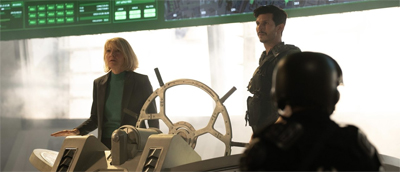
Steering the ship.
This ties into the larger vision that Davies has for his return to Doctor Who, which is obviously a show aimed at children. It is a show intended to construct a safe world for children. It is also a concept that exists to give those children a place into which they might escape. Davies seems to have constructed his return to Doctor Who as the antithesis of something like J.K. Rowling’s Harry Potter, a narrative that imagines a place where children can be themselves. The Doctor dying to save a single child – particularly a child of colour – feels like a fitting culmination to that approach.
As such, it feels important that this recontextualisation of Susan, one of the core aspects of Doctor Who mythology, happens within the context of an openly queer take on the Doctor. Doctor Who has always been a queer-coded show, and so it is certainly valid to retroactively fold that queerness into the show’s history and original dynamics. The Doctor might not have a family defined by blood and genetics, but that does not mean that it is any less a family.
This also fits neatly with the episode’s reframing of “bigeneration” as an attempt by the Time Lords to survive extinction by embracing new forms of procreation and reproduction. It makes sense of the Rani’s disgust with Misses Flood’s broaching of the idea in Wish World. The Rani’s imagined reality is built on the concept of the purity of heteronormativity, and so any form of family that is not built around the conventional family unit cannot be understood within her ideological framework.
There is a clear sense in The Reality War that this is an iterative process. It is very revealing that the episode suggests that Conrad was actually trying to be the Doctor, that he was trying to embody the advice that the Doctor gave him at the end of Lucky Day that he fights for people “who just want to get through their day, and feel safe, and warm, and fed.” However, as a straight white man, Conrad has a somewhat limited perspective and understanding of the world. His vision is restricted.
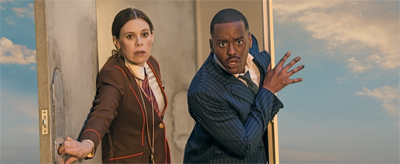
Opening doors.
The Reality War suggests that this is the nature of progress, that understandings of and narratives of reality are subject to constant revision and reimagining, reworking and reconceptualisation. This ties into the era’s anxiety over continuity. After all, attempting to freeze a story or a society in a particular moment in time is to erase any potential opportunity for it to grow or evolve in meaningful ways. It is in, in some ways, a redemptive construction of Davies’ preoccupation with destroying and rebuilding reality. Maybe it’s not a bad thing that reality is subject to reinvention or reconstruction.
To be clear, The Reality War does not work. It is broken in the way that Davies finales tend to be broken, and have been broken for decades. The opening forty minutes are just incoherent noise and nonsense. However, there is something more interesting at play in the episode, and that comes out in the final stretch of the episode. It is a capstone on the Fifteenth Doctor, the first iteration of the character to be coded as explicitly queer, that retroactively cements that queerness as a core part of the character, but which also understands the Doctor as a hero who speaks to children.
It is an incredibly messy object, but it’s an undeniably interesting and strangely compelling object – not despite, but – because of its messiness.
Filed under: Television | Tagged: children, continuity, daughter, doctor who, family, history, Omega, queer, russell t. davies, Susan, the doctor, the fifteenth doctor, the rani, the reality war, Time Lord, time travel, wish world |



 the m0vie blog
I didn’t know what to think about today’s episode. I had a feeling of “oh no, this is a mess” rising throughout the first act, but was left with the feeling that I’d witnessed a colossal… something, whatever that something was. Not a negative, not a positive, but I couldn’t get it off my mind.
Reading this (and especially tying it all together with queer found family) was what made the episode click for me. I’ve really enjoyed your reviews: this season especially, for giving added dimension, but in general. Thank you.