












“We’re going to bring down God. Are you with us?”
In many ways, Wish World feels like a thesis statement for Davies’ return to Doctor Who.
It is a story that is, very overtly, about the power of stories and narratives to warp reality. It is a story about the violence that comes from attempts to impose restrictive and suffocating conformist narratives upon people, and how media can bend reality to a point that doubt can cause the world itself to literally crack open. Davies’ return to Doctor Who has been fascinated by the porous nature of reality and the power of television as a medium, and all of that comes crashing to a head with Wish World.

A delightful John-ty adventure.
Wish World is very obviously setting up The Reality War, the big blockbuster-sized finale that will be the first episode of Doctor Who to premiere on BBC One since The Giggle, allowing for the Christmas Specials The Church on Ruby Road and Joy to the World. A significant portion of the episode amounts to pieces being moved around the board so that they can deliver in the season finale, to the point that the Rani herself has to acknowledge that the final act of the episode is largely “exposition.” It is always difficult to discuss the first part of a two-part episode in isolation, and that is especially true of a the first part of a season finale.
However, Wish World works largely on its own terms, crystalising the ideas that have been simmering across these twenty episodes since The Star Beast, articulating themes that are clearly weighing on Davies’ mind.
As a showrunner, Davies has never been particularly graceful at setting up plot points to pay off towards the end of the season. “Bad Wolf” was just a production joke, a word repeated often enough across the season to be brought back up in The Parting of the Ways. “Torchwood” began as a production anagram of Doctor Who, before being seeded in the second season as a set-up for a spin-off. “You are not alone” was so vague an allusion to the Master that it may as well have never existed, and “Mister Saxon” as an anagram “Master No. Six” only made sense using an esoteric metric.
Indeed, a lot of the criticism “Susan Triad Technology” as a set-up for “Sue Tech” leading to “Sutekh” missed the reality that Davies’ set-ups and reveals never really made any sense if any critical thought was applied to them. This is not a problem, per se, as there is something to be said for the fact that most of his finale set-ups are relatively unobtrusive. Sure, Misses Flood might address the camera at the end of Empire of Death in a way that teases the coming season, but that scene has no real impact on the actual narrative of the story in question.
This is true leading into Wish World. A lot of the plot set-up in The Interstellar Song Contest was awkward and stilted. It was surreal to have Carole Ann Ford make her return to the show as a series of strange visions that had little to do with the actual story being told. When Misses Flood bigenerates into the Rani in the postcredits scene, it has nothing to do with the story that has been told to this point and there is no sense of what significance the name “Rani” is supposed to have for a viewer who tuned in early for Eurovision.
Indeed, as an aside, it feels a little bit like that tease in The Interstellar Song Contest was a relatively late addition to the episode. Wish World arguably works better if the audience has no idea who the Rani actually is. Conrad’s narration builds to a reunion between a Time Lord and a Time Lady, which feels like an event of itself. Time Lords are still so rare in the revival, and the season has done enough to draw attention to the (second) destruction of Gallifrey in Spyfall, Part II, that the return of any Time Lord feels like a big deal.
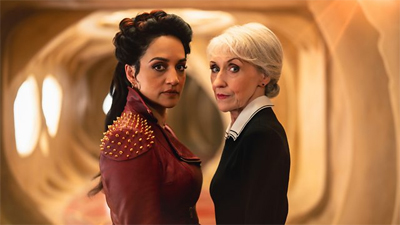
Before the Flood…
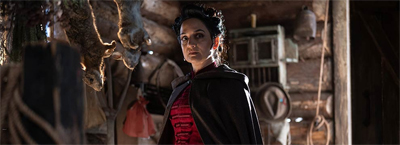
Indeed, Conrad’s narration is so vague and abstract that the viewing audience might assume that Archie Panjabi is playing another female version of the Master. After all, Michelle Gomez appeared at the season premiere. Even within the episode itself, the Rani’s confrontation with the Doctor in the bone palace is clearly designed to build to her bold declaration “I am the Rani!” complete with flashbacks to Mark of the Rani and Time and the Rani.
This is a much better introduction to the character than the teaser at the end of The Interstellar Song Contest, if only because it falls back on the familiar Davies trick of relying on his lead actor to sell the significance and the importance of a returning foe. Christopher Eccleston’s performance in Dalek went a long way to selling the iconic pepperpots as a credible foe, and David Tennant’s horror of realisation in Utopia provided a pivot on which that episode could turn. Gatwa gets to sell shock and horror at the Rani’s reveal, which communicates that the Rani is a big deal.
Indeed, part of the appeal of Wish World is the fact that it doesn’t actually make that much of a fuss around the Rani as a character. She is essentially defined as a mad scientist dabbling in the intersection between science and magic, treating the world as a petri dish, and serving largely as a catalyst for the big universe-shattering season finale return of Omega. The Rani could arguably have been an original character, but she also makes sense within the context of the character as defined in her earlier appearances.
All of which is to say that Wish World is about as good a return as one could hope for with regards to a villain that Steven Moffat famously dismissed with the (entirely reasonable) observation that “No one knows who the Rani is.“ Davies’ solution is to construct a narrative that works whether or not the audience has any idea who the Rani is, casting a suitably big-name actor in the part, and inviting them to go so large ham that they can materialise Palermo ham out of thin air.
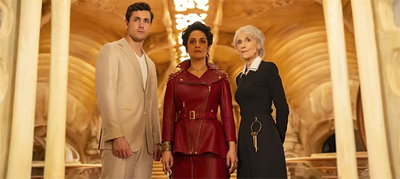
Trinity of terror.
The Rani is really just a plot device to facilitate the story that Davies wants to tell with Wish World, and it feels like the story that Davies has been wanting to tell since he returned to Doctor Who. Over the past two seasons, Davies has been preoccupied with the power of the image and ideas, of media and messaging. Building off some of the central themes of Moffat’s tenure as showrunner, Davies has been preoccupied with the sense that to image a thing is to try to conjure it into being.
It was there in the aliens driven mad by signals broadcast into space in Wild Blue Yonder, in the madness imprinted on television in The Giggle, in the VHS cassette brought to life in The Legend of Ruby Sunday, the constructed retrofuturism of The Robot Revolution, in the living cartoon in Lux, in the manifesting window in The Story and the Engine, in the weaponisation of the television broadcast in The Interstellar Song Contest. It was more directly evoked by Conrad’s use of new media in Lucky Day. The Doctor literally broke through the fourth wall in Lux, entering the audience’s living room.
Indeed, television is central to Wish World. Conrad is the glue that holds this reality together, and he addresses his subjects through television. The opening credits are bookended by Conrad, who even cuts in over the title card. Conrad addresses his subjects paternalistically. Even to adults, Conrad is “Uncle Conrad” or “Uncle Connie.” Conrad invites himself into the population’s homes, even into their bedrooms.
As with so much of the previous two season, Davies is very overtly in conversation with Disney, who are effectively his corporate partners. Wish World owes a great deal to WandaVision, particularly in its portrayal of this throwback fantasy in which the Doctor works for the “Unified National Insurance Team”, only to find himself questioning the nature of the reality in which he finds himself.
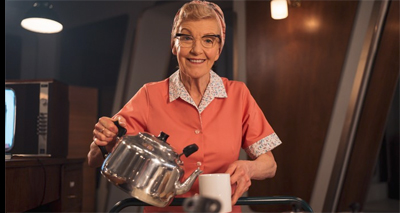
“WOULD! YOU! CARE! FOR! SOME! TEA!”
It feels of a piece with Davies evoking Star Wars in The Robot Revolution or Aliens in The Well, and even mentioning both Loki and the Marvel Cinematic Universe in The Story and the Engine. Disney is a gigantic international conglomeration with the power to construction fictional universes and even manifest them upon reality. There is a reason that Disney’s theme parks are cited as a key example of the hyperreality of “simulacra and simulations.” Disney has the power to warp reality, and it aims that power squarely at children.
It is very telling that Conrad’s addresses take the form of children’s entertainment. The format of the show evokes Cbeebies Bedtime Stories, as he welcomes viewers with the promise, “And now it’s time for today’s story.” The cover of “Doctor Who and the Deadly Wish” is designed to evoke J.K. Rowling’s Harry Potter series. Parents treat Conrad as a sort of babysitter, with Belinda putting Connie inside to watch Conrad while the Doctor speaks with Ruby.
Indeed, the entirely elaborate fiction of Wish World is being conjured into being by a child, the seventh son of a seventh son. Conrad’s storytime might be broadcast to the world, but he is reading to a child in a crib. Wish World is, in a very literal and very direct way, about the stories that adults tell children and how those stories shape the world as those children will perceive it. After all, as Lucky Day reveals, Conrad himself had his defining experience with the Doctor as a child.
This is, in essence, Davies meditating on the power of children’s entertainment in general and of Doctor Who in particular. After all, children’s entertainment can be insidious and corrupting. Rowling as transformed from a beloved icon to a raving bigot. More broadly, one of the central planks of modern reactionary thought has been to limit and control the narratives consumed by children – to limit the books that they can read and to restrict the perspectives present in the works they consume.
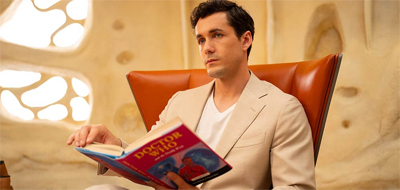
A Rowl– sorry, a rousing tale.
Interestingly, one of the more striking choices in Wish World is the sense in which the episode is at least somewhat sympathetic to Conrad. Conrad is a complete monster, but he is not presented as an especially spiteful god. He is not actively choosing to erase people and countries from the world. His limitations are not the result of conscious choice. Instead, his limitations are just a result of his narrow perspective.
Conrad forgets to read the weather for South Africa, so the nation floods. He is able-bodied, so cannot conceive of what life must be like for those who are not. As the disenfranchised explain to Ruby, “He’s not disabled, so he literally can’t see us.” Conrad is not explicitly seeking to erase the people who don’t fit into his worldview, he simply doesn’t think about them at all and so they get pushed to the margins. This is a surprisingly sympathetic accounting for how these systems and structures disempower those at the fringes.
Perhaps this is something of a mea culpa on the part of Davies, who has openly acknowledged that he has historically had blindspots and not thought about the implications of the stories that he was telling while he was telling them. This is why it is so important to Davies that this new era of Doctor Who should feel inclusive. It was a big deal when Davies made the TARDIS wheelchair accessible in The Giggle.
However, it also gets at larger systemic issues in broader culture. The modern world is structured in such a way as to diminish and marginalise those who do not conform to the established narratives. “I swear I’ve never seen this place before,” Ruby admits on visiting the homeless encampment. “Yes you have,” Shirley corrects her. “You walk past it everyday and you ignore us.” As she explains, “We get ignored. We’re poor and forgotten and irrelevant. And that’s the way the world is.” It is a very humanist – and non-accusatory – framing of these very real issues.
Rani of terror.
Of course, Conrad’s philosophy is openly reactionary and conservative. He is obsessed with heteronormativity and breeding. He talks about the Doctor’s companions and how “sometimes they’d leave him, so they could go and fall in love and marry and have babies.” This is not an unfair summary of departures in episodes like The Green Death or The Invasion of Time. Conrad talks about how the Doctor yearns for “the old days” and a “faithful companion.”
The reality of Wish World has no place for single women, particularly older single women. The Doctor encourages Ibrahim to ask Kate out on a date. “If you two got together, she wouldn’t have to work,” the Doctor explains, matter-of-factly. “It’s undignified. You’d be saving her.” When the Doctor asks Mel what her plans are for the upcoming holiday, she explains, “Oh, you know, I’m single, no parents, no children. So I will sit in silent contemplation and be jolly glad.”
There is a strong sense that the women in Wish World exist only to produce children. As Belinda’s grandmother explains, “You know her path in life. It’s all very clear: good little girl, then good little wife, then good little mother.” Belinda’s mother pipes in, “And as Conrad says, that’s what we’re here for.” It is interesting how deeply unsettling these sequences are, even as they are brightly lit and seemingly mundane.
This is the right-wing reactionary school of thought. The modern political right is obsessed with “fertility rates“ and “birth rates.” Indeed, so many modern right-wing policy positions make sense filtered through this lens, such as tougher restrictions on abortion and efforts to force women out of the workforce to make them dependent on male earners. This has clearly been on Davies’ mind, since he made the choice to premiere Doctor Who on Disney+ with Space Babies, an episode about abortion and fertility anxiety.
Tabling a motion for discussion.
The Rani arguably also makes a certain about of sense in the context of a story like this. As much as the Rani could be said to represent anything beyond a pantomime villain, she is a mad scientist, specifically an evolutionary biologist. The far-right has a long history of leaning on (frankly insane) interpretations of evolutionary biology – which occasionally manifests as “social Darwinism” – to justify what effectively amounts to eugenics and forced breeding. The Rani is, in that sense, a fairly timely villain.
Naturally, this fixation on procreation leads to the erasure and marginalisation of queer perspectives. There is no place for a queer man in this world. The Doctor has to be married to Belinda and has to become a father. When the Doctor describes Ibrahim as “a beautiful man”, he immediately has to walk it back. “What’s that supposed to mean?” Ibrahim demands. “You’re a man. How can you find another man beautiful?” The Doctor’s queerness is an existential threat to the status quo.
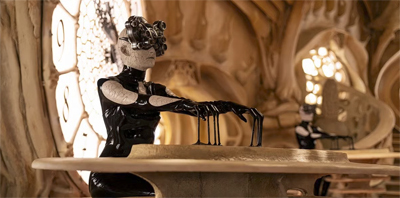
It feels appropriate that Wish World is stalked by dinosaurs – “fossils or relics” from a bygone age – and that the Rani rules over the planet from a palace literally constructed of bone. This world is not living or vibrant. It is instead a nostalgic invocation of an idealised past that never existed. It’s very telling that Conrad’s propaganda is styled after the romantic Second World War posters.
This is the thing about modern conservatism. It is obsessed with the recreation of some imagined past, one that promises to take people back into a world that never actually existed by suppressing any perspective outside of the white, heterosexual, male gaze. In its own way, Wish World is a fascinating companion piece to The Robot Revolution, both stories about disenfranchised young men who conjured a fantastical world into being drawn from mid-century iconography.
No doubt.
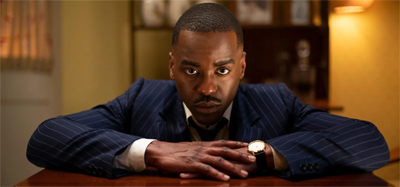
It is revealing that this entire world is effectively manifested into reality through a larger meta-narrative. The Rani explains that the baby alone was not enough to conjure this reality into being. She needed something more powerful to help bring the world to life. In a somewhat fuzzy piece of plotting, the Rani explains that she weaponised the Vindicator, the tool that the Doctor has been using all season to help get Belinda home.
The specifics of this plot point are standard Davies expositional nonsense, but the thematic mechanics are fascinating. According to the Rani, the Vindicator created “a web of power” across all of time and space. That language seems deliberate and evocative, suggesting the web of stories that appeared in The Story and the Engine, which was a metaphor for the metaphysical connections formed by narrative and the interconnectivity of the internet age.
The Rani describes this construct as “a web of titanic power ready for me to use. Power great enough to amplify the wishes of a god, allowing Conrad to create an entire world.” Naturally, any mention of an interconnected web cannot help but evoke the internet, particularly in the context of a large set of themes concerned with the point of intersection between reality and constructed narratives.
The internet has arguably broken reality, shattering what little tether held large portions of the population to a shared reality. The internet has made it more difficult for human beings to process what is real and what is not, and to live in self-contained and sheltered bubbles. There is a credible argument that the internet is largely responsibility for the insanity of the modern world, allowing the modern forces of fascism to erode any sense of objective “truth“ and encourage the enthusiast embrace of obvious falsehoods.
The window of opportunity is closing.
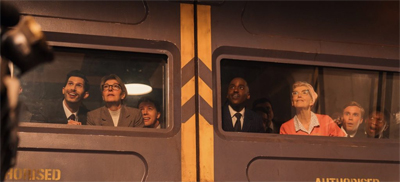
However, what is really interesting and clever about Wish World is the extent to which Davies understands that this narrative is a lie and that even the people who peddle it rarely actually believe in it. Central to Wish World is the idea that the Rani is smart enough to understand that the lie that Conrad has created cannot be maintained over an extended period. This nostalgic, heteronormative, sexist fantasy is a lie that is so self-evidently ridiculous that the centre cannot hold.
“You cannot wish a whole world into existence,” the Doctor counters. The Rani agrees, “Exactly, it’s full of mistakes and it cannot sustain itself, because you have doubts.” As Misses Flood explains, “The doubts are not a problem. The doubts are the whole point.” It is impossible for the human mind to accept the reality that Conrad and the Rani have constructed because it runs so counter to the basic human experience. That’s why it takes Conrad such effort to maintain the illusion. It’s this conformity, this repression, this censorship that is so unnatural.
The smartest twist in Wish World is that the lie itself isn’t the existential threat. It is the fact that the lie is unsustainable, even those trapped within it, and that fractures the very skin of reality – the attempt to reconcile something that is fundamentally irreconcilable. The contradictions and the impossibilities eventually mount, building to critical mass. The lies that this ideology constructs become so counterintuitive that the only sane response is insanity.
This is the thesis argument of Wish World, that the sense that the modern world has lost any grip on reality does not exist in opposition to the reactionary fantastical nostalgia of people like Conrad, but as an inevitable outcome of their philosophy. That all of the chaos and violence and brutality and nonsense that defines contemporary discourse is a reaction to the realisation that the fantasy these reactionary ideologues have been peddling was never – and never could be – real.
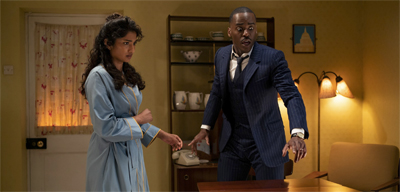
Doctor and nurse.
When that it is true, everything comes apart. Everything breaks into pieces. Everything collapses.
Filed under: Television | Tagged: communication, conspiracy theories, continuity, doctor who, ideas, narratives, power, pronatalism, Rani, reactionary, reality, russell t. davies, story, Television, the internet, the rani, wish world |



 the m0vie blog
Have I just read a Doctor Who review that actually intellectually engages with it themes and deeper thoughts instead of just whining it’s not Blink, obsessing over fan service minutiae, listing lazy CinemaSins-like nitpicks, or being just an AI-generated “ending explianed” SEO slop?
Is this even the 2025 internet?