












“I’m saying no.”
“With regret, your powers are only nominal.”
“Why is it all so mad? Why is everything on this planet so stupid?”
One of the interesting consequences of the relatively compressed modern season of Doctor Who is the way that it collides episodes into one another.
With only eight episodes in a given season, there isn’t room for the sort of structure that Davies brought to his first four years overseeing Doctor Who, when he would reintroduce the show to audiences each year with a triptych that opened in the present and followed with a celebrity historical and a futuristic science-fiction episode. Rose gave way to The End of the World and The Unquiet Dead. Smith and Jones led into The Shakespeare Code and Gridlock. Partners in Crime fed into The Fires of Pompeii and Planet of the Ood. Davies’ second season was the exception, opening with New Earth and Tooth and Claw, but that was notably the only one of Davies’ four seasons that didn’t have to open with the introduction of a new companion, with The Christmas Invasion having introduced the Tenth Doctor.
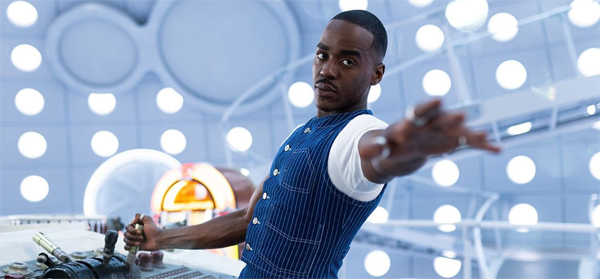
Extending its reach.
The Robot Revolution is put in the awkward position of having to combine the typical Davies season opener that introduces Belinda Chandra as a companion but also being Davies’ big high-concept pseudo-political idiosyncratic science-fiction story like Gridlock or Planet of the Ood. The result is a strange cocktail, that doesn’t quite cohere but is nevertheless compelling. For all the criticism of Davies’ return as showrunner, his second tenure does not lack for ambition and ideas. The Robot Revolution is bursting with concepts and thoughts, with Davies eager to scream his ideas at the loudest possible volume. The Robot Revolution is, in typical Davies style, incredibly maximalist in its storytelling. It brushes past plot points and ideas with reckless abandon and breathless enthusiasm.
Whatever the episode’s flaws, it’s certainly not the product of assembly line production.

The march of progress…
One of the more interesting aspects of Davies’ second tenure as showrunner is the sense that he actively continued to watch the show after his first departure. Davies is a genuine fan, and that is reflected in certain creative choices, such as his continued effort to rehabilitate “the Timeless Child” with the aggressiveness of a writer who has spent time in the fandom trenches. However, Davies is not just a fan. He is a professional television writer, and it is very clear that he watched the work of his successors with that creative eye. Many of Davies’ key creative decisions during his second tenure exist in conversation with choices made by Steven Moffat, which allows the pair an interesting discourse unfolding across decades of an individual franchise.
The Robot Revolution owes no small debt to Steven Moffat. The story leans heavily on warped temporal mechanics, one of Moffat’s favourite recurring tropes. The Doctor himself frames the plot logic as “timey-wimey.” The episode ends with the Doctor promising to get Belinda back to her own time, even if they have to take “the long way ’round”, another of Moffat’s recurring turns of phrase. Davies is not being subtle. He is not hiding his influences. Indeed, the entire plot of The Robot Revolution hinges on a nonsense bootstrap paradox, where the robots are sent by Alan to capture Belinda, only for Belinda to order them to capture Alan, creating a closed loop.
Belinda is also very consciously indebted to Clara, the defining companion of the Moffat era and a character who completely redefined the role of the companion within Doctor Who. The default point of comparison for Belinda would obviously be Martha. Like Martha, Belinda is the second companion of this Doctor’s tenure, a woman of colour replacing a working class blonde. Like Martha, Belinda is introduced working at a hospital. Indeed, even the introduction of the robots recalls the arrival of the Judoon in Smith and Jones, these big and burly behemoths with little regard for the damage that they cause. Indeed, both Martha and Belinda are abducted by these aliens on their first adventure, although the Judoon take an entire hospital.
However, Clara is a much stronger point of comparison. This makes sense, given that Davies has written about his abiding affection for the character. Belinda is a new sort of companion for Davies. Historically, Davies’ companions have been defined by their sense of curiosity and wonder, their eagerness to see the larger universe. Even Donna, the most contentious and adversarial companion of Davies’ first era, possessed an earnest sense of excitement about seeing the cosmos when she was reintroduced in Partners in Crime. In contrast, The Robot Revolution goes out of its way to establish Belinda as a character who is decidedly unimpressed with the world of Doctor Who.
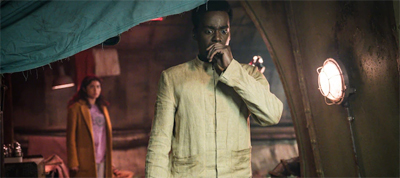
Belinda is not a believer.
Belinda is established as a strong-willed character from the outset. She bristles at Alan’s attempt to impose the label “miss” on her, and it is subsequently revealed that she broke up with him because she refused to let him control her life. She makes wry asides about the patients and the staff at the hospital where she works. When a bunch of gigantic robots burst into her homer to abduct her, her first reaction amounts to, “You’re not real, actual robots are you? Because that’s just ridiculous.” As she is taken into space, her first instinct is to shift the blame for the situation on to Alan. Rather than being awed by the inhabitants of “Missbelindachadra”, she is deeply frustrated. “Why is everything on this planet so stupid?” she demands. “Don’t shush me!” she warns the Doctor early in their relationship.
Like Clara, Belinda eschews the traditional dynamic between Doctor and companion. Clara made the Doctor wait on her, rather than living in the TARDIS. Belinda insists that the Doctor drop her home before continuing on his adventures. Like Clara, Belinda is decidedly unconvinced by the Doctor’s swagger. The closing scenes of the episode initially seem to adhere to the familiar seduction scenes that marked stories like Rose or Smith and Jones, but Belinda refuses to be won over. “I am not one of your adventures!” she protests. “You are dangerous,” she clocks him. She can see right through the Doctor, in a way that distinguishes her from characters like Rose, Martha or Ruby. The episode ends with the Doctor being being thrown through Belinda’s timeline, mirroring Clara’s journey in The Name of the Doctor.
Indeed, the most interesting idea in The Robot Revolution might be the way that the episode compares the Doctor and Alan. There is a sense that Belinda sees through the Doctor so quickly because she has experience with these sorts of relationships. It is very telling that one of the cornerstones of that confrontation in the TARDIS concerns boundaries and consent, the Doctor testing Belinda’s DNA without checking with her first. It is obviously very different from Alan trying to dictate what clothes Belinda can wear, but in both cases there is a male character who assumes that they know better than their female companion, acting in an obviously paternalistic manner. Alan is even introduced giving Belinda the stars, albeit in a much less impressive way than the Doctor can.
This hardly a novel approach to the character of the Doctor. During his first tenure, Davies would regularly problematicise the Doctor’s relationship to much younger and much less experienced women. After the Ninth Doctor watches Gallifrey burn, his first impulse is to take Rose, his new companion, into the far future so she can watch her own world burn. The Tenth Doctor was oblivious to the emotional damage that he was causing to Rose and Martha. This continued under Moffat’s tenure, with the Eleventh Doctor learning to see Amy and Clara as people, rather than puzzles to be solved. Chibnall would push the idea to breaking point, implying that the relationship between Doctor and companion was the Doctor perpetuating Tecteun’s abusive dynamic.
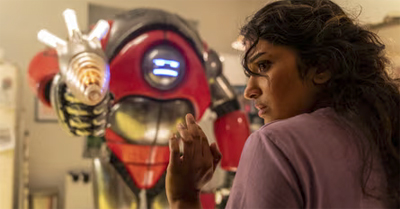
Arresting television.
Again, it’s clear that Davies has been watching Doctor Who in the years since his departure. A large part of the Twelfth Doctor’s tenure was about the idea of repairing and healing that dynamic between Doctor and companion, trying to navigate the imbalance in power and experience between the two. Indeed, that closing scene in The Robot Revolution owes a lot to the conversation between Clara and the Twelfth Doctor in Kill the Moon, suggesting that Belinda is starting from the point where Clara really began renegotiating the power dynamic between Doctor and companion. It’s a smart approach, and one that not only helps to define Belinda as a character distinct from Ruby, but also starts to shade the Fifteenth Doctor as a unique take on the character.
The Fifteenth Doctor was introduced in The Giggle as a version of the character more open about his feelings. He has done the work. He has gone to therapy. He is more open about himself. Even in The Robot Revolution, he is more open about his curiosity concerning Belinda than the Eleventh Doctor was with either Amy or Clara, laying it all out on the table. The Doctor has grown in many ways. However, that final scene with Belinda illustrates that his bubbly cheerful persona still has blindspots. In particular, most likely unconsciously, he clearly has a “playbook” for seducing and recruiting new companions, hitting many of the same beats in winning these young women over. It’s not malicious, it’s likely not even deliberate, but it is a pattern of behaviour. Belinda, who escaped a troubled relationship, instantly clocks it.
It’s a genuinely novel approach for Davies as showrunner, and it illustrates that Davies has been paying attention to what happened to the series in his absence. Indeed, it seems depressingly likely that certain vocal fans will react strongly against Belinda for the simple and compelling narrative choice to have the character openly challenge the conventions of Doctor Who, much as certain segments of fandom reacted strongly against Clara for daring to push the boundaries of the companion’s role within the show. This is not to suggest that Belinda is unlikeable or unrelatable. She is decidedly self-starting within the narrative of The Robot Revolution, whether working quickly to treat the survivors of a horrific assault or deciding to sacrifice herself for the greater good.
To be, this is a fairly standard beat when introducing a new companion. These characters have to do something to stand out from the crowd, to prove that they are worthy of the Doctor’s (or the audience’s attention). However, Belinda does this in a way that is deliberately provocative, quipping about how the Doctor lives up to his name by standing around as a nurse does all of the work. Belinda is a decidedly prickly character, and this choice alone makes her a very exciting addition to Doctor Who. It draws a nice contrast between Belinda and Ruby, rather than treating Belinda as a clear surrogate or replacement.
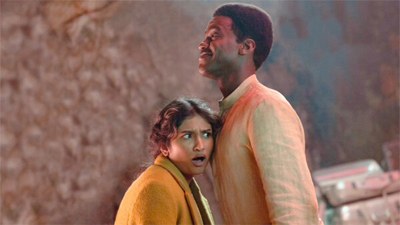
Familiar beats.
It’s very conscious effort on Davies’ part to keep Doctor Who relatively fresh. In some ways, this makes Belinda feel like an update to Martha, the companion who directly followed Rose and who could – at times – feel a little generic and passive. However, it also reflects an understanding of the companion’s role within Doctor Who and the target audience for the show. If the companion is to be understood as the audience surrogate, then it is perfectly reasonable to reject the assertion that such a character need arrive into the show as a fan. The Doctor must win Belinda over, just as Doctor Who must win over viewers who are not already predisposed to love it.
There are other elements of The Robot Revolution that feel indebted to Moffat. It is directed by Peter Hoar, who previously oversaw A Good Man Goes to War, an episode that Davies has singled out as one of his favourites. The pacing owes a lot to what Elizabeth Sandifer described as the “narrative acceleration“ of the late Smith era, where Moffat would distill a premise to its essence and strip out all but the most essential plot beats in an essence to speed up with plot. The plot hinges on the familiar Moffat trope of having the Doctor stranded in one place for an extended period of time – as in The Lodger, The Power of Three, The Time of the Doctor, Heaven Sent, The Husbands of River Song, World Enough and Time, Joy to the World – with the Doctor spending six months on “Missbelindachadra” before Belinda arrives. It also employs a final twist that recontextualises the story to that point.
There are even shades of Moffat’s “dark fairy tale” approach to Doctor Who to be found in The Robot Revolution, which is obviously heavily influenced by The Wizard of Oz. This is a story about a lost queen being taken home to her kingdom, which perhaps makes Belinda a literal Disney princess. When Belinda is first confronted by “the Great AI Generator”, she peers through what looks like a magic mirror. In its original monstrous form, “the Great AI Generator” looks a lot like a a giant malevolent teddy bear. It is also worth acknowledging that the confusion between “AI” and “Al” feels like a particularly Moffat-y contrivance, like the translation of “Melody Pond” to “River Song” or the meaning of the title of The Name of the Doctor. It’s a plot resolution that hinges upon high-concept wordplay, to keep with the storybook theme.
Of course, while Davies is very heavily drawing from Moffat, it’s worth acknowledging that he does not share all of Moffat’s strengths. Davies has always been more of a “big idea” writer, tending to fudge the mechanics of his stories. Davies has a tendency to handwave the internal plot logic of his narratives, pushing harder for his big themes and ideas than for an entirely internally consistent narrative. On a plot level, The Robot Revolution makes very little sense. It is hard to understand the temporal mechanics of what happens with Belinda and Alan. If Alan can send the robots to retrieve Belinda at a point after he was abducted, then how does Belinda send the robots to retrieve Alan before she was abducted. The entire plot hinges on that contrivance, and it’s never clearly articulated.
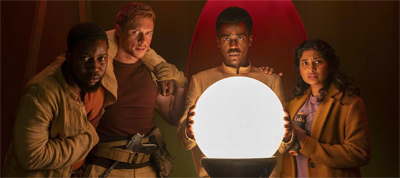
A glowing endorsement.
Similarly, Davies’ embrace of Moffat’s fast-paced approach to scripting is awkward and clumsy. The Robot Revolution moves incredibly quickly from one idea to the next. It assumes the audience is smart enough to understand the basic narrative conventions driving the plot, and so sketches many of them in pencil. There are plenty of great ideas in The Robot Revolution that feel somewhat under-cooked in execution, most obviously the character of Sasha-55. Sasha-55 is a familiar Doctor Who archetype, particularly in the context of Davies’ approach to the show. She is the almost-companion. She is the character that Doctor connects with, who seems like she will become a companion, but who dies horrible in a way that shocks the Doctor and the audience.
There are plenty of examples of that sort of character across Davies’ first four seasons as showrunner, most obviously Jabe in The End of the World or Lynda Moss in Bad Wolf. Sasha-55 is introduced as a potential companion for the Doctor. The Doctor reveals via exposition that she helped him survive during his six months on “Missbelindachadra.” She helps him infiltrate the royal chamber under the guise of the “historian.” During the firefight, Sasha-55 insists that the Doctor see to Belinda before fulfilling his promise to her, “Take her home, Doctor, then take me to the stars.” Inevitably, Sasha-55 is disintegrated by the robots.
This is not a bad narrative beat, on paper. However, the execution amounts to little more than the arc outlined above. There is no meat on the bone. Sasha-55 is introduced, gets a handful of lines, and then is killed off. The Robot Revolution seems to assume that the audience can intuit her narrative and thematic function from the exposition provided. It is a very stripped-down take on a familiar archetype. Unfortunately, it is too stripped down. It feels rushed and unearned. Davies is clearly trying to hit as much plot as possible to create a sense of forward momentum driving the episode, but Sasha-55 never feels like an actual character, so the emotional weight that the episode tries to hang on her is never convincing.
There are similar issues with the character of Alan, where it feels like the episode would be a little stronger had it even hinted at Alan’s true nature before the turn. It’s obvious from that opening scene that Alan is not a great guy, he’s immediately identifiable as “a bad boyfriend.” He complains that girls aren’t good at math and he confesses to wanting to own the stars. However, there is a sense that The Robot Revolution needs just a little bit more to set up the idea that he was controlling and domineering before revealing his true nature. This is not suggest that The Robot Revolution needed to spoil its major twist, just that the reveal could have been better seeded within the episode – whether in terms of character or theme.
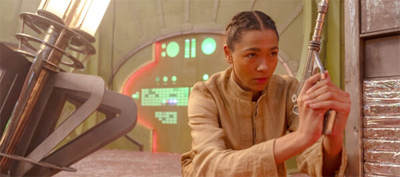
Sash and burn.
Still, allowing for these issues, there is a lot to like about The Robot Revolution. Whatever issues the second Davies era might have, it continues to feel like a breathe of fresh air in the aftermath of the dull streaming aesthetics of the Chibnall era. Indeed, there is something very playful in the production design and style of The Robot Revolution, which is bold and bright in its retrofuturism. Another Moffat-esque touch is the extent to which the eponymous robots recall the design of the Hydroflax from The Husbands of River Song, like a design lifted directly from the cover of a trashy cult paperback novel by some forgotten written. Even their rocket, which recalls the “Ferrari” glimpsed in Planet of the Ood, feels like a deliberate throwback to an older style of science-fiction.
The Robot Revolution is an obviously expensive episode of television, but it is never afraid to be silly. There is a sense that Davies is writing a script that is accessible to children. (When the Doctor drops the phrase “timey-wimey”, Belinda counters, “What am I? Six?”) As with Space Babies, there is little concern for what adult fans might deem too childish or silly, which is perfectly reasonable approach. The robots are silly and fun, including an adorable little cleaning robot that seems designed specifically to appeal to younger audience members. This is a far cry from the short of dry and dusty aesthetic that defined futuristic stories like The Ghost Monument or The Battle of Ranskoor Av Kolos during the Chibnall era or the decision to replace the Daleks’ iconic plunger in Resolution. This is not particularly worried about looking “realistic” or “convincing.”
It is a welcome creative choice. It lends The Robot Revolution a distinct visual aesthetic. It is undeniably a visual approach that is designed to interest younger viewers. Davies has always understood that Doctor Who is a family show, and the opening stretches of his seasons are often specifically tailored towards younger viewers, as demonstrated by the monsters and production design of stories like Aliens of London, World War Three, Rise of the Cybermen, The Age of Steel, Daleks in Manhattan, Evolution of the Daleks, The Sontaran Stratagem and The Poison Sky. Davies often designs the opening sections of his seasons to be “toyetic”, populated with the sorts of imagery and iconography that can hold a younger audience member’s attention.
Indeed, there is perhaps something cheeky and subversive in the idea that this future world that initially appears to be designed by generative artificial intelligence but is eventually revealed to be shaped by an angry young gamer is essentially recycled wholesale. Again, as with the revelation that Belinda is a Disney princess, it’s nice that “Missbelindachadra” looks like it might have been lifted from the imagination of George Lucas. This is a world of rebels fighting fascists, where the useless officials dress and robes and look like Jedi. It’s clever to meld that aesthetic with The Wizard of Oz. It seems deliberate that much of the first half of The Robot Revolution feels like it is repurposed from existing material, whether from classic science-fiction or from older Doctor Who. Even the robots themselves feel highly derivative of concepts that Doctor Who has done before.
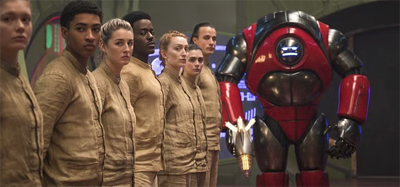
The future is now, but also seventy years ago.
The robots fly in fifties flying saucers, recalling the Daleks. Indeed the shots of those saucers attacking the city might easily have been lifted from The Day of the Doctor. The robots’ disintegration beams also evoke the classic Dalek blasts. The robots’ plan to pair Belinda with “the Great AI Generator” as “queen and machine combined” because “it demands union” recalls the threat of Cyberman conversion. At one point, “the Great AI Generator” promises, “Conversion will be a world without sadness or pity. You will achieve serenity, peace and joy.” This sounds quite similar to the pitch that John Lumic makes in The Age of Steel. There is something interesting in the presentation of this nostalgia as an existential threat, particularly following the use of Sutekh in The Legend of Ruby Sunday and Empire of Death.
In some ways, Davies is venturing back into the past of Doctor Who. Belinda is very consciously an older style of companion. The concept of a companion trapped on the TARDIS with the Doctor was a fixture of the classic show, most obviously with Ian and Barbara but continued through to Tegan. Davies is also – as always – heavily influenced by eighties Doctor Who. Belinda owes a very obvious debt to Ace, a young woman swept away from Earth and taken into a futuristic space world. This adds a nice layer to the Wizard of Oz references in The Robot Rebellion, as Ace was very obviously and very heavily inspired by the character of Dorothy Gale. Davies is drawing from the show’s past in shaping its present, an interesting conversation stretching across decades of continuity.
Much like New Earth or Gridlock, the endearing silliness of The Robot Revolution owes a lot to the science-fiction stories overseen by Andrew Cartmel, including Paradise Towers and Dragonfire. There is an understanding that Doctor Who should never take itself too seriously, and so the episode is populated with charmingly stupid jokes like the idea that everything on this planet is named for Belinda: “Missbelindachandra”, “Missbelindachandraville”, “Missbelindachandrabots”, “Missbelindachandrakind.” It is a goofy commitment to the bit that helps to distinguish Doctor Who from comparable science-fiction franchises like Star Trek or Star Wars.
Indeed, a large part of the charm of The Robot Rebellion is the sense in which it remains a Russell T. Davies story to its core. As much as it reflects the author’s influences and interests, it is also undeniably a reflection of his worldview. This is obvious even in how the story draws from Steven Moffat. Initially, The Robot Revolution seems like a classic Moffat story about a system that has run amok, like The Doctor Dances or The Girl in the Fireplace. It initially seems like the robots are malfunctioning, that they have misinterpreted vital information and are acting in error. This is, after all, initially framed as a story about artificial intelligence, and Moffat has a fondness for stories about broken systems that spiral out of control. This is arguably why Moffat has a much stronger grasp on the Cybermen than Davies ever did, because he understands their logic.
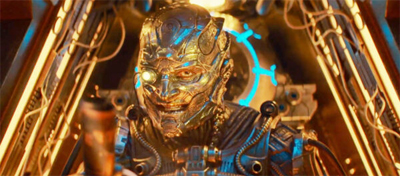
Because of the not-so-wonderful things he does.
However, the big twist in The Robot Revolution is that this is really a Davies story. The systems have not run amok. These machines are not operating out of control. This is not an accident that resulted from a lack of empathy. The revelation in The Robot Revolution is that every terrible thing that has happened is a deliberate act of malice perpetrated by a human being with active intent. Moffat tended to believe that people were good and that systems were inhuman. In contrast, Davies was always more firmly committed to the idea that human beings where capable of being the worst monsters of all, as demonstrated in stories like Midnight or Children of Earth. There is no ghost in the machine, there is only Alan.
In some ways, this recalls the approach that Davies took to scripting Dot and Bubble in the prior season. That was another episode that was built around a familiar collection of science-fiction tropes only to build to a revelation that the actual horror was something more mundane and recognisable. In Dot and Bubble, carnivorous space slugs gave way to a story about the nightmare of racism. In The Robot Revolution, cartoonish robots and anxieties about artificial intelligence give way to a study of entitled masculinity. It’s a nice way to structure an episode, and it reflects Davies’ distinct interests as a writer. It is also a clear difference between how Davies scripted during his first tenure and how he approaches his return to the show, with the closest analogue during his initial stewardship being something like Midnight.
It seems like Davies has an understandable fascination with generative artificial intelligence. It seems to inform the subtext of Wild Blue Yonder, with the monsters there characterised as unconvincing imitations of life with distended limbs and distorted faces. However, the clever twist in The Robot Revolution is built on the understanding that the rise of generative artificial intelligence is not happening in a vacuum. It is not an event without a cause. It is not a trend disconnected from larger cultural forces. Davies understands this notion of artificial intelligence run amok as tied to the broader social and political climate. In particular, as a byproduct of a certain modern strain of reactionary technocracy.
After all, this generative artificial intelligence is being pushed by the same tech companies that exert a very strong influence on contemporary politics. Elon Musk is heavily pushing Grok and selling what remains of Twitter to his startup xAI as he whispers in the ear of the Trump Administration. The Hollywood studios seeking to economically exploit this technology blatantly pander to Trump’s administration, openly acknowledging that it is good for business and tailoring their content to reflect the current reactionary moment. This is also tied to a very contemporary set of masculine anxieties. Mark Zuckerberg pushes Meta (and Facebook) to embrace artificial intelligence at the same time he bemoans the loss of “masculine energy“ in corporate tech.
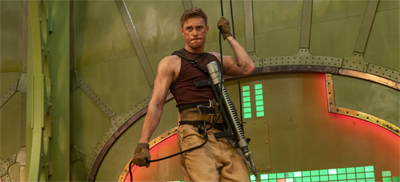
Hang in there.
The push for generative artificial intelligence is as political as it is economic or practical. It often seems to be framed as an irrational hatred of the creative class, an attempt to humble artists by feeding their work into gigantic plagiarism engines. This is rooted in an anger and resentment often anchored in particular social context. Trumpism dovetailed nicely with “GamerGate.” Elon Musk seems to perceive gamers a key political constituency, to the point of lying about his own abilities as a gamer for social capital. This is all tied to politics of angry young white male resentment. Davies very cannily argues that the engine driving all of this is a bitter young white man who feels entitled – entitled to control Belinda and entitled to control the world.
Alan is initially framed as relatively harmless; he’s nerdy and socially awkward. However, behind that seemingly innocuous exterior there is something darker stirring. It’s a complete lack of empathy, a stubborn unwillingness to see others as individuals with agency and autonomy. He attempts to dictate Belinda’s life. When he arrives on “Missbelindachandra”, he is thrilled to finally be given the power of a god. “You mean, it’s like a game?” he asks. “With robots and cities and lasers? And you’re saying it’s mine? And I can make up the rules and win!” As he is plugged into the machine, as he takes over the world, he admits, “I feel strong, like never before. I feel power!” (It is notable that many young men support the reactionary politics of the moment because they feel it will force women out of the workforce and into domestic roles for them.)
Belinda suggests that Alan has “taken coercive control and made it complete control of the whole planet”, turning “Missbelindachandra” into “Planet of the Incels.” Davies is not subtle. Davies has never been especially subtle. However, he’s also entirely on point. After all, so much of modern culture and politics is informed by the bitter anger of young men like Alan. There is a straight line to be drawn between bitter young men being angry at the inclusion of women and queer people in their video games and the end of the American Century due to the absurd trade policies enacted over the past couple of weeks. That is a frankly insane sentence to type, but these are insane times.
There is even something a little cheeky and subversive about Davies using this idea as a jumping-off point to the first season of Doctor Who to feature an exclusively non-white TARDIS team. Doctor Who itself has been targetted by the same sort of angry young white men typified by Alan, reacting strongly against what they perceive as the intrusion of “political correctness” into Doctor Who. Indeed, Varada Sethu quite correctly observed that the series should wear such criticism from reactionary forces as a badge of honour. As Gatwa conceded, “Look at us. We get to be in the TARDIS. We’re going to piss off so many people.“ That is a deeply insane observation, but it is sadly reflective of the current times.
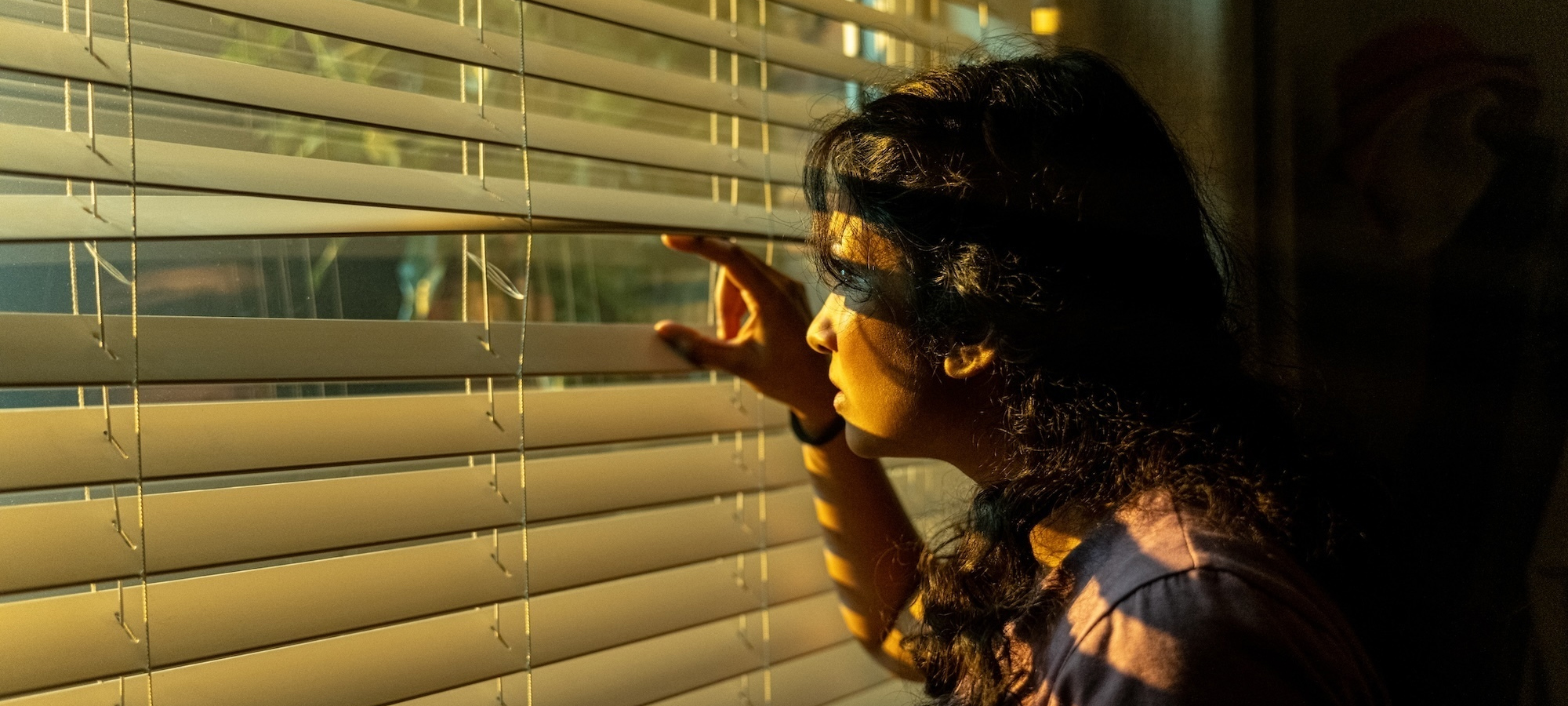
Going in blind.
In some ways, for all that Davies is screaming the episode’s themes at the top of his lungs, The Robot Revolution feels like it is in some subtle way about this. It is about the first exclusively non-white TARDIS team venturing into a retro-futuristic science-fiction world conjured from the fantasies of an angry young gamer. It is about the collision of past and future science-fiction, a decidedly old-fashioned vision of what the future should look like – a world of robots, flying saucers, rebels, totalitarianism that could have been lifted from the “Rabid Puppies” Hugo slate – that has to be brought into the present by a much more modern set of characters.
There has been a lot of handwringing over Disney’s investment in Doctor Who, particularly when it comes to the show’s long-term viability. There was an understandable fear that Disney’s involvement in Doctor Who would come with some editorial oversight, particularly at a time when the studio has become increasingly conservative and reactionary. More broadly, there was a worry that Disney would encourage Davies to sand down the show’s rougher edges, to push it more in the direction of generic “content soup“ like contemporary Star Wars or Marvel releases. This was, after all, the general direction that Chris Chibnall was pushing the show, trying to make Doctor Who look like any other streaming science-fiction series.
Whatever criticisms can be levelled at Davies’ second tenure overseeing Doctor Who, it does not feel like the work of compromise. It’s impossible to imagine a Marvel or Star Wars streaming show that would even dare to articulate the words “Planet of the Incels”, for fear of the inevitable right-wing backlash. The Robot Revolution is unabashedly and unashamedly itself, a clear extrapolation from and development of earlier work like Gridlock that reflects the chaos of the current moment. Davies is angry. Davies is excited. Davies has things to say. That alone puts Doctor Who in a much healthier creative position than ostensibly larger franchises like Star Wars or Star Trek. (Allowing, of course, for Andor.)
The Robot Revolution is not a particularly elegant episode of Doctor Who, but it is bristling with ideas and concepts, delivered with energy and verve to spare. It is far from perfect, but it is alive and vital in a way that distinguishes Davies’ tenure from that of his immediate predecessor. The Robot Revolution is loud and messy, but it is unapologetically Doctor Who.
Filed under: Television | Tagged: ai, American Century, Artificial Intelligence, doctor who, gamergate, ncuti gatwa, planet of the incels, reactionary, retrofuturism, russell t. davies, steven moffat, the doctor, the robot revolution, trump |



 the m0vie blog
It’s interesting that you’re back–you didn’t find the time to review Series 14? The show hasn’t felt the same to me since 2017, but RTD’s second run is certainly an improvement over Chibnall’s. Haven’t seen this episode yet, but I do like that we’re leaning back in a more sci-fi oriented direction this year. Here’s hoping we’re not heading for another Wilderness Era.
It’s neat that you’re back after not finding the time to review Series 14–I was looking forward to your takes on Boom and Joy to the World specifically, for, em, obvious reasons. It was great to get another high concept Moffat script after so long, and it reminded me of why this show has just felt lacking to me since 2017. Of all the modern writers, Moffat was the one to truly seize this show’s limitless potential with both hands.
I’m hoping this season improves a bit on the last.