












“There’s just this… gap.”
“It’s no great mystery. You had a bit of a breakdown, sweetheart. And then you got better.”
“Sometimes I think there’s something missing. Like I had something lovely, and it’s gone.”
Doctor Who is back.

Who’s back.
It seems fair to acknowledge that the Chris Chibnall era was a tough time for Doctor Who. Part of this was simply the quality of the show itself, which steeply declined compared to the previous ten seasons. The show lost a lot of its charm and wit under Chibnall, often squandering the good will that Chibnall earned by casting Jodie Whittaker. After all, what’s the point of casting one of the most compelling British actors of her generation if she’s just going to stand around and listen to exposition as the plot happens around her in stories like The Timeless Children or The Power of the Doctor.
There was a sense that the show’s cultural cachet collapsed in the five years following The Woman Who Fell to Earth. Audiences were excited and energised by the era. Over eight million people tuned in live to watch The Woman Who Fell to Earth, the viewership climbing to nearly eleven million over catch-up in the week that followed. That audience quickly evaporated. The final episode of the Chibnall era, The Power of the Doctor, only consolidated to 5.3 million in the week following its original broadcast. This is not a reflection on Whittaker, but it does underscore the extent to which the show collapsed over the Chibnall era.
Indeed, there is a sense in which Doctor Who was hanging over the precipice. Producer Matt Strevens acknowledged that the team shot Whittaker’s regeneration in The Power of the Doctor unsure whether Doctor Who would be picked up for another season. Of course, there is some indication that producer Russell T. Davies had already approached the BBC about returning to the show by that point, but it is still worrying that neither the BBC nor Davies were in a comfortable enough position to reassure Chibnall and Strevens that the show would, in fact, go on. Chibnall only found out 36 hours before the official announcement.
This perhaps explains the inherent nostalgia of The Star Beast. It is a relatively cautious reintroduction to Doctor Who. It brings back David Tennant and Catherine Tate, the two stars of Davies’ last full season as showrunner, fifteen years ago. It’s fairly easy to justify this decision from a commercial perspective. Tennant is beloved. He is as tied to the role as Tom Baker. He has consistently topped rankings of the best Doctors, more than a decade after leaving the role. It makes sense to bring back David Tennant as the face of Doctor Who, as a way of restoring audience interest in a property that has squandered a lot of good will.
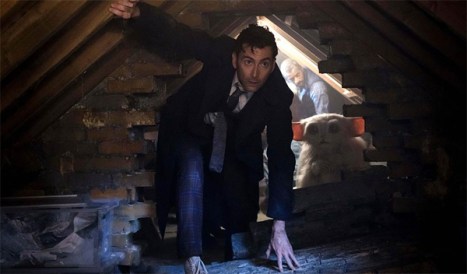
Setting a new ceiling of quality.
More than that, the fourth season represents something of a golden age of Doctor Who. Just in terms of quality, there is a solid argument to be made that the fourth season is the best season of Doctor Who ever produced. It was certainly the most popular. The fourth season finale, Journey’s End, was the most watched show on British television that week, marking the first time that Doctor Who had topped that particular ranking. It was a triumphant accomplishment for Davies. The writer had taken a cancelled and maligned piece of British science-fiction and turned it into the biggest thing on television.
At the same time, there is perhaps something inherently cynical in playing the proverbial hits. After all, The Power of the Doctor was saturated with references and callbacks across the franchise’s long history, including a number of extended cameos from actors who had previously appeared on the show. It is a little disappointing that Davies returned to Doctor Who and felt the need to have to bring back Tennant and Tate. Even allowing for the fact that this is the show’s sixtieth anniversary and the necessity of winning back the audience, it is still somewhat disheartening.
This anxiety is woven into the text of the episode. Encountering an alien rocket that landed in London, the Doctor muses that it is undergoing repairs. “It didn’t land in the steel works by mistake,” he realises. “It came to be mended.” The Doctor himself is having a genuine crisis of identity, admitting to Bingham, “I don’t know who I am any more.” Thoughts of decay and decline permeate the episode. At one point, it’s revealed that Donna opted not to take her husband’s name. “She refused to be Noble Temple because she said it sounds like an old ruin.” This is a process of restoring old ruins.
This is a large part of what these major franchises are now, just callbacks and references to things that the audience already recognises. Strange New Worlds is an entire Star Trek show built around the cast of The Cage, the abandoned original pilot. Ahsoka is a love letter to decades of Star Wars continuity that is borderline impenetrable to casual fans. Movies like The Flash and Indiana Jones and the Dial of Destiny cynically try to tap into generational nostalgia, to restore damaged franchises by bringing back recognisable stars. The Star Beast is not so far removed from these examples.
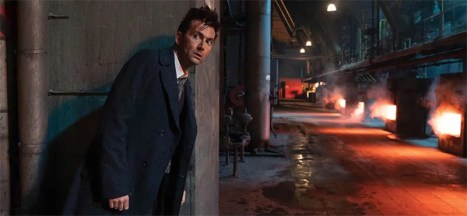
Steel yourself.
To give Davies credit, there are two key factors that elevate The Star Beast. The first is simply that Davies is very good at this stuff. Watching The Star Beast, it’s comforting to be reminded just how good Davies is at writing character and dialogue. On a simple nuts-and-bolts level, one of the big issues with the Chibnall era was that Chibnall was simply never as good at characterisation or banter as either Davies or Moffat. This was obvious from the opening moments of The Woman Who Fell to Earth, which keeps cutting across multiple plot threads to disguise the script’s weakness when it comes to character and dialogue.
In contrast, The Star Beast just luxuriates in its characters. It trusts its cast and its dialogue to hold the audience’s attention. There are consistently funny jokes, clever asides and well-observed lines. To put it simply, it is fun to hang out with these characters again. It is almost a shame when the obligatory alien invasion happens, because it means drifting away from interactions between Donna and her family or between the Doctor and Donna. This is something that has been missing from Doctor Who for more than half a decade. Character exchanges haven’t been this fun since Twice Upon a Time.
Davies just has a keen understanding of human nature. He came up writing soap operas and dramas. He has spent his time away from Doctor Who writing compelling adult television. Chibnall scripts tended to be plot-driven, with characters often jostled along whatever direction the script opted to go. In contrast, Davies’ plotting tended to be a bit looser, because he was always less interested in what exactly was happening than what it meant and who it was happening to.
The nostalgia of The Star Beast runs deeper than the return of Tennant and Tate. This is a classic Davies era season premiere. It is of a piece with episodes like Rose, Smith and Jones or Partners in Crime. It is a thematic introduction to Davies’ idea of Doctor Who, but it is also firmly invested in what it means for a character to wander into the world of Doctor Who. In The Star Beast, Donna is the archetypal Davies era companion, like Rose or Martha or her earlier self. She is a person living a mundane existence who longs for escape and wonder, and who gets swept up in something much larger than herself.
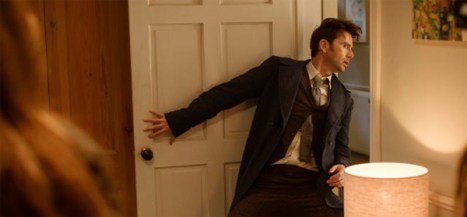
Tennant has always left the door open for a possible return.
Donna is so exceptional because she is so normal. “She’s so ordinary, she’s brilliant,” the Doctor remarks of Donna. Donna’s lament to Sylvia is the same expression of boredom experienced by other Davies era companions. She sits in the kitchen, that most domestic of spaces, and confesses that she wants something more than what she has been given. More firmly tied to an austerity-era Britain, she wonders what has been taken from her. She admits, “Some nights, I lie in bed thinking, ‘What have I lost?'” It’s all archetypal Davies era stuff, with the alien invasion at the heart of the story almost reduced to an afterthought.
Here’s the thing, though: it works. It is obviously different from how Moffat and Chibnall approached their season premieres. Moffat tended to eschew Davies’ pseudo-social-realism for a more fairytale vibe, moving away from flats and terraced houses into country villages and universities. Chibnall never really got it to work. Characters like Ryan or Yaz never got that sort of establishing character beat, never got that sense of perspective or motivation. It often seemed like Chibnall’s companions were there because Doctor Who was a show that had companions, so those characters would work as well as any.
The Star Beast simply works in a meat-and-potatoes way better than any season premiere since The Pilot. It sets up characters and themes in a clear and accessible way. It also does a decent job of setting up the idea of Doctor Who, whether for lapsed viewers or for those who have never watched the show before. The Star Beast reintroduces elements like U.N.I.T., a core part of the franchise’s mythology. It is built around the most accessible of Doctor Who story templates: the alien invasion that escalates to a cataclysmic threat. It’s just efficient and effective in a way that Doctor Who has not been in a while.
To be honest, as cynical as that might sound, that would be enough. The primary purpose of The Star Beast is to effectively restore the audience’s faith in Doctor Who, to demonstrate that the production team can make consistently entertaining television. That’s a low bar, but clearing it is important. This is a far more watchable piece of television than, say, The Vanquishers or Legend of the Sea Devils. It’s satisfying and crowd-pleasing Saturday night television that hits all of its marks. Grading on a curve, it’s the most promising piece of Doctor Who in over five years.
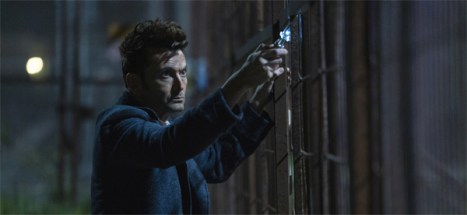
All these puns could become grating.
However, to Davies’ credit, there’s more to it than that. The basic structure and beats of The Star Beast may be classic Davies, but there is something more interesting bubbling beneath the surface. Davies demonstrates that he is as good a writer as he was fifteen years ago, which is a pretty high standard. Then he goes further, demonstrating the extent to which he has grown and evolved in the years since he left Doctor Who. Davies shades The Star Beast with little details that demonstrate how much he has changed in his years away from the franchise.
Most obviously, Davies has clearly been watching Doctor Who. He takes the best aspects from his two successors, and folds them into his approach in a way that demonstrates a sincere willingness to adapt with the times. The best part of the Chibnall era was the extent to which it embraced diversity, both in front of and behind the camera. Davies embraces that lesson, crafting a much more inclusive version of Doctor Who. He casts transgender performer Yasmin Finney as Donna’s daughter Rose, and makes her transition part of the text. He includes Ruth Madeley as Shirley Anne Bingham, a wheelchair-bound scientific advisor.
These are fundamentally good decisions. During his initial tenure, Davies wasn’t always particularly cognisant of issues around race or gender. This time, he is a lot more thoughtful. He has acknowledged as much in discussing the reinvention of Davros in Destination: Skaro. Just like Moffat’s decision to give the Twelfth Doctor “sonic sunglasses” allowed any kid who couldn’t afford to buy a licensed sonic screwdriver to play Doctor Who, there is something commendable in the decision to let Bingham be part of the episode’s action sequences in a way that allows kids in wheelchairs to play Doctor Who.
There’s also a tenderness to The Star Beast. The episode’s decision to tie Rose’s transgender identity to the Doctor is undoubtedly a bit clumsy, feeling like it perhaps explains something that doesn’t need to be explained. It risks reducing Rose’s identity to a bit of continuity and lore. There’s an argument that the connection is arguably best left metaphorical. “She chose her own name,” the Doctor exclaims, drawing a connection between Rose asserting her identity and the Doctor’s decision to call themselves “the Doctor”, a strong theme through the Moffat era.
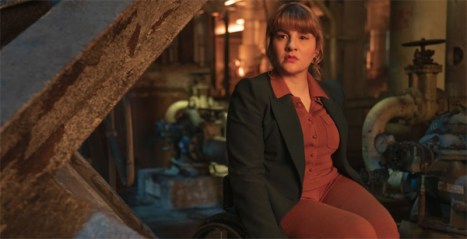
Here comes the science (-tific advisor)…
However, even if the specificity of the execution itself is a little awkward and perhaps even misguided, the decision serves to reaffirm Doctor Who as an inclusive space. The Doctor is transgender. Davies has spoken passionately on the subject, and is working hard to make Doctor Who feel more welcoming. This is undoubtedly something that feels important to Tennant as well. Intention goes a long way in these circumstances, and it’s clear that this comes from a place of earnestness.
This is Davies embracing the single best aspect of the Chibnall era, and more explicitly folding it into the text of the show itself. There is a certain bluntness to this, but it is sincere and endearing. There’s a lovely little scene in which Sylvie talks to Donna about Rose, and acknowledges her fear of accidentally misgendering the young woman or saying the wrong thing. It’s sweet and it’s honest, and it goes a very long way. One of the bigger issues with the Chibnall era was the sense that this inclusive attitude towards production existed entirely at odds with the scripts. Davies interweaves the two.
More interestingly, there is a sense that Davies has also been paying attention to the work done by his direct successor, Steven Moffat. This is even more exciting, because Moffat pushed the boundaries of what Doctor Who could be, and the Chibnall era largely responded by completely ignoring those big ideas. One of the bigger issues with the Chibnall era was the sense that Doctor Who felt much smaller in terms of outlook and ideas than it had in decades, as Chibnall declined to expand on (or even engage with) the ways that Moffat had reinvented Doctor Who.
Davies engages with the legacy of the Moffat era in a number of ways both large and small. Most obviously, despite sharing a name with Davies first companion, Rose is framed in terms that directly evoke Amy Pond – even beyond choosing her own name. In particular, there is a lot of The Eleventh Hour in terms of how Rose’s character is framed. “The shed was the memory of her TARDIS,” the Doctor gasps, recalling how Amy first met the Doctor in the ruins of her garden shed. “The toys,” Donna adds. “Every creature we met she remembered as a toy!” Those fan-made dolls are effectively “the Raggedy Doctor” writ large.
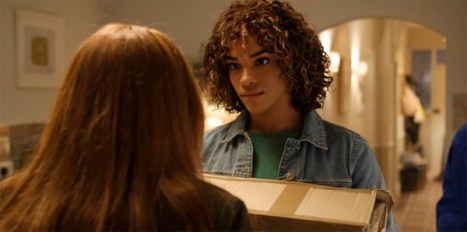
Davies really Rose to the occasion.
More to the point, Rose serves the same function as Amy. She is a young fan whose love of Doctor Who, and whose fannish devotion to it, ends up saving the day. In The Eleventh Hour and The Big Bang, Amy was a metaphor for the fans who saved Doctor Who, bringing the show back from the wilderness through the act of remembering a wondrous thing they encountered as a child. Rose serves a similar purpose. She is a child who grew up with revival Doctor Who, and who ends up being part of the show’s resurrection and revival after this near-cancellation. It’s all very Moffat-esque, if a little inelegant.
Indeed, the inclusion of Rose goes a long way towards tempering the largely legitimate criticisms of The Star Beast as potentially cynical nostalgia bait. While he is delaying the introduction of Ncuti Gatwa for a couple of weeks, Davies is at least cognisant that Doctor Who survives by recruiting new fans rather than pandering to old ones. It’s a show that has always appealed to younger viewers, counting on their affection to sustain it. Doctor Who survives because it is always embracing a new set of fans rather than waiting for its existing fanbase to die.
Crucially, it is Rose who allows Donna to survive the metacrisis. Donna’s daughter provides her with the strength that she needs to continue on. Donna shares her experiences of the Doctor with Rose, even subconsciously, creating a bond that allows the show to continue moving forward. Rose celebrates the show in her own way, preserves it in her toys and her projects. In a very real way, Doctor Who is her inherentence. There’s something heartwarming in that, tempering the obvious nostalgia of bringing back Tennant and Tate.
This Moffat influence is more obvious the emphasis on the importance of memory and continuity. Davies was responsible for resurrecting Doctor Who after more than a decade in television oblivion. He did that largely by establishing firm boundaries between what came before and the show as it existed. The Time War was a metaphor for the gulf that separated the classic and revival eras, a trauma so large that it could never be fully healed. There was an absence at the heart of Davies’ Doctor Who, a sense that his version of the show was – by necessity – something distinct from what came before.
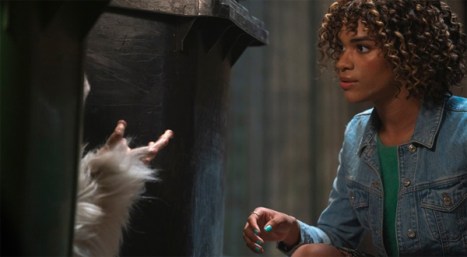
Bin there.
This was the central tragedy of Donna Noble. When she dared to assume a position of equal narrative importance to the Doctor, she had to be punished. That punishment was effectively the erasure of her self. It was the deletion of her time on Doctor Who. Her memory was wiped, just like all those tapes at the BBC or just like all that ambiguous continuity that unfolded across the novels, the comics and the audio plays in the gap between the new and the old series. Boundaries needed to be maintained. There was a natural order to the universe, even if that order was tragic.
The Moffat era challenged and rejected these assumptions. The Time War was resolved in the show’s fiftieth anniversary episode, The Day of the Doctor. In that same episode, Gallifrey was restored. More to the point, Moffat seemed to engage with Donna’s fate. In Face the Raven, Heaven Sent and Hell Bent, Moffat suggested that it was possible for a companion to assume the narrative role of the Doctor without being punished for their hubris. After all, what is “the Doctor-Donna” but the ultimate expression of the thematic idea seeded through the ninth season, “the Hybrid?”
Throughout Moffat’s run, there was this strong recurring emphasis on the idea of memory as identity, one’s self fundamentally tied to one’s awareness and experience. In The Big Bang, the Doctor survives because Amy remembers him. In The Wedding of River Song, even after the timeline resets, Amy insists that her torture of Madame Kovarian still counts because she remembers it. In Deep Breath, the Doctor struggles with his own patchy memory, suggesting that the show’s internal continuity errors are just the result of a faulty memory. In Hell Bent, the Doctor’s memory is wiped rather than Clara’s, inverting Donna’s fate.
More than that, Moffat took an expansive approach to the idea of continuity. If something could be remembered, then it was real within the world of the show and it happened. The Night of the Doctor folds in a lot of the off-screen continuity around the Eighth Doctor. The show would frequently reference comic book stories like Grant Morrison and John Ridgway’s The World Shapers. While Davies adapted the beloved novel Human Nature into live action, it seems notable that The Star Beast marks the show’s sixtieth anniversary by adapting a more niche comic written by Pat Mills and John Wagner and illustrated by Dave Gibbons.
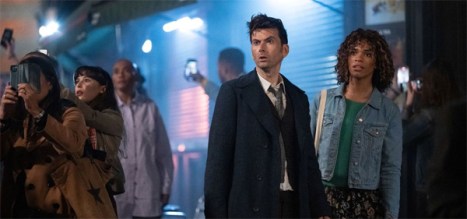
Bringing the show back down to Earth.
Indeed, continuity seems to be a major recurring preoccupation of these three specials. It’s to Davies’ credit that this engagement with the show’s history extends beyond simple nostalgia for its own sake. These three stories seem to be drawing on Doctor Who continuity that exists in lacunas. Rose drew from the popular memory of Doctor Who. It took its cues from Spearhead from Space, one of the most iconic and beloved Doctor Who serials ever produced. In contrast, The Star Beast is drawing directly from a tie-in comic book familiar to only the most hardcore of Doctor Who fans.
In this context, it’s notable that these three specials will culminate in The Giggle, a story that casts Neil Patrick Harris as the Toymaker. Davies has already confirmed that this will be a reimagining of the eponymous character from The Celestial Toymaker, a black-and-white serial that does not exist any longer and has yet to be animated or restored. Interestingly, Michael Gough’s version of the Toymaker got the final line in the “Next Time” trailer that broadcast at the end of The Daleks in Colour. There are, of course, rumours of an upcoming animated adaptation, but could there be a bigger surprise waiting?
There is a sense of Davies engaging with the history of Doctor Who that exists beyond the popular memory of it. The Star Beast is literally and figuratively about the restoration of memory, reconciling the history of Doctor Who that extends even beyond the episodes available in the online “Whoniverse.” Donna is a character who, like Doctor Who itself, has an incomplete memory. The restoration of that memory is the central objective of The Star Beast, creating an expansive vision of the internal continuity of Doctor Who that includes erased episodes and tie-in comics.
The climax of The Star Beast also feels like Davies acknowledging Moffat’s implicit critiques of his writing in stories like Hell Bent. Pointedly, the episode builds to a very Davies era climax. As the stakes escalate, the Doctor finds themselves trapped in a situation where it initially seems like they have to make a truly horrific choice, sacrificing an innocent for the greater good. Davies even frames this in such a way as to evoke the Tenth Doctor’s regeneration in The End of Time, Part II, as the character rages against fate for forcing them into this position. “Why does it have to be this?” he demands.
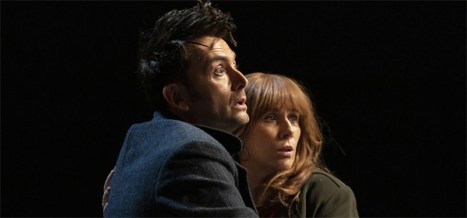
Doctor Donna Friends.
The climax is essentially restaging the end of Journey’s End. “All this coincidence was heading here,” the Doctor laments. He sternly warns Donna, “It will kill you. You’ll die.” Donna decides to make the sacrifice, accepting it as a small price to pay to save the millions of people in London below. This is standard Davies stuff, building to a moment where the companion makes some horrific sacrifice that the Doctor ultimately gets to feel really bad about. The Doctor triggers Donna’s memory.
And she survives. The bad thing doesn’t happen. Donna’s memory is restored, but also her intelligence and canniness. She isn’t just the version of Donna who appeared in Partners in Crime, she is the version of Donna who saved reality in Journey’s End. This is very consciously a post-Clara take on the concept of the companion. It demonstrates that Davies was watching and paying attention to the Moffat era. Much as Moffat engaged with and expanded upon Davies’ work, Davies is taking the opportunity to respond to that. It’s wonderful to see.
Indeed, the ending of The Star Beast makes it clear that Davies has embraced some of Moffat’s lyricism. The closing scenes between the Doctor and Donna in the TARDIS place a lot of emphasis on the importance of memory. When Donna accepts the Doctor’s offer of a cup of coffee, he responds, “With cold milk?” She nods, “Well remembered.” The Doctor presses the point. “I really do remember, though,” he admits. “Every second with you.” It’s a fitting theme for the show’s sixtieth anniversary, the idea that memory is important and should be celebrated.
There are other Moffat-y touches within The Star Beast. Obviously, the episode is an adaptation of an existing comic book story, but it is very much engaged with the idea of monsters in a way that resonates with the recurring motifs of the larger Moffat era. The Meep claims to be pursued by “monsters”, with the Wrarth looking like the sorts of villains who usually feature in Doctor Who, only for the episode to turn that idea on its head. This was a recurring motif in the later Moffat era, with episodes like Hide, Listen and Twice Upon a Time often seeming to explicitly reject the idea of classic “monsters for the sake of monsters.”
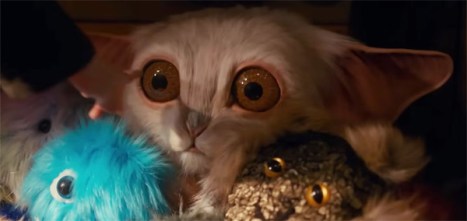
The very “extra” terrestrial.
Of course, Davies is also working with director Rachel Talalay. Talalay is one of the key creative voices of the later Moffat era, directing key episodes like Dark Water, Death in Heaven, Heaven Sent, Hell Bent, World Enough and Time, The Doctor Falls and Twice Upon a Time. By that measure, Talalay is handily one of the best directors ever to work on Doctor Who, and it makes sense that Davies’ return to the show should reteam him with such an important creative figure. It creates a sense of continuity, particularly with episodes like Heaven Sent and Hell Bent.
The Star Beast eschews a lot of the prestige television trappings that defined the Chibnall era, which tended towards a minimalist aesthetic and a desaturated colour palette. The Star Beast establishes itself as big and colourful science-fiction, with a decidedly retro-futurist aesthetic. The Meep’s rocket is all dials and switches on chrome panels. The colours are vivid. The lighting is more vibrant than it has been. The Wrarth look more than a little silly, and unashamedly so. It’s delightful. To be fair, it was nice that the Chibnall era embraced its own style, but it often seemed insecure in itself, as if it was embarrassed to be Doctor Who.
At the same time, this is still the work of Russell T. Davies. Davies still retains his own pet interests and themes. In particular, Davies seems to be returning to his classic conception of the Doctor. Of course, this comparison is somewhat unavoidable given the casting of David Tennant. Tennant steps back into the role as if he hasn’t missed a beat, even though it’s been a decade since he last played the role on television in The Day of the Doctor. Tennant might technically be playing the Fourteenth Doctor, but it’s clear that this is an extension of the Tenth Doctor, right down to the way that he runs.
Moffat presented the Doctor as a fairy tale character, but also a person willing to do the work necessary to become “a good man.” Moffat was decidedly wary of the idea of the Doctor as a war criminal or a legendary figure, preferring to think of the character as “an idiot with a box.” In contrast, Davies approaches the Doctor with genuine almost biblical awe. To Davies, the Doctor is “the Oncoming Storm” or “the Lonely God.” He is a walking weapon of mass destruction, even with the best intentions. It’s interesting how quickly The Star Beast returns to that conception of the character.
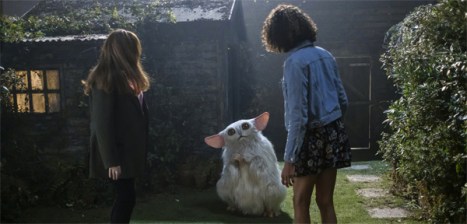
Meep Meep.
This is most obvious with the Meep, which is set as an obvious parallel with the Doctor. “My chosen pronoun is the definite article,” the Meep explains at one point, something that resonates with the Doctor. Telling its sob story about being the last of its kind, much like the Doctor, the creature admits, “It breaks both my hearts.” The Doctor seems to recognise a soul mate. “You’ve got two hearts?” he asks. “So do I.” Like the Doctor, the Meep presents itself as something goofy and harmless before revealing itself to be capable of mass murder at the slightest provocation.
The Meep’s encounter with Rose arguably isn’t too different from how the Doctor tends to pick up his companions. “The Meep is all alone,” it admits to Rose, seeking an obvious emotional connection. It recognises something in Rose that it can appeal to, “You sound lonely.” This is very much in keeping with how the Doctor tends to present himself during the Davies era, as this wounded and mysterious character who is both alone and lonely, and who draws people who feel similarly isolated into his orbit. It’s no wonder the Meep recognises the Doctor as a “two-hearted monster.”
Indeed, it’s tempting to wonder whether the Doctor sees through the Meep’s ruse so quickly because he recognises himself in the seemingly adorable children’s plaything. It’s stunning how quickly the Doctor slips back into his more temperamental earlier persona, warning the gathered aliens, “There will be no violence until such time as I deem it fit and proper.” Indeed, the Meep’s decision to completely destroy London before leaving it behind to go on cool space adventures is arguably only marginally more direct than the Doctor’s tendency to leave thousands of dead bodies in their wake.
Of course, Davies doesn’t really do anything with that idea in the specific context of The Star Beast. After all, The Star Beast is a very meat-and-potatoes episode. It’s about re-establishing the character and the show, setting up larger themes and arcs, and doing so in an accessible and fun way. As such, that point of comparison is seeded as something that the audience can sit with, allowing them to engage with the Doctor as a decidedly more ambiguous figure than he chooses to present himself. Still, it’s very much in keeping with how Davies has traditionally approached the character.
He will knock four times.
With The Star Beast, Doctor Who is back. The question now is where Davies will take it.
Filed under: Television | Tagged: continuity, david tennant, doctor who, Donna, Donna Noble, fan service, history, nostalgia, russell t. davies, the chibnall era, the doctor, the meep, the moffat era, the star beast |



 the m0vie blog
Leave a comment