• Following Us

  • Categories

  • Check out the Archives


  • Awards & Nominations

Non-Review Review: Hell or High Water

Hell or High Water is a modern western, a tale of the land and the people shaped by it.

Hell or High Water revels in the old cowboy tropes. Repeatedly over the course of the film’s runtime, eye witnesses liken the outlaw pair at the centre of the story to “cowboys” or “cowpokes.” Set in West Texas, the film unfolds in a world of cowboy hats and rattlesnakes. This is a story about lonely men in the desert, land and self-determination. At one point, a half-Native American half-Mexican character pauses to reflect upon the idea that this is essentially the foundational myth of the frontier playing out again. The actors might change, but the roles remain the same.

No Country for Young Men.

No Country for Young Men.

Hell or High Water is bitter and cynical reflection on the concept of land and ownership, and the importance that it plays to the American identity. Towards the end of the film, bank robber Toby Howard justifies his actions by reference to generations of struggle; the generations that came before and the generations that will follow, and the land that has either condemned or sustained them. Toby is quite literally building his own future out there on the frontier, his bank robberies motivated by the urge to wrest back his family’s land so he might wrest a profit from it.

Like its lead characters, and like the land that drives them to this desperate course of action, Taylor Sheridan’s script is reserved and restrained. There is an economy to it, a sparseness and a leanness that suits this tale and the people inhabiting it. However, Sheridan’s script implicitly trusts director David Mackenzie, who manages to find a striking beauty and a stunning brutality in this rugged landscape inhabited by these rugged men.
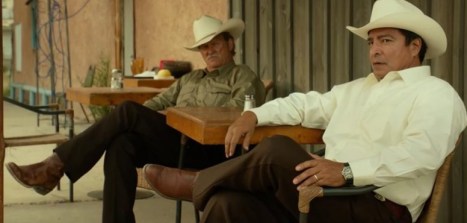
At home on the Ranger...

At home on the Ranger…

Continue reading

Non-Review: Don’t Breathe

Don’t Breathe works reasonably well for about two thirds of its runtime.

The premise of Fede Alvarez’s Detroit-based horror is quite clever, a stew of familiar ideas thrown into a blender and delivered in a very stylish manner. Don’t Breathe is a film that begs to be summarised in pithy one-liners that bridge movie titles using the dreaded “… with …” In those terms, Don’t Breathe is Home Alone meets Halloween, Wait Until Dark meets The Bling Ring, Panic Room meets Saw. The combinations are infinite, as are the influences. And there is a charm to that.

Firing blind.

Firing blind.

Horror is a visceral genre; doing something new is great, but so is doing something familiar in a novel way. For its first two thirds, Don’t Breathe is an exciting and tense horror movie with an ingenious high concept and with a number of reliable jump scares. Fede Alvarez does not necessarily innovate, but he understands how to pace a sequence for maximum tension and he has a great eye for cinematic influences. Contemporary culture can often feel like “remix” culture, mashing old ideas together to create something interesting. Don’t Breathe fits with that.

The problem comes during the movie’s third act, when the thrills and horror slow down just long enough to flesh out the “monster” at the centre of the film. As it pushes into its climax, Don’t Breathe becomes a lot less intriguing and effective. In those final twenty minutes, Don’t Breathe indulges the baser impulses of the horror genre in a manner that is crass and cheap. Don’t Breathe begins as a series of inventive homages to the best that horror genre has to offer. Unfortunately, it ends as a demonstration of the genre’s worst attributes.

Setting his (gun) sight on them.

Setting his (gun) sight on them.

Continue reading

Non-Review Review: The Young Offenders

The Young Offenders is mighty Cork, boi.

Perhaps the most enjoyable aspect of Peter Foott’s coming of age adventure comedy is its sense of place. There are any number of Irish films that depict modern rural life, most obviously the films of John McDonagh (Calvary or The Guard) or Garage or even Smalltown. However, for all that those stories deal with big themes and bold ideas, it is rare to get a perfect sense of place. As with just about any country, Ireland offers a rich and diverse cultural landscape, and The Young Offenders is interested in exploring that landscape even before the first use of a map insert.

theyoungoffenders1

Continue reading

Star Trek – The Savage Curtain (Review)

This July and August, we’re celebrating the release of Star Trek Beyond by taking a look back at the third season of the original Star Trek. Check back every Monday, Wednesday and Friday for the latest update.

Gene Roddenberry returns to Star Trek, to put the show to rest.

Two of the final three episodes of this third season originated with Roddenberry, putting paid to the idea that the veteran executive producer was entirely absent from the year. Roddenberry had departed the show at the start of the season, after issuing NBC with an ultimatum regarding the scheduling of his series. He had moved out of the Star Trek production offices and across the lot to develop his own projects. The standard narrative of the third season suggests that Roddenberry was no longer around to keep the show on the rails.

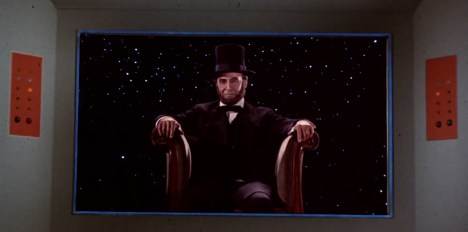
Holy space!Lincoln...!

Holy space!Lincoln…!

This is untrue, in a number of respects. Roddenberry was involved in the production of the third season, just not as actively as he had been. He was responsible for commissioning and championing a number of early third season episodes inherited by Fred Freiberger, including Elaan of Troyius and The Paradise Syndrome. He had even used his remaining leverage to shamelessly try to shoehorn merchandise into Spock’s Brain and Is There in Truth No Beauty? He was also drawing an executive producer salary and nabbed two late-season production slots.

Of course, this argument also relies on the assumption that Roddenberry understood Star Trek better than anybody else. Roddenberry had created Star Trek, but he was not the singular vision behind it. Writers like Dorothy Fontana and producers like Gene L. Coon were as responsible for shaping the show as Roddenberry in many respects. Roddenberry might have talked a good game, but he was also a producer who believed that The Omega Glory would have made a good pilot for the show.

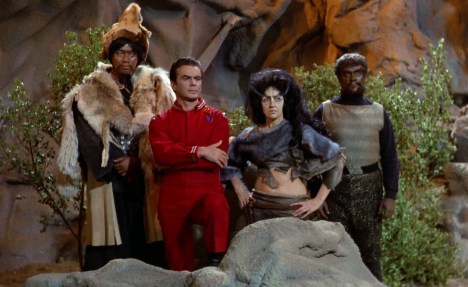
Legion of Doom!

Legion of Doom!

If anything, there is something faintly damning about Gene Roddenberry’s triumphant return to the series at the end of its third year. Neither The Savage Curtain nor Turnabout Intruder are good episodes. In fact, the best thing that can be said about Roddenberry’s two final contributions is that The Savage Curtain probably isn’t quite as bad as And the Children Shall Lead or The Way to Eden. Still, both episodes feel regressive and awkward. Roddenberry’s writing is a reminder of just how far the show had come in the care of other producers.

However, at least The Savage Curtain is memorable.

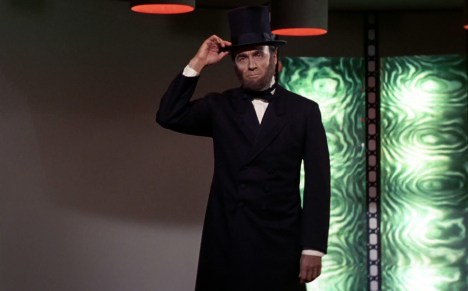
Topping it all off.

Topping it all off.

Continue reading

Star Trek – Requiem for Methuselah (Review)

This July and August, we’re celebrating the release of Star Trek Beyond by taking a look back at the third season of the original Star Trek. Check back every Monday, Wednesday and Friday for the latest update.

Requiem for Methuselah is a surprisingly quiet episode.

The basic premise of the episode suggests sound and fury. The crew of the Enterprise have been infected by a deadly illness. McCoy speculates that there are only four hours in which to save the crew. Desperately searching for a cure, Kirk leads an away team down to a planet rich in the necessary minerals. When a man claiming to be the planet’s sole inhabitant refuses to allow Kirk access to the mineral, there is a tense stand-off; Kirk threatens to have the Enterprise obliterate the man and take the compound by force.

"You know, falling in love with the surrogate daughter of the man who can save my ship might not be the best tactical move here. Particularly since I've known her all of two hours."

“You know, falling in love with the surrogate daughter of the man who can save my ship might not be the best tactical move here. Particularly since I’ve known her all of two hours.”

Despite this rather high-stakes set up, the rest of Requiem for Methuselah is rather low-key. Despite his initial hostility to the uninvited guests, the mysterious stranger invites Kirk and the away team to his home. The episode spares the audience the sight of crew members sick and dying, with Scotty and Uhura (and a “skeleton crew”) doing a respectable job of holding down the fort as the end approaches. Even when the first couple of attempts to manufacture a cure fall flat, McCoy and his colleagues remain professional and dignified through to the end.

In a way, this would seem to capture the tone of this stretch of the third season.

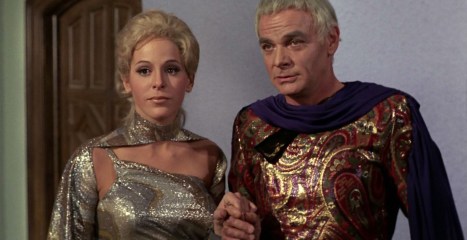
Our man Flint.

Our man Flint.

Continue reading