












Tarzan is a mess. The core tale of a boy raised by apes who struggles to reconnect with his human heritage will always have resonance – the character has endured much more successfully than Edgar Rice Borroughs’ other pulp hero, John Carter. However, this motion-capture adaptation feels like it spends more time pandering and condescending than it does trying to tell an interesting or engaging story.
All the “big” Tarzan moments are hit with the enthusiasm of checking off a list (from “me, Tarzan — you, Jane” to “ooo-ee-ooo-ee-ooo-ee-ooo!”), but there is a staggering lack of trust in the idea of Tarzan to carry a Tarzan movie. Tarzan is a family film that very heavily talks down to its audience – a family constructed around the idea that children aren’t smart enough to follow basic narrative structures. So not only is the plot incredibly one-dimensional, predictable and linear, it is repeatedly and patronisingly explained to the audience.

I am Tarzan, hear me roar!
The last decade has seen an explosion in family-friendly movies that don’t talk down to the younger members of the audience. They recognise that children are not idiots and are capable of following basic plot structures and recognising archetypes. Generally speaking, the success of classic Pixar speaks to the idea that children are shrewder than most animators would have conceded. The strong family films of the last few years have followed suit, realising that kids don’t just want bright colours and snazzy animation – they want the same thing any viewer wants, a good story well told.
Tarzan feels like something on an unnecessary hold-over. The movie looks fairly good – even if the motion capture isn’t cutting edge, the 3D is rendered very well; even if the environments outside the jungle look like levels from a videogame, the jungle itself feels vibrant. However, the script isn’t even willing to stand aside and let the visuals carry the story. The result is a patronising and condescending mess that feels like it is talking down to an audience that it grossly under-estimates.
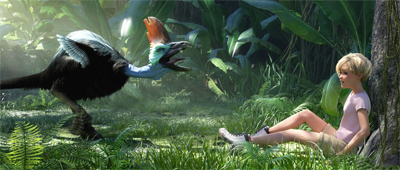
Bird song…
The obvious point of comparison here is Walt Disney’s take on Tarzan from 1999. While not ranking among the best of the studio’s animated pantheon, the story came at the tail end of what had been a fantastic decade for the studio. It won’t be grouped with classics like The Lion King or Beauty and the Beast, but that version of Tarzan was an effective version of the story told well. It wasn’t quite as mature or sophisticated as the films that would be produced by Pixar, but it acknowledged that children could follow a simple plot and understand basic storytelling concepts.
In contrast, this more modern adaptation of Tarzan feels practically pre-historic, despite the presence of helicopters or machine guns or walkmen or a moral about green energy. In sheer storytelling terms, Tarzan is a mess. It never seems to know exactly what audience it is aiming for. Condescending narration is looped over the animation, as if aimed at pre-school children who might need to be made aware of the the fact that sharp-fanged gorilla we just saw bludgeon another gorilla to death is “evil.” At the same time, some of the movie skews old. At one point, Jane quips, “This is a jungle, not a singles bar.”
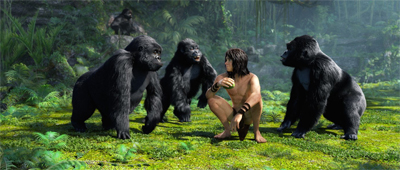
Monkey business…
This confusion seeps into every frame of the film. Tarzan is presented as a hero so noble that he will not bring himself to slay a brutal rival gorilla, one responsible for killing both a male rival and an infant. However, retreating businessmen are apparently fair game. “They’re getting away!” Jane gasps as some executives manage to make it into a helicopter and try desperately to get out alive. Our heroic Tarzan is having none of that, and so makes sure to send the corrupt executive, his lackey, and their unfortunate pilot, to an early grave. Because that’s how we win this war, people.
That said, for a movie so bloodthirsty, Tarzan has surprisingly little stomach for violence. Family-friendly films can address violence and death, in ways that children are able to deal with. Often, it serves as a catalyst for some mature discussion or reflection. Instead, Tarzan is positively excited by violence. Our hero’s most trust tool is a knife that has not been rusted with age. He uses it freely, against rival gorillas and wild crocodiles. In both cases, he breaks the skin. In both cases, the movie doesn’t seem shocked or horrified; just oddly impassive.

Meet the parents…
Never has a scene of a young infant falling to its death been rendered so completely ineffective as it is here. Similarly, the brutal bludgeoning of of a rival by an “evil” gorilla seems more like a light tap on the head. At one point, our corrupt executive launches an attack on somebody close to Tarzan, to up the dramatic stakes; however, the film is curiously sedate when dealing with that plot point. The result is something that feels almost cynical – an attempt to have its cake and eat it too. Tarzan carries a knife he uses in combat and other characters die, but the fact that this is unpleasant is never addressed.
There’s an argument to be made that Tarzan is trying to avoid upsetting young children; however, the way that it relishes these violent acts as convenient plot devices is a little unsettling. Violence that is so bland it is portrayed as generic and meaningless feels something that should be less welcome in a family film than violence that is horrific and has consequences. Again, Tarzan hits on many of the same scenes and set ups as the older Disney film, but the Disney film is able to render these sequences in a way that is much more effective while seeming considerably less cynical.
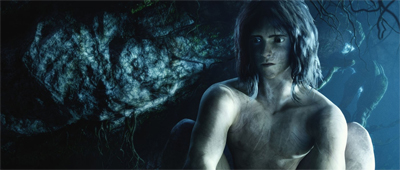
Tarzan fights dirty…
There’s a lot about Tarzan that feels cynical. It features a gigantic power-generating asteroid as a plot device, but that seems to exist purely so the movie can feature dinosaurs in its opening ten minutes. The movie also borrows quite heavily from the iconography of various superhero movies – with a strange focus on 2005. There’s a precious creepy asteroid setting that evokes Superman Returns and Tarzan even employs a few moves from the Batman Begins playbook.
The climax also feels heavily influenced by Avatar, with a “nature vs. the military industrialists” showdown that asks the audience to celebrate what amounts to cold-blooded murder. There’s even a rather weird supporting character introduced in the last act purely to creepily threaten Jane (with no prior context) who seems to have been designed to evoke Stephen Lang’s Quaritch from Avatar.
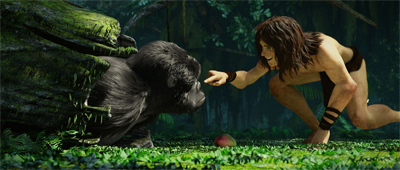
Logging some complaints with the animal cruelty people…
The 3D on Tarzan is actually pretty great, well-rendered from the source material. The computer animation is less impressive, looking a little bit dated and allowing characters to wander into the uncanny valley. The audio dub sits particularly uncomfortable on top of the film. That said, with some better direction and art management, the movie could have looked a lot better. There are moments when the film seems to embrace its hero, allowing him to swing through the vines and run along fallen logs, but these moments are too few and far between, often interrupted by horribly pointless and condescending narration.
Every time it seems like the movie might find its feet or catch its breath, the script steps in to smother any hope that might be lingering. Our villain tries to coerce an employee into cooperating with a little economic blackmail; the script thinks this may be too subtle, so he segues into threatening the man’s daughter. This is movie that unironically offers the observation, “Tarzan had found the one thing more powerful than all the energy in the universe: the love of a woman.” I’m a little curious to see Tarzan balancing those scales and crunching those numbers, to be honest.

It’s a jungle out there…
Tarzan endures as one of the great pulp fiction characters. Unfortunately, Tarzan seems unlikely to endure as one of the more worthy adaptations.
Filed under: Non-Review Reviews | Tagged: film, Movie, non-review review, review, tarzan, tarzan (2013) |



 the m0vie blog
Leave a comment