• Following Us

  • Categories

  • Check out the Archives


  • Awards & Nominations

Doctor Who: The Doctor, The Widow & The Wardrobe (Review)

To celebrate the fiftieth anniversary of the longest-running science-fiction show in the world, I’ll be taking weekly looks at some of my own personal favourite stories and arcs, from the old and new series, with a view to encapsulating the sublime, the clever and the fiendishly odd of the BBC’s Doctor Who.

The Doctor, The Widow & The Wardrobe originally aired in 2011.

I don’t understand. Is this place real, or is it fairyland?

Fairyland? Oh, grow up, Lily.

Fairyland looks completely different.

– Lilly and the Doctor get their geography straightened out

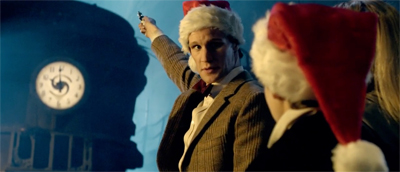
The Doctor, The Widow and the Wardrobe is, like A Christmas Carol before it, a rather wonderful idea. A Christmas Carol mashed up Doctor Who with one of the best-loved Christmas narratives of all time. The Doctor, The Widow and the Wardrobe does something similar, substituting CS Lewis for Charles Dickens. It’s a fantastic idea, given that Doctor Who is the spiritual successor of that peculiarly British thread of childhood fantasy.

The only real problem with The Doctor, The Widow and The Wardrobe is that it can’t quite stretch that good idea across an hour of television.
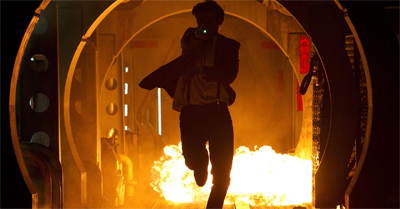
On the run again...

On the run again…

Continue reading

My 12 for ’13: Philomena & Harsh Truths

This is my annual countdown of the 12 movies that really stuck with me this year. It only counts the movies released in Ireland in 2013, so quite a few of this year’s Oscar contenders aren’t eligible, though some of last year’s are.

This is number 8…

Every country has its own shameful secrets, the parts of its history that it would gladly lock away in a box far from prying eyes, and would be happy to never speak of them again. Slavery has been pushed to the forefront of American popular consciousness over the past year or so. Spielberg’s Lincoln dealt with the topic in a very philosophical manner, while 12 Years a Slave offered a more visceral exploration and Django Unchained sought to shock and discomfort its audience with its exploration of past atrocities.

In Ireland, we have an entire lost generation. In a society where the Catholic Church held an inequitable amount of authority, and prevailing moral values led to condemnation of single mothers, countless young women effectively signed their lives away to indentured servitude, parting with their children and devoting years of their lives to financing the church by providing free labour. It’s something that we’ve only recently begun to come to terms with, with Taoiseach Enda Kenny apologising publicly for their treatment in February of this year.

Philomena bristles with a righteous sort of anger, offering the remarkable story of one woman who lived through that.

philomena3

Continue reading

Doctor Who: A Christmas Carol (Review)

To celebrate the fiftieth anniversary of the longest-running science-fiction show in the world, I’ll be taking weekly looks at some of my own personal favourite stories and arcs, from the old and new series, with a view to encapsulating the sublime, the clever and the fiendishly odd of the BBC’s Doctor Who.

A Christmas Carol originally aired in 2010.

If you’re my babysitter, why are you climbing in the window?

Because if I was climbing out of the window, I’d be going in the wrong direction. Pay attention.

– Kazran and the Doctor get things straight

A Christmas Carol might just be the best Doctor Who Christmas Special ever produced, if only because it’s such a brilliantly obvious idea, executed with the show’s traditional wit and charm. Russell T. Davies tended to write the Christmas Special in the style of a gigantic blockbuster episode of Doctor Who, but Moffat adopts a slightly different approach to what has quickly become the annual tradition of the Doctor Who Christmas Special.

Davies traditionally had the Doctor collide with genres of Christmas television viewing. The Christmas Invasion was American blockbuster sci-fi, The Runaway Bride was fun odd-couple comedy action film, Voyage of the Damned was a disaster flick in space and The Next Doctor was a celebration of quaint Victoriana. In contrast, Moffat has Doctor Who collide with beloved children’s stories in his first two Christmas Specials. His second two are burdened with dealing with left-over plot threads.

A Christmas Carol is perhaps the most effective distillation of “Doctor Who as a story” that the show has ever managed, on top of being a wonderfully moving piece of Christmas television and hitting on the major themes of the Moffat era as a whole.

Turning back the clock...

Turning back the clock…

Continue reading

My 12 for ’13: Iron Man 3 & Shane Black’s Christmas in April

This is my annual countdown of the 12 movies that really stuck with me this year. It only counts the movies released in Ireland in 2013, so quite a few of this year’s Oscar contenders aren’t eligible, though some of last year’s are.

This is number 9…

While Tim Burton’s underrated Batman Returns remains the definitive superhero Christmas movie, Iron Man 3 comes pretty darn close. Which is very strange, for a movie released in towards the end of April in Europe and in the United States in early May. This paradoxical festivity is just one of the many ways that Iron Man 3 feels more like a Shane Black film than a piece of the expansive and ever-growing Marvel Cinematic Universe.

And that’s a good thing.

ironman3a

Continue reading

My 12 for ’13: Much Ado About Nothing & The Joy of a Shakespearean Sex Comedy…

This is my annual countdown of the 12 movies that really stuck with me this year. It only counts the movies released in Ireland in 2013, so quite a few of this year’s Oscar contenders aren’t eligible, though some of last year’s are.

This is number 10…

I feel a little sorry for Shakespeare. The guy wrote some of the most influential and iconic plays ever composed; invented countless turns of phrase and even words; became inexorable associated with theatre and stage work… and yet he’s still hated by just about every student forced to sift through Romeo & Juliet or Hamlet or Macbeth as part of their education. While Shakespeare is easy enough to read once you get a grip of it, or once you have enough experience, forcing kids to read those plays at school is one of the most effective ways to kill enthusiasm for the Bard.

The beauty of Shakespeare is that he isn’t just an “important” writer, that he isn’t just a key part of the evolution of world literature, a formative figure in the history of narrative. Not that any of those are minor accomplishments, mind you. The real beauty of Shakespeare is that he’s actually very good. Not with qualifications like “… for his time” or “… in context.” Shakespeare remains a great writer in the most fundamental “this is actually a pretty good story well told” sort of way.

muchadoaboutnothing3

The best directors to adapt Shakespeare’s work to film realise this, and accept that Shakespeare is still a great storyteller; you just need to figure out how to translate his works properly to the screen, in the same way you’d translate a modern best-seller or a beloved cult comic book. Kenneth Branagh figured out how to do this, with his adaptations almost popping off the screen.

Much Ado About Nothing demonstrates that Joss Whedon has it pretty figured out as well.

muchadoaboutnothing5

Continue reading

My 12 for ’13: Lincoln & Lawyering

This is my annual countdown of the 12 movies that really stuck with me this year. It only counts the movies released in Ireland in 2013, so quite a few of this year’s Oscar contenders aren’t eligible, though some of last year’s are.

This is number 11…

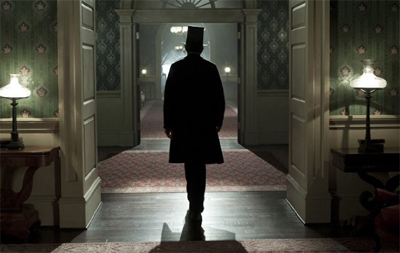
At its best, Lincoln manages to capture that beautiful conflict at the heart of democracy – the question of the difference that exists between democracy as a form of government and simple majoritarianism. Is it possible to preserve these fine and noble institutions and structures while constantly working around them?

lincoln11

Continue reading

Doctor Who: The Specials (Review/Retrospective)

In theory, the specials were a great idea. The BBC is in the middle of converting to high-definition broadcast. One of their best-loved and most respected dramas isn’t quite ready to make that leap, and will require extensive re-working in order to be sustainable for high-definition broadcast, which seems to be the future of home entertainment. It’ll be a year before the show can get back to churning out thirteen episodes and a Christmas Special.

However, the show runner who brought the show back from the dead and turned it into a highlight of your broadcast schedule, and the beloved lead actor who has become deeply associated with the lead role are willing to do a series of five specials that you can broadcast to fill the gap year. Producing a series of Doctor Who specials to tide over the viewing public and keep the show fresh in the public’s mind was a great idea. After all, you don’t want fans to forget about the show.

doctorwho-theendoftimepart2o

The plan has the added benefit of allowing Russell T. Davies and David Tennant a bit more freedom to stretch their wings. Davies can work on Torchwood in a way that he was never able to find time before, producing the superb Children of Earth. Tennant can work with Royal Shakespearean Company, playing the lead in Hamlet. All this, and fans get their prescription dose of Doctor Who and the BBC has the time to upgrade the show so it can broadcast in high definition. Everybody wins! Everybody stays happy!

Unfortunately, there’s a bit of a catch. It turns out that these five episodes have to do more than merely “tide” fans over. These five specials are also the last episodes that will be written by Davies and that will star Tennant. So these five specials become more than just a way to stop the public forgetting about Doctor Who. They also have to close out what has been a phenomenal era for the show, and wrap up everything in a nice big bow. And this is where the specials don’t really work.

doctorwho-thewatersofmars19

Continue reading

Non-Review Review: Anchorman 2 – The Legend Continues

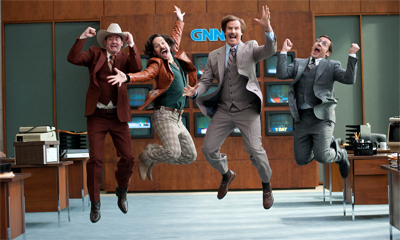
Anchorman 2: The Legend Continues is perhaps twenty minutes too long, and indulges in a little bit too much of the nostalgia common in comedy sequels during its final act, but it’s a movie with its heart in the right place. More message-driven than its direct predecessor, and much more of an ensemble piece, Anchorman 2: The Legend Continues is an enjoyable example of the sorts of cringe comedy that made the original such a cult classic. While it might not measure up perfectly, it ranks quite highly among the annals of comedy sequels.

Jumping for joy?

Jumping for joy?

Continue reading

My 12 for ’13: Blue Jasmine & The Power of a Lead Performance

This is my annual countdown of the 12 movies that really stuck with me this year. It only counts the movies released in Ireland in 2013, so quite a few of this year’s Oscar contenders aren’t eligible, though some of last year’s are.

This is number 12…

There are a lot of reasons to like Blue Jasmine. Woody Allen adapting Tennessee Williams for the Great Recession was always going to be worth a look. The film’s elegant jazz-style narrative style, one that’s free-form but still hits the key notes. The brilliant supporting cast that even hints at a possible rehabilitation for Andrew Dice Clay.

However, there’s one reason above all others to love Blue Jasmine: Cate Blanchett.

bluejasmine4

Continue reading

Doctor Who: The Next Doctor (Review)

To celebrate the fiftieth anniversary of the longest-running science-fiction show in the world, I’ll be taking weekly looks at some of my own personal favourite stories and arcs, from the old and new series, with a view to encapsulating the sublime, the clever and the fiendishly odd of the BBC’s Doctor Who.

The Next Doctor originally aired in 2008.

Oh, goodness me. Well. But this is… but this is nonsense.

Well, that’s one word for it.

Complete and utter, wonderful nonsense. How very, very silly.

– Jackson Lake and the Doctor

The Next Doctor actually has a pretty audacious concept. It’s one gigantic tease that plays off the audience’s media savvy. Airing after David Tennant’s departure from the role had been announced, but before Matt Smith had been named as Tennant’s successor, The Next Doctor is one gigantic tease. Like the surprise “regeneration” at the climax of The Stolen Earth, it’s a shrewd attempt to turn the audience’s expectations against themselves.

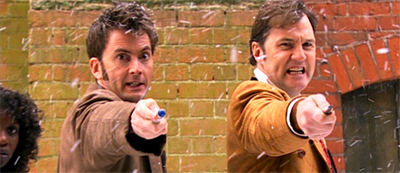
After all, the gap between an announced departure of an existing lead and the point where he actually leaves is rife for experimentation – particularly in a show about time travel. Up until The Next Doctor actually aired, it was quite possible that David Morrissey was Tennant’s successor, and The Next Doctor was a rather clever twist on the classic “multi-Doctor” story by having the Doctor team up with his future self.

Of course, as with The Doctor’s Daughter, Davies was just teasing. It’s to Davies’ credit that The Next Doctor remains interesting even after the illusion begins to slip. The first half is actually a wonderfully solid mystery and character study, albeit one that descends into confusion and chaos in the second half of the episode.

The Next Doctor...?

The Next Doctor…?

Continue reading