• Following Us

  • Categories

  • Check out the Archives


  • Awards & Nominations

Star Trek – The Alternative Factor (Review)

To celebrate the release of Star Trek: Into Darkness this month, we’ll be running through the first season of the classic Star Trek all this month. Check back daily to get ready to boldly go. It’s only logical.

Well, here we are. The Alternative Factor. We’ve had weak episodes before. I’ll concede that shows like Court Martial and The Menagerie, Part II wouldn’t rank among my favourites of the season. However, there was always just enough there to make them interesting, if not compelling. There were good ideas, clumsily executed. There was something value to be found in watching these episodes. The Alternative Factor lacks those sorts of redemptive values, and it’s the first time on this re-watch I have actually wondered where my fifty minutes went, and lamented the fact that watching The Alternative Factor inched me ever-closer to death.

The Alternative Factor is – I’d argue – the weakest episode of a remarkably strong first season of Star Trek. While some would consider it one of the worst episodes the show ever produced, I’m reluctant to commit to that sort of certainty. After all, we still have the third season to come, and I’m hesitant to rank The Alternative Factor as that much worse than The Turnabout Intruder or The Way to Eden or And the Children Shall Lead or Spock’s Brain. Yep, there’s a lot to look forward to if I ever get around to finishing the third season of the show.

Still, the fact that The Alternative Factor might possibly not be the worst thing to happen to Star Trek in its nearly fifty years of existence is damning with faint praise. But I’m sure the episode will take whatever it can get.
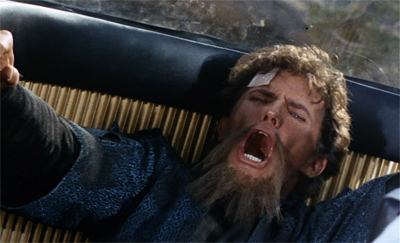
It hurts!

It hurts!

Continue reading

The Fantastic Four #108 – The Monstrous Mystery of the Nega-Man (Review)

To celebrate the release of Star Trek: Into Darkness this month, we’ll be running through the first season of the classic Star Trek all this month. Check back daily to get ready to boldly go. It’s only logical.

We’ll be supplementing our coverage of the episodes with some additional materials – mainly novels and comics and films. This is one such entry.

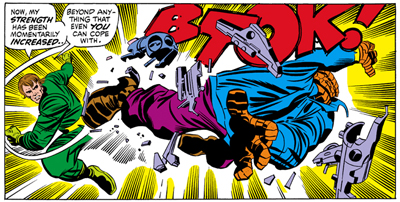
Jack Kirby is one of the defining comic book creators of the twentieth century. He started out working in the medium during the Great Depression. He was a major force during the Golden Age of comics, creating the character of Captain America in 1940. However, Kirby displayed an incredible ability to evolve and adapt over time. In the 1970s, for example, Kirby would move towards crafting cosmic odysseys and epic god-like conflicts. However, during the 1960s, he played a huge role in the development of Marvel Comics during the 1960s. With a flair for science-fiction story-telling and a knack for crafting iconic characters, Kirby came to be one of the talents who defined the period known as “the Silver Age.” Working with Stan Lee, Kirby created characters like The Fantastic Four and The X-Men, who defined not just Marvel, but the entire medium.

I think it’s fair to cite Star Trek as a major influence on Jack Kirby’s work in comic books, particularly his later work on The Fantastic Four. I know that his fans can be very protective of their idol, and he certainly deserves a lot of the praise heaped upon him. I know that Kirby’s possible influence on Star Wars remains a massive bone of contention. That said, I suspect that Star Trek made quite an impression on Kirby.

A smashing time...

A smashing time…

Continue reading

Star Trek – Arena (Review)

To celebrate the release of Star Trek: Into Darkness this month, we’ll be running through the first season of the classic Star Trek all this month. Check back daily to get ready to boldly go. It’s only logical.

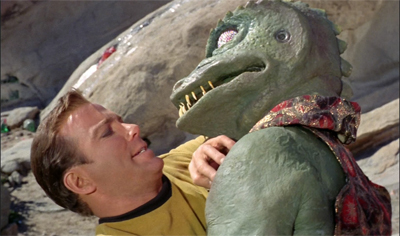
Arena is a fascinating piece of Star Trek, because it’s such an iconic and important piece of franchise history, despite the fact that it’s far from the best that the show has to offer. Indeed, the basic premise of the show is rather generic science-fiction B-movie stuff. Kirk is forced to compete against a lizard-like alien by some god-like beings to ensure the survival of his crew. The script, by producer Gene L. Coon, is credited to a story written by Fredric Brown. Despite its similarities to Brown’s short story of the same name, Arena also shares quite a few plot points with a 1964 episode of The Outer Limits, Fun & Games. None of this is to suggest that Coon was consciously channelling these sources when he wrote the teleplay, just to illustrate how generic the basic plot is.

However, despite (or perhaps because of) this rather straightforward and familiar set-up, Arena is a truly memorable episode of Star Trek. Like quite a few other episodes of the original Star Trek, the episode produced images and concepts that have resonated well outside Star Trek fandom, to the point where elements like the Gorn or Kirk’s highly dubious improvised weapon will be recognisable to people who have never actually seen the episode. However, the episode is also vitally important to the Star Trek franchise itself, as it offers a more thorough expansion and exploration of the back story that has been inconsistently hinted at throughout this first season. Arena is really the first episode to feature a fully-formed framework for the internal logic of the Star Trek universe, one that has informed half-a-century of the franchise.

Plus, you know, Kirk wrestles a lizard man.

Don't pretend you aren't loving every minute of this, Shatner!

Don’t pretend you aren’t loving every minute of this, Shatner!

Continue reading

Star Trek: The Next Generation – Requiem by Michael Jan Friedman & Kevin Ryan (Review)

To celebrate the release of Star Trek: Into Darkness this month, we’ll be running through the first season of the classic Star Trek all this month. Check back daily to get ready to boldly go. It’s only logical.

We’ll be supplementing our coverage of the episodes with some additional materials – mainly novels and comics and films. This is one such entry.

At the risk of stating the obvious, Star Trek is a franchise spanning almost half-a-century with six leading actors and five different television shows. Due to its nature, one of the more enjoyably fanboy-ish pastimes is attempting to reimagine various confrontations and encounters, swapping out the characters involved. How would Kirk have responded to the Borg? Would Sisko have been ideally suited to dealing with the Xindi threat? What if Janeway faced the Doomsday Machine? Different characters have different defining moments, and those moments often play to their particular strengths. It might be fun to watch Khan spar with Picard, but it probably wouldn’t work as well as it did with Kirk. Q and Kirk would probably have difficulty striking it off.

Still, Kirk’s confrontation with the Gorn in Arena stands as one of the most iconic moments in the whole of the franchise, to the point where the weird toga-wearing god-like being at the end barely gets a look-in. Indeed, based on Sisko’s fanboy gushing in Trials and Tribble-ations, it seems to be one of Kirk’s defining moments within the shared Star Trek universe. So it might be fun to take Captain Jean-Luc Picard, and put him through that same sort of confrontation.

tng-requiem

Continue reading

Star Trek – The Squire of Gothos (Review)

To celebrate the release of Star Trek: Into Darkness this month, we’ll be running through the first season of the classic Star Trek all this month. Check back daily to get ready to boldly go. It’s only logical.

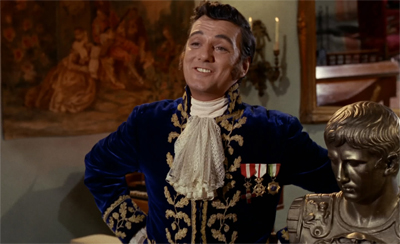
It’s easy to see why The Squire of Gothos has become such a Star Trek touchstone. The show is iconic, but there are particular images and ideas that resonate beyond the core fanbase. Captain Pike’s wheelchair from The Menagerie is one such example, as is the fight with the Gorn from Arena. It’s amazing that Star Trek could produce so many memorable and distinctive images so quickly. Trelane might not have the same name recognition, or even the same pop culture cache, but The Squire of Gothos makes quite an impression.

Indeed, the image of a god-like being acting like a spoilt child, dressed in all manner of period military clothing is a great visual, and it’s little wonder that Roddenberry would return to that idea when he was writing Encounter at Farpoint, the first episode of Star Trek: The Next Generation. Similarly, The Squire of Gothos is one of the major influences on Futurama‘s superb parody/homage, Where No Fan Has Gone Before, right down to the wonderful “twist” ending that has been spoiled by almost half-a-century of pop culture osmosis.

Still, even apart from its massive influence on pop culture, The Squire of Gothos is still a fantastic piece of television, and an example of Star Trek at its very best.

It's hip to be squire...

It’s hip to be squire…

Continue reading

Doctor Who: The Name of the Doctor (Review)

How do we get down there? Jump?

Don’t be silly. We fall.

– Clara and the Doctor set things straight

Like The Wedding of the River Song, The Name of the Doctor suggests that Moffat might be better served by reverting to the Davies-era model of two-part season finalés. The strongest season ender of the Moffat era (and probably the best season finalé of the revived show) was The Big Bang, because it felt like Moffat had enough space to allow his ideas to breathe. The Name of the Doctor is a lot sharper and a lot more deftly constructed than any of the closing episodes from Russell T. Davies’ seasons, but it feels a little too compact, a little too tight for its own good.

To be fair, Moffat is has very cleverly structured his season. The mystery of Clara was seeded as early as Asylum of the Daleks and hints have been scattered throughout the past year of Doctor Who. Even the build-up to the final line of the episode feels like an idea that Moffat has been toying with since The Beast Below. Despite all this, it still feels like The Name of the Doctor could do with a little more room to elaborate and develop the concepts at the core of the story.

Journey to the centre of the Doctor?

Journey to the centre of the Doctor?

Continue reading

Star Trek – Shore Leave (Review)

To celebrate the release of Star Trek: Into Darkness this month, we’ll be running through the first season of the classic Star Trek all this month. Check back daily to get ready to boldly go. It’s only logical.

When I talk about the surreal sixties energy that really holds quite a bit of Star Trek together, it’s quite possible that it sounds like a back-handed compliment, a cheap and easy gig at a cult television show. However, I mean that sincerely. When I argue that the illogical and somewhat scattershot dynamism of the last act of Court Martial can barely hold the patchwork script together, it’s quite possible that I sound like I’m being sarcastic. However, my affection for the mad-cap mayhem particular to the first iteration of Star Trek is entirely genuine. Although it makes no sense, the climax to Court Martial isn’t the problem. Everything leading up to it is.

I think Shore Leave is pretty much the perfect iteration of this concept. It is, from start to finish, absolutely insane nonsense that threatens to fall apart if one concentrates too hard on any particular detail. However, it’s executed with enough energy and drive that it becomes a compelling and surreal piece of television, and one of the best illustrations of the kind of weirdness that the classic Star Trek could pull off almost effortlessly.

No bunny business...

No bunny business…

Continue reading

Star Trek – The Menagerie, Part II (Review)

To celebrate the release of Star Trek: Into Darkness this month, we’ll be running through the first season of the classic Star Trek all this month. Check back daily to get ready to boldly go. It’s only logical.

I will admit that I am sceptical of Gene Roddenberry as a writer. There’s no denying that Roddenberry was a fantastic ideas man. After all, his concepts and characters have stood the test of time. Without Roddenberry, there would be none of the Star Trek that we all love so dearly. As such, I feel a little guilty when I criticise his writing, or when I argue that his influence on the early years of Star Trek: The Next Generation held the show back from greatness. (I’d suggest that it was only when Roddenberry’s involvement was minimised, and the writers were allowed to add shading to his futuristic utopia that The Next Generation truly came into its own.)

Still, Roddenberry was always an excellent salesman, and his script for The Menagerie brings out that quality in abundance. The Menagerie is effectively an excuse for why the show ran out of original scripts half-way through its first year, and Roddenberry might not make the most convincing argument, but he still makes it compelling.

Watching Star Trek on Star Trek...

Watching Star Trek on Star Trek…

Continue reading

Star Trek – Burning Dreams by Margaret Wander Bonanno (Review)

To celebrate the release of Star Trek: Into Darkness this month, we’ll be running through the first season of the classic Star Trek all this month. Check back daily to get ready to boldly go. It’s only logical.

We’ll be supplementing our coverage of the episodes with some additional materials – mainly novels and comics and films. This is one such entry.

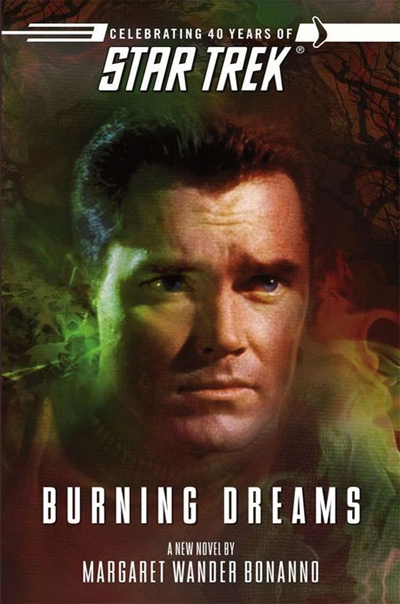
It’s amazing just how iconic and influential the character of Christopher Pike is, despite the fact that he only appeared as a guest character in a two-part episode of the first season of Star Trek. Of course, he was the lead character of a pilot that was filmed in 1964, but not aired until almost a quarter of a century later, but it still seems strange that the character should hold such sway over Star Trek fandom. Perhaps it’s a sign of how preoccupied fans are with trivia and minutiae. Maybe it’s a sign of how skilfully Star Trek cultivates holes in its own mythology (in this case Pike’s time as captain) for the fans to fill. It might even be the lingering sense of tragedy surrounding the “captain who never was”, played by an actor who died at the young age of 42.

Whatever the reason, it feels appropriate that Pike was one of the characters celebrated and included in the franchise’s 40th anniversary celebrations, and the character is well served by the decision to task Margaret Wander Bonanno with writing “the definitive Pike novel.”

tos-burningdreams

Continue reading

Non-Review Review: The Great Gatsby (2013)

The Great Gatsby feels like candy floss for the soul. A little of it is tempting, even appetizing. It was a curious texture, a strange sense of lightness, but also curiously heavy. Appealing to look at, and fun to pick at, it’s not something to be digested in large portions. The opening fifteen minutes of The Great Gatsby pop and sizzle, as Luhrman blends stylish visuals with an inability to keep anything still. The cameras, the actors and even the scenery seem to be moving to a beat – one occasionally intruding on the sound track. Such energy and vibrance is hard to resist, but it’s also exhausting – as much for the film as the audience. Once the movie settles into its own style and routine, it winds up feeling a lot like its protagonist. You’re not quite sure it’s really there.

thegreatgatsby2

Continue reading