












To celebrate the release of The Adventures of Tintin: The Secret of the Unicorn in the United States later this month, I’ll be taking a look at some of nineties animated television show. Check back daily!
Note: This is our review of the animated episode, check out our review of the book here.
We’re just finished the more fantastical series of Hergé’s adventures, where he took his lead (and supporting cast) to the bottom of the ocean, to the heart of a lost Inca society and even to the moon itself. The animated series proved quite adept at handling these stories. The fact that Hergé’s two-part adventures translated to four-part feature-length episodes was just icing on the cake. However, I find myself wondering how the team will handle The Calculus Affair. It’s a relatively mature adventure, and it represents a point where the series became considerably more self-aware and reflexive. Given some of the changes made to earlier stories, I can’t help but wonder how the series will deal with these very different themes and ideas.
Tintin must have ticked off some important people in his time...
At its core, The Calculus Affair is a Cold War thriller, that sees Professor Cuthbert Calculus develop a potential weapon of tremendous power, which leads to his kidnap. Naturally, a foreign power wants to get its hand on this weapon of mass destruction, reflecting the nuclear arms race that brewed in the wake of the Second World War. Of course, you could argue that Hergé was mounting a meta-textual defense against the allegation of collaboration made against him, but The Calculus Affair is very clearly a highly sophisticated book. Naturally, I was curious about how it would be adapted for a family television show.
I’m not too surprised that the political content was toned down. While we witness the destructive power of the device early on (and throughout), and it’s not ambiguous that the bad guys have sinister plans for it. Still, we don’t witness the demonstration of the weapon’s power, nor is it explicitly explained that it will be harnessed as a weapon. The closest we get to an explicit acknowledgement comes at the end of the episode, as Calculus himself concedes that “some people could use it for war-like ends.”
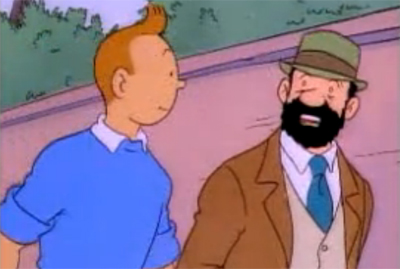
A walk in the park for Tintin and Haddock...
However, I don’t mind this change in tone, because the team come up with another effect frame of reference for the adventure. It feels, watching it, as if the episode was written and directed as “James Bond meets Indiana Jones.” Sure, the sequences were all in the book, but they work well in animation, evoking those films. For example, the sight of Tintin and company hijacking a tank calls to mind Indiana Jones and the Last Crusade, as does the motorbike bit, and the helicopter in action looks almost like a reference to From Russia With Love.
In fact, I will admit that I could see this working as a big budget family film. Before I’d seen the episode, this particular instalment would have been way down my projected feature film adaptations, due to the themes and content, but the episode brings Hergé’s action set pieces to life in such a way that I can’t help but wonder what a blockbuster director might do with these sequences, using the Cold War as a backdrop to the adventure. I think I’m curious.

Tintin takes a dive...
So The Calculus Affair demonstrates that perhaps there isn’t too much to be afraid of as we enter this more self-aware phase of the series. Still, while Red Sea Sharks should be easy enough to adapt, I’ll be curious to see The Castafiore Emerald on screen.
Filed under: Television | Tagged: Adventure of Tintin, Calculus Affair, Cold War, Hergé, indiana jones, Professor Calculus, The Adventures of Tintin: Secret of the Unicorn, the adventures of tintin: the calculus affair, The Calculus Affair, tintin, tintin: the calculus affair, United States |



 the m0vie blog
Leave a comment