












It’s like a Hollywood blockbuster murder mystery brought to life. I can see it now: Bruce Willis as a cocky private detective investigating the dispatching of a controversial emerging star. A lot of people are mumbling in their drinks, but everyone’s afraid to say what they know. That is, until a surly-voiced stranger straightens up and says what’s on everyone’s mind. Cue Sam Elliot:
The Catholic Church happened to The Golden Compass, as far as I’m concerned. It did ‘incredible’ at the box office, taking $380million. Incredible. It took $85million in the States. The Catholic Church … lambasted them, and I think it scared New Line off.
Did the Catholic kill The Golden Compass, a potentially viable fantasy franchise in the mould of Harry Potter or The Lord of The Rings (or at least as far as fans would have you believe)? Let’s investigate.
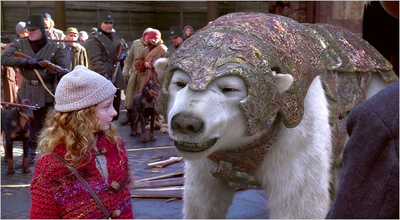
An un-bear-able crime?
First things first. Let’s look at the evidence. The first thing is motive. Did the Catholic Church want to kill the movie franchise? And if so, why? Well, the motive is straight forward. The movies are extremely anti-religious – anti-Catholic in particular. Philip Pullman is like Richard Dawkins for kids. His fictional theocracy – the Magisterium – is a mid-16th century Catholic Church, snuffing out any hint of enlightened scientific thought and – as if that weren’t dastardly enough – as literally as it is possibly neutering the imagination of children.
You can see why the Catholic Church is not too keen on it – even after the religious element was toned down by a cautious studio. Here’s a sample of the rhetoric from Bill Donaghue, CEO of the Catholic League:
These books denigrate Christianity, thrash the Catholic Church and sell the virtues of atheism.
…
They’re intentionally watering down the most offensive element. I’m not really concerned about the movie, [which] looks fairly innocuous. The movie is made for the books. … It’s a deceitful, stealth campaign. Pullman is hoping his books will fly off the shelves at Christmastime.
And – having seen the films – it isn’t as though the adaptation is exactly subtle. The head of the Magisterium dress like Vatican officials and Magisterium offices look more than a little little churches.
So we have motive, most certainly. And these organisations would happily claim that they successfully killed the franchise in the crib. There’s more evidence which suggests that a religious angle is behind the cancellation of the two sequels (the franchise is a trilogy of books). The director of the original film – Chris Weitz – has made it clear that he envisaged the sequels as being a lot less subtle, without the compromise necessary to get the first film made:
I mean to protect the integrity of those remaining chapters. The aim is to put in the elements we need to make this movie a hit, so that we can be much less compromising in how the second and third books are shot.
That certainly goes towards motive.
But there’s really more here. I think this is far too easy to believe and doesn’t stand up to scrutiny. Surely if the Catholic Church could influence Hollywood policy, it would prevent the release of more overtly anti-Catholic films. Take, for example The DaVinci Code or its sequel Angels and Demons. The franchise features the suggestion that Jesus fathered a family which continues to the present day and a pope who threatens to blow up the Vatican (while framing… you guessed it, scientists), among other things. I think these are the kind of big budget epics the Vatican would be more likely to spend its time attempting to stop. The protested those movies to a similiarly high public profile, but it made no difference.
So, the Catholic Church would have killed the movie franchise, but I don’t think they did. That gives them too much credit as movers or shakers.
Let’s look at the surrounding factors. First, why does The Golden Compass deserve a sequel. Very simply, New Line always made it clear that potential sequels depended on the financial success of the original film:
New Line president Toby Emmerich has continued to assert that the mini-major plans to shoot the second and third stories in Pullman’s trilogy, but only if the first performs well. But he also said this week that the hiring of Amini represents a significant commitment toward going ahead with the next film.
That seems fair – even blockbusters like The Matrix or Batman Begins didn’t earn sequels until the original films had earned enough money at the box office.
Defenders of the franchise, including the above Sam Elliot, make the case that the film did very well financially – the figures don’t bear that out. $372 million is certainly a respectable amount – but that’s a global estimate. The $70 million that the film made in the United States made it the 39th biggest earner of the year. When your movie is beaten by one of the lowest-grossing best Picture winners ever, No Country For Old Men, it’s not a good sign. A $180 million movie finishing just ahead of the $8 million low-budget Saw IV is perhaps equally disappointing.
At its most basic, this is not the best time for Hollywood to be taking financial risks. We are in the middle of a recession. The studios simply don’t have the money to gamble, even on sequels to mediocre films. They need conclusive proof that movie can spawn a ridiculously successful sequel before they will greenlight a budget approaching $200 million – which is massive by any standards. That’s just the way things are:
Earlier this year, Warner Bros decided not to make a follow-up to The Golden Compass, the first instalment of Philip Pullman’s His Dark Materials trilogy. At the time, the studio suggested that the decision to abandon the sequel, The Subtle Knife, had been made because the original had upset Christian groups.
However, the real reason was likely to have been more prosaic: The Golden Compass received lukewarm reviews and managed to generate just $70m at the US box office. Although the film staved off disaster by taking $300m internationally, investors were sceptical about a follow-up.
I tend to agree with that logic. Sometimes the simplist explanation is the best. And before people start complaining that the movie was a victim of the religious right, which led to its relatively meagre success – a way of indirectly arguing that “the Church did it” – I would suggest that the Church really doesn’t influence movie-goers so directly. Box office successes happen regardless of what the Church says. I cite the aforementioned adaptations of the Dan Brown novels, which did the business at the US box office despite condemnations from the Church. The same for the Harry Potter franchise.
I’m going to be honest and state that the movie simply wasn’t that good. It’s heavy-handed message was part of the problem – it had no sense of pacing or character and seemed to be just one really long rant on the part of the author. As the failure of An American Carol demonstrated, people don’t go to the cinema to get a boring lecture one way or the other. But above that, it was boring.
The movie franchise wasn’t murdered. It was euthanised.
Filed under: Movies | Tagged: catholic church, chris weitz, controversy, films, his dark materials, his dark materials trilogy, hollywood, Movies, new line, northern lights, philip pullman, phillip pullman, religion, sam elliot, sequel, the golden compass, the subtle knife |



 the m0vie blog
Leave a comment