












I’m kinda excited about The Time Traveler’s Wife. Soppy romantic movies generally don’t reel me in particularly well, but there’s something… romantic about a couple where one of two is shifting back and forth in time (what made Lost‘s The Constant possibly the sweetest hour of television last year). Lest sci-fi-phobes be worried by the notion of a time traveling romance (and why should they – what is the problem people have with science fiction as a genre?), the time traveler in question suffers from a genetic disorder which causes his brain to leap backwards and forwards in time. Because apparently if it doesn’t involve futuristic technology, it isn’t science fiction. Anyway, the story (adapted from a book) reminds me of a similar concept executed on the BBC a few years back.
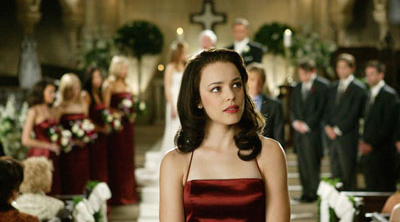
Clare Abshire wonders how it's possible for her husband to be late...
I’m speaking about The Girl in The Fireplace, an episode of the Doctor Who revival penned by Stephen Moffat. It seems to be particularly pertinent to discuss the episode now, as Moffat is officially taking over the franchise (filming on his first season as show runner will be starting shortly). Moffat is one of those ridiculously talented writers who seems able to shift between genres at ease. American readers will come to know him as the writer behind the Spielberg/Jackson Tintin adaptations coming our way soon – though he’s had to ramp down his involvement to focus on running the UK’s biggest science fiction franchise. As you do.
Anyway, the plot of his second script for the show (or third if you count a Comic Relief special) borrows (or steals) quite liberally from the core premise of The Time Traveler’s Wife. A man jumps around the life of a woman who is condemned to a linear existence. There are obviously differences in the main conceit – in this case the Doctor only seems to jump forward, rather than in either direction; the lady in question is historical figure Madame du Pompadour; and the Doctor actually physically (rather than mentally) travels through time. There are obviously larger differences as well – creepy killer robots, an abandoned spaceship, and an adopted horse name Arthur (“good name for a horse!”) – but at its core the episode remains quite true to the concepts and themes of the book.
It follows the life of Jeanne-Antoinette Poisson, the famous mistress to the King of France. Encountering a stranger in her bedroom at the age of eight, he mysteriously reappears fifteen or so years later. The catch is that only minutes have passed for our erstwhile hero. As her life continues along the “slower path”, he whizzes in and out around her – never knowing when or if he will reappear and how long will have passed for her. Of course, there is some stuff about killer robots wanting to harvest her brain (which is a lot smarter than it sounds and plays out better than you’d think), but the main focus is clearly on the romantic element (and Moffat is fairly unambiguous, despite what the more radical elements of fandom would have you believe).

The Doctor waits for a (French) kiss...
The episode picked up a rake of awards from all manner of impressive-sounding bodies (continuing Moffat’s hot streak, his earlier two parter The Empty Child/The Doctor Dances and his subsequent Doctor-lite story Blink both picked up a truckload of awards). There’s a legitimate case to be made for naming The Girl in The Fireplace as the best episode in the show’s almost-half-a-century history, and certainly the revival. The episode handles its themes impressively, also managing the lightness that the series does well. It also features two stunning central performances and actually explores what it would be like to travel through time without a tether to hold you in place.
As I mentioned above, I’m kinda looking forward to The Time Traveler’s Wife. Rachel McAdams is watchable in just about anything, and Eric Bana has a fairly impressive range. It’s a fairly inventive look at the notion of time travel and how it would affect even small things like interpersonal relationships. I’m just hoping that the movie can manage a sense of pathos and tragedy in a fairly dignified and mature way. If you want to see how it can be done, I recommend The Girl in The Fireplace.
Filed under: Movies, Television | Tagged: doctor who, film, madame du pompadour, stephen moffat, The Girl in The Fireplace, The Time Traveler's Wife |



 the m0vie blog
Leave a comment